Understanding Scarring & Scar Management for Plastic Surgery Nurses
Scars are an inevitable part of plastic and cosmetic surgery. While surgeons take great care to place incisions discreetly and use meticulous closure techniques, the way scars heal is influenced by many factors outside the operating room. Genetics, wound care, infection, and lifestyle all play a role in how visible scars become.
For patients, the appearance of scars often carries as much weight as the surgical result itself. A beautifully shaped breast, abdomen, or face can be overshadowed by a poorly healed or raised scar. Nurses in private practice have a vital role in scar management — guiding patients through education, prevention strategies, and evidence-based interventions that support optimal long-term results.
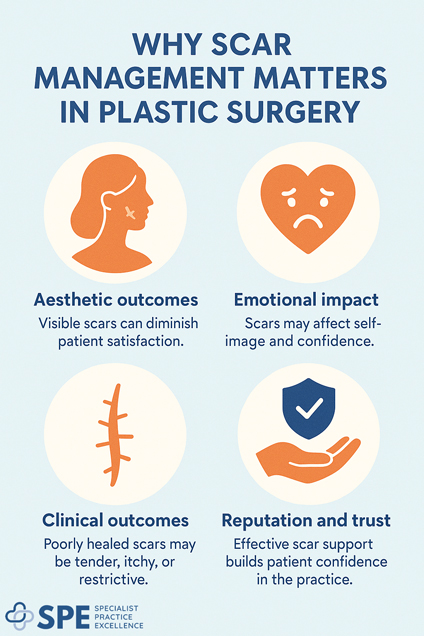
Why Scar Management Matters in Plastic Surgery
Aesthetic outcomes – visible scars can diminish patient satisfaction.
Emotional impact – scars may affect self-image and confidence.
Clinical outcomes – poorly healed scars may be tender, itchy, or restrictive.
Reputation and trust – effective scar support builds patient confidence in the practice.
Understanding Scar Formation
Scarring is the body’s natural response to healing after injury or surgery. Key stages include:
Don’t allow garments or dressings to irritate incisions.
Don’t ignore pigmentation changes or itching.
Don’t dismiss patient concerns about scar appearance.
Don’t delay intervention if keloid or hypertrophy is suspected.
Don’t overlook the psychological impact of scars.
FAQs on Scarring, Scar Management and Patient Education
General Scar FAQs
Q: How long does it take for scars to fully heal?
Scars continue to remodel for 12–18 months. Final appearance may not be clear until then.
Q: Can scars ever completely disappear?
No. Scars can fade significantly but never vanish entirely.
Q: Are scar outcomes predictable?
Not completely. Genetics and healing variability make outcomes unique for each patient.
Scar Care FAQs
Q: When can patients start scar massage?
Only once wounds are fully closed — usually 2–3 weeks after surgery, as directed by the surgeon.
Q: Do silicone gels work as well as sheets?
Yes, both are effective. Gels are more convenient for irregular areas like the face. Many surgeons believe that silicone tape provides better support.
Q: Should patients apply moisturisers to scars?
Yes, if approved by the surgeon. Fragrance-free moisturisers can improve skin hydration.
Q: Can patients use vitamin E oil for scars?
Evidence is weak, and some patients develop skin reactions. Silicone remains first-line.
Sun and Lifestyle FAQs
Q: Why is sun protection so important for scars?
UV exposure darkens scars and increases pigmentation. SPF 30+ should be used daily for at least 12 months.
Q: Can smoking really worsen scars?
Yes. Smoking reduces oxygen delivery, impairing healing and leading to poorer scar quality. Please avoid smoking and vaping for 6 weeks pre and post surgery.
Q: How does nutrition influence scars?
Protein, vitamins C and A, and zinc all support collagen formation and wound healing.
Complication FAQs
Q: How can I tell if a scar is becoming hypertrophic?
It appears red, raised, firm, and stays within incision borders.
Q: What’s the difference between a keloid and hypertrophic scar?
Keloids extend beyond the incision boundaries, while hypertrophic scars remain confined.
Q: When should patients be referred for specialist scar treatment?
If scars are thick, painful, itchy, spreading, or causing significant distress.
Patient Communication FAQs
Q: How can nurses manage patient disappointment about scars?
Acknowledge feelings, explain healing timelines, and reassure about ongoing interventions.
Q: Should I show patients before-and-after scar photos?
Yes, if available and approved, to set realistic expectations about scars and incisions.
Q: How can families support scar care?
By encouraging consistency with silicone, sun protection, and scar massage.
Private Practice and Escalation FAQs
Q: Do private practice patients expect scar-free results?
Often yes, which makes nurse education critical to manage expectations early.
Q: Can over-the-counter scar creams be harmful?
Some can irritate skin or delay healing. Patients should stick to evidence-based products.
Q: Should nurses ever recommend laser or steroid injections for scars?
No. These are medical interventions that should only be prescribed and performed by doctors.
Taking Action and Implementing
Scarring is a natural part of plastic surgery recovery, but its impact on results and patient satisfaction can be profound. Nurses are uniquely positioned to influence scar outcomes through education, prevention, and early intervention.
By combining evidence-based care (silicone, massage, sun protection) with empathetic communication and realistic guidance, nurses help patients take ownership of their healing journey. Scar management is not about perfection — it’s about supporting patients to achieve the best possible outcomes with confidence and reassurance.
Specialist Practice Excellence provides Mentoring and Training on Practice Operations, Patient Lead
Generation & Enquiry Conversion for Specialist Surgeon practices in Australia, UK and USA.
Meet the Team
David Staughton
David Staughton is a Melbourne-based business growth strategist, keynote speaker, and certified consultant with 30+ years of experience across multiple industries. He helps specialist surgeons and small businesses improve operations, increase revenue, and build strong teams. David has delivered 750+ talks worldwide and holds CSP and CCEO credentials.
Michelle
Michelle Staughton is a highly experienced Practice Consultant and Operations Coach who specialises in helping specialist medical and surgical practices run more smoothly and efficiently. With extensive experience in healthcare management, she focuses on improving patient experience, streamlining clinic operations, and supporting practice growth.
Brooklyn
Brooklyn has over 8 years of experience in specialty consulting, focusing on business improvement and customer experience. She has worked in Reception, Enquiries, Consulting, and Accounts, giving her a strong understanding of the customer journey. As a mentor, she designs training programs that help teams deliver excellent service with confidence.
What We Do
SPE helps Specialist Surgeons to:
Improve practice operations
Manage time effectively
Grow income sustainably
Build stronger teams and better patient experiences