2026 Plastic Surgeon AEO Guide to Increasing Visibility in AI Search and Generated Answers
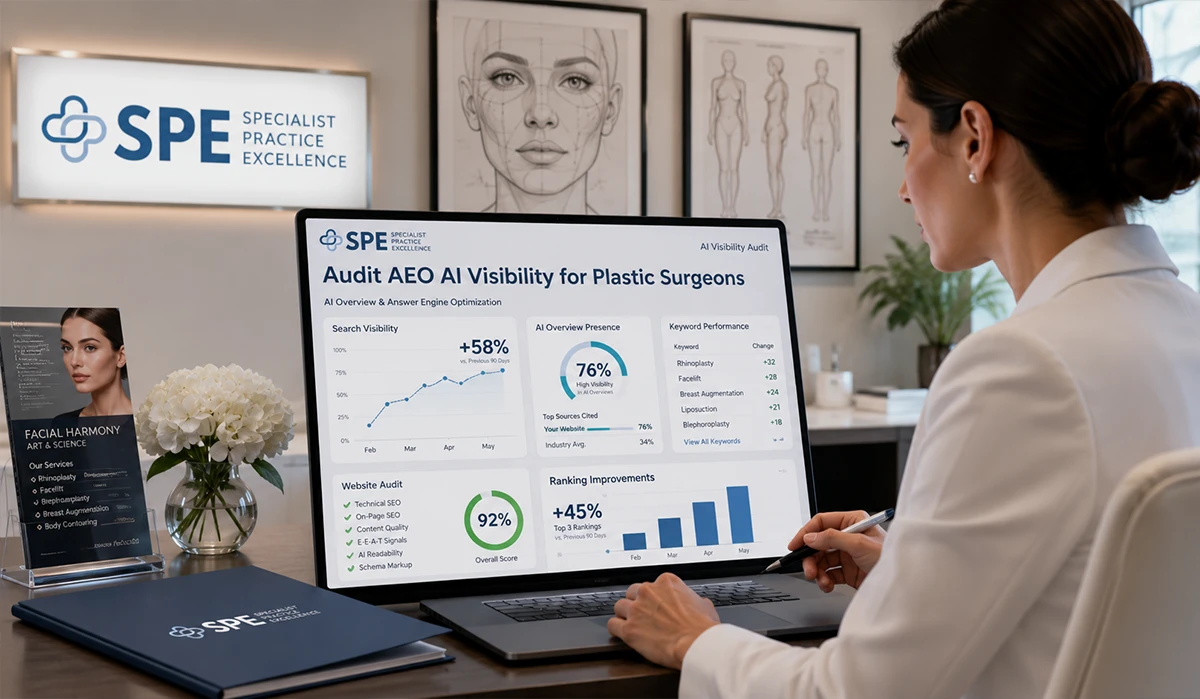
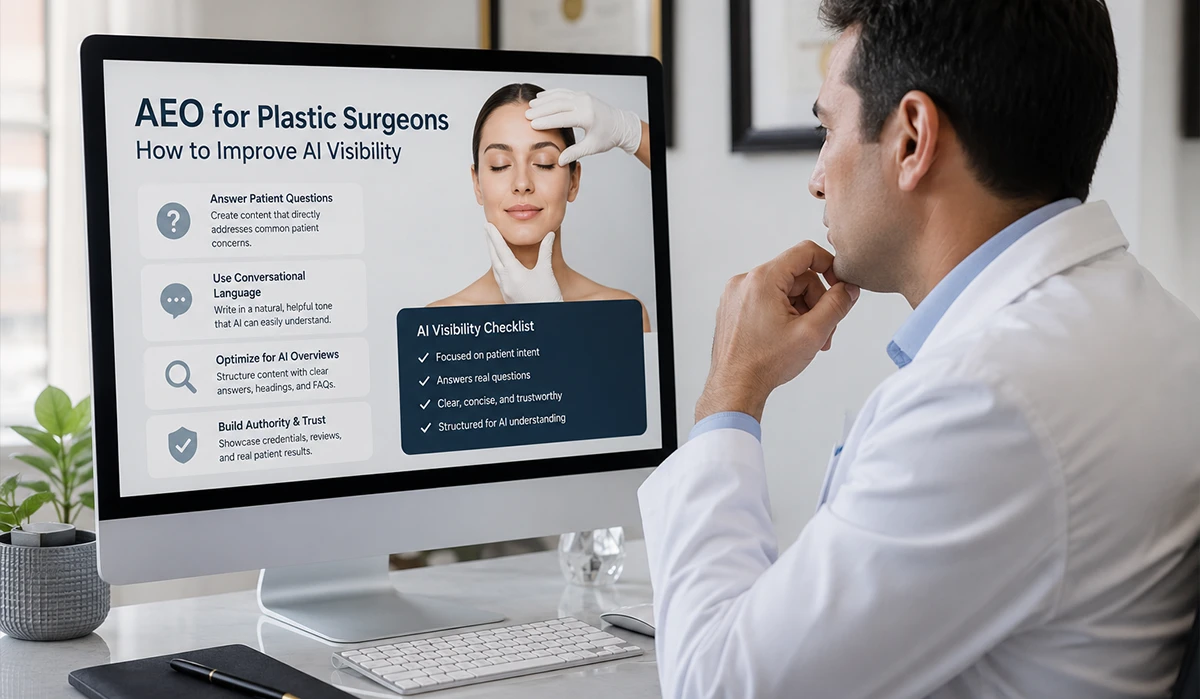
Executive Summary – How to Get Found in AI Searches
Patients increasingly use AI systems like Google AI (Genesis), ChatGPT, Claude, Grok, Perplexity and MS Copilot to research:
- Which plastic surgeons perform a procedure
- Which surgeons practise in a particular city
- What qualifications a surgeon holds
- What a procedure involves
- How to compare two similar procedures
- Procedure Price Ranges for their location
- What recovery may be like
- What patients say about a surgeon
- Which surgeon may be appropriate for a complex or revision case
This changes how practices must approach online visibility.
Traditional SEO focuses largely on helping webpages rank in search results. Answer Engine Optimisation, or AEO, also aims to make a surgeon’s information easy for AI systems to:
- Discover
- Understand
- Verify
- Retrieve
- Summarise
- Cite
- Associate with relevant procedures and locations
AEO is not a separate collection of secret technical tricks.
Google states that its established SEO principles continue to apply to AI Overviews and AI Mode. It does not require special AI schema, AI text files, or unique AI optimisation methods. Google also warns against focusing on tactics such as unnecessary content “chunking,” artificial mentions, or llms.txt files instead of useful, original content.
The most effective strategy is to make the surgeon’s genuine expertise:
- Clearly documented
- Consistent across the internet
- Supported by credible sources
- Connected to specific procedures
- Relevant to a defined geographic market
- Presented in accessible text
- Supported by original clinical insights
- Kept accurate and current
A plastic surgeon does not need to become famous worldwide to gain AI visibility. The surgeon needs to become one of the clearest, most credible, and best-supported answers for a defined question.
Examples include:
- Breast revision plastic surgeon in Houston
- Deep plane facelift surgeon in Sydney
- Post-weight-loss body contouring surgeon in Manchester
- Natural-looking breast augmentation surgeon in San Jose
- Revision rhinoplasty specialist in New York
- Plastic surgeon experienced with post-GLP-1 patients
The best AEO strategy is therefore built around clarity, focus, evidence, consistency, and authority.
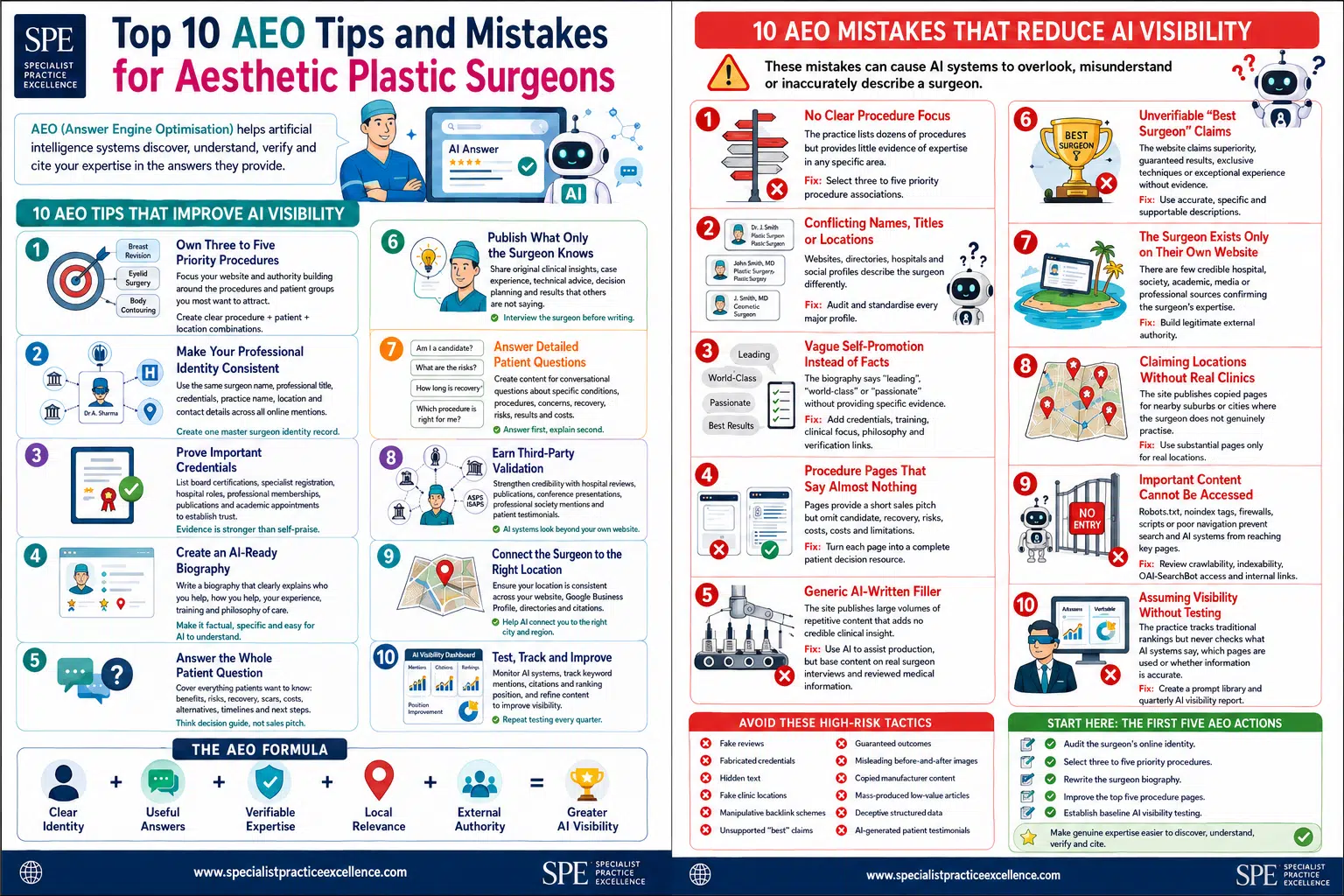
1. What AEO Means for a Plastic Surgeon
Answer Engine Optimisation (AEO) is the process of improving the information available about a surgeon so that search engines and AI systems can provide accurate answers about:
- Who the surgeon is
- Where the surgeon practises
- Whether the surgeon’s credentials can be verified
- Which procedures the surgeon performs
- Which procedures are a particular clinical focus
- What distinguishes the surgeon’s approach
- What patients may expect
- Which sources support the information
- Whether the surgeon is relevant to the user’s question
AI visibility can take several forms.
Direct Brand Visibility
The patient asks:
Tell me about Dr Jane Smith.
The system needs sufficient reliable information to create an accurate surgeon profile.
Procedure Visibility
The patient asks:
Which plastic surgeons perform revision breast surgery in Dallas?
The system must connect the surgeon with:
- Revision breast surgery
- Plastic surgery
- Dallas
- Relevant credentials
- Evidence of experience
Educational Citation Visibility
The patient asks:
How long does swelling last after a facelift?
An AI system may cite or use the surgeon’s recovery guide as supporting information.
Comparison Visibility
The patient asks:
What is the difference between a breast lift and breast augmentation?
A clear comparison page may be retrieved or cited.
Local Recommendation Visibility
The patient asks:
Who performs tummy tuck surgery near me?
The system may use local business information, the surgeon’s website, maps, directories, reviews, and third-party sources.
Reputation Visibility
The patient asks:
What do patients say about Dr Jane Smith? or Tell me about Reviews for Dr Jane Smith
The answer may draw from online reviews and independent profiles.
A practice should optimise for all five forms of visibility rather than concentrating only on “best surgeon” prompts.
2. How AI Search Finds Information
Different AI platforms use different systems, models, indexes, search partners, and retrieval processes. The precise weighting of their signals is not public.
However, several principles are clear.
Google AI Search
Google states that AI Overviews and AI Mode may perform multiple related searches across subtopics and sources. Google calls this “query fan-out.” This means a detailed patient question may be broken into several smaller searches before an answer is assembled.
For example:
Who is a suitable plastic surgeon for revision tummy tuck surgery after major weight loss in Melbourne?
This could trigger searches involving:
- Revision tummy tuck
- Post-weight-loss surgery
- Melbourne plastic surgeons
- Specialist registration
- Surgeon experience
- Reviews
- Recovery information
- Relevant professional profiles
A surgeon must therefore appear across the connected subtopics, not merely rank for one exact keyword.
ChatGPT Search
OpenAI distinguishes between:
- OAI-SearchBot, used to surface sites in ChatGPT search
- GPTBot, used for potential model training
- ChatGPT-User, which may access pages following a user request
A practice may allow OAI-SearchBot while separately blocking GPTBot. Sites that block OAI-SearchBot will not normally be included in ChatGPT search answers, although a basic navigational link may sometimes still appear.
Microsoft Copilot and Bing
Microsoft uses Bing’s search and indexing systems to support web-grounded Copilot answers. Microsoft recommends sound indexing practices, including sitemaps, crawlable internal links, robots.txt management, and IndexNow for faster discovery of updated content.
Bing Webmaster Tools introduced AI Performance reporting in 2026. It can report citations, cited pages, grounding query phrases, and visibility trends across supported Microsoft AI experiences.
The Practical Lesson
A surgeon’s AI visibility depends on four stages:
Discovery
Can the system find and crawl the information?
Understanding
Can it determine what the page, surgeon, procedure, and clinic are about?
Verification
Can important claims be confirmed from reliable sources?
Selection
Is the information useful and relevant enough to include in the answer?
3. The Seven Foundations of Plastic Surgery AEO
A strong AEO programme should address seven foundations.
Foundation 1: Entity Clarity
The internet should clearly identify the surgeon as one real person with:
- One consistent professional name (not multiple name variations)
- One accurate title
- Verifiable qualifications
- Defined current practice locations
- Specific clinical interests
- Consistent professional profiles
Foundation 2: Clinical Relevance
The surgeon must be visibly connected with the procedures and patient groups the practice wants to attract.
Foundation 3: Evidence
Important claims must be supported by primary or credible third-party sources.
Foundation 4: Useful Answers
The website must answer the detailed questions patients ask before consultation.
Foundation 5: Authority
Independent websites should mention, profile, cite, quote, or validate the surgeon.
Foundation 6: Technical Accessibility
Search engines and AI crawlers must be able to access, render, index, and interpret the content.
Foundation 7: Local Prominence
The surgeon must be clearly associated with the correct clinic, city, region, hospitals, and local market.
Weakness in any one foundation can reduce overall visibility.
4. Build a Clear Surgeon Entity
An AI system should not need to guess who the surgeon is.
Create one master surgeon identity record containing the following information.
Core Identity
- Full professional name
- Preferred public name
- Correct professional title
- Practice name
- Primary website
- Primary location
- Additional genuine practice locations
- Professional headshot
- Contact information
Qualifications and Registration
- Medical degree
- Plastic surgery training
- Fellowships
- Board certification
- Specialist registration
- Medical registration number where appropriate
- Relevant recognised professional memberships
- Current licence or registration status
- Academic appointments
- Hospital affiliations or privileges
Clinical Identity
- Main areas of practice
- Priority procedures
- Revision experience
- Complex case experience
- Patient groups treated
- Surgical philosophy
- Approach to patient selection
- Approach to safety
- Approach to natural-looking outcomes
- Procedures the surgeon does not offer
Authority Information
- Publications
- Research
- Conference presentations
- Teaching roles
- Fellowship training roles
- Textbook contributions
- Media commentary
- Podcast interviews
- Awards that can be independently verified
- Leadership positions
The same core information should appear consistently across:
- Surgeon biography
- Practice website
- Google Business Profile
- Bing Places
- Medical board or registration profile
- Hospital profiles
- Professional society profiles
- Academic profiles
- Medical directories
- YouTube
- Conference profiles
- Journal author pages
- Media biographies
In the USA, American Board of Plastic Surgery certification can be verified through the ABPS public database. ABMS also provides a public board-certification verification service.
Do not use credentials simply because they sound impressive. Use the exact wording provided by the relevant registration or certification authority.
5. Conduct an Entity Consistency Audit
Create a spreadsheet containing every significant profile or mention of the surgeon.
Record:
| Field | What to Check |
| Surgeon name | Same spelling and professional format |
| Title | Accurate and legally permitted |
| Credentials | Current and correctly ordered |
| Practice name | Current branding |
| Address | Complete and consistent |
| Telephone | Correct local number |
| Website | Correct canonical domain |
| Biography | Current career information |
| Procedures | Current clinical focus |
| Images | Current and professional |
| Social links | Correct accounts |
| Hospital affiliations | Current and verifiable |
| Registration | Correct and active |
| Opening hours | Accurate |
| Old practices | Clearly marked as historical |
| Awards | Genuine and properly described |
Common problems include:
- Old clinic addresses
- Former practice names
- Different versions of credentials
- Profiles that describe procedures no longer offered
- Directory pages using an outdated biography
- Confusion between cosmetic surgeon and plastic surgeon
- Duplicate Google Business Profiles
- Different telephone numbers
- Conference pages that link to an old website
- Former hospital affiliations presented as current
- Two surgeons with similar names being merged
Correct the highest-authority sources first.
6. Create an AI-Ready Surgeon Biography
Most surgeon biographies are too promotional and too vague.
Statements such as the following provide little retrievable information:
- Passionate about excellence
- Committed to beautiful results
- A leader in aesthetic surgery
- Dedicated to personalised care
- Internationally recognised
- One of the best surgeons
An AI-ready biography should contain specific facts.
Recommended Biography Structure
Opening Identity Statement
The opening paragraph should state:
- Full name
- Accurate professional title
- Main location
- Practice name
- Principal clinical focus
Example:
Dr Jane Smith is a board-certified plastic surgeon practising in Austin, Texas. Her aesthetic practice focuses on breast surgery, abdominal contouring, mommy makeover surgery, and revision procedures.
Credentials
Explain:
- Medical education
- Plastic surgery training
- Fellowship training
- Board certification or specialist registration
- Professional memberships
- Academic or hospital roles
Areas of Clinical Focus
Name the procedures the surgeon genuinely wants to become known for.
Do not publish a list of every conceivable procedure in the opening section.
Surgical Philosophy
Explain:
- How the surgeon assesses patients
- How treatment plans are selected
- What the surgeon considers a good outcome
- When the surgeon may recommend against surgery
- How safety influences decisions
- How the surgeon approaches scars, proportions, and recovery
Relevant Experience
Include verifiable information such as:
- Years in specialist practice
- Relevant case experience
- Revision practice
- Teaching
- Publications
- Presentations
- Research interests
Avoid unsupported surgical volume claims.
Patient and Geographic Relevance
State:
- Clinic locations
- Regions served
- Whether interstate or international patients are treated
- Languages spoken
- Consultation options
- Relevant hospitals or accredited surgical facilities
Verification Links
Where appropriate, link to:
- Medical board profile
- Specialist registration
- Board-certification record
- Hospital profile
- Professional association page
- Publications
- University profile
These links help patients and machines validate the information.
7. Decide What the Surgeon Should Be Known For
AI systems are more likely to form a strong association when the surgeon’s positioning is focused.
A practice should define:
Primary Procedure Associations
Choose three to five procedures or clinical categories.
Examples:
- Deep plane facelift
- Facelift and neck lift
- Revision rhinoplasty
- Breast revision
- Mommy makeover surgery
- Post-weight-loss body contouring
- Post-GLP-1 body contouring
- Natural-looking breast augmentation
- Complex abdominal revision
- Male facial rejuvenation
Primary Patient Associations
Examples:
- Women after pregnancy
- Patients after major weight loss
- Patients after GLP-1 weight loss
- Patients seeking revision surgery
- Women over 50 considering facial surgery
- Men considering facial rejuvenation
- Patients with previous implant complications
- Patients travelling for surgery
Primary Geographic Associations
Examples:
- Plastic surgeon in Houston
- Facelift surgeon in Melbourne
- Breast surgeon in Manchester
- Revision plastic surgeon in New York
Primary Philosophy Associations
Examples:
- Conservative facial rejuvenation
- Natural-looking breast surgery
- Detailed revision planning
- Staged body contouring
- Safety-focused outpatient surgery
- Individualised implant selection
Every important online asset should reinforce these associations without repeating identical copy.
8. Build Complete Procedure Pages
A procedure page should function as a useful patient decision resource, not an advertising brochure.
Essential Procedure Page Sections
Direct Definition
Answer “What is this procedure?” within the first 100 words.
Problems the Procedure May Address
Explain the anatomical or aesthetic concerns that may lead a patient to seek the procedure.
Suitable Candidates
Describe:
- Relevant physical concerns
- General health considerations
- Expectations
- Smoking status
- Weight stability
- Pregnancy considerations
- Psychological readiness
- Previous surgery considerations
When Surgery May Not Be Suitable
This is often missing and can add meaningful clinical value.
Consultation and Assessment
Explain what the surgeon assesses, such as:
- Skin quality
- Tissue distribution
- Scarring
- Anatomy
- Previous surgery
- Medical history
- Patient goals
- Risk factors
- Alternative options
Procedure Options
Explain the main variations without implying that one technique suits everyone.
The Surgeon’s Decision Process
This is one of the strongest opportunities for original content.
Explain:
- Why one technique may be selected
- When a combined procedure may help
- When a smaller operation may be preferable
- When surgery should be delayed
- When revision risk is higher
Anaesthesia and Facility
Describe the usual approach accurately without making a guarantee.
Recovery Timeline
Break recovery into stages:
- First 24 hours
- First 72 hours
- First week
- Weeks two to four
- One to three months
- Longer-term settling
Scars
Explain:
- Likely scar location
- Normal scar maturation
- Factors affecting scars
- Scar care
- Individual variation
Risks and Complications
Provide balanced information in readable language.
Expected Outcomes and Limitations
Explain what surgery may and may not achieve.
Cost Factors
Where permitted, explain what affects the total fee:
- Surgeon
- Anaesthesia
- Facility
- Implants or devices
- Garments
- Aftercare
- Complexity
- Revision status
- Combined procedures
Alternatives
Explain relevant surgical and non-surgical alternatives.
Frequently Asked Questions
Answer genuine patient questions. Do not create repetitive FAQs solely for keyword coverage.
Google announced that FAQ rich results stopped appearing from May 7, 2026, with associated reporting and testing support being withdrawn. FAQs can still be valuable for patients and content understanding, but they should not be created merely to obtain an FAQ rich result.
Authorship and Review Information
Include:
- Written by
- Medically reviewed by
- Date published
- Date last reviewed
- References where appropriate
Schema.org provides properties such as reviewedBy and lastReviewed for MedicalWebPage markup, although using these properties does not guarantee special search or AI treatment.
9. Create Procedure Content Clusters
One procedure page cannot answer every patient question.
Build a connected cluster around each priority procedure.
Example: Facelift Content Cluster
Core Page
- Facelift surgery
Technique and Comparison Pages
- Deep plane facelift versus SMAS facelift
- Facelift versus neck lift
- Facelift versus non-surgical treatment
- Mini facelift versus full facelift
- Primary versus revision facelift
Decision Pages
- Am I ready for a facelift?
- What age is appropriate for facelift surgery?
- When might a surgeon advise against a facelift?
- How to choose a facelift surgeon
- Questions to ask at a facelift consultation
Recovery Pages
- Facelift recovery timeline
- First 72 hours after facelift surgery
- When can I return to work?
- When can I exercise?
- How long does facial swelling last?
Safety Pages
- Facelift risks and complications
- Warning signs after facelift surgery
- Anaesthesia for facelift surgery
- Smoking and facelift surgery
Outcome Pages
- How long do facelift results last?
- Facelift scars
- What does a natural-looking facelift mean?
- Why facelift results differ between patients
Local and Surgeon-Specific Pages
- The surgeon’s facelift philosophy
- How the surgeon plans facelift surgery
- Facelift consultation in the relevant city
- Travelling for facelift surgery
The pages should link to each other in ways that help the patient move through the decision process.
10. Answer the Questions Patients Ask AI Systems
AI users often ask longer and more specific questions than traditional search users.
Build content around these categories.
Surgeon Selection
- How do I choose a plastic surgeon?
- What qualifications should I check?
- What is the difference between board certification and medical licensing?
- How many consultations should I attend?
- How can I compare two surgeons?
- What should I ask about revision policies?
- What makes a surgeon experienced in a particular procedure?
Candidacy
- Am I suitable for surgery?
- Is my weight stable enough?
- Should I finish having children first?
- Can I have surgery after GLP-1 weight loss?
- Does smoking affect my candidacy?
- Can I combine procedures?
- Is surgery safe with my medical condition?
- When might a surgeon refuse surgery?
Recovery
- How painful is recovery?
- How much help will I need?
- When can I drive?
- When can I sleep normally?
- When can I return to work?
- When can I travel?
- When can I exercise?
- When will swelling resolve?
- When will I see the final result?
Risks
- What are the most common complications?
- What complications require urgent attention?
- How can risk be reduced?
- What happens if healing is delayed?
- What happens if the result is uneven?
- When is revision surgery considered?
- Who pays for revision surgery?
Results
- Will the result look natural?
- How visible will the scars be?
- How long will the outcome last?
- Can ageing change the result?
- Can pregnancy change the result?
- Can weight changes affect the result?
- What can surgery not correct?
Costs
- How much does surgery cost?
- Why do fees differ between surgeons?
- What is included in the quote?
- Are postoperative visits included?
- Are garments included?
- What happens if another operation is required?
- Is financing available?
- Is any part covered by insurance, Medicare, or private health insurance?
Comparisons
- Breast lift versus implants
- Implant removal versus replacement
- Liposuction versus tummy tuck
- Deep plane versus SMAS facelift
- Upper blepharoplasty versus brow lift
- Body lift versus tummy tuck
- Surgical versus non-surgical facial rejuvenation
- Primary versus revision rhinoplasty
Create one authoritative page for each meaningful question rather than publishing dozens of shallow articles.
11. Add Original Clinical Information
Generic content can be produced by almost any clinic.
Original clinical information gives the page a reason to be selected or cited.
Interview the surgeon about:
- How candidates are assessed
- Which anatomical features affect planning
- How the surgeon chooses between techniques
- Common reasons patients are not suitable
- How previous surgery changes planning
- How revision cases differ
- How the surgeon manages asymmetry
- How scars influence procedure choice
- How weight loss changes skin and tissues
- How implant selection is approached
- When combined surgery is appropriate
- When staged surgery is safer
- How anaesthesia decisions are made
- What patients commonly misunderstand
- What realistic outcomes look like
- What causes avoidable recovery problems
- What warning signs patients should understand
- What the surgeon has changed after years of experience
Turn the surgeon’s answers into:
- First-person commentary
- Short videos
- Clinical FAQs
- Procedure page sections
- Comparison articles
- Decision guides
- Recovery guides
- Consultation checklists
Do not invent opinions and attribute them to the surgeon.
12. Improve Information Gain
Information gain means providing useful knowledge that is not simply copied or paraphrased from competing pages.
Examples include:
Better Candidate Explanations
Instead of:
Good candidates are healthy adults with realistic expectations.
Explain:
- What “healthy” means in the context of that procedure
- Which health issues require further assessment
- Why weight stability matters
- Why expectations may be unrealistic
- How previous surgery affects candidacy
Better Recovery Information
Instead of:
Most patients return to work in two weeks.
Explain:
- The difference between home-based and public-facing work
- How combined procedures change recovery
- Why swelling varies
- What activities remain restricted
- What symptoms should prompt a call to the practice
Better Comparison Content
Instead of declaring one procedure “better,” explain:
- Which anatomical problem each procedure addresses
- What each procedure cannot correct
- How recovery differs
- How scars differ
- Why a surgeon may recommend one over the other
Better Risk Information
Explain the difference between:
- Common temporary effects
- Less common complications
- Urgent warning signs
- Factors that may increase risk
- Steps used to reduce risk
This approach improves patient education and makes the content more distinctive.
13. Use Clear AI-Retrievable Formatting
Good content should be easy for both humans and machines to interpret.
Recommended Page Structure
- Clear page title
- One-paragraph direct answer
- Short summary
- Descriptive headings
- Concise paragraphs
- Lists where they improve clarity
- Tables for comparisons
- Timelines for recovery
- Surgeon-specific insights
- Risks and limitations
- Related questions
- Author and reviewer information
- References and review date
Use Precise Headings
Weak:
Things to consider
Better:
Who may be suitable for breast lift surgery?
Weak:
Your journey
Better:
What happens during a tummy tuck consultation?
Weak:
Getting back to normal
Better:
When can I return to work after facelift surgery?
Answer First, Explain Second
Under each heading, begin with a direct answer.
Example:
How long does swelling last after facelift surgery?
Significant swelling often improves during the first few weeks, but smaller changes may continue for several months. The timing varies with the extent of surgery, the patient’s tissues, healing, and postoperative course.
The rest of the section can then explain the detail.
Use Comparison Tables Carefully
| Question | Breast Lift | Breast Augmentation |
| Main purpose | Reshapes and elevates the breast | Adds or restores volume |
| Implant required | Not always | Usually |
| Changes nipple position | Often | Not reliably |
| Removes excess skin | Yes | No |
| Scars | Around the areola and possibly vertically or in the fold | Usually smaller incision patterns |
| Best option | Depends on anatomy and goals | Depends on anatomy and goals |
Avoid declaring a universal winner.
14. Strengthen Third-Party Authority
A surgeon describing themselves as experienced is a first-party claim.
Independent sources make that claim easier to verify.
High-Value Third-Party Sources
- Medical board or registration profiles
- Board-certification databases
- Hospital profiles
- University profiles
- Recognised professional associations
- Peer-reviewed publications
- PubMed author records
- Conference programmes
- Professional faculty profiles
- Journal interviews
- Reputable media coverage
- Podcast interviews
- Professional educational organisations
- Clinical trial records
- Textbook or chapter listings
Medium-Value Sources
- Established medical directories
- Local business organisations
- Reputable local media
- Industry publications
- Verified professional profiles
- Relevant charity profiles
Lower-Value Sources
- Generic business directories
- Paid “top doctor” lists with unclear methods
- Duplicate profile networks
- Press-release syndication
- Self-created award sites
- Unmoderated listing websites
The goal is not to obtain the largest number of mentions. It is to obtain accurate mentions from sources that have a legitimate reason to discuss the surgeon.
15. Develop a Surgeon Media and Commentary Strategy
Create a list of topics on which the surgeon can provide credible expert commentary.
Examples:
- Changes in facelift techniques
- Safe patient selection
- Post-GLP-1 body changes
- Breast implant decision-making
- Revision surgery
- Recovery misconceptions
- Medical tourism risks
- Social media expectations
- How edited images affect patient expectations
- Preparing for elective surgery
- Differences between surgical and non-surgical options
- Emerging technology
- Patient safety
- Cosmetic surgery trends
Provide journalists and publishers with:
- A concise expert biography
- Credentials
- Areas of expertise
- Professional photograph
- Contact details
- Previous commentary
- Suggested topics
- Links to evidence-based resources
Media exposure should support the surgeon’s genuine areas of expertise rather than chase unrelated publicity.
16. Optimise Local AI Visibility
Many high-intent AI questions include a location.
Google states that local visibility is mainly influenced by relevance, distance, and prominence. Complete information, links, reviews, and positive ratings can contribute to local visibility.
Google Business Profile Checklist
Ensure the profile contains:
- Correct practice name
- Accurate primary category
- Appropriate secondary categories
- Correct address
- Correct telephone number
- Current website
- Accurate hours
- Genuine appointment link
- Clear business description
- Relevant services
- Current photographs
- Clinic exterior and interior
- Surgeon and team photographs
- Accessibility details
- Parking information where appropriate
Do not add procedures, locations, or business names that are not genuine.
Create Strong Location Pages
Each real clinic location should have its own page containing:
- Clinic name
- Full address
- Telephone
- Map
- Opening hours
- Procedures available
- Surgeons practising there
- Parking
- Public transport
- Accessibility
- Consultation information
- Photographs of the location
- Nearby landmarks
- Links to relevant hospital or facility information
Avoid producing dozens of near-identical suburb pages.
A surgeon should not claim to practise in a location merely because patients travel from that area.
Strengthen Local Relevance
Develop legitimate local evidence through:
- Hospital affiliations
- Local society membership
- Local media interviews
- Community education
- Local professional events
- Regional conference participation
- Local patient resources
- Local business citations
- Local referral relationships where appropriate
Use Bing Places
Microsoft specifically recommends maintaining accurate information through Bing Places for businesses seeking visibility in location-based AI responses.
17. Improve Review Signals Ethically
Reviews can provide evidence about:
- Communication
- Consultation experience
- Staff interactions
- Follow-up
- Recovery support
- Practice organisation
- Patient expectations
- Procedure-specific experiences
Google prohibits fake engagement, paid reviews, reviews created through device or account manipulation, and incentives linked to review sentiment.
The FTC’s Consumer Reviews and Testimonials Rule, effective since October 21, 2024, prohibits practices including fake reviews, sentiment-conditioned incentives, undisclosed insider reviews, deceptive review suppression, and falsely independent review websites.
Ethical Review Request Process
- Ask eligible patients consistently.
- Do not ask only patients believed to be happy.
- Ask for an honest account of the experience.
- Do not provide suggested praise.
- Do not require a five-star rating.
- Do not reward positive sentiment.
- Do not disclose protected patient information in responses.
- Do not pressure patients to identify their procedure.
- Provide a private feedback route as well.
- Monitor reviews for patterns that require operational improvement.
Useful Review Request Wording
Thank you for choosing our practice. Patient feedback helps us understand what we are doing well and where we can improve. You are welcome to leave an honest review of your experience. Please avoid including personal medical information unless you are comfortable making it public.
Responding to Reviews
A response should:
- Thank the reviewer
- Avoid confirming that the person is a patient
- Avoid discussing treatment details
- Avoid arguing
- Invite private contact where appropriate
- Use a neutral and professional tone
Australian Warning
Australian practices must obtain current legal and regulatory advice before using testimonials in advertising. The Australian cosmetic surgery and higher-risk cosmetic procedure advertising requirements are stricter than general review-platform rules.
18. Use Video to Strengthen Expertise
Video can help establish the surgeon’s identity, expertise, communication style, and relationship to a procedure.
Priority Video Types
- What the procedure does
- Who may be suitable
- Who may not be suitable
- How the surgeon chooses a technique
- Recovery stages
- Risks and limitations
- Procedure comparisons
- Consultation preparation
- Common misconceptions
- Revision surgery considerations
- Questions patients should ask
- When the surgeon may recommend no surgery
Video Optimisation Checklist
Every important video should have:
- Descriptive title
- Clear procedure name
- Surgeon’s full name
- Practice location
- Detailed description
- Chapters
- Accurate captions
- Full transcript
- Link to the relevant procedure page
- Relevant thumbnail
- VideoObject structured data where appropriate
- Embedded placement on a related webpage
Important clinical information should not exist only inside a video. Google recommends making important information available in textual form while supporting it with relevant images and video.
19. Make the Website Technically Accessible
AEO cannot work well when important pages are blocked, missing, duplicated, or difficult to render.
Technical Checklist
- HTTPS enabled
- Mobile-friendly design
- Fast and stable pages
- Logical website architecture
- Crawlable navigation
- XML sitemap
- Accurate canonical tags
- Correct robots.txt
- No accidental noindex
- Limited duplicate content
- Proper redirects
- No broken internal links
- Descriptive URLs
- One primary version of each page
- Important text rendered in accessible HTML
- Images compressed
- Alt text used appropriately
- Videos captioned
- Forms accessible
- Clear heading hierarchy
- Structured data tested
- Search Console verified
- Bing Webmaster Tools verified
Check AI Crawler Access
Review:
- Web server logs
- Robots.txt
- Content delivery network settings
- Firewall rules
- Bot protection systems
- Security plugins
Allowing OAI-SearchBot can help pages appear in ChatGPT search. This setting is separate from permission for GPTBot training access.
Use IndexNow
IndexNow allows participating search engines to be notified when content is:
- Added
- Updated
- Removed
This can shorten the delay between a change and its discovery. It does not guarantee ranking or citation.
20. Use Structured Data Correctly
Structured data can help search engines classify page content. It is not a shortcut to AI recommendations.
Google states that there is no special structured data required for AI Overviews or AI Mode. Structured data should match the visible page content.
Potentially Relevant Schema Types
Physician
May describe:
- Surgeon or physician office
- Medical specialty
- Available services
- Hospital affiliation
- Address
- Contact details
Schema.org includes Physician properties such as medicalSpecialty, availableService, and hospitalAffiliation.
MedicalClinic
May describe:
- Clinic
- Address
- Opening hours
- Medical specialty
- Services
- Contact details
- Whether new patients are accepted
Schema.org defines MedicalClinic as both a medical organisation and local medical business.
MedicalWebPage
May describe:
- Medical information page
- Medical audience
- Reviewer
- Last reviewed date
- Main content
MedicalProcedure
May help describe the procedure discussed on a page.
Person
Useful for a surgeon’s individual identity.
Organization
Useful for the practice entity.
LocalBusiness
Useful for a genuine clinic location.
Article
Useful for educational articles.
VideoObject
Useful for embedded educational videos.
BreadcrumbList
Useful for communicating site hierarchy.
ImageObject
Useful for important clinical or educational images.
Important Restrictions
- Mark up only visible information.
- Do not mark up invented awards.
- Do not mark up unsupported ratings.
- Do not describe an individual surgeon as the clinic when the entities differ.
- Do not create fake locations.
- Do not aggregate ratings copied from other websites.
- Do not expect schema to guarantee a rich result.
- Do not use schema to make claims not visible to patients.
Google does not allow self-serving LocalBusiness or Organization review markup to qualify for review stars when the reviewed organisation controls the reviews about itself.
21. Build an AI-Ready Knowledge Base
Create one internal source of truth for the surgeon and practice.
Surgeon Record
- Name
- Credentials
- Registrations
- Training
- Fellowships
- Professional memberships
- Hospital affiliations
- Academic appointments
- Publications
- Presentations
- Awards
- Media
- Clinical interests
- Philosophy
- Locations
Procedure Record
For every procedure:
- Preferred name
- Alternative names
- Definition
- Candidate factors
- Contraindications
- Technique options
- Anaesthesia
- Facility
- Recovery
- Risks
- Scars
- Limitations
- Cost factors
- Alternatives
- Surgeon’s approach
- Frequently asked questions
Practice Record
- Legal name
- Trading name
- Addresses
- Telephone numbers
- Website
- Opening hours
- Team
- Facilities
- Hospitals
- Accreditation
- Consultation process
- Fees
- Policies
- Financing
- Aftercare
- Emergency arrangements
Content Governance
Assign owners to:
- Clinical accuracy
- Compliance
- SEO
- Website updates
- Directory updates
- Review monitoring
- Structured data
- Analytics
- AI testing
The knowledge base should be reviewed at least quarterly and whenever a major practice detail changes.
22. Measure AI Visibility
AEO should be measured systematically rather than by occasionally asking one chatbot a question.
Establish a Prompt Library
Test prompts across five groups.
Branded Prompts
- Who is Dr [Name]?
- What is Dr [Name] known for?
- Where does Dr [Name] practise?
- What qualifications does Dr [Name] hold?
- Is Dr [Name] board-certified or specialist registered?
- What procedures does Dr [Name] perform?
Procedure Prompts
- Which surgeons perform [procedure] in [city]?
- Who specialises in revision [procedure]?
- Which surgeons discuss natural-looking [procedure] results?
- Who treats patients after major weight loss?
Local Prompts
- Plastic surgeons in [city]
- Breast surgeon near [suburb]
- Facelift surgeon in [region]
- Revision plastic surgeon in [state]
Educational Prompts
- How long is recovery after [procedure]?
- What are the risks of [procedure]?
- What is the difference between [procedure A] and [procedure B]?
- Who may not be suitable for [procedure]?
Comparison Prompts
- Dr [Name] versus Dr [Competitor]
- Which surgeons offer [technique]?
- Who has experience with revision cases?
Record the Results
Track:
- Was the surgeon mentioned?
- Was the practice mentioned?
- Was the information accurate?
- Which procedure was associated with the surgeon?
- Was the location accurate?
- Was the website cited?
- Which page was cited?
- Which third-party source was cited?
- Was a competitor mentioned?
- Were credentials accurate?
- Was the description positive, neutral, or negative?
- Was important information missing?
Use Platform Data
Google began rolling out a Generative AI performance report in Search Console during 2026. The report may show impressions from AI Overviews and AI Mode, broken down by page, country, and device. It is not yet available to every property.
Bing Webmaster Tools’ AI Performance dashboard can show total citations, cited pages, grounding query phrases, and citation trends across supported Microsoft AI experiences.
ChatGPT referral traffic can be identified through the utm_source=chatgpt.com parameter added to referral links from ChatGPT search.
Main AEO Metrics
- AI citations
- AI impressions
- Number of cited pages
- Procedure associations
- Location associations
- Branded search growth
- Organic impressions
- Referral traffic from AI
- Engaged visits from AI
- Consultation enquiries
- Consultation quality
- Assisted conversions
- Accuracy of AI-generated surgeon profiles
Do not treat one AI answer as a permanent ranking. Outputs can change between platforms, users, locations, and dates.
23. Compliance Guidance
AEO content remains advertising when it promotes a medical practice. AI visibility does not remove normal advertising obligations.
USA
Practices should consider:
- State medical board advertising rules
- Accurate use of board-certification claims
- FTC advertising requirements
- Review and testimonial rules
- HIPAA privacy requirements
- Patient image consent
- Disclosure of material relationships
- Substantiation of clinical claims
- Local rules covering professional titles
The FTC requires solid support for health-related advertising claims.
HIPAA generally requires written authorisation before protected health information is used or disclosed for marketing, subject to defined exceptions.
Avoid:
- Guaranteed outcomes
- Unsupported superiority claims
- Misleading “best surgeon” claims
- False board-certification claims
- Purchased reviews
- AI-generated patient testimonials
- Undisclosed staff or family reviews
- Revealing patient information in review responses
- Using images without suitable authorisation
Australia
Australian cosmetic surgery advertising requires particular caution.
The Medical Board of Australia publishes specific guidelines for registered medical practitioners advertising cosmetic surgery. AHPRA also introduced guidelines for advertising higher-risk non-surgical cosmetic procedures effective from September 2, 2025.
Practices must consider:
- National Law advertising requirements
- Medical Board cosmetic surgery guidelines
- Correct specialist titles
- Testimonials
- Before-and-after imagery
- Risk information
- Vulnerable consumers
- Financial incentives
- Influencer content
- Body image messaging
- TGA restrictions
- Prescription-only medicines
- Medical device and therapeutic-good claims
The TGA states that social media posts, comments, hashtags, paid promotions, blogs, and streaming content can constitute therapeutic-goods advertising when they promote the use or supply of a therapeutic good.
Do not assume that educational wording automatically removes a page from advertising rules.
UK
UK surgeons should consider:
- GMC professional standards
- ASA and CAP advertising rules
- CQC requirements where relevant
- Correct use of titles
- Prescription-only medicine rules
- Under-18 targeting restrictions
- Responsible use of testimonials
- Before-and-after images
- Promotional offers
- Claims about results and risks
The GMC requires cosmetic intervention marketing to be factual, verifiable, responsible, and not misleading. It must not trivialise risk, exploit vulnerability, imply guaranteed results, or describe an intervention as risk-free.
ASA and CAP guidance covers exaggerated claims, before-and-after images, professional titles, testimonials, prescription medicines, and restrictions on targeting cosmetic intervention advertising to people under 18.
CQC-regulated independent doctors and clinics must display current ratings on relevant websites in a clear and conspicuous manner.
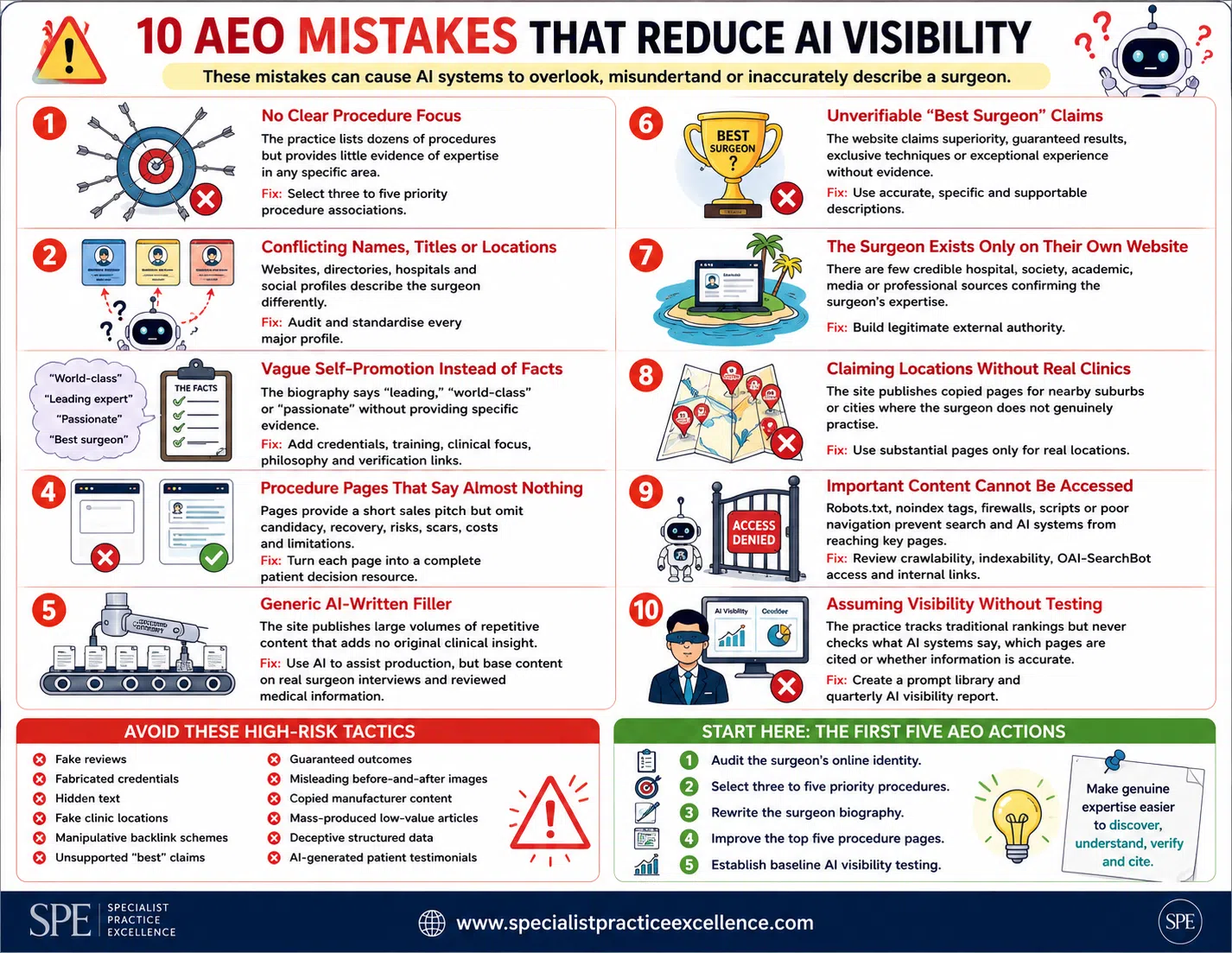
24. Common AEO Mistakes
1. Trying to Rank for Every Procedure
Problem: The surgeon has no clear area of authority.
Correction: Select three to five priority clinical associations.
2. Using Generic Surgeon Biographies
Problem: The biography contains praise but few verifiable facts.
Correction: Add credentials, training, locations, procedure focus, philosophy, and verification sources.
3. Publishing Mass-Produced AI Content
Problem: Articles repeat generic information already found elsewhere.
Correction: Add original surgeon interviews, decision criteria, and clinical explanations.
4. Blocking Important Crawlers
Problem: Security settings prevent discovery.
Correction: Review robots.txt, firewalls, CDN settings, and server logs.
5. Relying Only on Schema
Problem: Structured data is treated as a substitute for strong visible content.
Correction: Make the page accurate and useful first, then mark it up appropriately.
6. Creating Fake Location Pages
Problem: The site claims a presence where the surgeon does not genuinely practise.
Correction: Create pages only for real, staffed, patient-facing locations.
7. Repeating the Same Content Across Cities
Problem: Near-duplicate doorway pages add little value.
Correction: Build substantial pages for genuine locations and regional patient needs.
8. Making Unsupported “Best” Claims
Problem: The claim is difficult to verify and may breach advertising rules.
Correction: Describe verifiable experience and clinical focus.
9. Ignoring Third-Party Profiles
Problem: AI systems find conflicting information.
Correction: Audit and update authoritative directories and profiles.
10. Copying Manufacturer Information
Problem: The content does not demonstrate the surgeon’s expertise.
Correction: Explain how the surgeon uses, selects, or evaluates the technology.
11. Hiding Risks
Problem: Content appears promotional and incomplete.
Correction: Discuss risks, limitations, candidacy, and alternatives.
12. Publishing Unreviewed Medical Content
Problem: Old information remains online after practice or clinical changes.
Correction: Add a review schedule and named clinical reviewer.
13. Treating Reviews as a Numbers Game
Problem: Aggressive solicitation increases compliance and platform risk.
Correction: Use a consistent and ethical feedback process.
14. Ignoring Video Transcripts
Problem: Important expertise remains locked inside audiovisual content.
Correction: Publish captions and accurate transcripts.
15. Measuring Only Google Rankings
Problem: The practice misses citations, AI referrals, and entity accuracy.
Correction: Track search, local, AI, reputation, and conversion metrics together.
25. Twelve-Month AEO Implementation Roadmap
First 30 Days: Correct and Clarify
Priority Actions
- Audit surgeon name, title, credentials, and locations
- Correct inaccurate profiles
- Verify Google Business Profile
- Verify Bing Places
- Rewrite the surgeon biography
- Check OAI-SearchBot access
- Check Google and Bing indexing
- Fix accidental noindex rules
- Define priority procedures
- Establish baseline AI testing
- Create the internal knowledge base
- Review compliance risks
Main Outcome
AI systems can correctly identify the surgeon and practice.
Days 31–90: Build the Foundation
Priority Actions
- Improve the top five procedure pages
- Add authorship and medical review information
- Create recovery and cost-factor content
- Add procedure comparison pages
- Improve internal linking
- Implement appropriate structured data
- Add video transcripts
- Improve clinic location pages
- Start ethical review requests
- Update major third-party profiles
- Implement IndexNow
- Create an AEO measurement dashboard
Main Outcome
The website becomes a reliable source for important patient questions.
Months 4–6: Build Topical Authority
Priority Actions
- Complete content clusters for priority procedures
- Publish surgeon decision-making content
- Record surgeon videos
- Create detailed candidate guides
- Create revision surgery resources
- Publish local procedure content
- Obtain credible podcast and media appearances
- Strengthen hospital and society profiles
- Improve before-and-after education where permitted
- Develop downloadable patient guides
Main Outcome
The surgeon becomes strongly associated with selected procedures and patient groups.
Months 7–9: Build External Authority
Priority Actions
- Pursue reputable media commentary
- Speak at relevant professional events
- Publish clinical or educational articles
- Participate in professional panels
- Develop peer collaborations
- Publish original practice data where ethical and statistically valid
- Expand YouTube education
- Strengthen local professional authority
- Correct remaining entity inconsistencies
Main Outcome
Independent sources increasingly validate the surgeon’s expertise.
Months 10–12: Refine and Scale
Priority Actions
- Compare AI visibility against competitors
- Update underperforming pages
- Expand cited content themes
- Review Bing grounding queries
- Review Google generative AI impressions if available
- Refresh clinical content
- Consolidate weak or duplicate pages
- Expand high-performing content clusters
- Improve conversion paths from AI traffic
- Repeat the full entity and compliance audit
Main Outcome
AEO becomes a repeatable practice-growth system rather than a one-off campaign.
26. The 50 Best AEO Tips for Aesthetic Plastic Surgeons
Tier One: Essential Actions
1. Define three to five priority procedures
Create a clear clinical focus rather than trying to become associated with every aesthetic procedure.
2. Standardise the surgeon’s name
Use the same professional name across all major online sources.
3. Use the correct professional title
Ensure the title is legally permitted and accurately describes specialist status.
4. Verify every credential
Link important qualifications to authoritative verification sources where practical.
5. Rewrite the surgeon biography
Replace promotional language with specific, verifiable facts.
6. State the surgeon’s main location clearly
Include the city and region in the biography, contact pages, and relevant profiles.
7. Build a master knowledge base
Maintain one approved source for credentials, procedures, policies, locations, and clinical information.
8. Check AI crawler access
Make sure robots.txt, firewalls, and security systems are not blocking relevant search crawlers.
9. Verify indexing
Use Google Search Console and Bing Webmaster Tools to confirm that important pages are indexed.
10. Improve the most commercially important procedure page
Start with the procedure the practice most wants to grow.
Tier Two: High-Impact Content
11. Put a direct answer below every major heading
Help users and retrieval systems identify the key point quickly.
12. Explain who is not suitable
Balanced candidacy content demonstrates clinical judgement.
13. Explain the surgeon’s decision process
Describe why one approach may be selected over another.
14. Publish procedure comparison pages
Answer high-intent questions involving two realistic treatment options.
15. Create recovery timelines
Break recovery into practical stages rather than providing one return-to-work estimate.
16. Discuss risks and limitations clearly
Complete information is more useful than promotional information.
17. Create cost-factor guides
Explain what affects fees without making misleading promises.
18. Build content clusters
Connect the main procedure page with recovery, risks, candidacy, comparisons, and consultation guidance.
19. Add original surgeon commentary
Capture insights that cannot be copied from a textbook or manufacturer page.
20. Replace generic copy
Remove content that could appear unchanged on any other surgeon’s website.
Tier Three: Entity and Authority
21. Audit third-party profiles
Correct medical directories, society profiles, hospital pages, and conference biographies.
22. Link to authoritative profiles
Help patients verify board certification, specialist registration, publications, and appointments.
23. Align all social biographies
Use consistent naming, credentials, locations, and procedure focus.
24. Maintain accurate hospital affiliations
Remove outdated affiliations and clarify the nature of current roles.
25. Create an expert media biography
Give journalists an accurate and concise profile to use.
26. Develop a media commentary programme
Comment only on subjects within the surgeon’s genuine expertise.
27. Record publications and presentations
Create a structured professional activity page.
28. Strengthen conference profiles
Ask event organisers to use the correct biography, credentials, and website.
29. Build legitimate local citations
Ensure real practice details are consistent across trusted local sources.
30. Remove or correct duplicate profiles
Reduce confusion caused by old practices and duplicated listings.
Tier Four: Local Visibility and Reputation
31. Fully complete Google Business Profile
Provide accurate business details, services, hours, photographs, and links.
32. Complete Bing Places
Do not rely on Google as the only local data source.
33. Create a page for every real clinic location
Provide unique and useful information for each genuine location.
34. Add local travel information
Include parking, transport, accessibility, and consultation details.
35. Ask for honest reviews consistently
Create an ethical system rather than occasional campaigns.
36. Never condition rewards on positive reviews
Avoid both platform penalties and regulatory risk.
37. Respond without revealing patient information
Keep responses neutral and privacy-conscious.
38. Analyse review themes
Use reviews to identify recurring strengths, weaknesses, and patient questions.
39. Encourage detailed experience-based feedback
Do not supply patients with promotional wording.
40. Monitor inaccurate reviews and listings
Use appropriate platform processes to address false information.
Tier Five: Technical and Measurement
41. Implement appropriate schema
Use Physician, MedicalClinic, MedicalWebPage, Article, VideoObject, and related types when accurate.
42. Ensure schema matches visible content
Do not hide claims inside structured data.
43. Add authorship and review dates
Make clinical accountability visible.
44. Publish video transcripts
Convert spoken expertise into crawlable text.
45. Use IndexNow
Notify participating search engines when important content changes.
46. Improve internal linking
Ensure every important page is connected to related procedure and surgeon pages.
47. Track ChatGPT referral traffic
Measure visits containing the relevant referral parameter.
48. Use Google’s generative AI report when available
Monitor which pages receive impressions in AI Overviews and AI Mode.
49. Use Bing’s AI Performance reporting
Review cited pages and grounding query phrases.
50. Repeat the AEO audit quarterly
AI visibility depends on sustained accuracy, authority, and content improvement.
27. AEO Scorecard
Score each category from 0 to 5.
| Category | Score |
| Surgeon identity consistency | /5 |
| Credential verification | /5 |
| Clear procedure positioning | /5 |
| Surgeon biography quality | /5 |
| Procedure page completeness | /5 |
| Original clinical insights | /5 |
| Content cluster coverage | /5 |
| Local profile quality | /5 |
| Review strength and compliance | /5 |
| Third-party authority | /5 |
| Technical crawlability | /5 |
| Structured data accuracy | /5 |
| Multimedia and transcripts | /5 |
| Content freshness | /5 |
| AI visibility measurement | /5 |
| Advertising compliance | /5 |
Interpretation
65–80: Strong AI-Ready Presence
The surgeon has a well-developed entity, useful content, and external authority.
45–64: Good Foundation with Important Gaps
The practice is discoverable but may not be strongly associated with priority procedures.
25–44: Weak and Inconsistent
AI systems may find incomplete, generic, or conflicting information.
Below 25: Significant Visibility Risk
The surgeon’s expertise, identity, and services may be difficult to verify or retrieve accurately.
Final Principle
AEO does not mean writing content for robots.
It means creating the clearest and most reliable online account of:
- Who the surgeon is
- What the surgeon is qualified to do
- Which procedures the surgeon focuses on
- How the surgeon makes clinical decisions
- Where the surgeon practises
- What patients need to understand
- Which independent sources support the claims
The aesthetic plastic surgeons most likely to gain sustained AI visibility will not necessarily be those publishing the largest volume of content.
They will be the surgeons whose genuine expertise is the easiest to discover, understand, verify, retrieve, and cite.
FAQs about AEO for Plastic Surgeons
Answer Engine Optimisation helps AI platforms understand, verify and cite a plastic surgeon’s credentials, procedures, locations and clinical expertise.
A surgeon may appear when reliable websites, professional profiles and useful procedure content clearly connect them with the patient’s question and location.
Create accurate, well-structured content that directly answers patient questions, demonstrates real expertise and can be supported by credible external sources.
No. Strong technical SEO, local SEO, helpful content and online authority remain the foundation that makes information accessible to AI search systems.
AI systems may favour surgeons whose credentials, procedure focus, location, reviews and third-party authority are easier to discover and verify online.
An llms.txt file is not a substitute for crawlable pages, strong internal linking, verified credentials and useful content that answers real patient questions.
Large volumes of generic AI content may weaken differentiation when the articles lack original surgeon insights, medical review and meaningful patient value.
It should clearly explain the surgeon’s title, training, certification, locations, priority procedures, hospital roles, clinical philosophy and verifiable achievements.
Reviews can strengthen local prominence and provide experience signals, but they must be genuine, ethically requested and handled according to privacy and advertising rules.
Most practices should initially focus on three to five priority procedures so their expertise is clear rather than diluted across dozens of weak service pages.
Structured data can help classify a surgeon, clinic and medical content, but it cannot guarantee rankings, citations or recommendations from an AI platform.
Hospital profiles, medical societies, publications, conferences and credible media can independently confirm claims made on the surgeon’s own website.
No. Thin location pages can appear manipulative; create substantial pages only for genuine clinics, real consultation locations and meaningful regional patient information.
Run a structured set of branded, procedure and location prompts at least quarterly, then record mentions, citations, factual errors and competitor visibility.
The most common mistake is publishing vague promotional content without clearly proving who the surgeon is, what they specialise in and why the information is trustworthy.