Building Better Prompts for Patient Education, Website Content, SEO and AEO
Artificial intelligence can help an aesthetic plastic surgery practice complete many routine tasks faster.
It can help a team:
- Plan patient education content
- Draft procedure guides
- Organise frequently asked questions
- Develop website pages
- Create social media ideas
- Prepare consultation resources
- Review feedback
- Build staff training exercises
- Analyse marketing data
- Document practice processes
However, AI does not automatically understand the surgeon, the practice or the intended patient.
It does not know:
- Which procedures the surgeon performs
- Which techniques the surgeon prefers
- How the practice explains recovery
- Which patients the practice serves
- Which claims have been approved
- Which regulations apply
- Which facts are accurate
- Which questions must be referred to the surgeon
The quality of the result depends heavily on the quality of the prompt.
A weak prompt may produce generic, inaccurate or unsuitable content.
A well-structured prompt gives the AI enough context to produce a useful first draft that can be reviewed by the appropriate person.
The goal is not to let AI run the practice.
The goal is to use AI as a structured assistant while keeping professional judgement, clinical accuracy and final approval with the human team.
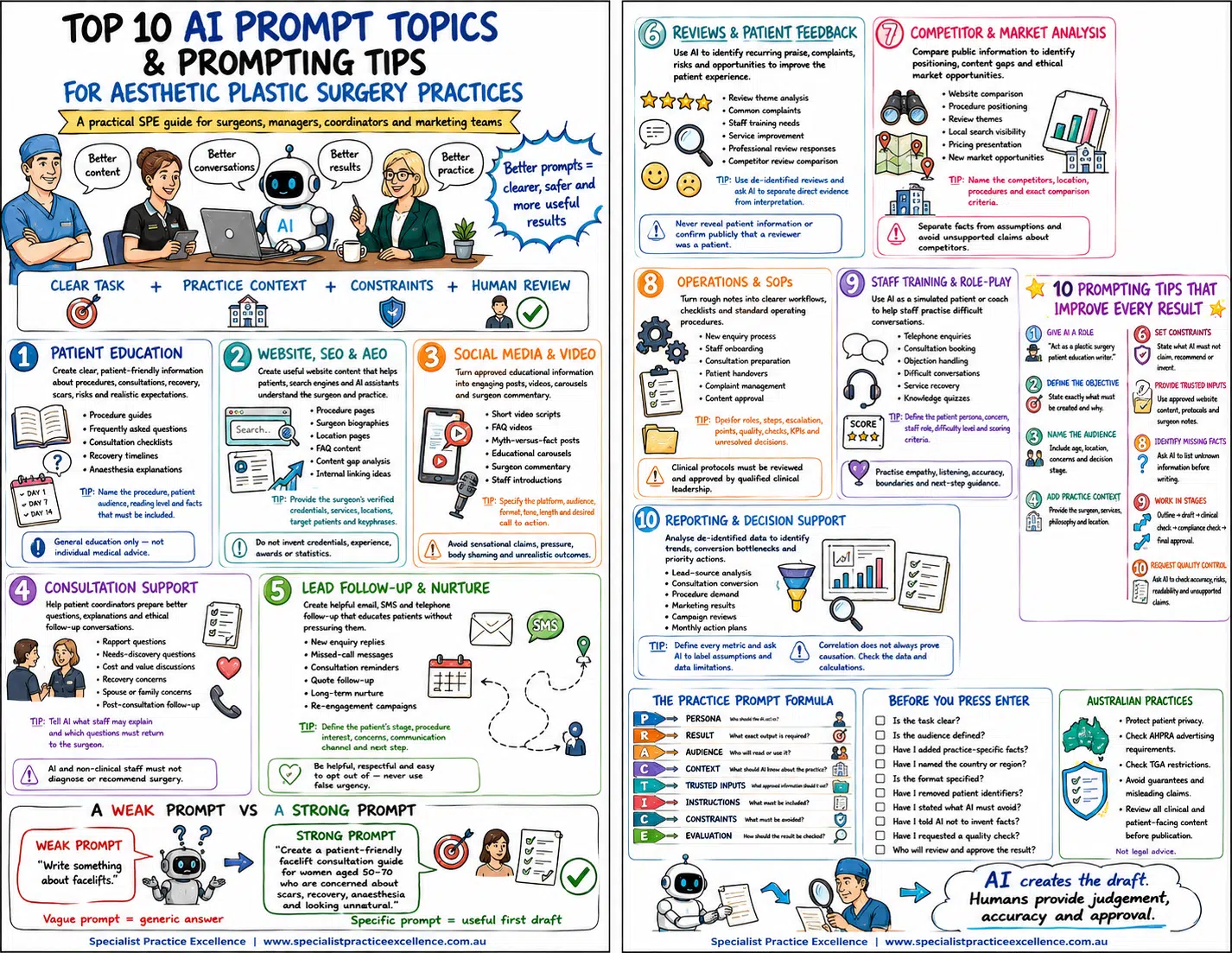
What Is an AI Prompt?
A prompt is the instruction you give an AI tool.
It may be one sentence, a set of questions or a detailed project brief.
For example: Write something about facelift surgery.
This is a prompt, but it is not a useful one.
The AI does not know:
- Who will read the content
- Which type of facelift is being discussed
- Where the practice is located
- What the surgeon wants patients to understand
- How long the content should be
- What tone to use
- Which risks should be discussed
- Which claims must be avoided
- Whether the content is for a webpage, email, brochure or video
A better prompt may say:
- Create a patient-friendly consultation guide for women aged 50 to 70 who are considering facelift and neck lift surgery.
- Explain the consultation process, candidacy, anaesthesia, scars, recovery, risks, realistic expectations and questions to ask the surgeon.
- Use clear Australian English at a grade 7 reading level. Do not promise results, minimise risks or provide individual medical advice.
- Use only the verified practice information provided below. Place any missing facts in a section titled “Information to Confirm”.
The second prompt gives the AI a clear task, audience, format and set of boundaries.
That usually produces a more useful result.
The Basic Formula for a Strong Prompt
A strong prompt should answer five questions:
- What is the task?
- Who is the audience?
- What does the AI need to know?
- What must the answer include or avoid?
- Who will review the final result?
A useful formula is: Clear task + practice context + trusted information + constraints + human review
Each part serves a different purpose.
✓ Clear task
State exactly what you want the AI to create.
Avoid instructions such as:
- Write some content
- Give me ideas
- Improve this
- Make this sound better
- Tell me about breast surgery
Instead, describe the specific output.
For example: Create a 1,500-word patient guide explaining breast reduction consultation, surgery, scars, recovery, risks and realistic expectations.
✓ Practice context
Tell the AI about the surgeon and practice.
This may include:
- Surgeon’s name
- Verified qualifications
- Practice name
- Location
- Procedures offered
- Procedures not offered
- Surgical philosophy
- Typical patients
- Preferred terminology
- Brand position
- Practice tone
- Facility information
- Anaesthesia arrangements
- Recovery approach
The AI should not be expected to guess these details.
✓ Trusted information
Provide approved source material where possible.
This may include:
- Existing website pages
- Surgeon interview notes
- Approved procedure information
- Practice protocols
- Consultation guides
- De-identified patient questions
- Staff training notes
- Brand guidelines
- Verified professional biographies
The stronger the source material, the less likely the AI is to fill gaps with assumptions.
✓ Constraints
Tell the AI what it must not do.
Useful constraints include:
- Do not guarantee outcomes.
- Do not describe surgery as risk-free.
- Do not diagnose the reader.
- Do not determine whether a person is suitable for surgery.
- Do not invent credentials.
- Do not invent prices.
- Do not invent complication rates.
- Do not mention procedures the practice does not offer.
- Do not use fear, shame or pressure.
- Do not copy competitor wording.
- Clearly identify information requiring confirmation.
✓ Human review
AI-generated work should be treated as a draft.
Depending on the task, final review may be required from:
- The surgeon
- A nurse
- The practice manager
- The marketing manager
- A privacy officer
- A compliance adviser
- An external consultant
AI may write confidently even when it is incorrect.
A polished answer is not always an accurate answer.
Use the PRACTICE Prompt Framework
The word PRACTICE can help staff remember the main parts of a strong prompt.
✓ P – Persona
Who should the AI act as?
Examples:
- A plastic surgery patient education writer
- A healthcare SEO strategist
- A patient experience trainer
- A practice operations consultant
- A medical content editor
The assigned role should match the task.
For example: Act as an experienced healthcare content writer who specialises in patient education for aesthetic plastic surgery practices.
Avoid giving the AI a role that encourages it to make clinical decisions.
Do not use: Act as the patient’s surgeon and decide which operation she needs.
✓ R – Result
What exact result is required?
Examples:
- A procedure guide
- A webpage outline
- A 60-second video script
- A consultation checklist
- A staff training exercise
- A review analysis
- An SOP
- A monthly marketing report
Be specific.
Instead of: Write about liposuction.
Use: Create a consultation preparation guide for patients considering liposuction, including candidacy, limitations, recovery, compression garments, scars, risks and questions to ask the surgeon.
✓ A – Audience
Who will read or use the answer?
Describe:
- Age range
- Location
- Procedure interest
- Knowledge level
- Main concerns
- Decision stage
- Reading level
For example: The audience is women aged 35 to 55 who are researching tummy tuck surgery after pregnancy and are concerned about scars, recovery, childcare and time away from work.
✓ C – Context
What should the AI know about the practice?
Include:
- Practice location
- Surgeon’s verified credentials
- Procedures offered
- Procedures excluded
- Surgical philosophy
- Positioning
- Patient journey
- Communication style
- Practice-specific policies
For example: The surgeon provides breast and body procedures but does not perform facial surgery. The practice is positioned as premium, personalised and focused on natural-looking outcomes.
✓ T – Trusted Inputs
What approved information should the AI use?
For example: Use the surgeon interview notes, recovery guide and approved website page provided below. Where the sources conflict, identify the conflict rather than choosing one version.
✓ I – Instructions
What must be included?
For example:
- Ten frequently asked questions
- A recovery timeline
- A section about scars
- A consultation checklist
- A gentle call to action
- A list of missing information
✓ C – Constraints
What must be avoided?
For example:
- Guarantees
- Superiority claims
- Invented statistics
- Medical diagnosis
- Aggressive sales language
- Unsupported safety claims
- Patient-identifying information
✓ E – Evaluation
How should the answer be checked?
For example: Review the completed draft for factual accuracy, unsupported claims, unclear statements, repetition, poor readability and information requiring surgeon confirmation.
Protect Patient Privacy
Patient privacy must remain a priority when using AI.
Practices should not paste identifiable patient information into a general AI tool unless that system has been formally approved for the intended use.
Identifiable information may include more than a patient’s name.
It may also include:
- Date of birth
- Address
- Phone number
- Email address
- Patient number
- Exact surgery date
- Exact consultation date
- Photographs
- Medical record details
- Unusual medical history
- Information that could identify the patient when combined
Removing a name does not always make information anonymous.
A safer approach is to use aggregated or de-identified information.
Instead of: Mary Smith, aged 47, from Brighton, had surgery on 14 June and called today because…
Use: Create a general response framework for a postoperative patient who is concerned about swelling and wants to know whether the issue should be reviewed by the clinical team.
Even when information has been de-identified, staff should only provide the minimum details needed to complete the task.
AI Prompt Topic 1: Patient Education
Patient education is one of the most valuable uses of AI in an aesthetic plastic surgery practice.
Patients often have similar questions about:
- Candidacy
- Procedure choices
- Anaesthesia
- Surgical facilities
- Incisions
- Scars
- Pain
- Swelling
- Bruising
- Time away from work
- Exercise
- Driving
- Follow-up
- Risks
- Results
- Costs
- Choosing a surgeon
AI can help organise these questions into clear educational resources.
It can also adapt approved information into different formats.
For example, one approved procedure guide could become:
- A webpage
- A downloadable PDF
- A consultation checklist
- An email series
- A set of FAQs
- A short video script
- A staff training sheet
- A social media carousel
Start with the patient’s real question
Weak patient education often begins with the procedure.
Strong patient education begins with the patient’s concern.
A patient may not search for:
Deep-plane facelift surgical technique.
They may ask:
- Will I look unnatural?
- How long will I be swollen?
- Will people know I had surgery?
- Where will the scars be?
- When can I return to work?
- What happens if I do not like the result?
- How do I know whether I am ready?
These questions should guide the prompt.
Example: weak patient education prompt
Write an article about facelift surgery.
This may produce a broad and generic answer.
Example: stronger prompt
Act as an experienced plastic surgery patient education writer.
Create a detailed guide for women aged 50 to 70 who are considering facelift and neck lift surgery.
The guide should answer common concerns about looking unnatural, scars, anaesthesia, swelling, bruising, social downtime, work absence, risks and realistic expectations.
Explain that treatment must be personalised after consultation and examination. Do not determine candidacy for an individual reader.
Use Australian English and clear language at a grade 7 reading level. Use short paragraphs, descriptive headings and bullet points.
Do not use “perfect”, “scarless”, “risk-free”, “painless” or “guaranteed”.
Use only the verified practice information below. List missing information before drafting the guide.
Include the intended use
The format should match where the content will appear.
A website article may need:
- SEO headings
- Internal links
- FAQs
- A call to action
- Metadata
A patient handout may need:
- Shorter sections
- A checklist
- More white space
- Clear warnings
- Contact information
A video script may need:
- A strong opening
- Spoken language
- Short sentences
- Visual suggestions
- A time limit
Tell the AI where the content will be used.
Ask for missing information first
One of the most useful instructions is: Before writing the draft, list any clinical, operational or practice-specific facts that are missing or uncertain. Do not invent them.
The AI may then identify questions such as:
- Which anaesthesia options are used?
- Where is surgery performed?
- What is the usual follow-up schedule?
- When may patients drive?
- When may patients exercise?
- Does the surgeon use drains?
- Which risks should be emphasised?
- Which procedures are commonly combined?
- What is the practice’s emergency contact process?
The practice can answer these questions before the content is completed.
This creates more accurate and more useful patient education.
Separate general information from practice policy
AI may understand general information about a procedure, but that does not mean it knows the surgeon’s protocol.
For example, recovery advice may differ between practices.
Instructions about:
- Showering
- Dressings
- Compression garments
- Exercise
- Driving
- Medication
- Sleeping position
- Wound care
- Returning to work
must match the treating team’s approved guidance.
The prompt should say:
Clearly separate general educational information from practice-specific postoperative instructions. Do not create medication, wound care or emergency instructions unless they have been supplied and approved by the clinical team.
Patient education quality-control checklist
Before publishing AI-assisted patient education, confirm:
- The procedure description is accurate.
- The surgeon offers the procedure described.
- The content does not determine individual candidacy.
- Risks have not been minimised.
- Recovery has not been presented as certain.
- No guarantees have been made.
- Practice protocols are correct.
- All clinical claims have been reviewed.
- The reading level is suitable.
- The next step is clear but not pressuring.
AI Prompt Topic 2: Website Content, SEO and AEO
AI can also help a plastic surgery practice improve the depth, structure and usefulness of its website.
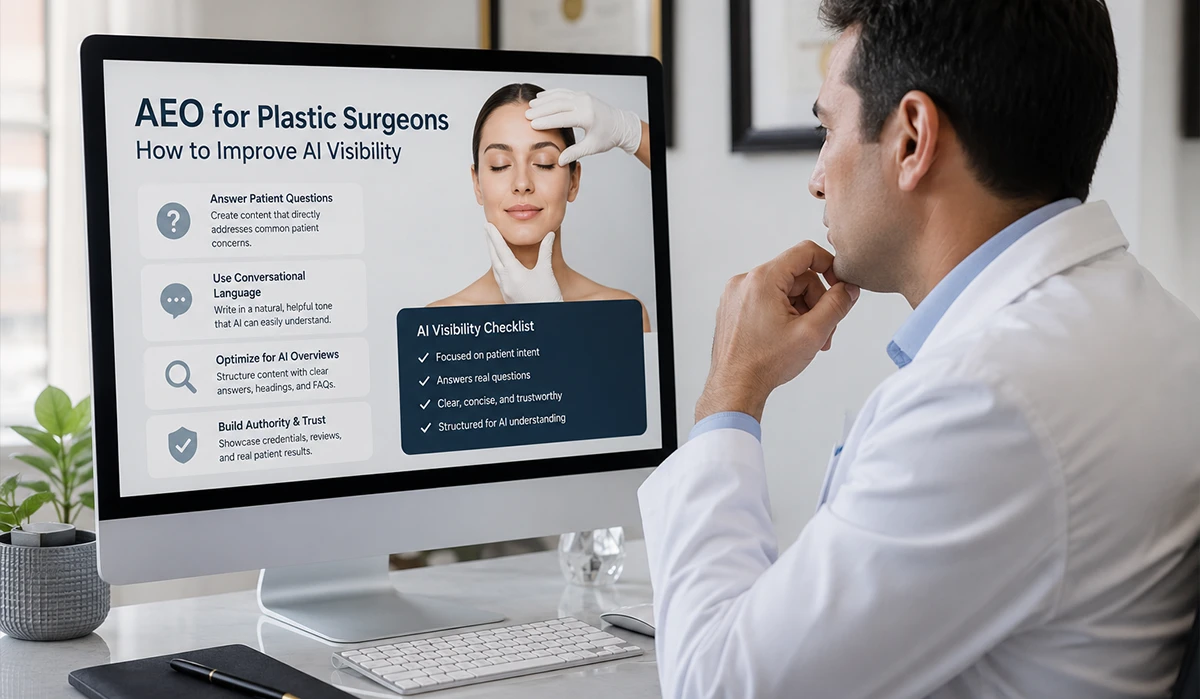
This includes traditional search engine optimisation and answer engine optimisation.
What is SEO?
Search engine optimisation helps search engines understand a webpage and decide when it may be relevant to a search.
SEO may include:
- Page topics
- Search intent
- Headings
- Keyphrases
- Internal links
- Metadata
- Local relevance
- Page speed
- Technical structure
- Content quality
What is AEO?
Answer engine optimisation helps search engines and AI assistants extract clear answers from a website.
It also helps them understand:
- Who the surgeon is
- Where the practice is located
- Which procedures are offered
- Which procedures are a priority
- What the surgeon is qualified to discuss
- How the surgeon approaches patient care
- Which facts are verified
- How different pages relate to one another
Good AEO content usually answers patient questions directly.
It avoids hiding the answer beneath long introductions or promotional claims.
Use AI to develop a content brief first
Do not always ask the AI to write the full page immediately.
Begin with a content brief.
A content brief may include:
- Primary search intent
- Secondary search intent
- Target audience
- Suggested page title
- Recommended headings
- Patient questions
- Related procedures
- Internal links
- Trust signals
- Missing practice information
- Suggested structured data
- Compliance risks
Once the brief has been reviewed, the practice can approve the structure before the page is written.
Example SEO and AEO prompt
Act as a healthcare SEO and AEO strategist specialising in aesthetic plastic surgery.
Create a detailed content brief for a tummy tuck procedure page for a plastic surgeon in Melbourne.
The intended audience is women aged 35 to 55 who are researching surgery after pregnancy or major weight loss. Their main concerns are scars, muscle separation, recovery, pain, childcare, time away from work and realistic outcomes.
Identify:
- Primary search intent
- Secondary search questions
- Suggested page structure
- Recommended headings
- Relevant clinical and geographic entities
- Frequently asked questions
- Internal linking opportunities
- Trust signals
- Schema opportunities
- Information needed for AI assistants to understand the surgeon’s expertise
Do not invent the surgeon’s credentials, experience, prices, case numbers, techniques, complication rates or hospital affiliations.
Finish with a section titled “Questions to Ask the Surgeon Before Writing the Page”.
Give the AI verified surgeon information
A strong surgeon or procedure page may need:
- Correct professional title
- Qualifications
- Registration details where appropriate
- Training history
- Fellowship information
- Society memberships
- Procedure focus
- Hospital or facility details
- Geographic locations
- Consultation process
- Surgical philosophy
- Recovery approach
- Revision policy
- Follow-up structure
AI should not create these facts.
It should organise verified information supplied by the practice.
Avoid unsupported “best surgeon” language
Promotional terms can create trust and compliance problems.
Examples include:
- Best surgeon
- Number one
- Leading expert
- Most advanced
- Safest technique
- Finest results
- World-class
- Guaranteed natural results
These claims may be difficult to prove.
Instead of asking AI to make the practice sound “better than everyone else”, ask it to explain verified differences.
For example:
- The surgeon’s procedure focus
- The consultation approach
- The practice’s follow-up process
- The surgeon’s training
- The types of cases commonly treated
- The level of patient education provided
- The practice’s approach to personalised planning
Specific facts are more credible than broad claims.
Write for patients first
SEO content should still be useful to a real person.
A page should help a patient understand:
- What the procedure may address
- What it cannot address
- Who may be considered
- What happens during consultation
- How planning is personalised
- Where surgery occurs
- What recovery may involve
- What risks should be discussed
- Which questions to ask
- How to arrange a consultation
Keywords should support the content rather than dominate it.
Avoid repeating the same location or procedure phrase in every paragraph.
Answer questions directly
AI assistants often extract direct answers from clearly written content.
For example:
How long does tummy tuck recovery take?
Recovery varies according to the extent of surgery, the patient’s health and the surgeon’s instructions. Many patients require several weeks before resuming normal daily activities, while strenuous exercise may be restricted for longer. Your surgeon will provide personalised advice based on your operation and progress.
The answer should appear near the question.
It should not begin with several paragraphs of advertising.
Ask AI to identify content gaps
A content gap is important information patients search for but cannot easily find on the practice website.
AI can help identify gaps such as:
- Lack of candidacy information
- Weak scar explanations
- Missing recovery guidance
- No anaesthesia information
- No consultation overview
- No revision information
- No explanation of combined procedures
- Weak surgeon biography
- Limited location information
- Missing FAQs
- No explanation of follow-up care
A useful prompt is:
Audit the following procedure page from the perspective of a prospective patient, a search engine and an AI assistant. Identify missing information, unanswered questions, weak trust signals, unsupported claims and opportunities for clearer direct answers. Do not rewrite the page yet.
Website quality-control checklist
Before publishing AI-assisted website content, check:
- The surgeon’s name and qualifications are correct.
- Locations are correct.
- Procedures offered are accurate.
- Excluded procedures have not been added.
- No prices have been invented.
- No awards or experience claims have been invented.
- Clinical information has been reviewed.
- Patient questions are answered clearly.
- Geographic terms are used naturally.
- Internal links are relevant.
- The call to action is appropriate.
- The content complies with the practice’s market and regulations.
A Reusable Prompt for Patient Education and Website Content
The following prompt can be adapted for many projects.
You are acting as an experienced plastic surgery patient education writer and healthcare SEO strategist.
Your task is to create [TYPE OF CONTENT] about [PROCEDURE OR TOPIC].
This content is for [PRACTICE NAME], located in [LOCATION].
The surgeon is [NAME AND VERIFIED CREDENTIALS].
The practice offers [PROCEDURES] and does not offer [EXCLUSIONS].
The intended audience is [AUDIENCE]. Their main questions and concerns are [CONCERNS].
Use the following approved source information:
[INSERT INFORMATION]
The content must include:
- [REQUIREMENT]
- [REQUIREMENT]
- [REQUIREMENT]
Use Australian English, short paragraphs and a grade 7 reading level.
Do not:
- Guarantee outcomes
- Minimise risks
- Diagnose the reader
- Determine candidacy
- Invent facts, credentials, prices or statistics
- Add procedures not offered by the practice
- Use pressure, fear or body-shaming language
Before drafting, list all missing or uncertain facts.
After drafting, review the content for clinical accuracy, unsupported claims, repetition, readability, SEO structure and information requiring human approval.
What to Do Next
A practice does not need to begin with complicated automation or advanced AI systems.
Begin with one approved use case.
A practical first project may be:
- Improving an existing procedure guide
- Creating a list of missing website FAQs
- Turning an approved webpage into a consultation checklist
- Building an SEO and AEO content brief
- Rewriting a technical explanation in patient-friendly language
Use the PRACTICE framework.
Provide verified source material.
Remove patient-identifying information.
Ask the AI to identify gaps.
Review the draft carefully.
The most important principle is simple:
AI should help the practice organise and communicate its expertise. It should not be allowed to invent that expertise.
Part 2: Social Media, Video, Consultation Support and Patient Follow-Up
AI can help an aesthetic plastic surgery practice create more consistent content and improve routine patient communication.
It can support:
- Social media planning
- Short-form video scripts
- Surgeon education videos
- Consultation preparation
- Patient coordinator training
- Follow-up emails
- SMS campaigns
- Long-term lead nurture
- Re-engagement campaigns
However, these uses require careful boundaries.
Plastic surgery content is not the same as ordinary retail marketing.
The practice is communicating about:
- Surgery
- Health
- Appearance
- Recovery
- Risks
- Vulnerability
- Personal expectations
- Significant financial decisions
The goal should not be to pressure patients into treatment.
The goal should be to help prospective patients understand their options, prepare useful questions and make informed decisions.
AI can help create the first draft.
The surgeon and practice team must remain responsible for the final message.
AI Prompt Topic 3: Social Media and Video Content
Social media gives surgeons an opportunity to educate prospective patients before they contact the practice.
Patients may follow a surgeon for weeks or months before booking a consultation.
During that time, they are often trying to answer questions such as:
- Does this surgeon understand my concerns?
- Does the surgeon explain procedures clearly?
- Will I be treated respectfully?
- Does the practice seem organised?
- Are the results likely to look natural?
- What is recovery really like?
- What questions should I ask during consultation?
- What are the risks?
- How do I compare surgeons?
AI can help organise content around these questions.
It can also turn one approved source into several formats.
For example, an approved facelift procedure page could become:
- A 60-second video
- A five-slide carousel
- A frequently asked question post
- A myth-versus-fact post
- A newsletter
- A consultation preparation video
- A surgeon commentary post
- A short staff training resource
This process is called content repurposing.
It can save time, but the practice must ensure that the meaning remains accurate when content is shortened.
Start with a content objective
Do not ask AI to create social media content without defining the purpose.
Possible objectives include:
- Educate patients
- Explain recovery
- Build surgeon authority
- Answer common questions
- Correct misconceptions
- Prepare patients for consultation
- Explain practice processes
- Improve trust
- Encourage guide downloads
- Invite patients to book a consultation
One post should usually have one main objective.
A post that tries to explain the procedure, discuss risks, promote the surgeon, advertise an offer and encourage immediate booking may become cluttered and unconvincing.
Weak social media prompt
Give me some ideas for Instagram.
This may produce generic topics that could apply to almost any cosmetic clinic.
Stronger social media prompt
Act as a healthcare social media strategist for an aesthetic plastic surgery practice.
Create ten educational Instagram Reel ideas about facelift and neck lift surgery.
The intended audience is women aged 50 to 70 who are concerned about looking unnatural, scars, anaesthesia, recovery time and choosing the right surgeon.
For each Reel, provide:
- A short title
- An opening hook
- Three surgeon talking points
- A visual suggestion
- A caption
- A gentle call to action
- A compliance risk to check
Use Australian English. Avoid guarantees, age shaming, fear, pressure, dramatic claims and suggestions that everyone is suitable for surgery.
This prompt creates a defined task with clear boundaries.
Create Content Around Real Patient Questions
Strong social content usually answers a specific patient question.
Examples include:
- What happens during a facelift consultation?
- How visible are facelift scars?
- How long does swelling last?
- What is the difference between a facelift and a neck lift?
- Can a facelift look natural?
- When can I return to work?
- What should I ask a plastic surgeon?
- How should I prepare for recovery?
- What can surgery not achieve?
- Why do treatment plans differ between patients?
These questions are more useful than broad promotional statements.
A patient is more likely to stop scrolling for:
“How long will I look swollen after facelift surgery?”
than for:
“Discover the ultimate facial transformation.”
The first addresses a real concern.
The second sounds promotional and may create unrealistic expectations.
Use AI to Build Content Pillars
A content pillar is a recurring theme used to organise social media.
An aesthetic plastic surgery practice may use the following pillars.
1. Patient Education
Examples:
- How procedures work
- Candidacy
- Consultation
- Anaesthesia
- Scars
- Recovery
- Risks
- Limitations
2. Surgeon Expertise
Examples:
- Surgical philosophy
- Training
- Conference education
- Case planning
- Technique discussions
- Decision-making principles
3. Patient Journey
Examples:
- First enquiry
- Consultation preparation
- Surgery planning
- Recovery support
- Follow-up care
- Long-term review
4. Practice Experience
Examples:
- Staff introductions
- Facility information
- Coordinator support
- Communication processes
- Patient resources
- Behind-the-scenes systems
5. Myths and Misconceptions
Examples:
- “A facelift should remove every line.”
- “Liposuction is a weight-loss procedure.”
- “Breast implants always look unnatural.”
- “Recovery is the same for everyone.”
- “A bigger operation always creates a better result.”
6. Safety and Decision-Making
Examples:
- How to choose a surgeon
- Questions to ask
- Importance of medical assessment
- Realistic expectations
- Risks
- Recovery planning
AI can help generate content ideas under each pillar.
Content pillar prompt
Create a three-month social media content plan for an aesthetic plastic surgery practice.
Use six content pillars:
- Patient education
- Surgeon expertise
- Patient journey
- Practice experience
- Myths and misconceptions
- Safety and decision-making
The priority procedures are [PROCEDURES].
The target audience is [AUDIENCE].
Provide four content ideas for each pillar. For every idea, include the format, patient question, key message and suggested call to action.
Do not create guarantees, pressure-based messaging or claims that cannot be verified.
Write Better Short-Form Video Scripts
Short-form video is useful because patients can hear the surgeon explain a topic directly.
However, AI-generated scripts often sound unnatural if the prompt is too vague.
Common problems include:
- Long introductions
- Repetitive statements
- Corporate language
- Overuse of marketing phrases
- Too much information
- Sentences that do not sound natural when spoken
- Weak openings
- No clear ending
A better prompt should define:
- Video length
- Speaker
- Audience
- Question
- Tone
- Required points
- Words to avoid
- Call to action
Short video prompt
Write a 60-second surgeon video script answering: “How long does swelling last after facelift surgery?”
The speaker is a specialist plastic surgeon.
The audience is women aged 50 to 70 considering their first facelift.
Use a calm, realistic and reassuring tone.
Begin with the direct answer. Then explain that swelling varies, early swelling is usually more noticeable, improvement happens gradually and individual recovery depends on the operation and patient.
Do not promise a fixed recovery date. Do not minimise risks. End by encouraging patients to discuss their personal recovery plan during consultation.
Use natural spoken Australian English and no more than 140 words.
Use Hooks Carefully
A hook is the opening line designed to capture attention.
Useful educational hooks include:
- “One of the most common questions I hear is…”
- “Here is what patients often misunderstand about…”
- “Before you book surgery, ask this question.”
- “Recovery is not the same for every patient.”
- “A consultation should help you understand three things.”
- “This procedure can help with some concerns, but not others.”
- “Here is why two patients may need different treatment plans.”
Avoid hooks based on:
- Fear
- Shame
- Age criticism
- Body criticism
- False urgency
- Guaranteed results
- Celebrity comparisons
- Financial pressure
Poor hook:
“Do not let your ageing face get any worse.”
Better hook:
“If you are considering facial surgery, understanding recovery is just as important as understanding the procedure.”
Repurpose Approved Content
AI can help a practice get more value from approved content.
For example, upload or paste an approved patient guide and ask AI to create:
- Three video scripts
- Five social posts
- One email
- One consultation checklist
- Ten FAQs
- One staff quiz
- One patient handout
Repurposing prompt
Use the approved source text below.
Create:
- Three 60-second surgeon videos
- Five patient FAQ posts
- One five-slide carousel
- One email newsletter
Do not add new medical claims or facts. Preserve the meaning of the source.
Clearly identify any statement that may become misleading when shortened.
Use Australian English and maintain a professional, educational tone.
Avoid Common Social Media Problems
AI-assisted social content should be checked for:
- Sensational claims
- Overpromising
- Trivialising surgery
- Inappropriate humour
- Pressure-based calls to action
- Body shaming
- Age shaming
- Misleading before-and-after presentation
- Incorrect procedure information
- Inappropriate prescription medicine references
- Patient privacy issues
- Claims that the practice cannot prove
For Australian practices, the final content should be reviewed against current AHPRA and TGA requirements where relevant.
Social Media Quality-Control Checklist
Before publishing, confirm:
- The content is factually accurate.
- The surgeon offers the procedure.
- The message is educational rather than pressuring.
- Risks and limitations are not hidden.
- No individual is diagnosed.
- No one is promised a result.
- Before-and-after material is genuine and approved.
- No patient information is disclosed.
- The call to action is appropriate.
- The content has been reviewed by the responsible person.
AI Prompt Topic 4: Consultation and Patient Coordinator Support
Patient coordinators often answer the same questions repeatedly.
They may discuss:
- Consultation availability
- Procedure information
- Surgeon background
- Fees
- Finance options
- Recovery planning
- Appointment preparation
- Next steps
- Practice policies
- Follow-up
AI can help create structured conversation guides, email drafts and role-play exercises.
However, there must be a clear boundary between administrative communication and clinical advice.
A coordinator should not:
- Diagnose a patient
- Confirm candidacy
- Recommend a procedure
- Interpret symptoms
- Promise results
- Minimise risks
- Change clinical advice
- Answer questions outside their role
AI prompts should reinforce these boundaries.
Use Frameworks, Not Robotic Scripts
A rigid script can make a coordinator sound unnatural.
A better approach is to create a conversation framework.
A framework may include:
- Opening
- Rapport
- Reason for enquiry
- Main concern
- Previous research
- Procedure goals
- Timing
- Practical barriers
- Questions
- Next step
The coordinator can use the framework while still speaking naturally.
Consultation enquiry framework prompt
Act as a patient experience trainer for an aesthetic plastic surgery practice.
Create a telephone enquiry framework for a patient interested in tummy tuck surgery.
Include:
- A warm opening
- Questions to understand the patient’s goals
- Questions about timing and practical concerns
- Ways to explain the consultation process
- Information the coordinator may provide
- Questions that must be referred to the surgeon or nurse
- A respectful invitation to book
Do not diagnose, determine candidacy, recommend surgery or use pressure.
Ask Better Discovery Questions
The purpose of a discovery question is to understand the patient.
It is not to interrogate them or convince them to proceed.
Useful questions include:
- What has prompted you to explore this now?
- What would you most like to understand?
- Which concerns matter most to you?
- Have you had previous surgery in this area?
- What have you already learned about the procedure?
- Is there anything making the decision difficult?
- Are you working towards a particular timeframe?
- What questions would you like the surgeon to answer?
- What would help you feel prepared for consultation?
Avoid questions that make assumptions.
Poor:
How soon do you want to fix this problem?
Better:
Are you considering a particular timeframe, or are you still gathering information?
Prepare for Common Patient Concerns
AI can create coordinator guidance for concerns such as:
- Price
- Recovery
- Anaesthesia
- Scars
- Pain
- Family support
- Work leave
- Childcare
- Comparing surgeons
- Fear of looking unnatural
- Fear of complications
- Uncertainty about timing
The objective is not to “overcome” every objection.
Some concerns should lead to:
- More education
- More time
- Another conversation with the surgeon
- A decision not to proceed
That is part of ethical patient care.
Concern-handling prompt
Create an ethical conversation guide for a patient coordinator speaking with a prospective facelift patient who is concerned about cost, recovery, anaesthesia and looking unnatural.
For each concern, provide:
- An empathetic response
- Two clarifying questions
- Information the coordinator may provide
- Information that must be referred to the surgeon
- A respectful next step
Do not pressure the patient or treat hesitation as a barrier that must be defeated.
Explain Value Without Attacking Competitors
Patients often compare surgeons and prices.
A coordinator may be asked:
- Why is your surgeon more expensive?
- Why should I choose this practice?
- Another clinic quoted less. Can you match it?
- What makes your surgeon different?
- How many operations has the surgeon performed?
- Why is your consultation fee higher?
AI can help create responses based on verified practice facts.
Possible value factors include:
- Surgeon training
- Procedure focus
- Consultation time
- Personalised planning
- Accredited facilities
- Anaesthesia arrangements
- Follow-up
- Staff support
- Revision policies
- Patient education
The practice should not invent or exaggerate these differences.
Value explanation prompt
Create a patient-friendly explanation of the value provided by [PRACTICE].
Use only the verified facts below:
[INSERT FACTS]
Explain the surgeon’s training, consultation approach, surgical planning, facility, anaesthesia, follow-up and patient support.
Do not criticise competitors. Do not claim to be the best or safest. Do not imply that a higher price guarantees a better result.
Prepare Follow-Up After Consultation
Post-consultation follow-up should help the patient:
- Clarify questions
- Review information
- Understand next steps
- Discuss practical concerns
- Decide whether they need another conversation
- Take time without pressure
Post-consultation call prompt
Create a post-consultation telephone framework for a patient coordinator.
The patient has met the surgeon about breast reduction surgery and has received a written quote.
Include:
- A warm opening
- Questions about how the consultation felt
- Questions about remaining concerns
- Ways to check understanding
- Questions that should return to the surgeon
- A summary of available next steps
Avoid artificial urgency, pressure and assumptions that the patient will proceed.
Build Coordinator Boundaries Into the Prompt
A useful instruction is:
Divide the response into:
- What the coordinator may explain
- What requires an approved practice resource
- What must be referred to the surgeon or clinical team
This creates a practical training tool.
Consultation Support Quality-Control Checklist
Confirm:
- The framework is patient-centred.
- The questions are respectful.
- The coordinator does not diagnose.
- The coordinator does not confirm candidacy.
- Clinical questions are escalated.
- The patient is not pressured.
- Costs are explained accurately.
- Practice policies are correct.
- Competitors are not criticised.
- The patient has time to make a decision.
AI Prompt Topic 5: Lead Follow-Up and Nurture
Many prospective patients do not book immediately.
They may be:
- Comparing surgeons
- Waiting for the right time
- Planning finances
- Organising leave
- Arranging childcare
- Concerned about recovery
- Unsure about surgery
- Not yet ready for consultation
A lead nurture campaign keeps the practice helpful and visible while the patient considers their options.
The purpose is not to send repeated sales messages.
The purpose is to provide useful information over time.
Segment the Patient Journey
The message should match the patient’s stage.
Useful stages include:
New Enquiry
The patient has contacted the practice but has not booked.
Useful content:
- Thank-you message
- Procedure guide
- Consultation explanation
- Surgeon information
- Frequently asked questions
Consultation Booked
The patient has an appointment.
Useful content:
- Preparation checklist
- What to bring
- Questions to consider
- Location and parking
- Forms
- Appointment reminders
Consultation Completed
The patient has met the surgeon but has not booked.
Useful content:
- Thank-you message
- Summary resources
- Recovery information
- Finance information
- Coordinator contact details
- Invitation to ask questions
Quote Provided
The patient is considering surgery.
Useful content:
- Quote explanation
- Inclusions
- Recovery planning
- Timing
- Booking process
- Questions for the clinical team
Not Ready Yet
The patient may proceed later.
Useful content:
- Occasional educational messages
- New guides
- Surgeon videos
- Planning resources
- Practice updates
Surgery Booked
The focus changes from sales to preparation and care.
Useful content:
- Preoperative instructions
- Payment reminders
- Appointment reminders
- Recovery preparation
- Support contacts
Weak Lead Follow-Up
Poor follow-up often includes:
- “Are you ready to book?”
- “Just checking in.”
- “Do you still want surgery?”
- Repeated discounts
- False deadlines
- Pressure
- Daily messages
- Generic templates
These messages offer little value.
Stronger Lead Follow-Up
A useful message should have a clear purpose.
For example:
- Answer one common question
- Provide a recovery checklist
- Explain the consultation
- Introduce the surgeon
- Clarify costs
- Share questions to ask
- Offer help
Multi-channel nurture prompt
Create a 45-day lead nurture campaign for women who have enquired about mommy makeover surgery but have not booked a consultation.
Include:
- Five emails
- Four SMS messages
- Three patient coordinator call tasks
For each contact, provide:
- Timing
- Objective
- Subject line or opening
- Main message
- Call to action
- Compliance concern
Cover candidacy, procedure combinations, scars, recovery, childcare, time away from work, consultation preparation and choosing a qualified surgeon.
Use a supportive and professional tone. Avoid pressure, false urgency, shame, discounts and guarantees.
Use Email, SMS and Telephone Differently
Each channel has a different role.
Best for:
- Detailed education
- Guides
- Videos
- Checklists
- Surgeon information
- Recovery planning
- FAQs
SMS
Best for:
- Short reminders
- Confirmation
- Booking links
- Simple questions
- Brief follow-up
Avoid placing sensitive information in SMS.
Telephone
Best for:
- Clarifying concerns
- Listening
- Complex questions
- Personal support
- Booking assistance
- Identifying clinical questions
Do not use the same message in every channel.
Example New Enquiry Sequence
Day 0: Immediate Response
Purpose:
- Confirm receipt
- Introduce the practice
- Explain what happens next
Day 1: Patient Guide
Purpose:
- Answer common procedure questions
- Build understanding
Day 3: Consultation Information
Purpose:
- Explain what happens during consultation
- Reduce uncertainty
Day 7: Coordinator Call
Purpose:
- Ask whether the patient has questions
- Understand concerns
- Offer booking support
Day 14: Recovery Planning
Purpose:
- Address work, family and practical preparation
Day 30: Surgeon Education Video
Purpose:
- Help the patient understand the surgeon’s philosophy
Day 45: Gentle Check-In
Purpose:
- Offer help without pressure
Create Procedure-Specific Campaigns
A facelift patient may care about:
- Looking unnatural
- Scars
- Social downtime
- Anaesthesia
- Revision surgery
A breast augmentation patient may care about:
- Implant choice
- Size
- Scars
- Breastfeeding
- Replacement
- Capsular contracture
A tummy tuck patient may care about:
- Muscle repair
- Scars
- Recovery
- Childcare
- Work
- Weight stability
One generic campaign will not address these differences.
Use Personalisation Carefully
Useful personalisation includes:
- First name
- Procedure interest
- Coordinator name
- Practice name
- Relevant guide
- Appropriate next step
Avoid using sensitive personal details in automated messages.
Do not include:
- Detailed medical history
- Private consultation information
- Embarrassing concerns
- Clinical findings
- Diagnostic language
Build Opt-Out and Consent Requirements Into the Workflow
The practice should confirm:
- The patient consented to contact.
- The communication channel is appropriate.
- Opt-out requests are honoured.
- Frequency is reasonable.
- Messages comply with applicable privacy and marketing rules.
- Sensitive information is not exposed.
AI can draft messages, but the CRM and communication workflow must be configured correctly.
Lead Nurture Quality-Control Checklist
Before activating a sequence, confirm:
- Each message has a purpose.
- The timing is reasonable.
- The content is procedure-specific.
- The message does not pressure the patient.
- Prices and policies are accurate.
- There is an appropriate call to action.
- Clinical questions are referred correctly.
- Consent and opt-out requirements are met.
- Sensitive information is protected.
- A staff member owns the workflow.
A Reusable Prompt for Social Media, Consultation Support and Follow-Up
You are acting as an experienced healthcare communication strategist for an aesthetic plastic surgery practice.
Your task is to create [OUTPUT] for [PRACTICE] in [LOCATION].
The intended audience is [AUDIENCE].
The procedure or topic is [TOPIC].
The audience’s main questions and concerns are [CONCERNS].
Use the following verified practice information:
[SOURCE INFORMATION]
The output must include:
- [REQUIREMENT]
- [REQUIREMENT]
- [REQUIREMENT]
Use a professional, supportive and patient-friendly tone.
Do not:
- Diagnose
- Confirm candidacy
- Recommend a procedure
- Guarantee outcomes
- Minimise risks
- Use pressure or false urgency
- Criticise competitors
- Invent credentials, prices, policies or statistics
- Include patient-identifying information
Clearly separate:
- Information staff may explain
- Information requiring an approved resource
- Questions requiring referral to the surgeon or clinical team
Before drafting, identify missing facts.
After drafting, review the output for accuracy, privacy, compliance, clarity, tone and appropriate staff boundaries.
A Practical Implementation Plan
A practice can begin using these prompts without creating a large AI project.
Step 1: Choose One Priority Procedure
Select a procedure with:
- High enquiry volume
- Repeated patient questions
- Strong growth potential
- Existing approved information
Step 2: Gather Source Material
Collect:
- Current webpage
- Procedure guide
- Surgeon notes
- FAQs
- Coordinator questions
- Recovery information
- Practice policies
Step 3: Create a Social Content Pack
Use AI to draft:
- Five videos
- Five social posts
- One carousel
- One email
Step 4: Create a Coordinator Guide
Develop:
- Enquiry questions
- Consultation explanation
- Boundaries
- Concern-handling guidance
- Follow-up framework
Step 5: Build a Short Nurture Campaign
Create:
- Three emails
- Two SMS messages
- One telephone follow-up task
Step 6: Review Everything
Assign:
- Clinical review
- Compliance review
- Brand review
- Final approval
Step 7: Measure the Result
Track:
- Content engagement
- Guide downloads
- Enquiry response
- Consultation bookings
- Patient questions
- Staff confidence
- Opt-outs
- Complaints
- Errors requiring correction
Final Principle
AI should help the practice communicate more clearly, not more aggressively.
The strongest social media, consultation and follow-up content does three things:
- Answers a real patient question
- Uses verified practice information
- Helps the patient make an informed decision without pressure
Part 3: Reviews, Competitor Research, Practice Operations and SOPs
AI can help an aesthetic plastic surgery practice see patterns that are difficult to detect manually.
It can organise:
- Patient reviews
- Feedback surveys
- Complaints
- Competitor websites
- Market positioning
- Content gaps
- Staff workflows
- Operational notes
- Standard operating procedures
- Training requirements
- Quality-control processes
These tasks are different from patient education or social media content.
They are less about writing persuasive copy and more about:
- Finding patterns
- Improving systems
- Identifying risks
- Clarifying responsibilities
- Supporting better decisions
However, AI should not be allowed to draw strong conclusions from weak evidence.
A review is not always a complete account of what happened.
A competitor’s website does not prove clinical quality.
A workflow generated by AI is not automatically safe or suitable.
The human team must check the evidence, understand the context and approve any action.
AI Prompt Topic 6: Reviews and Patient Feedback
Patient reviews can reveal valuable information about the practice.
Reviews often contain comments about:
- The surgeon
- Patient coordinators
- Front-desk staff
- Communication
- Wait times
- Pricing
- Consultation quality
- Surgery-day experience
- Recovery support
- Results
- Billing
- Facilities
- Follow-up
A single review may be emotionally powerful, but it does not always represent the wider patient experience.
AI is most useful when it analyses a larger group of reviews and identifies recurring themes.
What AI Can Do With Reviews
AI can help the practice:
- Group similar comments
- Count recurring themes
- Identify repeated complaints
- Identify repeated praise
- Compare positive and negative feedback
- Find patient journey problems
- Suggest staff training priorities
- Draft internal improvement plans
- Draft careful public responses
- Compare reputation themes with competitors
The practice should use review analysis to improve the patient experience.
It should not use AI to:
- Create fake reviews
- Hide legitimate criticism
- Attack reviewers
- Identify anonymous patients
- Pressure patients to change reviews
- Invent explanations
- Publicly argue about clinical care
Begin With De-Identified Information
Reviews may contain identifying details.
Before entering review material into an AI platform, remove unnecessary information such as:
- Patient names
- Contact details
- Exact treatment dates
- Exact surgery dates
- Medical record numbers
- Personal medical history
- Names of family members
- Payment details
- Staff names where identification is unnecessary
Public reviews are visible online, but that does not mean the practice should copy personal details into every internal system.
Use the minimum information required for the analysis.
Decide What You Want to Learn
Do not simply ask:
Summarise these reviews.
This may produce a broad description without useful action.
A better prompt should define the categories, time period and purpose.
For example:
Analyse these de-identified reviews from the past 12 months. Identify recurring praise, recurring complaints, patient journey problems, high-risk concerns and recommended improvement priorities.
The more precise the question, the more useful the analysis.
Create a Review Classification System
A standard classification system makes review analysis more consistent.
Useful categories include:
Enquiry Experience
- Telephone response
- Email response
- Speed of contact
- Booking process
- Staff warmth
- Availability
Consultation
- Surgeon communication
- Listening
- Time spent
- Explanation quality
- Professionalism
- Feeling rushed
- Questions answered
Patient Coordinator
- Responsiveness
- Knowledge
- Follow-up
- Empathy
- Pressure
- Quote explanation
Front Desk
- Courtesy
- Check-in
- Wait times
- Communication
- Privacy
Surgery Day
- Facility
- Anaesthesia experience
- Staff reassurance
- Organisation
- Discharge process
Recovery
- Instructions
- Access to support
- Nurse contact
- Surgeon follow-up
- Pain concerns
- Wound concerns
- Response time
Results
- Satisfaction
- Expectations
- Scarring
- Symmetry
- Natural appearance
- Revision concerns
Administration
- Quotes
- Inclusions
- Billing
- Refunds
- Finance
- Scheduling
- Paperwork
Review Analysis Prompt
Act as a patient experience analyst for an aesthetic plastic surgery practice.
Analyse the following de-identified patient reviews from the past [TIME PERIOD].
Classify each review into:
- Enquiry experience
- Consultation
- Surgeon communication
- Patient coordinator
- Front desk
- Surgery day
- Recovery support
- Results
- Billing and administration
- Wait times
Identify:
- The ten most common positive themes
- The ten most common negative themes
- High-risk concerns
- Repeated communication problems
- Staff training opportunities
- Process improvement opportunities
- Topics requiring leadership review
Separate:
- Direct evidence from the reviews
- Reasonable interpretation
- Assumptions that cannot be confirmed
Do not identify patients or staff members. Do not assume every review is factually complete.
Distinguish Frequency From Severity
A common complaint is not always the most serious complaint.
For example:
- A long wait time may appear in ten reviews.
- A postoperative communication failure may appear in only one review.
The first may be more frequent.
The second may present greater risk.
Ask AI to score themes in two ways:
- Frequency
- Severity
Prompt extension
For every negative theme, assign:
- Frequency: low, medium or high
- Severity: low, medium, high or critical
- Likely impact on patient trust
- Recommended owner
- Suggested next action
This produces a more useful management report.
Look for Journey Breakdowns
A review may reveal that the problem was not one person.
It may reveal a broken process.
For example:
“The surgeon was excellent, but I did not know who to contact after surgery.”
This may indicate:
- Unclear discharge instructions
- Poor contact information
- No named recovery contact
- Inconsistent after-hours guidance
- Weak staff handover
AI can help identify where the patient journey broke down.
Ask:
Which stage of the patient journey appears to have failed?
Useful journey stages include:
- Enquiry
- Consultation booking
- Consultation
- Quote
- Preoperative preparation
- Surgery day
- Discharge
- Early recovery
- Long-term follow-up
- Revision or complaint handling
Build a Monthly Voice of the Patient Report
A useful monthly report may include:
- Number of reviews analysed
- Average rating
- Strongest positive themes
- Most common complaints
- Highest-risk issue
- New issue appearing this month
- Staff training priority
- Process improvement priority
- Owner
- Deadline
- Metric to monitor
Monthly report prompt
Create a monthly Voice of the Patient report using the de-identified reviews and survey comments below.
Include:
- Executive summary
- Top five strengths
- Top five concerns
- New or worsening issues
- High-risk comments
- Staff training recommendations
- Process recommendations
- Responsible owner
- Suggested deadline
- Metric to review next month
Use a neutral tone. Do not overstate conclusions.
Use AI to Draft Review Responses Carefully
Public review responses require caution.
A response should not:
- Confirm that the reviewer was a patient
- Discuss the procedure
- Reveal clinical details
- Reveal financial information
- Argue about what happened
- Blame the reviewer
- Suggest the reviewer is dishonest
- Use a defensive tone
A safe response usually:
- Thanks the reviewer
- Acknowledges the concern
- States the practice’s commitment to care
- Invites private contact
- Avoids private details
Negative review response prompt
Draft a professional response to the following negative review.
Do not confirm that the reviewer was a patient.
Do not discuss treatment, medical history, payments, appointments or private communications.
Express concern, state that the practice takes feedback seriously and invite the reviewer to contact the practice privately so the matter can be reviewed.
Use a calm, respectful and non-defensive tone.
Example response
Thank you for sharing your feedback. We are sorry to hear that your experience did not meet your expectations. Our team takes concerns about communication and patient care seriously. To protect privacy, we cannot discuss individual circumstances publicly, but we invite you to contact the practice directly so the matter can be reviewed appropriately.
This response does not admit fault or disclose private information.
Review Response Quality-Control Checklist
Before publishing, confirm:
- The response does not confirm the patient relationship.
- No clinical information is disclosed.
- No payment information is disclosed.
- The tone is calm.
- The reviewer is not blamed.
- The response is not argumentative.
- The invitation to contact the practice is clear.
- A senior staff member has approved the response.
- The practice has a process for following up privately.
AI Prompt Topic 7: Competitor and Market Analysis
Competitor analysis can help a plastic surgery practice understand how the local market is presented online.
It may reveal:
- Common procedure claims
- Weak content areas
- Strong patient education
- Local search competitors
- Pricing presentation
- Review themes
- Consultation offers
- Positioning patterns
- Missing information
- Opportunities for differentiation
However, competitor research must be handled carefully.
A website is a marketing source.
It does not prove:
- Surgical skill
- Safety
- Patient outcomes
- Financial success
- Case volume
- Reputation among peers
- Quality of care
AI should not turn marketing claims into accepted facts.
Define the Purpose of Competitor Research
Do not ask:
Tell me how to beat my competitors.
This encourages vague and aggressive recommendations.
Instead ask:
Compare how five local practices present facelift surgery online and identify ethical opportunities to improve patient education, differentiation and search visibility.
The second prompt defines a practical purpose.
Choose the Right Competitors
A competitor may be:
- A local plastic surgeon
- A facial plastic surgeon
- A cosmetic surgery clinic
- A hospital-based service
- A high-visibility surgeon outside the region
- A strong online publisher
- A non-surgical aesthetic clinic competing for the same patient
Do not assume that the top Google result is the practice’s main business competitor.
Competitors should be selected according to:
- Procedure
- Location
- Patient audience
- Price position
- Brand position
- Search visibility
- Reputation
- Referral market
Set Comparison Criteria
Competitor research is more useful when every practice is judged using the same criteria.
Useful criteria include:
Surgeon Information
- Professional title
- Verified credentials
- Training
- Procedure focus
- Professional memberships
- Biography depth
- Philosophy
Website Content
- Procedure page depth
- FAQs
- Recovery information
- Risk information
- Candidacy
- Consultation guidance
- Location information
- Blog content
- Video content
Patient Experience
- Enquiry options
- Booking process
- Consultation fee
- Coordinator contact
- Finance information
- Recovery support
- Follow-up information
Reputation
- Review volume
- Review recency
- Common praise
- Common complaints
- Response quality
SEO and AEO
- Local visibility
- Procedure visibility
- Clear question-and-answer content
- Entity consistency
- Internal linking
- Structured data
- Trust signals
Positioning
- Premium
- Natural results
- Revision expertise
- High-volume
- Boutique
- Technology-led
- Patient education
- Luxury
- Convenience
- Affordability
Competitor Analysis Prompt
Act as a healthcare market analyst specialising in aesthetic plastic surgery.
Compare [PRACTICE] with the following competitors:
[COMPETITOR LIST]
Evaluate each practice using the same criteria:
- Surgeon credentials
- Procedure focus
- Website depth
- Patient education
- Consultation information
- Recovery information
- Pricing presentation
- Before-and-after presentation
- Review themes
- Local SEO visibility
- AEO readiness
- Brand positioning
Use publicly available evidence.
Separate:
- Verified facts
- Marketing claims
- Reasonable inference
- Information that cannot be confirmed
Do not make claims about clinical quality, safety or outcomes unless reliable evidence is available.
Finish with ten ethical opportunities for [PRACTICE] to improve its information, positioning and patient experience.
Compare Content, Not Just Design
Practices often focus on whether a competitor’s website looks modern.
Design matters, but content may matter more.
Ask:
- Does the page answer patient questions?
- Does it explain risks?
- Does it explain recovery?
- Does it explain candidacy?
- Does it explain what the procedure cannot do?
- Does it show who the surgeon is?
- Does it help patients prepare for consultation?
- Does it contain verified, specific information?
- Is the information easy for AI assistants to understand?
A visually attractive site with weak content may still offer an opportunity.
Identify Content Gaps
A content gap is information that patients want but competitors do not explain well.
Examples may include:
- How to compare surgeons
- What happens during consultation
- What the fee includes
- Revision policy
- Recovery milestones
- Scar care
- Anaesthesia
- Combining procedures
- Post-weight-loss surgery
- Emotional readiness
- Support at home
- Travel planning
- Long-term follow-up
Content gap prompt
Review the competitor pages below and identify patient questions that are poorly answered or not answered at all.
Group the gaps into:
- Candidacy
- Consultation
- Procedure planning
- Anaesthesia
- Risks
- Recovery
- Scars
- Costs
- Follow-up
- Choosing a surgeon
Rank the gaps by likely patient importance and content opportunity.
Use Competitor Reviews as Market Research
Competitor reviews can show what patients value.
For example, patients may repeatedly praise:
- Clear communication
- A natural result
- Easy access to staff
- Detailed consultation
- Fast responses
- Recovery support
They may repeatedly criticise:
- Poor follow-up
- Long waiting times
- Unexpected fees
- Feeling rushed
- Pressure
- Poor communication
This does not prove what happens in every case.
It does show which themes matter enough for patients to mention publicly.
Competitor review prompt
Compare the recurring review themes for [PRACTICE] and [COMPETITORS].
Identify:
- Shared strengths
- Shared complaints
- Unique strengths
- Reputation gaps
- Patient expectations
- Opportunities for service improvement
Do not treat review volume or star rating as proof of clinical quality.
Avoid Defamation and Unsupported Claims
AI-generated competitor reports must not include statements such as:
- This surgeon is unsafe.
- This clinic performs poor surgery.
- Their results are bad.
- Their reviews are fake.
- They have a high complication rate.
- They are financially unsuccessful.
- They use unqualified staff.
Unless such statements are supported by reliable, lawful and appropriate evidence, they should not appear.
Use neutral language.
Instead of:
Competitor A provides poor recovery support.
Use:
Recovery support information was difficult to locate on the public website, and several reviews mentioned communication concerns. This does not establish the full quality of the practice’s recovery care.
Build an Evidence Table
Ask AI to present findings in a table with:
- Claim
- Source
- Date
- Evidence type
- Confidence
- Fact or inference
- Action for our practice
This makes the research easier to review.
Competitor Analysis Quality-Control Checklist
Confirm:
- Every practice was judged using the same criteria.
- Sources are recorded.
- Dates are recorded.
- Facts are separated from claims.
- Inference is clearly labelled.
- No clinical-quality conclusions are based on marketing content.
- No defamatory language is used.
- Competitor wording has not been copied.
- Recommendations are ethical.
- The report focuses on improving the practice, not attacking others.
AI Prompt Topic 8: Operations and Standard Operating Procedures
Many practices operate using information stored in:
- Staff memory
- Emails
- Chat messages
- Handwritten notes
- Old documents
- Verbal instructions
- Different systems
- Individual habits
This can create inconsistency.
A standard operating procedure, or SOP, explains how a recurring task should be completed.
AI can help convert rough information into a structured draft.
Useful SOP topics include:
- New enquiry handling
- Missed calls
- Consultation booking
- Consultation preparation
- Quote follow-up
- Surgery booking
- Preoperative preparation
- Patient handovers
- Complaint management
- Review requests
- Content approval
- Staff onboarding
- Daily opening
- Daily closing
- Data entry
- Lead source tracking
- Monthly reporting
AI Should Organise the Process, Not Invent It
An AI tool may produce a professional-looking SOP even when it does not know the practice’s real workflow.
That creates risk.
For example, it may invent:
- Response times
- Escalation rules
- Staff responsibilities
- Clinical steps
- Required forms
- Approval requirements
- Documentation systems
- Patient instructions
The prompt must say:
Do not invent policies or clinical instructions. Identify missing decisions.
Gather the Raw Process First
Before asking AI to create an SOP, collect information from the people who actually perform the task.
Ask:
- What triggers the process?
- Who begins it?
- Which systems are used?
- What happens first?
- What happens next?
- What can go wrong?
- When must the issue be escalated?
- What information must be recorded?
- Who approves the final step?
- How is success measured?
The source material may be messy.
That is acceptable.
AI can help organise it.
Core SOP Structure
A useful SOP may include:
- Title – A clear process name.
- Purpose – Why the process exists.
- Scope – Which situations, teams and locations it covers.
- Definitions – Terms staff need to understand.
- Roles and Responsibilities – Who owns each step.
- Required Systems and Resources – CRM, telephone, forms, templates or clinical systems.
- Procedure – The exact sequence of steps.
- Response – Time Standard – How quickly each step should occur.
- Escalation Criteria – When the issue must be passed to another person.
- Documentation – What must be recorded and where.
- Quality Checks – How errors are prevented.
- KPIs – How performance is measured.
- Training – What staff must know.
- Review Date – When the SOP will be checked and updated.
SOP Prompt
Act as a practice operations consultant for an aesthetic plastic surgery clinic.
Convert the notes below into a formal SOP for [PROCESS].
Include:
- Purpose
- Scope
- Definitions
- Responsible roles
- Required systems
- Step-by-step procedure
- Response-time standards
- Escalation criteria
- Documentation requirements
- Quality checks
- Key performance indicators
- Staff training requirements
- Review date
Do not invent policies, timelines, staff authority or clinical instructions.
Place missing decisions in a section titled “Information Required Before Approval”.
Example: New Surgical Enquiry SOP
A new enquiry process may include:
- Lead received
- Contact details checked
- Consent status recorded
- Lead source recorded
- Procedure interest recorded
- Immediate acknowledgement sent
- First call attempted
- Questions answered within staff scope
- Clinical questions identified
- Consultation offered
- Follow-up task created
- Outcome recorded
The exact steps will vary by practice.
AI can help turn these steps into:
- A formal SOP
- A flowchart
- A checklist
- A staff training script
- A CRM task list
- An audit checklist
Convert One SOP Into Multiple Tools
Once an SOP has been approved, AI can adapt it into:
- A one-page checklist
- A staff training guide
- A role-play
- A quiz
- A flowchart
- A new employee worksheet
- A manager audit tool
- A KPI report
Repurposing prompt
Use the approved SOP below.
Create:
- A one-page staff checklist
- A ten-question knowledge quiz
- A manager audit checklist
- A role-play scenario
- A flowchart outline
Do not change the approved process or add new requirements.
Build Escalation Rules
An SOP should state when staff must stop and escalate.
Examples include:
- A patient describes a clinical symptom.
- A patient expresses severe distress.
- A complaint includes a safety concern.
- A patient threatens legal action.
- A payment dispute cannot be resolved.
- A privacy concern is raised.
- A staff member is unsure.
- The request falls outside policy.
- The patient demands a guarantee.
- A postoperative concern is reported.
AI can help organise escalation rules, but qualified leaders must approve them.
Add Quality Checks
A process is stronger when it includes checks.
For example:
- Has the patient’s name been confirmed?
- Was the lead source recorded?
- Was the consultation type selected correctly?
- Was the correct guide sent?
- Was the follow-up task created?
- Were clinical questions escalated?
- Was the outcome recorded?
- Was the opt-out request honoured?
These checks reduce reliance on memory.
Add KPIs Carefully
KPIs should help improve the process.
Possible measures include:
- Average response time
- Percentage contacted within the standard
- Consultation booking rate
- Follow-up completion rate
- Data completeness
- Missed-call recovery rate
- Complaint resolution time
- Patient satisfaction
- Error rate
Do not choose KPIs only because they are easy to count.
A fast response is useful, but speed should not replace quality.
Test the SOP Before Approval
A professional-looking document may still fail in practice.
Test the SOP using real or simulated cases.
Ask:
- Can a new employee follow it?
- Are responsibilities clear?
- Are there missing steps?
- Are escalation rules practical?
- Does the process match the CRM?
- Are time standards realistic?
- Does it protect privacy?
- Does it create unnecessary work?
- Does it support the patient?
Update the SOP after testing.
Version Control
Every approved SOP should include:
- Document owner
- Approval date
- Version number
- Last review date
- Next review date
- Approved by
- Summary of changes
This prevents staff from using different versions.
Operations Quality-Control Checklist
Before approving an AI-assisted SOP, confirm:
- The real process has been documented.
- Staff responsibilities are correct.
- No clinical instructions were invented.
- Escalation rules are clear.
- Response times are realistic.
- Privacy requirements are addressed.
- Required systems are named.
- Documentation requirements are clear.
- KPIs are meaningful.
- The process has been tested.
- The document has an owner and review date.
A Reusable Prompt for Reviews, Competitor Research and SOPs
You are acting as an experienced healthcare practice analyst and operations consultant.
Your task is to [ANALYSE OR CREATE] [SUBJECT] for [PRACTICE].
The objective is to [OBJECTIVE].
Use the following source information:
[SOURCE MATERIAL]
Evaluate or organise the information using these categories:
[CATEGORIES]
Separate:
- Verified facts
- Direct evidence
- Reasonable interpretation
- Unconfirmed assumptions
- Missing information
Do not:
- Identify patients unnecessarily
- Reveal private information
- Invent policies
- Invent clinical instructions
- Make defamatory claims
- Treat marketing claims as fact
- Treat correlation as proof
- Overstate conclusions
Provide:
- Key findings
- Risks
- Priority actions
- Responsible owner
- Suggested deadline
- Metric to monitor
Review the final answer for accuracy, privacy, fairness, unsupported claims and information requiring leadership approval.
A Practical Implementation Plan
A practice can apply these ideas using one focused project.
Step 1: Choose One Data Source
Examples:
- The past 100 reviews
- Patient survey comments
- Five competitor websites
- Notes for one recurring process
Step 2: Remove Identifiers
Remove information that is not needed for the task.
Step 3: Set Clear Categories
Decide what the AI should look for.
Step 4: Ask for Evidence and Interpretation Separately
Do not allow assumptions to be presented as facts.
Step 5: Create a Priority List
Rank findings by:
- Patient impact
- Risk
- Frequency
- Effort
- Business value
Step 6: Assign Owners
Every action should have a responsible person.
Step 7: Test the Recommendation
Do not make a major process change based only on an AI report.
Step 8: Review Results
Measure whether the change improved:
- Communication
- Response time
- Patient experience
- Staff consistency
- Data quality
- Conversion
- Risk control
Final Principle
AI can help a practice see patterns and organise systems.
It cannot replace context.
A review does not tell the whole story.
A competitor’s website does not prove clinical quality.
An AI-generated SOP is not approved simply because it looks professional.
The safest approach is:
Gather evidence, define the task, separate fact from inference, identify missing information and require human approval.
Part 4: Staff Training, Role-Play, Reporting and Decision Support
AI can help an aesthetic plastic surgery practice improve staff capability and make better use of its business data.
It can support:
- Telephone training
- Consultation role-play
- Objection-handling practice
- New employee onboarding
- Knowledge testing
- Coaching feedback
- Monthly reporting
- Lead analysis
- Consultation conversion analysis
- Marketing review
- Procedure demand analysis
- Meeting preparation
- Quarterly planning
- Action tracking
These uses are valuable because they help the practice turn information into action.
However, AI should not be allowed to:
- Judge staff using incomplete data
- Replace management
- Make employment decisions
- Diagnose the cause of poor performance without evidence
- Recommend unsafe patient communication
- Treat correlation as proof
- Present forecasts as guaranteed outcomes
- Use identifiable patient information unnecessarily
AI is most useful when it helps the team practise, organise, compare and investigate.
Human leaders must still interpret the findings and make the final decisions.
AI Prompt Topic 9: Staff Training and Role-Play
Staff training is often inconsistent in aesthetic plastic surgery practices.
A new employee may receive:
- A few documents
- Informal instructions
- Shadowing
- Old scripts
- Verbal feedback
- Different advice from different people
This can create gaps in:
- Knowledge
- Confidence
- Communication
- Role boundaries
- Escalation
- Patient experience
- Follow-up consistency
AI can help structure training and provide repeated practice without requiring a manager to conduct every exercise.
Where AI Can Support Staff Training
AI can help create:
- Role-play scenarios
- Telephone enquiry simulations
- Consultation booking practice
- Patient coordinator exercises
- Service recovery scenarios
- Complaint-handling exercises
- Procedure knowledge quizzes
- New staff onboarding plans
- Coaching scorecards
- Mystery-shopper exercises
- Difficult conversation practice
- Clinical escalation exercises
The strongest use is simulation.
AI can act as a prospective patient while the staff member practises responding.
Use AI as a Simulated Patient
A useful role-play should feel realistic.
The simulated patient should have:
- A clear procedure interest
- A personal reason for enquiring
- Practical concerns
- Emotional concerns
- Limited knowledge
- Possible misconceptions
- Questions
- A level of hesitation
- A decision stage
For example, a patient considering tummy tuck surgery may be concerned about:
- Scars
- Pain
- Childcare
- Time away from work
- Cost
- Recovery
- Whether pregnancy has caused muscle separation
- Whether liposuction is also required
The AI should not immediately agree with everything the staff member says.
It should respond naturally and ask follow-up questions.
Basic Role-Play Prompt
Act as a prospective patient considering breast reduction surgery.
You are 42 years old and are concerned about scars, recovery, cost, time away from work and whether the result will still look proportionate.
You have spoken with two other practices and are unsure whether to book a consultation.
Respond to one question at a time. Do not make the conversation too easy.
Do not provide feedback until I say, “End role-play”.
This allows the employee to conduct a realistic conversation.
Add a Scoring Framework
After the role-play, AI can assess performance.
Useful scoring categories include:
- Opening
- Rapport
- Listening
- Empathy
- Questioning
- Accuracy
- Clarity
- Professionalism
- Boundaries
- Escalation
- Value explanation
- Next-step guidance
- Pressure avoidance
Role-play assessment prompt
After the role-play, score the staff member from 1 to 10 in:
- Rapport
- Empathy
- Listening
- Question quality
- Accuracy
- Professionalism
- Clinical boundaries
- Next-step guidance
For each category:
- Explain the score
- Quote one example from the conversation
- Suggest improved wording
- Recommend one practice exercise
This creates specific coaching feedback.
Define the Staff Member’s Role
The AI must understand what the employee is permitted to do.
A front-desk employee may be responsible for:
- Greeting the caller
- Recording contact details
- Identifying procedure interest
- Explaining the booking process
- Arranging consultation
- Escalating clinical questions
A patient coordinator may be responsible for:
- Understanding patient concerns
- Explaining the patient journey
- Discussing approved fees
- Providing approved resources
- Following up
- Identifying questions for the surgeon
A nurse may have a different clinical scope.
The prompt should state the employee’s role and boundaries.
Role boundary prompt
The employee is a non-clinical patient coordinator.
They may explain:
- Consultation process
- General practice information
- Approved fees
- Scheduling
- Finance options
- Follow-up steps
They may not:
- Diagnose
- Confirm candidacy
- Recommend surgery
- Interpret symptoms
- Change clinical instructions
- Promise outcomes
During the role-play, include at least two questions that should be referred to the surgeon or clinical team.
This tests whether the employee recognises their limits.
Create Different Difficulty Levels
Training should progress gradually.
Level 1: Straightforward
The patient:
- Is polite
- Knows the procedure
- Has simple questions
- Is ready to book
Level 2: Uncertain
The patient:
- Has several concerns
- Is comparing practices
- Needs more information
- Is not ready to book
Level 3: Difficult
The patient:
- Is frustrated
- Challenges fees
- Has conflicting information
- Asks clinical questions
- Wants guarantees
Level 4: High Risk
The patient:
- Expresses severe distress
- Reports a possible complication
- Threatens legal action
- Raises a privacy concern
- Requires immediate escalation
High-risk scenarios must use practice-approved escalation rules.
AI should not invent emergency advice.
Example Telephone Enquiry Role-Play
Act as a prospective patient enquiring about facelift surgery.
You are 61 years old. You want a natural-looking result but are worried about anaesthesia, scars, cost and looking overdone.
You have seen another surgeon and received a lower quote.
Ask:
- Why this surgeon costs more
- Whether the surgeon can guarantee a natural result
- How many days you will need off work
- Whether the coordinator thinks you are suitable
Respond realistically to the staff member.
Do not make the conversation easy.
At the end, assess whether the employee avoided guarantees, stayed within role boundaries and explained the next step clearly.
Train Staff to Ask Better Questions
Poor questions tend to be closed and transactional.
Examples:
- Do you want to book?
- What procedure do you want?
- When are you available?
- Can you afford the fee?
Better questions help the employee understand the patient.
Examples:
- What has prompted you to explore this now?
- What would you most like to understand?
- Which concerns matter most to you?
- What have you learned so far?
- Is there anything making the decision difficult?
- What would help you feel prepared for consultation?
AI can generate question banks for specific procedures.
Question bank prompt
Create 30 patient-centred discovery questions for a coordinator speaking with someone considering mommy makeover surgery.
Group the questions into:
- Goals
- Concerns
- Previous research
- Timing
- Recovery planning
- Family support
- Financial planning
- Questions for the surgeon
Avoid intrusive medical questions, pressure and assumptions.
Use AI for Objection Practice
In ethical healthcare communication, an objection is not something that must always be overcome.
A concern may indicate that the patient needs:
- More information
- More time
- A second consultation
- Clinical clarification
- Financial planning
- Support at home
- A decision not to proceed
AI can help staff practise responding without pressure.
Objection role-play prompt
Act as a prospective patient who has completed a consultation but has not booked surgery.
Your main concerns are:
- The fee
- Time away from work
- Fear of anaesthesia
- Family opposition
- Looking unnatural
Raise one concern at a time.
The employee should respond with empathy, clarify the issue and offer an appropriate next step.
Penalise pressure, dismissiveness, false urgency, guarantees and criticism of competitors.
Train Service Recovery
Service recovery is the response when something has gone wrong.
Examples include:
- A delayed callback
- A booking error
- A long wait
- Incorrect information
- A billing concern
- A missed follow-up
- A poor handover
A useful service recovery framework is:
- Listen
- Acknowledge
- Clarify
- Apologise where appropriate
- Explain what happens next
- Take ownership
- Follow up
Service recovery role-play
Act as a frustrated patient whose consultation was delayed by 45 minutes and who did not receive an update.
The staff member must:
- Listen without interrupting
- Acknowledge the inconvenience
- Avoid making excuses
- Explain the next step
- Offer appropriate follow-up
Assess the response for empathy, ownership, clarity and professionalism.
Use AI to Create Knowledge Quizzes
Knowledge quizzes help identify gaps before they affect patients.
Topics may include:
- Practice procedures
- Surgeon credentials
- Consultation process
- Fees
- Finance
- Recovery resources
- Staff boundaries
- Escalation
- Privacy
- Lead management
- CRM use
Quiz prompt
Create a 25-question staff knowledge quiz based only on the approved source material below.
Include:
- 15 multiple-choice questions
- Five true-or-false questions
- Five scenario questions
Provide an answer key and explain each answer.
Do not add facts that are not contained in the source.
Build a Structured Onboarding Programme
AI can help turn policies and SOPs into a staged onboarding plan.
A patient coordinator onboarding programme may include:
Week 1
- Practice orientation
- Surgeon biography
- Procedure overview
- Systems
- Privacy
- Role boundaries
Week 2
- Telephone enquiries
- Consultation booking
- Lead follow-up
- CRM documentation
- Shadowing
Week 3
- Procedure-specific questions
- Cost and value conversations
- Recovery planning
- Role-play
Week 4
- Post-consultation follow-up
- Objection practice
- Service recovery
- Assessment
Onboarding prompt
Create a four-week onboarding plan for a new patient care coordinator in an aesthetic plastic surgery practice.
Include:
- Daily learning objectives
- Required reading
- System training
- Shadowing
- Role-play
- Knowledge testing
- Manager review
- Sign-off criteria
Use only the approved SOPs and practice information provided.
Create Manager Coaching Reports
AI can help turn training notes into structured coaching reports.
A report may include:
- Skill practised
- Strengths
- Gaps
- Examples
- Improved wording
- Next exercise
- Review date
The manager should confirm that the feedback is fair and supported by evidence.
AI should not make employment decisions.
Staff Training Quality-Control Checklist
Before using an AI-generated training tool, confirm:
- The role is defined correctly.
- Staff boundaries are clear.
- Practice policies are accurate.
- Clinical questions are escalated.
- Scenarios are realistic.
- Pressure tactics are not rewarded.
- Feedback is specific.
- High-risk scenarios use approved protocols.
- Staff know AI feedback is a coaching aid.
- A manager reviews the result.
AI Prompt Topic 10: Reporting and Decision Support
Aesthetic plastic surgery practices often collect large amounts of data but struggle to turn it into useful decisions.
Data may exist in:
- CRM systems
- Practice management software
- Advertising platforms
- Website analytics
- Telephone systems
- Spreadsheets
- Financial software
- Patient surveys
- Review platforms
AI can help organise and explain this information.
It can identify:
- Trends
- Gaps
- Bottlenecks
- Anomalies
- Missing data
- Possible causes
- Questions requiring investigation
- Priority actions
However, the analysis is only as reliable as the data.
Poor data produces poor conclusions.
Define Every Metric
Different practices use the same words differently.
For example, “conversion rate” may mean:
- Enquiries converted to consultations
- Consultations converted to surgery
- Quotes converted to surgery
- Calls converted to bookings
- Leads converted to revenue
The prompt should define the calculation.
Example definitions
- Lead – A new person who has made an identifiable enquiry.
- Qualified Lead – A lead who meets the practice’s agreed criteria.
- Consultation Booked – A consultation appointment has been scheduled.
- Consultation Attended – The patient completed the consultation.
- Surgery Booked – The patient signed the required documents and paid the defined booking amount.
- Lead-to-Consult Conversion – Consultations booked ÷ qualified leads.
- Consult-to-Surgery Conversion – Surgeries booked ÷ consultations attended.
- Cost per Lead – Advertising spend ÷ leads generated.
- Cost per Consultation – Advertising spend ÷ consultations booked.
Without clear definitions, AI may calculate the wrong result.
Clean and De-Identify the Data
Before using data with an AI system:
- Remove unnecessary patient names.
- Remove contact information.
- Remove medical information.
- Use unique anonymous identifiers if needed.
- Standardise procedure names.
- Standardise lead sources.
- Correct duplicate records.
- Check missing fields.
- Define time periods.
- Confirm currency and tax treatment.
For an Australian practice, financial data should be labelled clearly in Australian dollars where relevant.
For example:
- Consultation revenue: A$42,000
- Marketing spend: A$18,500
- Average surgical fee: A$23,000
Do not mix currencies without clearly identifying them.
Start With a Business Question
Do not begin with:
Analyse this spreadsheet.
Begin with a specific question.
Examples:
- Why did consultation bookings fall?
- Which lead sources produce attended consultations?
- Which procedures are growing?
- Where are patients dropping out?
- Which coordinator follow-ups are overdue?
- Which campaigns produce high-quality leads?
- How long does it take patients to book?
- Which months have the highest demand?
- Which procedures have low consultation conversion?
AI is more useful when it knows what decision the report should support.
Monthly Performance Analysis Prompt
Act as a healthcare practice performance analyst.
Analyse the de-identified data below for [DATE RANGE].
The practice is located in Australia, and all financial figures are in Australian dollars.
Use the following definitions:
- Lead: [DEFINITION]
- Consultation booked: [DEFINITION]
- Consultation attended: [DEFINITION]
- Surgery booked: [DEFINITION]
- Revenue: [DEFINITION]
Analyse:
- Lead volume
- Lead sources
- Response time
- Consultation booking
- Consultation attendance
- Surgery booking
- Procedure demand
- Coordinator activity
- Marketing spend
- Revenue
Identify:
- Trends
- Bottlenecks
- Anomalies
- Missing data
- Possible causes
- Questions requiring investigation
Do not treat correlation as proof of causation.
Label every assumption.
Finish with five priority actions, each with an owner, deadline and metric.
Build a Conversion Funnel
A surgical patient journey may include:
- Lead received
- Lead contacted
- Consultation offered
- Consultation booked
- Consultation attended
- Quote provided
- Surgery booked
- Surgery completed
AI can calculate or interpret conversion between stages.
For example:
- 300 leads
- 240 contacted
- 150 consultations booked
- 130 attended
- 55 surgeries booked
Possible conversion rates include:
- Contact rate: 240 ÷ 300 = 80%
- Lead-to-consultation booking: 150 ÷ 300 = 50%
- Consultation attendance: 130 ÷ 150 = 86.7%
- Consult-to-surgery booking: 55 ÷ 130 = 42.3%
- Lead-to-surgery booking: 55 ÷ 300 = 18.3%
The value is not only in the calculation.
The practice should ask:
- Why were 60 leads not contacted?
- Why did 20 booked patients not attend?
- Why did 75 attending patients not book?
- Were all leads suitable?
- Was follow-up completed?
- Were data fields missing?
- Did procedure mix change?
Avoid Simplistic Staff Comparisons
It may be tempting to rank coordinators by conversion rate.
This can be misleading.
One coordinator may receive:
- More difficult leads
- Lower-quality lead sources
- More revision cases
- More complex procedures
- More international patients
- Fewer enquiries
A fair comparison may need to consider:
- Procedure mix
- Lead source
- Patient readiness
- Fee level
- Consultation type
- Time period
- Sample size
- Follow-up workload
- Data quality
Fair comparison prompt
Compare coordinator performance using:
- Lead volume
- Lead source mix
- Procedure mix
- Response time
- Consultation booking
- Attendance
- Surgery booking
- Follow-up completion
- Data completeness
Do not rank staff using one metric alone.
Identify contextual factors that may affect the comparison.
Analyse Marketing Quality, Not Just Lead Quantity
A campaign may generate many leads but few consultations.
Another may generate fewer leads but more surgery bookings.
Useful marketing metrics include:
- Lead volume
- Cost per lead
- Contact rate
- Consultation booking rate
- Attendance rate
- Surgery booking rate
- Cost per booked surgery
- Revenue
- Time to book
- Cancellation rate
- Procedure mix
For example:
Campaign A
- Spend: A$10,000
- Leads: 200
- Cost per lead: A$50
- Surgeries booked: 4
- Cost per booked surgery: A$2,500
Campaign B
- Spend: A$10,000
- Leads: 80
- Cost per lead: A$125
- Surgeries booked: 10
- Cost per booked surgery: A$1,000
Campaign A has cheaper leads.
Campaign B may have better commercial performance.
AI can help expose this difference.
Ask AI to Find Missing Data
A report should identify data quality problems.
Examples include:
- Unknown lead source
- Missing procedure interest
- Missing coordinator
- Missing outcome
- Duplicate lead
- Incorrect dates
- Inconsistent statuses
- Missing marketing spend
- Revenue recorded differently
- Cancelled consultations counted as attended
Data quality prompt
Audit this dataset for:
- Missing fields
- Duplicate records
- Inconsistent labels
- Impossible dates
- Conflicting statuses
- Outliers
- Calculation risks
Explain how each issue could distort the report.
Distinguish Correlation From Causation
Suppose consultation conversion increased after a new coordinator started.
That does not prove the coordinator caused the increase.
Other factors may include:
- Better leads
- A new campaign
- Seasonal demand
- Different procedures
- Fee changes
- Surgeon availability
- Follow-up changes
- Data recording changes
AI should use language such as:
- May be associated with
- Could indicate
- Requires investigation
- One possible explanation
- The available data does not prove
Avoid:
- This definitely caused
- This proves
- The coordinator is responsible
- The campaign failed because
Create Action-Oriented Reports
A useful report should not end with observations.
It should recommend actions.
Each action should include:
- Problem
- Evidence
- Recommendation
- Owner
- Deadline
- Metric
- Review date
Example action
- Problem – Thirty-two per cent of new leads were not contacted within one business day.
- Evidence – The CRM shows delayed first contact during Mondays and Tuesdays.
- Recommendation – Assign a backup coordinator during peak enquiry periods and introduce a twice-daily uncontacted-lead report.
- Owner – Practice manager.
- Deadline – Two weeks.
- Metric – Percentage of leads contacted within one business day.
- Review – After 30 days.
Use AI to Prepare Meetings
AI can turn a report into a meeting agenda.
Meeting prompt
Use the monthly performance report below to create a 45-minute management meeting agenda.
Include:
- Five-minute summary
- Key metrics
- Three issues requiring decisions
- Discussion questions
- Assigned actions
- Owners
- Deadlines
- Metrics for the next meeting
This helps meetings focus on decisions rather than reading reports aloud.
Use AI for Scenario Planning
AI can help explore possible scenarios.
For example:
- What happens if consultation volume grows by 20%?
- What staffing may be required?
- What happens if the consultation fee changes?
- How many leads are needed for a target number of surgeries?
- What happens if attendance improves?
- What happens if marketing spend shifts between channels?
These are planning exercises, not predictions.
Scenario planning prompt
Create three planning scenarios for the next quarter:
- Conservative
- Expected
- Growth
Use the assumptions below.
For each scenario, estimate:
- Leads
- Consultations booked
- Consultations attended
- Surgeries booked
- Revenue
- Staffing requirements
- Operational risks
Clearly label all assumptions.
Do not present the forecast as guaranteed.
Use AI to Build a Decision Brief
A decision brief can help leaders evaluate an issue.
For example:
- Should the practice hire another coordinator?
- Should consultation hours be extended?
- Should more marketing budget go to facelift content?
- Should a procedure be promoted?
- Should a new CRM workflow be introduced?
Decision brief prompt
Create a decision brief about [DECISION].
Include:
- Decision required
- Current situation
- Available evidence
- Options
- Benefits
- Risks
- Costs
- Assumptions
- Missing information
- Recommended next step
- Metric for evaluating the decision
Do not make the final decision on behalf of management.
Reporting Quality-Control Checklist
Before relying on an AI-assisted report, confirm:
- The data is de-identified.
- Metric definitions are clear.
- Currency is consistent.
- Dates are correct.
- Duplicates have been checked.
- Missing data is identified.
- Calculations are verified.
- Sample sizes are large enough.
- Correlation is not treated as causation.
- Staff comparisons are fair.
- Assumptions are labelled.
- Recommendations have owners and metrics.
- Management has reviewed the findings.
A Reusable Prompt for Training, Reporting and Decisions
You are acting as an experienced aesthetic practice trainer and performance analyst.
Your task is to [CREATE TRAINING / ANALYSE DATA / PREPARE A DECISION BRIEF].
This is for [PRACTICE] in [LOCATION].
The intended users are [STAFF OR LEADERSHIP GROUP].
The objective is to [OBJECTIVE].
Use the following approved information:
[SOURCE INFORMATION OR DATA]
The output must include:
- [REQUIREMENT]
- [REQUIREMENT]
- [REQUIREMENT]
Use the following definitions:
[METRIC OR ROLE DEFINITIONS]
Do not:
- Reveal patient information
- Diagnose
- Invent policies
- Reward pressure tactics
- Make employment decisions
- Treat correlation as causation
- Present forecasts as guarantees
- Make conclusions unsupported by the data
Clearly label:
- Verified facts
- Evidence
- Interpretation
- Assumptions
- Missing information
Finish with:
- Priority actions
- Responsible owner
- Deadline
- Metric
- Review date
Review the final answer for accuracy, privacy, fairness and practical usefulness.
A Practical Implementation Plan
A practice can begin with one training exercise and one report.
Step 1: Select One Staff Skill
Examples:
- Telephone enquiry
- Consultation booking
- Quote follow-up
- Recovery concern escalation
- Service recovery
Step 2: Define the Standard
Provide:
- Approved language
- Role boundaries
- Escalation rules
- Practice policies
- Scoring criteria
Step 3: Run a Role-Play
Ask AI to act as the patient.
Step 4: Review the Feedback
A manager should confirm whether the feedback is accurate and fair.
Step 5: Repeat the Exercise
Use a more difficult patient scenario.
Step 6: Select One Business Question
Examples:
- Why are consultations falling?
- Which campaigns produce surgeries?
- Where are leads being lost?
- Which procedures are growing?
Step 7: Clean the Data
Remove identifiers, define metrics and correct obvious errors.
Step 8: Generate the Analysis
Ask AI to separate evidence, interpretation and assumptions.
Step 9: Assign Actions
Give every priority an owner, deadline and metric.
Step 10: Review the Result
Measure whether the training or operational change improved performance.
Final Principle
AI is most valuable when it helps people practise, question and improve.
It should not replace:
- A manager’s judgement
- Fair staff assessment
- Clinical escalation
- Financial verification
- Strategic leadership
For staff training, the formula is:
Approved standards + realistic practice + specific feedback + manager coaching
For reporting, the formula is:
Clean data + clear definitions + careful interpretation + accountable action
When these principles are followed, AI can help an aesthetic plastic surgery practice build a stronger team and make better-informed decisions.
Artificial intelligence can help an aesthetic plastic surgery practice improve patient education, website content, SEO, social media, consultation support, lead follow-up, review analysis, competitor research, operations, staff training and performance reporting.
The best results come from prompts that define the task, audience, practice context, trusted source material, required format and clear constraints. AI should be used to organise information, create first drafts, identify gaps and support decision-making, but it must not replace clinical judgement, patient assessment, privacy controls, compliance review or human approval.
By using structured prompts, protecting patient information, separating facts from assumptions and reviewing every important output, practices can use AI more safely, consistently and effectively.
About Specialist Practice Excellence
Specialist Practice Excellence helps plastic surgeons and aesthetic practices use AI as a practical business tool – not simply as a faster way to create generic content. SPE supports practices with AI strategy, prompt development, website content, SEO, AEO, patient education, marketing systems, team training and practice growth. The goal is to help practices save time, improve the quality of their work and use AI without losing accuracy, compliance or the surgeon’s individual voice.
About David Staughton
David Staughton is a medical practice growth consultant, speaker and AI strategist who works with surgeons and practice teams across Australia, the United States and the United Kingdom. He helps practices identify where AI can deliver the greatest value, develop better prompts and workflows, and turn practice knowledge into useful content, training resources and operating systems. His approach combines new technology with practical experience in patient conversion, marketing, team performance and specialist practice management.
Get More Value From AI in Your Practice
Using better prompts is an important first step, but the greatest gains come from building a clear AI strategy around your practice, patients and growth goals.
Specialist Practice Excellence can help you develop customised AI tools, create an accurate practice knowledge base, improve your website and patient resources, train your team on AI, and identify high-value opportunities to improve or automate everyday work. To discuss how your practice can use AI more effectively, contact us.