How Plastic Surgeons Can Build Trust by Answering the Questions Patients Are Already Asking
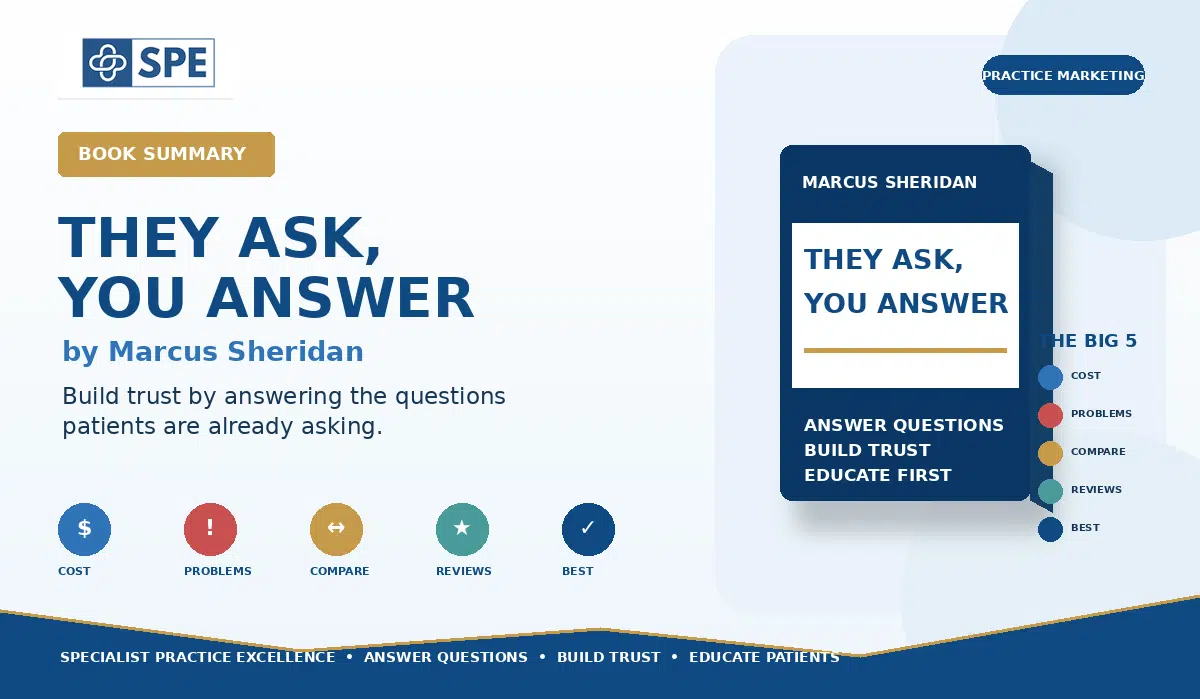
They Ask, You Answer by Marcus Sheridan shows how plastic surgery practices can build trust by answering the questions patients are already asking.
Websites often explain that the surgeon is experienced, the practice offers personalized care, and each procedure is tailored to the individual. These statements may be true, but they do not always answer the questions patients type into search engines or ask privately before scheduling a consultation:
- How much will surgery cost?
- What could go wrong?
- How painful is recovery?
- Which procedure is right for my concern?
- What are the disadvantages?
- Will the result look natural?
- How does one treatment compare with another?
- Who should not have this procedure?
- How do I choose the right surgeon?
- What happens if I decide not to proceed?
Marcus Sheridan’s They Ask, You Answer argues that businesses build trust when they stop hiding from difficult questions and become the most useful, honest source of answers in their field.
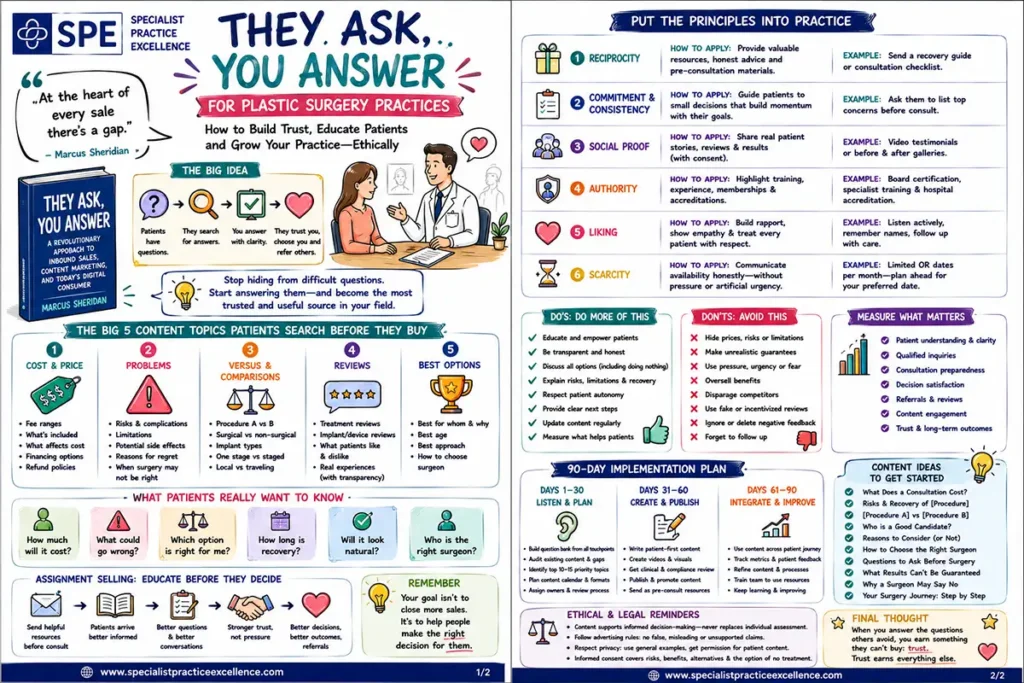
The book presents the framework as an approach to inbound sales, content marketing, and the behavior of modern digital consumers. Its core message is that organizations should become obsessed with what customers are thinking, asking, fearing, comparing, and searching for—and then answer those questions clearly and thoroughly.
For plastic surgeons, the book’s principles can improve:
- Patient education
- Website quality
- Search visibility
- Consultation preparedness
- Inquiry quality
- Patient trust
- Team communication
- Content planning
- Expectation setting
- Long-term reputation
However, the framework requires careful adaptation.
A pool company can speak openly about product drawbacks, competitors, and prices without navigating the clinical and ethical responsibilities that apply to healthcare. A plastic surgery practice must ensure that educational content remains accurate, balanced, non-misleading, privacy-conscious, and subordinate to individualized clinical assessment.
The objective is not to use information to make more people choose surgery.
It is to help people understand:
- Whether surgery may be relevant
- What questions they should ask
- What trade-offs are involved
- What alternatives exist
- Why individual assessment matters
- When delaying or declining treatment may be appropriate
What Is They Ask, You Answer About?
The philosophy begins with one question:
What is the customer thinking?
Sheridan’s official book page describes They Ask, You Answer as a business philosophy built around understanding how customers think, speak, act, and search while moving through a decision. Its goal is to help an organization become the most trusted voice in its industry.
The model challenges common marketing habits such as:
- Avoiding prices
- Hiding disadvantages
- Speaking only about benefits
- Publishing generic promotional content
- Waiting for the marketing department to invent topics
- Treating sales and marketing as separate functions
- Measuring content only through traffic
- Assuming prospective patients need to speak with staff before receiving useful information
Instead, Sheridan encourages organizations to:
- Collect every genuine customer question.
- Answer those questions openly.
- Address uncomfortable subjects competitors avoid.
- Use written and video content to educate before direct contact.
- Integrate content into the sales or consultation process.
- Build a culture in which subject-matter experts participate in education.
- Measure whether content helps people make better decisions.
Official materials now describe They Ask, You Answer as the foundation for the broader Endless Customers framework, but the central principle remains the same: answer difficult questions transparently and become known and trusted.
Who Is Marcus Sheridan?
Marcus Sheridan is an entrepreneur, author, and communication speaker. His approach developed after his swimming-pool company struggled during the 2008 financial crisis.
According to Sheridan and the organizations that teach the framework, he began writing detailed online answers to the questions customers repeatedly asked about fiberglass pools. That work became the foundation of They Ask, You Answer.
The lesson Sheridan drew from the experience was not merely that blogging generates website traffic.
It was that buyers reward businesses willing to educate them honestly before asking for a sale.
For a plastic surgery practice, this translates into:
Educate patients before asking them to book, pay, or proceed.
The River Pools Story
The best-known story behind the book concerns River Pools and Spas.
During the financial crisis, Sheridan’s company faced severe financial pressure and declining demand. Instead of relying only on traditional advertising, the team began publishing detailed answers to the questions prospective pool buyers were asking.
They wrote about:
- Cost
- Problems
- Product comparisons
- Reviews
- The best available options
These topics later became known as The Big 5. Sheridan’s current educational materials continue to identify them as the high-intent subjects people commonly research before contacting a business.
The Plastic Surgery Lesson
A prospective patient rarely begins with:
I would like to read a general description of rhinoplasty.
They are more likely to ask:
- What does rhinoplasty cost in my city?
- What are the most common problems after rhinoplasty?
- Open versus closed rhinoplasty: what is the difference?
- How long will swelling last?
- Can rhinoplasty affect breathing?
- What happens if I dislike the result?
- How do I compare surgeons?
- When is revision surgery considered?
- What can surgery not fix?
These questions may feel commercially uncomfortable, but they are already being asked.
When the practice does not answer them, the patient finds answers elsewhere—from competitors, social media creators, forums, advertising pages, or AI-generated summaries.
The Core Principle: Become the Most Trusted Teacher
The book’s philosophy can be summarized as:
Answer what patients ask—even when the answer is difficult.
This requires the practice to publish content that is:
- Honest
- Useful
- Detailed
- Easy to understand
- Balanced
- Specific
- Transparent about limitations
- Written for patients rather than search engines alone
Trust is not created by repeatedly stating:
We are trusted.
Trust is created by demonstrating that the practice will address:
- Cost
- Risk
- Recovery
- Disadvantages
- Alternatives
- Suitability
- Uncertainty
- Situations in which surgery may not be recommended
A surgeon builds credibility when patients can see that education does not disappear when the subject becomes commercially inconvenient.
The Big 5 Content Topics
Sheridan’s framework identifies five categories that prospective buyers repeatedly research:
- Cost and price
- Problems
- Comparisons
- Reviews
- Best-in-class options
Current official teaching materials continue to present these as the primary high-intent questions organizations should answer transparently.
For plastic surgery, each category requires ethical and clinical adaptation.
1. Cost and Price
Many medical websites avoid discussing cost.
Possible reasons include:
- Each operation is individualized.
- Surgeon, anesthesia, facility, implants, garments, and follow-up may be priced separately.
- Complexity varies.
- Quotes change.
- The practice fears losing inquiries before consultation.
- Competitors may see the fees.
- Staff prefer to discuss value personally.
These are reasonable concerns, but silence does not remove the question.
Patients still want to know:
- The typical fee range
- What the fee includes
- What may increase or reduce cost
- Whether revisions are included
- Whether financing is available
- Which fees are non-refundable
- Whether postoperative care is included
- Why one surgeon may charge more than another
Ethical Cost Content
A responsible article might explain:
- That exact fees require individual assessment
- A genuine approximate range when the practice can provide one
- Surgeon fees
- Anesthesia fees
- Facility fees
- Implant or device expenses
- Garment or medication expenses
- Preoperative testing
- Postoperative appointments
- Factors affecting complexity
- Financing terms
- Refund and cancellation policies
Example Titles
- Facelift Cost in Houston: Fees and Factors to Consider
- How Much Does Breast Reduction Cost?
- What Is Included in a Plastic Surgery Quote?
- Why Plastic Surgery Fees Vary Between Surgeons
- Questions to Ask Before Using Medical Financing
What to Avoid
Do not:
- Advertise an unrealistic “starting from” figure that few patients receive
- Hide mandatory facility or anesthesia costs
- Use financing to make treatment appear inexpensive
- Suggest that higher cost guarantees a better result
- Create false discounts
- Use price deadlines to rush decisions
- Imply that a consultation automatically leads to treatment
Transparency about financial incentives and material information supports informed decision-making and trust.
2. Problems and Drawbacks
This is one of the most valuable—and most avoided—content categories.
Patients want to know:
- What could go wrong?
- What are the disadvantages?
- What do patients commonly underestimate?
- Why might someone regret the procedure?
- What limitations remain afterward?
- Who may be unsuitable?
- What does recovery actually feel like?
- When are results unpredictable?
Plastic Surgery Problem Content
Possible topics include:
- Common Challenges During Facelift Recovery
- Reasons Breast Implants May Require Further Surgery
- Limitations of Liposuction
- When Abdominoplasty May Not Be the Right Choice
- Possible Causes of Dissatisfaction After Rhinoplasty
- What a Breast Lift Cannot Correct
- Risks and Trade-Offs of Combining Procedures
- Reasons a Surgeon May Recommend Delaying Surgery
Balanced Problems Content
A useful article should distinguish between:
- Expected effects
- Common temporary experiences
- Recognized risks
- Less common complications
- Individual variability
- Warning signs requiring medical review
- Limitations of treatment
- Reasons not to proceed
The goal is not to frighten readers.
It is to help them understand that surgery involves genuine trade-offs.
AMA guidance states that informed consent should include the burdens, risks, expected benefits, alternatives, and the option of forgoing treatment.
Why Problems Content Builds Trust
A patient may reasonably think:
If this practice is willing to discuss complications and limitations before I contact them, they may also communicate honestly during consultation.
That is a stronger trust signal than generic claims about excellence.
3. Versus and Comparison Content
Patients compare options constantly.
They may compare:
- Procedures
- Techniques
- Surgeons
- Surgical versus non-surgical treatment
- One-stage versus staged surgery
- Local versus out-of-state care
- Implant types
- Recovery pathways
- Facility options
- Primary versus revision surgery
Useful Plastic Surgery Comparisons
- Facelift Versus Neck Lift
- Breast Lift Versus Breast Augmentation
- Liposuction Versus Abdominoplasty
- Surgical Versus Non-Surgical Rhinoplasty
- Implant Removal Alone Versus Removal With Lift
- Open Versus Closed Rhinoplasty
- One Combined Operation Versus Staged Procedures
- Local Plastic Surgeon Versus Traveling for Surgery
How to Write Fair Comparisons
A responsible comparison should explain:
- What each option addresses
- What it does not address
- Typical trade-offs
- Recovery differences
- Scarring
- Longevity
- Suitability factors
- Risks
- Situations in which each may be considered
- Why individual assessment is necessary
The article should not force every comparison toward the option the practice sells most profitably.
ASPS advertising guidance states that comparative advertising should not be false, deceptive, misleading, or unfairly disparaging.
Competitor Comparisons
Sheridan’s philosophy encourages openness about alternatives, but medical practices should be cautious about publishing simplistic “Surgeon A versus Surgeon B” articles.
A safer approach is to teach readers how to compare providers:
- Relevant certification
- Scope of practice
- Procedure experience
- Facility accreditation
- Anesthesia arrangements
- Follow-up
- Emergency contact
- Communication
- Pricing transparency
- Revision policies
The aim is to improve the patient’s evaluation process, not attack a competitor.
4. Reviews
Within They Ask, You Answer, reviews are broader than collecting positive testimonials.
Review content can examine:
- A treatment
- A product
- An implant
- A device
- A service
- A type of provider
- Whether something is suitable for particular circumstances
Plastic Surgery Review Content
Examples include:
- Are Silicone Breast Implants Right for Everyone?
- Is Non-Surgical Rhinoplasty Worth Considering?
- Who May Benefit From a Mini Facelift—and Who May Not?
- What Patients Should Know Before Choosing Medical Tourism
- Reviewing the Advantages and Limitations of Fat Transfer
A good review should explain:
- Who the option may suit
- Who it may not suit
- Advantages
- Disadvantages
- Risks
- Alternatives
- Questions to ask
- Why recommendations vary
Patient Reviews and Testimonials
Patient testimonials can support trust, but practices must treat them differently from independent educational reviews.
The FTC requires reviews and endorsements to be truthful, and material relationships should be disclosed. Its Consumer Reviews and Testimonials Rule also prohibits several deceptive practices involving fake or manipulated reviews.
A plastic surgery practice should not:
- Buy fake reviews
- Ask employees to pose as patients
- Require positive sentiment
- Hide material incentives
- Alter a testimonial’s meaning
- Present exceptional outcomes as typical
- Use a testimonial to make unsupported clinical claims
Testimonials also require appropriate privacy and authorization processes when patient information is involved.
5. Best-in-Class Content
Patients search for:
- Best plastic surgeon near me
- Best facelift surgeon
- Best breast implant type
- Best procedure for loose abdominal skin
- Best age for a facelift
- Best scar treatment
- Best recovery garment
Ignoring the word “best” does not stop these searches.
The responsible approach is to define what “best” depends on.
Example: Best Facelift Surgeon
Rather than claiming:
We are the best facelift practice.
Publish:
How to Choose a Facelift Surgeon: Qualifications, Experience, Facility Standards, Follow-Up, and Questions to Ask
Example: Best Procedure
Instead of:
A facelift is the best facial rejuvenation procedure.
Explain:
- Which concerns a facelift addresses
- Which concerns it does not address
- When another procedure may be more relevant
- Why anatomy, health, goals, and recovery tolerance matter
- When no surgery may be appropriate
The Ethical Rule
“Best” should be framed as:
Best for whom, under what circumstances, and based on which criteria?
Unsupported superiority claims can mislead patients. ASPS advertising policy requires advertisements to be non-deceptive and appropriately substantiated.
The Questions Every Practice Should Collect
The content strategy should begin with real patient questions—not keyword software alone.
Sources include:
- Inquiry calls
- Consultation notes
- Patient coordinator conversations
- Nurse questions
- Social media comments
- Website searches
- Email inquiries
- Postoperative calls
- Questions from caregivers
- Reasons patients delay
- Reasons patients decline
- Complaints
- Questions asked during second consultations
Create a Question Bank
Possible columns include:
- Patient question
- Procedure
- Decision stage
- Who hears it
- Frequency
- Clinical review required
- Best format
- Existing content
- Priority
- Responsible author
- Review date
Every repeated question represents a potential educational resource.
Address the Questions Competitors Avoid
The framework becomes powerful when the practice is willing to answer difficult questions such as:
- Why might someone regret this operation?
- What are the visible scars?
- What does the first week feel like?
- Why do some results look unnatural?
- How can results change with aging or weight?
- What happens if a complication occurs?
- How are revisions handled?
- Why might a surgeon decline a patient?
- Is a less expensive surgeon necessarily unsafe?
- When is the more expensive option not worthwhile?
- What are the limitations of before-and-after photographs?
- What should patients know about traveling for surgery?
Avoiding these questions may protect the practice from short-term discomfort, but answering them can create deeper trust.
Assignment Selling
One of Sheridan’s best-known concepts is assignment selling: providing useful educational content before a sales conversation so the prospective buyer arrives better prepared.
For plastic surgery, this might mean sending carefully selected resources before consultation.
Pre-Consultation Assignment
A patient considering abdominoplasty might receive:
- What Abdominoplasty Can and Cannot Correct
- Abdominoplasty Risks and Recovery
- Liposuction Versus Abdominoplasty
- Questions About Pregnancy and Weight Stability
- How to Prepare for Your Consultation
The purpose is not to persuade the patient toward abdominoplasty.
It is to help them arrive with:
- More realistic expectations
- Better questions
- Clearer understanding of alternatives
- Awareness of recovery requirements
- Recognition that the surgeon may recommend another option
After-Consultation Assignment
After the surgeon makes a recommendation, the practice may provide:
- A written explanation of the proposed procedure
- Alternatives
- Risks
- Recovery guidance
- Financial information
- A decision checklist
- Contact pathways for further questions
Content supports the conversation. It does not replace individualized consent.
The Role of Video
Patients may prefer to see and hear complex concepts explained rather than read long articles.
Useful video topics include:
- What happens during a consultation
- Why a surgeon may recommend no operation
- How the team assesses recovery readiness
- What “natural-looking” means
- The difference between skin, fat, and muscle concerns
- How postoperative swelling changes over time
- Questions patients should ask every surgeon
- What before-and-after photographs cannot show
Helpful Video Types
Surgeon Q&A
Answer one focused question directly.
Procedure Comparison
Use diagrams to explain differences.
Recovery Timeline
Show stages without promising an exact experience.
Patient Journey Video
Explain what happens from inquiry to follow-up.
Staff Introduction
Clarify the roles of coordinators, nurses, and administrators.
Facility Explanation
Explain where surgery occurs and who provides anesthesia.
The video should be educational—not a substitute for consultation or a vehicle for unsupported claims.
Sales and Marketing Alignment
The book argues that content should not belong only to the marketing department.
In a plastic surgery practice:
- Surgeons hear clinical questions.
- Coordinators hear decision questions.
- Nurses hear recovery questions.
- Front-desk staff hear logistical questions.
- Managers hear service complaints.
- Billing staff hear cost questions.
Every department has information the content team needs.
A Useful Monthly Content Meeting
Participants might include:
- Surgeon
- Practice manager
- Patient coordinator
- Nurse
- Marketing lead
- Website or content specialist
Questions to discuss:
- What did patients ask most often?
- Which issue created confusion?
- Which expectation required correction?
- What delayed decisions?
- What problem appeared after surgery?
- What website article would have helped?
- Which existing resource needs updating?
Content Should Support Self-Selection
Strong content does not attract everyone.
It helps people determine whether the practice may or may not suit them.
A good article can explain:
- Who may benefit
- Who may not
- What expectations are realistic
- What recovery requires
- What alternatives exist
- When treatment may be delayed
- When the practice may refer elsewhere
This may reduce total inquiry volume while improving inquiry quality.
For example, a detailed article about recovery may discourage a person who cannot arrange support. That is not a marketing failure.
It is responsible self-selection.
Eight Hypothetical Plastic Surgery Scenarios
These examples are hypothetical.
Scenario 1: The Website Avoids Cost
Problem
Patients repeatedly call only to ask for a price range.
They Ask, You Answer application
Publish an article explaining the typical fee structure, what is included, and the factors that change cost.
Ethical boundary
Do not advertise a misleading low starting price.
Measure
Track whether inquiries arrive with a clearer understanding of fees.
Scenario 2: Patients Expect No Visible Scarring
Problem
The website describes benefits but gives little information about scars.
Application
Create procedure-specific scar guides covering location, variability, maturation, and limitations.
Measure
Track whether scar-related expectations are better documented during consultation.
Scenario 3: Coordinators Repeat the Same Explanation Daily
Problem
The team repeatedly explains the difference between a breast lift and implants.
Application
Create a comparison article and video, then send them before consultation.
Measure
Assess whether patients arrive with more specific questions.
Scenario 4: Marketing Generates Unsuitable Inquiries
Problem
Promotional content emphasizes dramatic transformations.
Application
Publish content explaining candidacy, limitations, recovery, risks, and reasons surgery may be declined.
Measure
Review inquiry suitability, not only lead volume.
Scenario 5: Patients Distrust the Quotation
Problem
The quote shows one total but does not explain its components.
Application
Publish a guide explaining surgeon, facility, anesthesia, device, and follow-up fees.
Measure
Track cost-related complaints and requests for clarification.
Scenario 6: The Surgeon Fears Discussing Complications Online
Problem
The practice worries that risk content will discourage patients.
Application
Create balanced, clinically reviewed content explaining recognized risks, warning signs, and why individualized consent is necessary.
Ethical benefit
Patients can make better-informed decisions.
Scenario 7: The Practice Wants More Reviews
Problem
Staff ask every patient for a positive review immediately after treatment.
Application
Create a neutral feedback process and ensure patients remain free to provide honest opinions.
Boundary
Do not condition benefits on positive sentiment or use undisclosed incentives.
Scenario 8: Patients Rely Too Heavily on Before-and-After Images
Problem
Patients believe a similar photograph predicts their result.
Application
Publish an article explaining variability in anatomy, lighting, healing, photography, and treatment plans.
Measure
Review whether patients understand that images are examples rather than guarantees.
Ten Best Lessons from They Ask, You Answer by Marcus Sheridan for Plastic Surgeons
1. Begin With Patient Questions
Do not begin with what the practice wants to promote.
2. Answer Difficult Questions Openly
Cost, risk, limitations, and disadvantages are trust-building subjects.
3. Write for Education, Not Applause
Useful content may be less promotional and more balanced.
4. Let Patients Self-Select
Good content should help unsuitable or unready patients recognize that surgery may not be right for them.
5. Use the Big 5
Build core content around:
- Cost
- Problems
- Comparisons
- Reviews
- Best options
6. Include the Whole Team
The best content topics often come from frontline conversations.
7. Use Content Before and After Consultation
Education should support the patient journey rather than exist only for search traffic.
8. Be Specific
“Recovery varies” is technically true but often unhelpful. Explain what causes variation and what patients may experience.
9. Review Content Regularly
Medical guidance, fees, technology, team members, and policies change.
10. Measure Trust and Understanding
Traffic is useful, but patient clarity and suitability matter more.
Ethical and Legal Boundaries
Informed Consent
Content can prepare patients, but it cannot replace individualized informed consent.
Physicians should explain the nature and purpose of treatment, burdens, risks, expected benefits, alternatives, and the option of no treatment. Patients must be able to make an independent and voluntary decision.
Truthful Advertising
Claims should be accurate, supportable, and not deceptive.
ASPS advertising policy emphasizes non-misleading communication, appropriate substantiation, and care with comparative claims and testimonials.
Reviews and Testimonials
FTC guidance requires endorsements and reviews to be truthful and material relationships to be disclosed. Fake or manipulated reviews can violate federal requirements.
Privacy
A common patient question can be turned into general education, but individual stories, images, messages, or identifiable circumstances should not be used casually.
HIPAA generally limits the use or disclosure of protected health information for marketing and may require individual authorization, subject to specific exceptions.
Individual Assessment
Articles should not diagnose readers or imply that general information confirms candidacy.
Include clear language explaining that recommendations depend on individual assessment.
Common Mistakes
Publishing Only Benefits
Balanced content should discuss drawbacks, limitations, and alternatives.
Hiding Behind “It Depends”
When an answer varies, explain what it depends on.
Writing for Search Engines Instead of Patients
Keywords should not make the content repetitive or unnatural.
Treating Every Question as a Lead-Generation Opportunity
Some questions should lead readers toward waiting, seeking another opinion, or avoiding treatment.
Outsourcing Without Clinical Review
A general writer may misunderstand medical nuance.
Creating Generic AI Content
AI can support drafting, but the practice must verify accuracy, originality, tone, privacy, and clinical appropriateness.
Using Testimonials as Evidence
One patient’s experience does not predict another’s outcome.
Measuring Only Traffic
A high-traffic article that creates false expectations is not successful.
Limitations of They Ask, You Answer
It Was Developed in Commercial Sales
The original framework grew from the swimming-pool industry, not healthcare.
Transparency Has Clinical Limits
A surgeon cannot provide individualized diagnosis publicly or reduce complex treatment decisions to simple universal answers.
Content Production Requires Resources
High-quality content needs:
- Clinical time
- Research
- Writing
- Review
- Editing
- Updating
- Distribution
Not Every Question Deserves a Long Article
Some questions are better answered through:
- A short FAQ
- A video
- A consultation
- A clinical discussion
- An emergency contact pathway
Results Are Not Guaranteed
Publishing useful content may support trust and visibility, but it does not guarantee rankings, inquiries, revenue, or patient satisfaction.
The Framework Can Become Formulaic
A website filled with repetitive cost, versus, and best-of articles may feel mechanical unless the content reflects genuine patient needs.
Transparency Is Not the Same as Disclosure Overload
Patients need understandable information, not enormous pages filled with every possible detail without hierarchy.
FAQs About They Ask, You Answer by Marcus Sheridan for Plastic Surgeons
Is the book relevant to medical practices?
Yes, particularly its emphasis on answering patient questions transparently. The framework must be adapted to clinical ethics, privacy, advertising rules, and informed consent.
What should a practice write first?
Begin with the questions patients ask most often about cost, risks, limitations, comparisons, recovery, and suitability.
Should a plastic surgeon publish prices?
Where possible, provide a genuine range or explain the fee structure and factors affecting cost. Avoid misleading low figures.
Will discussing risks discourage patients?
It may discourage some people, including those unwilling to accept the trade-offs. That may improve suitability and decision quality.
Can articles replace the consultation?
No. Content provides general education. Individual recommendations require clinical assessment.
Who should write the content?
Writers can help, but surgeons and appropriate clinical staff should supply expertise and review medical information.
Should the practice mention competitors?
Teach patients how to compare providers fairly. Avoid unsupported attacks or misleading superiority claims.
Can patient questions be used as content?
Yes, when generalized and de-identified. Do not reveal identifiable information without appropriate authorization.
How often should content be updated?
Review it whenever fees, guidance, team members, techniques, policies, or evidence change. Assign a regular review date.
What is the most important lesson?
Answer the questions patients genuinely care about—even when those questions are uncomfortable for the practice.
Key Takeaways from They Ask, You Answer by Marcus Sheridan
- Patients are already researching cost, risks, comparisons, reviews, and the best options.
- Avoiding difficult questions sends patients elsewhere for answers.
- Trust grows when practices educate before promoting.
- Cost content should explain real fees and variables.
- Problems content should discuss risks, limitations, and reasons not to proceed.
- Comparisons should be balanced and clinically relevant.
- Reviews and testimonials must be truthful and appropriately authorized.
- “Best” content should define criteria rather than make unsupported superiority claims.
- Content can improve consultation preparation but cannot replace informed consent.
- The goal is better-informed, more suitable patients—not maximum inquiry volume.
Final Thought
They Ask, You Answer encourages plastic surgeons to stop asking:
What should we promote this month?
And start asking:
What are patients worried about, confused about, comparing, and afraid to ask?
The strongest plastic surgery content is not necessarily the most polished or promotional.
It is the content that clearly explains:
- What surgery may achieve
- What it cannot achieve
- What it costs
- What recovery requires
- What can go wrong
- What alternatives exist
- Who may not be suitable
- Why individual assessment matters
A practice that answers those questions openly demonstrates confidence without making guarantees.
It shows patients that the team is willing to educate them even when the honest answer may be:
- Wait
- Consider another option
- Seek another opinion
- Accept a limitation
- Do not proceed
That is the medical-practice version of They Ask, You Answer:
Tell patients what they genuinely need to know, not only what the practice wants them to hear.