
Nurses Guide to Managing Complications with Breast Implants
Implants, whether for breast augmentation, reconstruction, or body contouring, are among the most common devices used in plastic surgery. While they are generally safe and effective, they introduce unique risks for patients in both the short and long term. For nurses in private practice, recognising implant-related complications early is essential for protecting patient safety, ensuring aesthetic outcomes, and maintaining trust.
This article explores common complications with implants, the nurse’s role in monitoring, practical management strategies, and when to escalate to the surgeon.
Why Implant Complications Require Vigilance
- Safety – untreated complications can threaten health or lead to revision surgery.
- Outcomes – implant problems can distort results or cause discomfort.
- Trust – patients expect clear communication and timely intervention.
- Legal risk – delayed recognition can lead to medico-legal consequences.
Common Early Complications with Implants
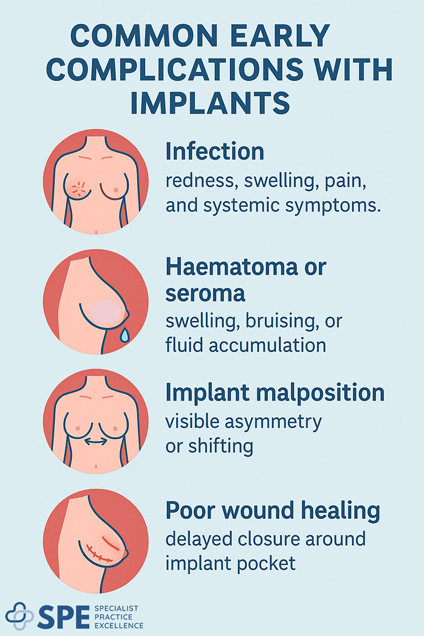
- Infection – redness, swelling, pain, and systemic symptoms.
- Haematoma or seroma – swelling, bruising, or fluid accumulation.
- Implant malposition – visible asymmetry or shifting.
- Poor wound healing – delayed closure around implant pocket.
Long-Term Implant Complications
- Capsular contracture – firm, distorted breast or implant area.
- Implant rupture or leak – changes in size, shape, or feel.
- Implant rippling – visible folds under thin tissue.
- Implant displacement – downward, outward, or sideways movement.
- Breast Implant Illness (BII) – reported systemic symptoms (fatigue, pain, brain fog).
- BIA-ALCL (Breast Implant-Associated Anaplastic Large Cell Lymphoma) – rare but serious; persistent swelling or seroma years after surgery.
The Nurse’s Role in Implant Care

- Assess wounds, swelling, and symmetry at each visit.
- Document objective findings with photos if permitted.
- Reassure patients while escalating red flags to the surgeon.
- Educate patients on how to monitor implants at home.
- Support long-term follow-up and implant replacement planning.
Red Flags That Require Escalation
- Sudden swelling, redness, or severe pain
- Persistent seroma or fluid around the implant
- Firmness, distortion, or asymmetry
- Sudden deflation or size change
- Late-onset seroma or breast swelling (possible BIA-ALCL)
Do’s and Don’ts for Implant Complication Management
Do’s
- Do monitor wounds and swelling closely in the early post-op period.
- Do educate patients about implant red flags.
- Do document findings in detail.
- Do escalate concerns to the surgeon promptly.
- Do reassure patients while avoiding false reassurance.
- Do support patients with long-term implant health education.
- Do encourage regular follow-up appointments.
Don’ts
- Don’t dismiss sudden swelling or redness.
- Don’t delay escalation of suspected rupture or contracture.
- Don’t overlook systemic symptoms patients may report.
- Don’t minimise the importance of long-term monitoring.
- Don’t provide medical treatments outside nurse scope.
- Don’t assume asymmetry is “normal” without assessment.
- Don’t ignore patient concerns about implant safety.
FAQs on Managing Complications with Breast Implants
Early Complications FAQs
Q: How can I tell the difference between swelling and a haematoma?
Normal swelling improves gradually, while haematomas present as firm, painful swelling with bruising.
Q: When does seroma typically appear?
Seromas usually appear within the first few weeks, presenting as soft, fluctuant swelling.
Q: Can infection occur even if the wound looks clean?
Yes, deep infections can occur without obvious external redness. Watch for systemic symptoms like fever.
Long-Term Complications FAQs
Q: What is capsular contracture and how does it present?
It is the hardening of scar tissue around the implant, causing firmness, distortion, and sometimes pain.
Q: How do I recognise a ruptured implant?
Signs include sudden change in size or shape, softness, or rippling. MRI is often required for confirmation.
Q: What is implant rippling?
Visible or palpable folds under thin skin, more common in very slim patients or with saline implants.
BIA-ALCL and BII FAQs
Q: What is BIA-ALCL?
A rare cancer linked to textured implants, presenting as swelling or seroma years after surgery.
Q: What are symptoms of Breast Implant Illness (BII)?
Patients may report fatigue, joint pain, brain fog, or rashes. Research is ongoing, but symptoms should be taken seriously.
Q: Should nurses escalate all reports of late-onset swelling?
Yes, late swelling must always be investigated to rule out BIA-ALCL or other complications.
Patient Education for Breast Implants FAQs
Q: How can I explain capsular contracture simply?
“It’s when scar tissue around the implant tightens and makes the breast feel firm or look different.”
Q: Should patients massage their implants?
Only if advised by the surgeon. Protocols vary depending on implant type and placement.
Q: How often should patients check their implants at home?
Encourage monthly self-checks for changes in size, firmness, or symmetry.
Escalation and Legal FAQs
Q: When should I escalate breast implant concerns to the surgeon?
Immediately if swelling, pain, redness, asymmetry, or systemic symptoms occur.
Q: Can nurses diagnose implant rupture?
No. Nurses can recognise signs but diagnosis requires imaging and surgeon review.
Q: What’s the best way to document suspected implant complications?
Use clear, objective language, measurements, and photographs (if practice policy allows).
Private Practice FAQs
Q: Do private practice patients expect faster responses to concerns?
Yes, accessibility and reassurance are critical in private care.
Q: Should nurses educate patients about implant replacement timelines?
Yes, implants are not lifetime devices; patients should understand the need for long-term follow-up.
Q: What’s the most common education gap with implants?
Patients often underestimate the possibility of long-term complications or revision surgery.
Taking Action and Implementing
Implant complications can range from minor concerns to serious health risks. Nurses are the first line of defence — recognising changes early, reassuring patients, and escalating to the surgeon when needed.
By combining vigilant monitoring, detailed documentation, and clear patient education, nurses protect both patient safety and long-term outcomes. Empowering patients with knowledge about their implants ensures they feel supported and confident in their recovery and beyond.