
AI for Plastic Surgery Practices in the USA, UK, and Australia
Artificial intelligence (AI) is evolving at an exponential pace. For plastic surgery practices, AI offers powerful opportunities to improve efficiency, support staff, and enhance the patient experience. But its use also requires careful consideration of ethical and regulatory guidelines.
This article explores the practical ways AI can transform a plastic surgery practice, with insights tailored to surgeons and managers in the United States, United Kingdom, and Australia.
Why AI Matters for Plastic Surgery Practices
Plastic surgery practices operate at the intersection of medicine, aesthetics, and business. Success depends not only on clinical expertise but also on patient trust, operational efficiency, and smart marketing. AI supports all three.
- Time savings: AI automates repetitive tasks such as appointment scheduling, reminders, billing, and reporting.
- Stress reduction: Staff are freed from administrative burdens and can focus on patient care.
- Patient experience: Faster responses, clearer communication, and personalised education improve satisfaction.
- Practice growth: Smarter marketing, data insights, and conversion strategies attract and retain more patients.
- Compliance support: AI can help monitor communications to ensure they align with advertising and regulatory standards.
For surgeons, this means more time in the operating room, less time buried in paperwork, and a practice that grows sustainably in a competitive environment.
Five Areas Where AI Delivers the Greatest Impact for Plastic Surgery Practices
1. Conversational AI and Chatbots
- Applications:
- Website bots answering common questions about surgery, recovery, or consultation booking.
- Virtual assistants that triage new patient enquiries and schedule consultations.
- After-hours support for patients needing reassurance or reminders.
- Benefits:
- Reduced workload for reception staff.
- Consistent and accurate patient communication.
- Improved patient response times.
- Regional Notes:
- USA: FTC requires that marketing claims made by bots be truthful and not misleading.
- UK: ASA guidelines restrict exaggerated claims or “guarantees” in chatbot responses.
- Australia: AHPRA strictly prohibits testimonials, meaning bots must be carefully trained to avoid patient stories or reviews.
Tools to Explore: Clara, Simplast, Tidio, Intercom, ChatGPT-powered custom bots.
2. Large Language Models (LLMs) for Clinical & Marketing Support
- Applications:
- Writing clear, patient-friendly procedure pages, blogs, and FAQs.
- Summarising intake forms, consultation notes, or medical reports.
- Drafting consent forms or internal staff training materials.
- Benefits:
- Faster and more consistent content creation.
- Improved accuracy and readability for patient communications.
- Streamlined documentation and reduced admin burden for surgeons.
- Regional Notes:
- USA: AI-generated patient education materials should avoid implying guaranteed outcomes.
- UK: Ads must be “responsible” and avoid preying on insecurities.
- Australia: AHPRA requires content to be factual, balanced, and free of testimonials or non-compliant before-and-after images.
Tools to Explore:
- OpenAI GPT, Anthropic Claude, Google Gemini, Microsoft Copilot.
- Prompt Engineering Tools: Prompt Genius (save prompts), AIPRM (pre-written prompt library), FlowGPT.
- Speech-to-text Support: Whisperflow.org for turning spoken notes into drafts.
3. Media Content Production for Patient Education
- Applications:
- Editing long-form patient education videos into short, shareable clips for Instagram, YouTube, and TikTok.
- Creating 3D simulations or educational animations (with clear disclaimers).
- Using avatars for explainer videos, FAQs, and post-op care reminders.
- Benefits:
- Consistent, high-quality content production without high costs.
- Stronger patient education and engagement.
- Easier repurposing of existing content.
- Regional Notes:
- USA: Before-and-after photos can be used but must be authentic, unaltered, and paired with disclaimers.
- UK: Visuals must not exaggerate results or create unrealistic expectations.
- Australia: AHPRA restricts before-and-after photos and prohibits testimonials, limiting visual marketing options.
Tools to Explore:
- Video & Audio: Descript (edit videos, remove filler words), Runway (AI video effects), ElevenLabs (voice cloning for explainer videos).
- Images: MidJourney, Leonardo, Ideogram, Canva AI.
- Avatars & AI Presenters: D-ID, HeyGen, Synthesia.
4. Personalization at Scale
- Applications:
- Automated drip campaigns customised by procedure interest (breast, body, face, non-surgical).
- Patient-specific reminders for pre-op prep and post-op recovery milestones.
- Dynamic website content that adapts to patient interests.
- Benefits:
- More effective patient nurturing.
- Increased consultation bookings and return visits.
- Improved perception of care and attentiveness.
- Regional Notes:
- USA: FTC requires transparency in personalised ads.
- UK: ASA limits targeting that exploits body insecurities.
- Australia: Patient communication must avoid testimonials or implied guarantees.
Tools to Explore: HubSpot AI, Go High Level (with AI modules), Mutiny, Persado, Patient Prism.
5. Workflow Automation in the Practice
- Applications:
- Appointment confirmations, rescheduling, and reminders.
- Digital consent forms and post-op instruction distribution.
- Automated financial dashboards and reporting.
- Staff rostering and task management.
- Benefits:
- Less admin for staff.
- Fewer missed appointments or errors.
- Smoother, more consistent patient journeys.
- Regional Notes:
- All three regions require that patient data be handled securely under HIPAA (USA), GDPR (UK), and Privacy Act (Australia).
Tools to Explore: Zapier AI, Microsoft Power Automate, Genie Solutions, Nextech.
Mastering AI Prompts in a Medical Context
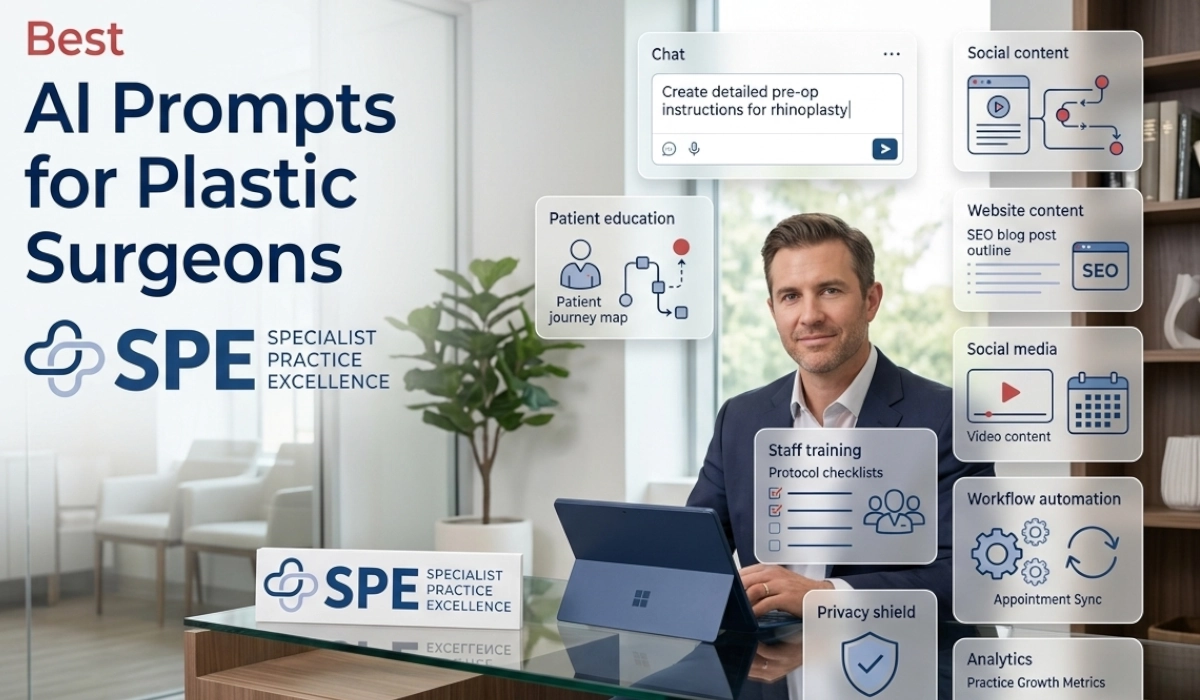
AI is only as useful as the instructions it receives. For plastic surgery, effective prompting ensures accuracy, compliance, and patient-friendliness.
- Principles for Practices:
- Be clear and direct: “Write a patient-friendly overview of tummy tuck recovery for the UK under ASA guidelines.”
- Provide context: specify region, audience, and compliance requirements.
- Define output format: blog, FAQ, checklist, or handout.
Prompt Formula for Practices:
- Persona: “Act as a medical writer for a plastic surgery practice.”
- Who you are: “This is for Dr. Smith, board-certified plastic surgeon.”
- Task: “Summarise facelift recovery process.”
- Intent: “Make it clear and balanced for patients.”
- Format: “Provide as bullet points.”
Advanced Prompting Strategies:
- Chaining: refine drafts step by step.
- Negative prompts: exclude testimonials or non-compliant claims.
- Interview prompting: have AI ask structured questions to gather info.
- 10-80-10 Rule: 10% input (prompt), 80% AI work, 10% final human edit for accuracy and tone.
Useful AI Tools Tailored for Plastic Surgery Practices
Here’s a consolidated “best of” list that practices can start experimenting with:
- Prompting & Content: Prompt Genius, AIPRM, Jasper, Copy.ai, ChatGPT.
- Speech-to-Text: Whisperflow.org, Whisper, Otter.ai.
- Profile & Branding: ProfilePicture.AI, Dreamwave, Fotor, HeadshotPro (affordable professional photos for websites and LinkedIn).
- Video & Visuals: Descript, Runway, MidJourney, Leonardo, Ideogram, Canva AI.
- Avatars & Clone Presenters: D-ID, HeyGen, Synthesia.
- Voice: ElevenLabs for patient explainer content.
- Knowledge Management: NotebookLM (Google), Mem AI, Perplexity.
- Ad Testing & Marketing AI: MintSmart.ai, Mutiny, Persado.
- Automation & Workflows: Zapier AI, Microsoft Power Automate, Go High Level, Genie Solutions.
Strategic Shifts for Practice Leaders
- Compliance-first mindset: Build safeguards so AI never generates non-compliant ads or patient materials.
- Create an AI playbook: Define how AI will be used, which tools are approved, and how outputs are checked.
- Train AI in your brand voice: Ensure content matches your tone, values, and level of professionalism.
- Balance tech with trust: AI should enhance — not replace — the human connection that patients expect from a surgeon.
- Adopt early: In all three regions, most practices are only experimenting. Early movers can gain lasting advantages in efficiency, marketing, and reputation.
FAQs about AI for Plastic Surgery Practices
FAQs about AI for Nurses
Q: Can AI help with post-operative patient monitoring?
Yes. Some AI-driven apps track patient-reported symptoms, wound photos, and recovery milestones. They can flag concerns early, but nurses still review and escalate any issues.
Q: Could AI reduce the time I spend writing nursing notes?
Absolutely. Speech-to-text tools like Whisperflow or Otter.ai can transcribe and structure notes, leaving you more time for patient care.
Q: Will AI ever replace nursing judgement?
No. AI can provide reminders, checklists, or alerts, but it cannot replace the intuition and clinical judgement developed through nursing experience.
Q: How can AI support pre-op patient education?
AI can generate customised handouts, videos, or FAQs for each procedure. Nurses can then focus on reinforcing and clarifying details during consultations.
Q: Can AI make shift handovers easier?
Yes. AI can summarise patient notes into concise handover reports, ensuring nothing important is overlooked when transitioning between nursing teams.
FAQs about AI for Patient Coordinators
Q: Can AI improve consultation show-up rates?
Yes. Automated reminders via text, email, or WhatsApp — combined with AI-personalised messaging — reduce no-shows and cancellations.
Q: Could AI help me answer patient questions faster?
Definitely. AI-powered knowledge bases allow coordinators to pull up instant, accurate answers about procedures, recovery timelines, or payment options.
Q: How can AI help me track patient leads?
AI-integrated CRMs (like Go High Level or Genie) can score patient enquiries, highlight hot leads, and even suggest the next best follow-up step.
Q: Will AI ever handle financial discussions with patients?
AI can generate quotes, payment plan comparisons, or financial FAQs, but sensitive conversations about pricing and affordability are best delivered by a human coordinator.
Q: Can AI help me personalise the patient journey?
Yes. AI can segment patients by interests (face, breast, body, non-surgical) and tailor communication, while coordinators ensure every interaction feels warm and human.
FAQs about AI for Practice Managers
Q: Can AI reduce my reception team’s workload?
Yes. Chatbots and automation can handle FAQs, appointment confirmations, and reminders, freeing staff to focus on personal service and complex enquiries.
Q: Could AI help me train new staff more quickly?
Definitely. AI can generate onboarding checklists, training videos, and even role-play scenarios to prepare new team members for patient interactions.
Q: What’s the biggest compliance risk with AI in a practice?
Accidentally publishing testimonials, exaggerated claims, or non-compliant before-and-after imagery. In Australia, this is strictly monitored by AHPRA; in the UK by ASA; and in the USA by the FTC.
Q: How can AI improve our consultation conversion rate?
AI can personalise email follow-ups, send pre-consultation education, and track leads through the funnel. Some systems score patients by engagement so the team knows where to focus.
Q: Do I need a dedicated “AI manager” in the practice?
Larger practices may benefit from someone overseeing AI tools, workflows, and compliance. For smaller clinics, a practice manager can guide implementation with surgeon oversight.
FAQs about AI for Surgeons
Q: Could AI draft my operative notes?
Yes. AI Medical Dictation tools like Heidi, Lyrebird, Whisperflow or Otter.ai can capture voice notes and create draft reports. With proper review, this saves significant time.
Q: Will AI eventually be able to recommend surgical plans?
It may support pre-operative planning and highlight risks, but the surgeon’s judgement, artistry, and experience remain central.
Q: Can I “clone” myself for patient education videos?
Yes. Tools like Synthesia or HeyGen allow creation of a digital twin avatar with your likeness and voice. It can explain procedures or post-op care, but disclosure is important, and live consultations remain essential.
Q: How can AI help me avoid burnout?
By automating admin tasks, reducing after-hours patient queries, and streamlining documentation, AI allows you to focus on surgery and meaningful patient care.
Q: What’s the ethical line between using AI for efficiency and losing authenticity?
The line is crossed when patients feel misled or disconnected. AI should amplify your expertise and personality — not replace it. Every AI output must be human-reviewed for accuracy and tone.
Taking Action
AI is reshaping plastic surgery practices across the USA, UK, and Australia. From chatbots to content creation, from personalised marketing to workflow automation, the benefits are immediate and significant.
For surgeons and managers, the path forward is clear:
- Adopt AI strategically.
- Train it in your compliance rules and brand voice.
- Use it to save time, grow the practice, and improve patient care.
Plastic surgery has always combined science, art, and innovation. AI is the next frontier — and practices that embrace it will lead the way in patient trust, efficiency, and growth.
Further Reading about AI for Plastic Surgery Practices
- AI for Plastic Surgeons
- The Future of AI for Plastic Surgery and Plastic Surgeons
- 100 Ways Plastic Surgeons and Plastic Surgery Clinics can use ChatGPT (AI)
- Best Medical Scribes – AI Enabled Consultation Notetakers
- Best AI Video Making Tools for Plastic Surgeons
- AI Tools for Medical Literature Research and Article Writing
- AI Productivity Tools for Plastic Surgery Practices
- AI Text Bots and Voice Bots for Plastic Surgeons
- Best AI Tools, Apps, Agents & Bots for Plastic Surgeons & their Practice – the BIG LIST