How to Use Claude Code for Plastic Surgeons with Use Cases
Your plastic surgery clinic depends on far more than a polished website. Behind your surgeon brand sits a complex network of procedure pages, enquiry forms, consultation booking tools, call tracking, CRM pipelines, email and SMS automations, analytics platforms, reporting dashboards, patient education resources and internal staff systems.
When these systems work together, the clinic can respond faster, track enquiries more accurately and give patients a smoother experience. When they do not, the practice may lose leads, send incorrect messages, duplicate patient records, misread its marketing results or create unnecessary work for staff.
What’s the difference between Claude, Claude Cowork and Claude Code?
Claude is Anthropic’s general AI assistant. It is mainly used through a conversational interface for research, analysis, writing, planning, summarising documents, answering questions and developing ideas. A plastic surgery practice might use Claude to draft patient education, analyse reviews, plan a marketing campaign or improve an internal procedure document. (anthropic.com)
Claude Cowork is designed for multi-step knowledge work that involves real files, documents, browser-based tools and connected business systems. Rather than only answering a question, Cowork can be assigned a broader task, gather context from approved sources and work through several steps to produce a deliverable. A clinic might use it to compare vendor proposals, organise a content library, review several reports or prepare a campaign briefing from multiple documents. Anthropic describes Cowork as a mode of Claude that moves beyond chat to delegated, multi-step work, while keeping people involved in the process. (www-cdn.anthropic.com)
Claude Code is Anthropic’s agentic coding system. It works within a development environment to understand a codebase, edit files, run commands, execute tests, investigate errors and help build or connect software systems. It is the most technically capable of the three products and the one most relevant to website development, CRM integrations, analytics implementation, custom scripts and digital infrastructure. (anthropic.com)
The simplest distinction is:
- Claude helps the practice think, analyse and create.
- Claude Cowork helps the team complete multi-step knowledge work across files and tools.
- Claude Code helps qualified users build, repair, connect, test and automate technical systems.
They may complement one another, but they are not interchangeable.
Claude Code should also not be treated as an unsupervised digital employee. Its effectiveness depends on the quality of the instructions, the systems it can access, the permissions it is given, the accuracy of the available information and the expertise of the person reviewing its work.
For plastic surgery clinics, the greatest value is not simply “having AI.” It is using an AI-assisted developer to solve clearly defined problems within the clinic’s digital ecosystem.
What Is Claude Code?
Claude Code is an AI-assisted development system that can work across an entire software project rather than responding only to isolated pieces of code.
Depending on the environment and permissions provided, it may be able to:
- Read and explain website or application files.
- Trace how different parts of a system connect.
- Search for the source of an error.
- Edit several related files.
- Create new functions or page components.
- Run development commands.
- Run automated tests.
- Review test failures.
- Work with Git and version control.
- Build integrations with approved APIs.
- Help automate repetitive technical work.
- Document the changes it makes.
Anthropic states that Claude Code can search codebases, make coordinated changes across multiple files, use command-line tools and run tests within the user’s existing development environment. The level of autonomy and access can be controlled, and production decisions remain the responsibility of the human user. (anthropic.com)
A useful working definition is:
Claude Code acts as an AI-assisted developer that can help technical users understand a codebase, edit files, run tests, investigate problems and build or automate digital systems.
The phrase technical users matters. A practice manager may be able to describe a problem, review a prototype and confirm whether the result meets the clinic’s needs. However, access to production websites, patient data, CRM systems and payment tools should remain under the control of appropriately qualified people.
Why Plastic Surgery Clinics Need Better Digital Infrastructure
Many established clinics have accumulated technology gradually.
The website may have been built by one agency. Paid search may be managed by another. The CRM may have been installed later. Online booking may operate through a separate platform. Phone calls may be tracked in one dashboard while form enquiries appear in another. Staff may still copy information manually between systems.
This commonly produces:
- Broken or inconsistent tracking.
- Duplicate contacts.
- Incorrect procedure tags.
- Lost enquiry notifications.
- Forms that work on desktop but fail on mobile.
- Automated messages that continue after a patient books.
- Inconsistent reporting between agencies.
- Outdated information on location pages.
- Slow procedure pages.
- Multiple versions of staff spreadsheets.
- Unclear ownership of digital systems.
- Unnecessary dependence on manual work.
Claude Code can help identify and address some of these problems. However, it works best when the clinic first defines the business problem rather than beginning with a vague request to “use AI.”
A strong Claude Code project normally has:
- A clear operational problem.
- A known system owner.
- Defined access limits.
- Measurable success criteria.
- A safe testing environment.
- Human review before deployment.
- A process for monitoring the result.
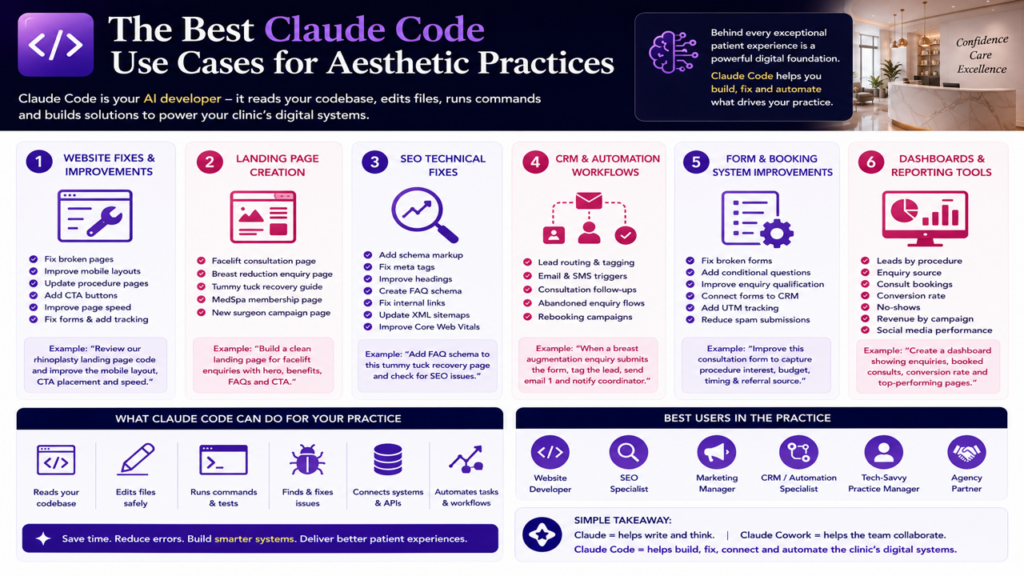
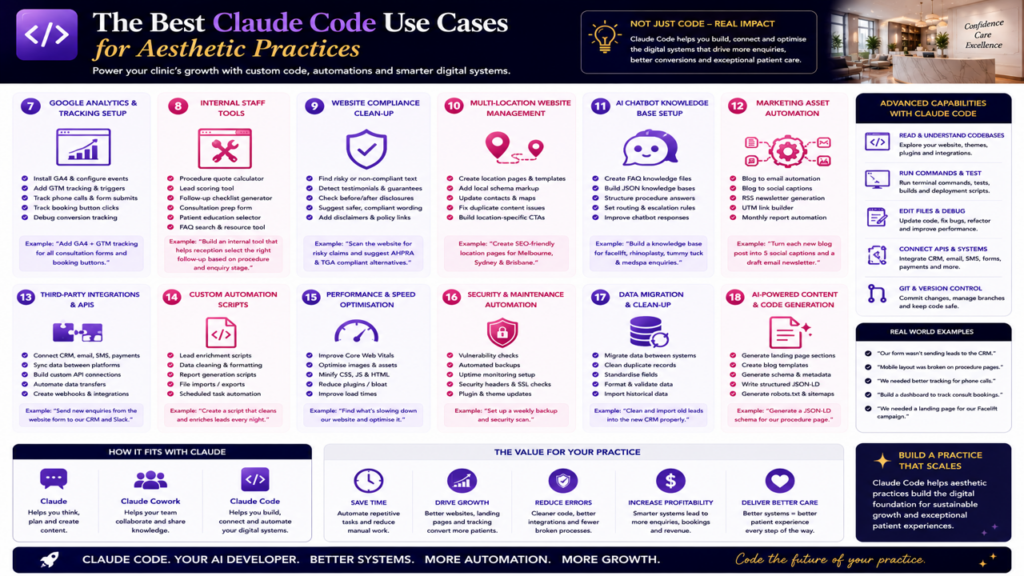
The 18 Best Claude Code Use Cases for Plastic Surgery Clinics
1. Website Fixes and Improvements
Plastic surgery websites often grow over many years. New procedure pages are added, templates change, plugins are installed, surgeons join the practice and old campaigns remain buried within the site.
This creates technical debt: the gradual accumulation of outdated, inconsistent or inefficient code and content structures.
Claude Code may assist with finding and correcting:
- Broken pages.
- Incorrect internal links.
- Missing images.
- Poor mobile layouts.
- Inconsistent buttons.
- Outdated phone numbers.
- Incorrect office addresses.
- Broken navigation menus.
- Form display errors.
- Missing calls to action.
- Poor heading structures.
- Accessibility problems.
- Conflicting tracking scripts.
- Outdated surgeon biographies.
- Pages using obsolete templates.
- Errors caused by plugins or theme updates.
Understanding the type of website problem
Not every website issue is a coding issue.
A weak procedure page may suffer from:
- A content problem: The information is thin, inaccurate or poorly organised.
- A design problem: The page looks cluttered or the call to action is hard to find.
- A code problem: A component does not display or behave correctly.
- A hosting problem: The server is slow or unstable.
- A plugin problem: Two extensions conflict.
- A tracking problem: Enquiries occur, but analytics does not record them.
- A strategy problem: The page targets the wrong patient or search intent.
Claude Code can help investigate the technical layer, but it cannot decide the surgeon’s clinical philosophy or replace a proper conversion strategy.
Plastic surgery clinic example
A rhinoplasty landing page looks acceptable on desktop but breaks on mobile. The consultation button moves off the screen, before-and-after photographs overlap and the enquiry form is difficult to complete.
A developer using Claude Code could ask it to:
- Inspect the page template and related style files.
- Identify mobile breakpoints affecting the page.
- Locate conflicting layout rules.
- prepare a proposed correction.
- Test the updated page at common screen sizes.
- check that the form and tracking still work.
- document the changes for review.
Example Claude Code instruction
Review the rhinoplasty landing page template and identify why the consultation button and gallery overlap on screens below 768 pixels. Propose the smallest safe code change, explain the cause and run the existing front-end tests. Do not modify production files.
Potential business value
A repaired page may:
- Reduce patient frustration.
- Improve mobile enquiry completion.
- Make the practice look more credible.
- Reduce calls from patients reporting website problems.
- Allow the marketing team to use the page confidently in campaigns.
Main safeguards
- Work in a staging environment.
- Create a backup first.
- Test all forms after the change.
- Check multiple browsers and devices.
- Confirm that analytics events still fire.
- Obtain clinical approval for changed medical content.
- Have a developer review the final code.
Best owner: Website developer or technically capable agency.
2. Landing Page Creation
A landing page is a focused page created for a particular procedure, campaign, location, surgeon or patient group.
Claude Code can assist with the technical construction of pages such as:
- Facelift consultation pages.
- Deep plane facelift pages.
- Breast reduction enquiry pages.
- Tummy tuck recovery resources.
- Mommy makeover campaigns.
- Post-GLP-1 body contouring pages.
- Male plastic surgery pages.
- Revision surgery pages.
- Out-of-town patient pages.
- New surgeon launch pages.
- Seminar registration pages.
- Medspa membership pages.
It may create reusable page components, connect the enquiry form, implement structured data, add campaign tracking and check the page across devices.
What a strong procedure landing page needs
The technical page is only one part of the project. A high-quality landing page should also include:
- A clear patient-focused headline.
- An explanation of the concern being addressed.
- A balanced procedure overview.
- Surgeon credentials.
- Candidacy information.
- Benefits and limitations.
- Recovery expectations.
- Risks and considerations.
- Before-and-after gallery links.
- Frequently asked questions.
- Location information.
- A clear consultation call to action.
- A mobile-friendly form.
- Trust and privacy information.
- Appropriate analytics.
Plastic surgery clinic example
A clinic is launching a campaign for post-GLP-1 body contouring. The marketing team needs a dedicated page rather than sending patients to a generic body surgery section.
Claude could help the team develop the campaign strategy and page copy. Claude Cowork could organise the clinical approvals, image selection and campaign checklist. Claude Code could then help the developer:
- Build the page from an approved template.
- Add modular sections for the abdomen, breasts, arms and thighs.
- Connect the form to the CRM.
- Add a “post-GLP-1” lead tag.
- Store campaign and UTM data.
- Trigger an internal coordinator notification.
- Add an analytics event for completed enquiries.
- Test the confirmation page.
Important limitation
Claude Code may build the technical framework, but it should not independently invent:
- Surgical outcomes.
- Recovery claims.
- Risk information.
- Candidacy rules.
- Surgeon qualifications.
- Device claims.
- Before-and-after descriptions.
These require clinical and compliance review.
Best owner: Website developer, working with the marketing manager, surgeon and compliance reviewer.
3. SEO Technical Fixes
Content SEO concerns what a page says and whether it answers a patient’s question well.
Technical SEO concerns whether search engines can efficiently discover, understand, render and organise the page.
Claude Code may assist with:
- Title and meta description templates.
- Canonical tags.
- Redirects.
- Broken internal links.
- XML sitemap creation.
- Robots.txt reviews.
- Heading hierarchy.
- Image attributes.
- Duplicate-page detection.
- JavaScript rendering problems.
- Internal linking systems.
- Structured data.
- Location page architecture.
- Archive and pagination problems.
- Core Web Vitals improvements.
- Technical content inventories.
Structured data
Structured data is code that gives search engines explicit information about a page and the entities described on it.
Potentially relevant types may include:
- Physician.
- MedicalClinic.
- LocalBusiness.
- Article.
- BreadcrumbList.
- FAQPage.
- VideoObject.
- ImageObject.
The correct type depends on the page and the search engine’s supported features.
Google recommends that structured data accurately represent the visible page content. Correct markup can make a page eligible for certain enhanced search appearances, but Google does not guarantee that a rich result will be displayed. (Google for Developers)
Plastic surgery clinic example
A clinic has published a detailed tummy tuck recovery guide. It contains 12 visible FAQs but no structured data, several broken internal links and an incorrect canonical URL.
A developer could use Claude Code to:
- Review the page template.
- Correct the canonical tag.
- find and repair broken links.
- add accurate FAQ structured data based only on visible questions.
- validate the markup.
- check that the page remains indexable.
- document what changed.
What Claude Code should not do
It should not:
- Create false reviews or ratings.
- Add qualifications the surgeon does not hold.
- Mark up content that is not visible.
- Create location pages with no unique value.
- generate large numbers of thin pages.
- Add misleading FAQ answers purely for search traffic.
- Promise rankings.
Technical SEO supports good content. It cannot compensate for weak clinical information, poor patient experience or an undifferentiated practice.
Best owner: Technical SEO specialist or developer.
4. CRM and Automation Workflows
A clinic’s CRM should record where an enquiry came from, what procedure the patient is considering, who is responsible for follow-up and what happens next.
In practice, many clinics have incomplete or fragile workflows.
Claude Code may help build, troubleshoot or document processes involving:
- Lead routing.
- Procedure tags.
- Location tags.
- Lead-source attribution.
- Coordinator assignment.
- Email confirmations.
- SMS confirmations.
- Consultation reminders.
- Abandoned enquiry follow-up.
- Quote follow-up.
- Rebooking campaigns.
- Long-term nurture.
- Review requests.
- Referral campaigns.
- Lead reactivation.
- Internal task creation.
- Escalation rules.
Detailed breast augmentation example
A prospective patient completes a breast augmentation form.
A well-configured workflow might:
- Validate the required fields.
- Search for an existing CRM contact.
- Create or update the contact.
- Record breast augmentation as the procedure.
- Record the campaign, source and landing page.
- Assign the contact to the correct coordinator.
- Send an approved acknowledgement.
- Create a follow-up task.
- Notify the coordinator.
- Begin an appropriate educational sequence.
- Stop automated messages when the patient responds or books.
- Record the eventual consultation and surgical outcome.
Claude Code may assist with the integration logic, webhook handling, duplicate checking, field mapping and error reporting.
Common workflow failures
- The form creates two contacts.
- Leads from one clinic are sent to another.
- A patient is tagged with the wrong procedure.
- Automated messages continue after the patient books.
- The coordinator is not notified.
- The source field is blank.
- Consent information is not retained.
- Time zones cause messages to be sent overnight.
- The system fails silently when an API is unavailable.
- A clinical question is handled by an administrative automation.
Clinical boundary
Automations can deliver approved educational information and administrative messages. They should not:
- Decide surgical candidacy.
- Diagnose a condition.
- Interpret symptoms.
- Give personalised recovery advice.
- Replace postoperative triage.
- Make emergency decisions.
Best owner: CRM or automation specialist, supported by the practice manager and clinical team.
5. Form and Booking System Improvements
The enquiry form is one of the most commercially important elements of a plastic surgery website.
A form that is too long may reduce completions. A form that is too short may produce poorly qualified enquiries. A form that fails to connect to the CRM may create the illusion that marketing is underperforming when the real problem is technical.
Claude Code can help with:
- Broken form repairs.
- Mobile usability.
- Conditional fields.
- Field validation.
- Clear error messages.
- CRM connections.
- UTM capture.
- Referral source capture.
- Spam protection.
- Duplicate prevention.
- Booking tool connections.
- Confirmation pages.
- Internal alerts.
- Submission logging.
- Failed-delivery notifications.
Conditional questions
A form does not need to ask every patient the same questions.
For example, after a patient selects tummy tuck, the form might display approved questions about:
- The primary concern.
- Recent weight change.
- Previous abdominal surgery.
- Preferred consultation timing.
- Preferred location.
- Virtual or in-person consultation preference.
- How the patient heard about the practice.
A breast reduction enquiry may need a different pathway from a facelift enquiry.
Data minimisation
Collect only what the clinic genuinely needs at that stage.
A first enquiry form usually does not need a complete medical history. Excessive data collection increases friction and may create additional privacy and security obligations.
For US clinics, any system that creates, receives, maintains or transmits electronic protected health information must be assessed within the clinic’s HIPAA compliance framework. HHS guidance explains that appropriate safeguards, risk analysis and business associate arrangements may be required when cloud providers handle ePHI. (HHS.gov)
Testing checklist
After changing a form, test:
- Desktop and mobile submission.
- Required fields.
- Invalid email addresses.
- International phone numbers.
- CRM record creation.
- Lead-source data.
- Staff notifications.
- Confirmation email.
- Confirmation page.
- Analytics event.
- Duplicate handling.
- Failure logging.
Best owner: Developer and CRM specialist.
6. Dashboards and Reporting Tools
Many clinics have large amounts of data but little reliable management information.
A marketing dashboard may show clicks and impressions. The CRM may show contacts. The coordinator may maintain a separate spreadsheet of consultations. The accounting system may hold revenue data. Without consistent definitions, the figures rarely match.
Claude Code can help build data pipelines, reporting scripts or dashboards that bring approved data together.
Useful clinic metrics
- Enquiries by procedure.
- Enquiries by location.
- Enquiries by source.
- Qualified lead rate.
- Consultation booking rate.
- Consultation attendance rate.
- Cancellation rate.
- No-show rate.
- Consultation-to-surgery conversion.
- Average time to first contact.
- Average time from enquiry to consultation.
- Average time from consultation to surgery.
- Cost per enquiry.
- Cost per consultation.
- Cost per booked surgery.
- Revenue by campaign.
- Revenue by procedure.
- Revenue by surgeon.
- Lead ageing.
- Follow-up completion.
- Website conversion rate.
- Phone call conversion.
- Coordinator performance.
Define the funnel before building the dashboard
The practice must agree on what each term means.
For example:
- Enquiry: A new person who has contacted the clinic.
- Qualified lead: An enquiry meeting the practice’s agreed administrative criteria.
- Booked consultation: A consultation has been scheduled.
- Attended consultation: The patient completed the consultation.
- Quoted patient: A formal estimate or treatment proposal was issued.
- Booked surgery: Required booking conditions have been met.
- Completed surgery: The procedure occurred.
If these definitions are unclear, Claude Code may create an impressive dashboard that reports the wrong information more efficiently.
Facelift campaign example
A clinic wants to know whether its facelift advertising is profitable.
A dashboard might combine:
- Advertising spend.
- Landing page enquiries.
- Call enquiries.
- Consultation bookings.
- Consultations attended.
- Surgical bookings.
- Revenue.
- Lead-source confidence.
- Time to first response.
Claude Code may help standardise the data, connect approved sources and flag records that cannot be attributed confidently.
Best owner: Data analyst, CRM specialist or technically capable agency.
7. Google Analytics and Tracking Setup
Analytics should help the clinic understand meaningful patient actions, not merely page views.
Claude Code may assist with Google Analytics 4, Google Tag Manager and related tracking configurations.
Potential events include:
- Consultation button clicks.
- Completed enquiry forms.
- Click-to-call actions.
- Online consultation bookings.
- Guide downloads.
- Video engagement.
- Gallery interactions.
- Procedure page engagement.
- Location selection.
- Financing information views.
- Campaign landing page conversions.
Google Analytics events can be designated as important business actions, but the practice must decide which actions genuinely represent progress through the patient journey. (Google Support)
A click is not always a conversion
A patient clicking “Request a Consultation” is not the same as:
- Completing the form.
- Booking a consultation.
- Attending a consultation.
- Booking surgery.
Tracking all four stages provides much more useful information than reporting every button click as a lead.
Common analytics problems
- A tag fires twice.
- Staff visits distort the data.
- The confirmation event fires before the form succeeds.
- A third-party booking platform loses the original source.
- Cross-domain tracking is not configured.
- Phone calls are not connected to campaigns.
- Cookie consent prevents some events from firing.
- CRM outcomes are never returned to the marketing platform.
- Agencies use different definitions of a conversion.
Example
A clinic wants to track consultation requests for breast, body and facial procedures.
Claude Code could help the technical team:
- Create a consistent event structure.
- Pass the selected procedure as a parameter.
- Track successful form completion rather than button clicks.
- Preserve campaign data.
- Test the events in a development environment.
- document the configuration.
- compare analytics submissions with CRM records.
Best owner: Analytics specialist, developer or performance marketing agency.
8. Internal Staff Tools
Not every useful system needs to be a large software platform.
Small, well-designed internal tools can remove repetitive administrative work.
Examples include:
- Procedure quote calculators.
- Consultation preparation checklists.
- Lead-scoring tools.
- Follow-up planners.
- Campaign URL generators.
- Patient education selectors.
- Call-review forms.
- Content approval trackers.
- Staff onboarding portals.
- Daily lead boards.
- Before-and-after consent trackers.
- Referral source clean-up tools.
- Internal knowledge search.
- Surgeon availability viewers.
- Finance estimate tools.
Lead-scoring example
A lead-priority tool might consider:
- Procedure interest.
- Preferred timing.
- Geographic location.
- Whether the person has responded.
- Consultation readiness.
- Preferred clinic.
- Previous enquiry history.
- Financing requirements.
- Availability for a consultation.
The score could help the coordinator decide which administrative follow-ups need attention first.
It should not be used to:
- Decide whether someone is medically suitable.
- Predict a surgical result.
- discriminate against a protected group.
- deny access to clinical assessment.
- replace professional judgement.
Risks of internal tools
Small tools often become important before the practice develops proper governance around them.
Problems may arise when:
- No one owns the tool.
- The logic is undocumented.
- Staff use different versions.
- Sensitive information is stored insecurely.
- Former employees retain access.
- A spreadsheet becomes a shadow medical record.
- Changes are made without testing.
- Staff treat an administrative score as a clinical decision.
Best owner: Practice manager with a developer, CRM specialist or operations consultant.
9. Website Compliance Clean-Up
Claude Code can assist with scanning website files and page content for language or patterns that may require human review.
It cannot certify that a website is legally or professionally compliant.
Potential review areas include:
- Guaranteed outcomes.
- Unsupported “best surgeon” claims.
- Absolute safety statements.
- Unrealistic recovery promises.
- Outdated surgeon qualifications.
- Missing disclaimers.
- Inconsistent procedure names.
- Unapproved device claims.
- Misleading before-and-after presentation.
- Testimonial use.
- Pricing and financing disclosures.
- Outdated privacy notices.
- Cookie consent implementation.
- Accessibility problems.
- Incorrect clinic locations.
- Missing risk information.
United States
US health-related advertising should be truthful, not misleading and adequately substantiated. FTC guidance explains that objective health claims require an appropriate evidentiary basis and that disclaimers cannot rescue an otherwise misleading central claim. (Federal Trade Commission)
HIPAA obligations may also apply when website tools, AI systems or vendors handle protected health information. The presence of a privacy policy alone does not make a workflow compliant.
Australia
Australian clinics must consider the advertising requirements for regulated health services, including the rules relating to misleading claims, unreasonable expectations and testimonials concerning clinical aspects of care. Ahpra states that testimonials about symptoms, treatment, clinical outcomes or practitioner skill cannot be used in advertising regulated health services. (ahpra.gov.au)
Where therapeutic goods are involved, TGA advertising rules may also apply. Some goods cannot be advertised to the public, while other claims are restricted or subject to the Therapeutic Goods Advertising Code. (Therapeutic Goods Administration (TGA))
United Kingdom
UK clinics should consider UK GDPR requirements for health information, which is treated as special category data, as well as CAP and ASA rules for cosmetic intervention advertising. UK guidance emphasises responsible advertising, evidence for objective claims and restrictions on targeting cosmetic intervention advertising to people under 18. (ICO)
Appropriate use of Claude Code
A useful task would be:
Search the website files for phrases such as “guaranteed,” “risk-free,” “permanent results,” “best surgeon,” “scarless,” and “no downtime.” Produce a page-by-page review list with the surrounding text. Do not rewrite or publish anything.
The report could then be reviewed by:
- The surgeon.
- The marketing manager.
- The clinic’s legal or compliance adviser.
- The website team.
Best owner: Compliance lead or practice owner, supported by a developer.
10. Multi-Location Website Management
Multi-location clinics often create a new page for each office. The problem is that many location pages contain little more than a different city name.
That can result in:
- Duplicate content.
- Incorrect addresses.
- Conflicting phone numbers.
- Wrong booking links.
- Surgeons shown at locations where they do not consult.
- Weak local relevance.
- Duplicate metadata.
- Confusing navigation.
- Inconsistent structured data.
Claude Code can help develop and maintain location-page systems.
Useful applications
- Create standard page templates.
- Insert location-specific information.
- Connect the correct booking link.
- Add local contact information.
- Relate surgeons to the correct offices.
- generate consistent navigation.
- add appropriate local structured data.
- identify duplicate sections.
- test map links.
- standardise opening hours.
- manage local tracking numbers.
- find outdated addresses across the website.
Example: New York City and the Hamptons
A plastic surgeon consults in Manhattan throughout the year and at a second clinic in the Hamptons on selected dates.
Each location page should clearly explain:
- Address.
- Contact details.
- Consultation availability.
- Procedures discussed at that location.
- Where surgery is performed.
- Parking or transport.
- Nearby accommodation where relevant.
- The correct consultation form.
- Which surgeon attends.
- Local photography.
- Specific information for out-of-town patients.
Useful location page versus doorway page
A useful page answers genuine patient questions.
A thin doorway page merely replaces “New York” with “Southampton” while keeping the rest of the text identical.
Claude Code can help find duplication, but the practice must provide meaningful local information.
Best owner: Developer and local SEO specialist.
11. AI Chatbot Knowledge Base Setup
A clinic chatbot is only as reliable as its source information, rules and escalation process.
Claude Code can help build or maintain the structured knowledge base behind a chatbot.
This may include:
- Procedure FAQs.
- Surgeon profiles.
- Clinic locations.
- Consultation policies.
- Financing information.
- Recovery guidance.
- Contact details.
- Booking information.
- Out-of-town patient information.
- Escalation rules.
- Emergency instructions.
- Version history.
- Content-source references.
- Review dates.
Four different classes of chatbot question
A safe system should distinguish between:
- Administrative questions
“Where is the clinic?” or “Do you offer virtual consultations?” - General educational questions
“What is a tummy tuck?” or “How long is recovery usually discussed as taking?” - Personalised clinical questions
“Am I suitable for surgery?” or “Is this swelling normal for me?” - Urgent concerns
“I have chest pain after surgery” or “My incision is bleeding heavily.”
The first two may be answered from approved material.
The third should be referred to a consultation or clinical team.
The fourth requires an approved urgent escalation protocol and should not be handled as an ordinary marketing enquiry.
Example chatbot knowledge base
The clinic creates approved files covering:
- Facelift.
- Rhinoplasty.
- Tummy tuck.
- Breast augmentation.
- Consultation fees.
- Financing.
- Locations.
- Recovery.
- Contact details.
- Postoperative escalation.
Claude Code could help:
- Convert approved information into a structured format.
- Add source and review dates.
- Detect conflicting answers.
- Create routing rules.
- test common questions.
- log unanswered queries.
- flag information requiring review.
Main risk
A chatbot can sound confident even when its information is incomplete. Human handover must be easy, visible and fast.
Best owner: AI implementation specialist, developer and designated clinical reviewer.
12. Marketing Asset Automation
A strong plastic surgery article can support far more than a single webpage.
After clinical and marketing approval, one article may be repurposed into:
- An email.
- Social media posts.
- A newsletter item.
- A short video outline.
- Coordinator talking points.
- An internal-linking plan.
- A patient guide.
- A campaign landing page.
- A reporting entry.
Claude Code may support the systems that move approved content between formats and platforms.
Post-GLP-1 example
The clinic publishes an approved article about body contouring after substantial weight loss.
A controlled workflow could:
- Detect the approved article.
- Extract the title, summary and key sections.
- Create a draft email template.
- Create draft social captions.
- prepare an RSS newsletter entry.
- generate tagged campaign links.
- add internal-link recommendations.
- create an item in the marketing calendar.
- send all drafts for human approval.
The key rule
Automate the distribution of approved information, not the uncontrolled creation of medical claims.
The system should not automatically:
- Publish claims about outcomes.
- Invent recovery promises.
- Select patient photographs.
- change risk information.
- promote an off-label or restricted therapeutic good.
- Send content without final review.
Best owner: Marketing operations specialist with clinical approval processes.
13. Third-Party Integrations and APIs
An API allows one software system to exchange information with another under defined rules.
A webhook is a message one system sends to another when a specific event occurs.
Claude Code can help developers build or troubleshoot connections among:
- Website forms.
- CRM platforms.
- Booking systems.
- Email platforms.
- SMS platforms.
- Call tracking.
- Analytics systems.
- Review platforms.
- Payment systems.
- Practice management software.
- Reporting dashboards.
- Cloud storage.
- Internal communication tools.
Example integration
A patient completes a facelift consultation form.
The system may need to:
- Create or update the CRM contact.
- Record the procedure.
- Preserve the campaign source.
- Assign the correct coordinator.
- send a confirmation.
- post an internal notification.
- create a follow-up task.
- send conversion information to the analytics system.
Claude Code can help write the integration logic and deal with issues such as:
- Authentication.
- Field mapping.
- API limits.
- Retry rules.
- Validation.
- Logging.
- Duplicate records.
- Error messages.
- Security.
Credential safety
API keys, passwords and security tokens should not be exposed in public code.
They are normally stored in protected configuration systems or environment variables.
Claude Code should receive only the minimum access needed for the task.
Best owner: Integration developer or CRM specialist.
14. Custom Automation Scripts
A custom script is a small program created to perform a defined task.
It may be more efficient than buying another platform when the requirement is narrow and stable.
Plastic surgery clinic examples include:
- Cleaning CRM records.
- Standardising phone numbers.
- Generating UTM links.
- Checking broken links.
- Auditing metadata.
- Renaming image files.
- Creating monthly reports.
- Detecting duplicate pages.
- Comparing sitemaps.
- Validating CRM fields.
- Monitoring priority website pages.
- Preparing data exports.
- Creating content inventories.
- Identifying missing procedure tags.
CRM clean-up example
A clinic has several years of inconsistent lead data.
The same procedure appears as:
- BA.
- Breast Aug.
- Breast augmentation.
- Augmentation mammoplasty.
- Breast implants.
A script could map these to an agreed standard, while preserving the original data.
It could also:
- Standardise phone formatting.
- Flag invalid email addresses.
- identify duplicate contacts.
- Detect missing sources.
- Convert date formats.
- prepare an import report.
Safe scripting process
- Back up the original data.
- Work on a copy.
- define transformation rules.
- test a small sample.
- review the results manually.
- produce an error report.
- run the full process only after approval.
- reconcile record counts.
- retain a rollback option.
Best owner: Data specialist or developer.
15. Performance and Speed Optimisation
Plastic surgery websites are often image-heavy.
They may contain:
- Large before-and-after galleries.
- High-resolution surgeon photography.
- Embedded video.
- Animation.
- Multiple tracking scripts.
- Chat widgets.
- Online booking tools.
- Third-party review feeds.
- Custom fonts.
- Numerous plugins.
Claude Code may help investigate and improve:
- Image sizing.
- Image compression.
- Modern image formats.
- Lazy loading.
- Script loading.
- CSS efficiency.
- JavaScript volume.
- Caching.
- Font loading.
- Plugin overhead.
- Database performance.
- Mobile responsiveness.
- Server response.
- Gallery performance.
Google’s Core Web Vitals measure loading performance, interactivity and visual stability. They are useful technical indicators of real-world website experience, although they should be interpreted alongside broader user and conversion data. (web.dev)
Breast augmentation page example
A breast augmentation page loads slowly because it contains:
- 25 oversized images.
- Three embedded videos.
- Two gallery plugins.
- Several advertising tags.
- A review widget.
- An unoptimised web font.
Claude Code may help the developer:
- Trace what loads on the page.
- identify the largest assets.
- find duplicate scripts.
- recommend loading changes.
- prepare image-processing rules.
- run performance tests.
- compare results before and after.
Main risk
Aggressive optimisation can break:
- Galleries.
- Forms.
- Consent banners.
- Navigation.
- Tracking.
- Booking widgets.
- Embedded videos.
All critical functions must be retested.
Best owner: Front-end developer or performance specialist.
16. Security and Maintenance Automation
Claude Code can support security and maintenance work, but it does not replace professional cybersecurity management.
Potential applications include:
- Dependency checks.
- Plugin reviews.
- Vulnerability scans.
- Backup verification.
- Uptime checks.
- SSL certificate checks.
- Security header reviews.
- Error-log analysis.
- File integrity checks.
- Access reviews.
- Failed-login reporting.
- Form testing.
- Update documentation.
- Maintenance reports.
Anthropic has introduced sandboxing and permission controls designed to restrict file and network access when Claude Code runs commands. These controls can reduce risk, but they do not remove the need for secure configuration, access management and human supervision. (anthropic.com)
Weekly maintenance workflow
A controlled maintenance process might:
- Check for outdated dependencies.
- identify known vulnerabilities.
- confirm that backups completed.
- test the main website.
- verify SSL status.
- submit each critical form.
- check the CRM connection.
- review recent error logs.
- create a maintenance report.
- escalate significant issues.
Principle of least privilege
Claude Code should receive only the access required to complete the approved task.
For example, a tool checking a website template may not need:
- CRM access.
- Patient records.
- Payment credentials.
- Production database access.
- Full server administration rights.
Best owner: Developer, IT provider or cybersecurity specialist.
17. Data Migration and Clean-Up
Clinics often need to migrate data when changing:
- CRM platforms.
- Website providers.
- Booking systems.
- Email platforms.
- Practice management systems.
- Analytics tools.
- Agencies.
Migration work may include:
- Exporting records.
- Mapping old fields to new fields.
- Standardising procedure names.
- Removing duplicates.
- Preserving consent records.
- Converting dates.
- Validating email addresses.
- Retaining campaign sources.
- Handling custom fields.
- Conducting test imports.
- Reconciling record counts.
- Producing an error report.
Old CRM example
A clinic is moving 15,000 enquiry records into a new CRM.
Before migration, it needs to determine:
- Which contacts are duplicates.
- Which patients opted into marketing.
- Which records are incomplete.
- Which procedure labels are inconsistent.
- Which contacts should be archived.
- Which follow-up stage each person belongs to.
- Whether old campaign information can be preserved.
Claude Code may help create transformation and validation scripts.
Important consent issue
Moving a record does not automatically give the clinic permission to place that person into a new marketing automation.
Consent, lawful processing, relevance and retention requirements must be reviewed separately.
Best owner: Data migration specialist, privacy adviser and CRM owner.
18. AI-Powered Content and Code Generation
Claude Code can help developers create technical structures that support patient content.
Examples include:
- Procedure page templates.
- Reusable content sections.
- FAQ display components.
- Metadata fields.
- Internal-linking tools.
- JSON-LD structured data.
- Redirect files.
- Sitemap utilities.
- Reporting scripts.
- Content inventories.
- Audit tools.
- Email templates.
- RSS templates.
Technical structure versus medical content
Claude Code may create the component that displays an FAQ.
That does not mean it should independently decide:
- What the patient answer should say.
- Which risk information must be included.
- What recovery period applies.
- Whether the patient is suitable.
- Which result claims are supported.
Procedure template example
A developer might ask Claude Code to create a reusable procedure page template with:
- Hero section.
- Overview.
- Benefits and limitations.
- Candidacy.
- Consultation.
- Procedure details.
- Recovery.
- Risks.
- FAQs.
- Surgeon credentials.
- Gallery link.
- Consultation form.
- Metadata fields.
- Structured data fields.
Clinical and marketing teams would then populate and approve the content.
Risks
- Hallucinated medical claims.
- Incorrect structured data.
- Duplicate content.
- Insecure code.
- Broken templates.
- Unapproved publishing.
- Missing disclaimers.
- Over-reliance on generic wording.
Best owner: Developer working with the surgeon, SEO team and compliance reviewer.
What Claude Code Can Do for a Plastic Surgery Practice
Read and Understand a Codebase
A codebase is the collection of files that make up a website, application or integration.
Claude Code may search the project and explain:
- Where page templates are stored.
- How forms submit data.
- Which files control navigation.
- Where analytics tags are inserted.
- How a CRM connection works.
- Which component produces a recurring error.
Clinic example: Trace how facelift form submissions move from the website to the CRM.
Supervisor: Developer.
Limitation: It can misunderstand unfamiliar or poorly documented systems.
Edit Files
Claude Code may update:
- Website templates.
- Scripts.
- Configuration files.
- Styling.
- Integration logic.
- Structured data.
- Documentation.
Clinic example: Correct the mobile layout of a breast reduction page.
Supervisor: Developer or agency.
Limitation: Generated changes still require testing and review.
Run Commands and Tests
A command instructs the development environment to perform an action.
Claude Code may run:
- Website build commands.
- Automated tests.
- Code-formatting tools.
- Link checks.
- Data-validation scripts.
- Performance tests.
Clinic example: Run form integration tests after a CRM update.
Supervisor: Developer.
Limitation: Commands can have unintended consequences if access is too broad.
Find and Fix Issues
Claude Code can review error messages, logs and related files to identify likely causes.
Clinic example: Investigate why online consultation bookings stopped appearing in analytics.
Supervisor: Analytics specialist or developer.
Limitation: The apparent cause may not be the root cause.
Connect Systems and APIs
Claude Code can help develop connections among approved systems.
Clinic example: Send website enquiries into the CRM and notify the coordinator.
Supervisor: Integration specialist.
Limitation: Vendor access, documentation, credentials and API availability are still required.
Automate Tasks and Workflows
Claude Code may create scheduled processes or event-based scripts.
Clinic example: Generate a monthly report of enquiries, consultations and booked surgeries.
Supervisor: Data or automation specialist.
Limitation: Automating a poorly designed process usually makes the problem larger.
Advanced Claude Code Capabilities
Working Across Complex Codebases
Claude Code can search directories, trace dependencies and make coordinated changes across multiple files. This can be valuable when a clinic website has been modified by several agencies and no single person fully understands it.
Running Terminal Commands
The terminal is a text-based interface used to run development tools.
A command might:
- Build the website.
- Run tests.
- Search files.
- Install an approved dependency.
- Check the Git status.
- Process images.
- Validate data.
Editing and Debugging Code
Debugging means finding and correcting the cause of a technical problem.
Claude Code may review:
- Error messages.
- Failed tests.
- Browser console errors.
- Server logs.
- API responses.
- Related code files.
Refactoring
Refactoring means restructuring code without intentionally changing what the system does.
This may make code:
- Easier to maintain.
- More consistent.
- Less repetitive.
- Easier to test.
- Easier for a new developer to understand.
Git and Version Control
Version control records how files change over time.
Important terms include:
- Repository: The project and its recorded history.
- Branch: A separate line of work used to make changes safely.
- Commit: A recorded set of changes.
- Pull request: A proposed change submitted for review.
- Staging: A test version of the website or system.
- Production: The live system used by patients and staff.
- Deployment: Moving approved changes into the live environment.
- Rollback: Reverting to an earlier working version.
Claude Code can assist with these workflows, but the organisation should decide who is authorised to approve and deploy changes.
APIs, Webhooks and Authentication
- API: A defined way for software systems to communicate.
- Webhook: A message sent when an event occurs.
- Authentication: The process of proving that a person or system is authorised.
- Environment variable: A protected configuration value used for items such as API credentials.
- Rate limit: A restriction on how many requests a system accepts within a period.
The Best Users of Claude Code in a Plastic Surgery Clinic
Website Developer
Suitable tasks include:
- Fixing pages.
- Building templates.
- Improving performance.
- Running tests.
- Managing deployments.
- Repairing integrations.
The developer remains responsible for architecture, security and final code quality.
SEO Specialist
A technical SEO specialist may use Claude Code for:
- Structured data.
- Internal linking.
- redirects.
- Canonical tags.
- Sitemap work.
- Metadata systems.
- Crawl audits.
- Technical page inventories.
The specialist still needs sound SEO judgement and should not use automation to create low-value pages.
Marketing Manager
A marketing manager may:
- Define the business problem.
- Prepare requirements.
- review prototypes.
- approve campaign logic.
- Test the patient journey.
- Confirm reporting needs.
The marketing manager should not be expected to deploy unreviewed production code.
CRM and Automation Specialist
Suitable areas include:
- Forms.
- Lead routing.
- Tags.
- Nurture sequences.
- Notifications.
- Source attribution.
- Reporting.
- API connections.
This person must understand both the software and the clinic’s actual workflow.
Technology-Savvy Practice Manager
A practice manager may be well placed to:
- Identify process problems.
- Document business rules.
- Test staff workflows.
- confirm whether the tool solves the problem.
- Coordinate vendors.
- Maintain ownership documentation.
More complex security, data and production work should be escalated to qualified specialists.
Agency Partner
An agency may use Claude Code to accelerate:
- Audits.
- Bug investigation.
- Landing page builds.
- Technical SEO.
- Integrations.
- Reporting.
- Maintenance.
AI assistance does not remove the agency’s accountability for quality.
Who Should Not Receive Unrestricted Access?
A person should not receive production access merely because they:
- Are enthusiastic about AI.
- Have watched a few tutorials.
- Can produce a working prototype.
- Understand marketing but not security.
- Do not know how to reverse a failed deployment.
- Cannot explain where sensitive data is stored.
How Claude, Claude Cowork and Claude Code Fit Together
| Tool | Primary role | Best clinic uses | Typical user | Important limitation |
|---|---|---|---|---|
| Claude | Conversational research, analysis, writing and planning | Content briefs, patient education drafts, review analysis, campaign strategy and summarisation | Surgeon, marketer, manager or consultant | Does not automatically operate the clinic’s technical systems |
| Claude Cowork | Multi-step knowledge work across approved files, documents and connected tools | Vendor comparisons, content organisation, report preparation, campaign coordination and document workflows | Knowledge worker, analyst, manager or operations team | Requires appropriate access, instructions and human oversight |
| Claude Code | Agentic coding and technical execution within development environments | Website fixes, integrations, scripts, testing, automation and data tools | Developer, technical SEO, automation specialist or agency | Generated actions and code still require security controls, testing and accountable approval |
Anthropic’s own product guidance distinguishes Claude Chat as a conversational surface, Cowork as a system for cross-application knowledge work and Claude Code as an agentic coding system for developers and technical teams. (www-cdn.anthropic.com)
Example: A New Facelift Campaign
Claude
The marketing team uses Claude to:
- Analyse the target patient.
- Plan the campaign.
- Draft the educational structure.
- Develop FAQ ideas.
- Create coordinator talking points.
Claude Cowork
The team uses Cowork to:
- Gather approved surgeon information.
- Compare existing procedure content.
- Organise images and documents.
- prepare the campaign brief.
- Track required approvals.
- produce a consolidated launch pack.
Claude Code
The technical team uses Claude Code to:
- Build the landing page.
- Connect the enquiry form.
- Add campaign tracking.
- Create CRM routing.
- Test mobile performance.
- Build a reporting view.
Real-World Plastic Surgery Clinic Examples
The enquiry form is not sending leads to the CRM
Likely cause: Broken webhook, expired credentials or incorrect field mapping.
Claude Code role: Inspect logs, test the submission and identify the failure.
Human specialist: CRM integration developer.
Desired outcome: Every valid enquiry reaches the CRM and produces an alert.
Safeguard: Reconcile test submissions between the website and CRM.
The mobile layout is broken
Likely cause: Conflicting style rules or an outdated page component.
Claude Code role: Trace the responsible files and prepare a responsive fix.
Human specialist: Front-end developer.
Desired outcome: A stable page across common screen sizes.
Safeguard: Test the form, gallery and call-to-action buttons after the change.
The clinic cannot track phone leads
Likely cause: Call tracking is not connected to campaign or CRM data.
Claude Code role: Assist with integration and source-recording logic.
Human specialist: Analytics and call-tracking specialist.
Desired outcome: Calls can be linked to procedure campaigns where technically and legally appropriate.
Safeguard: Maintain privacy notices and avoid recording sensitive calls without proper governance.
The website contains outdated claims
Likely cause: Old pages were never included in recent compliance reviews.
Claude Code role: Search all files for high-risk phrases and produce a review report.
Human specialist: Compliance adviser and surgeon.
Desired outcome: Risky wording is identified systematically.
Safeguard: Do not allow automated rewriting or publication without review.
Consultation bookings cannot be attributed
Likely cause: The booking tool operates on a separate domain and loses campaign data.
Claude Code role: Help implement cross-domain or server-side attribution where supported.
Human specialist: Analytics developer.
Desired outcome: Better source visibility.
Safeguard: Compare analytics with CRM and booking records.
The clinic needs a sales dashboard
Likely cause: Data is spread across advertising, CRM and spreadsheets.
Claude Code role: Help combine and standardise approved data.
Human specialist: Data analyst.
Desired outcome: A reliable enquiry-to-surgery funnel.
Safeguard: Define every stage before calculating conversion rates.
A new surgeon needs a launch page
Likely cause: The website has no reusable surgeon campaign template.
Claude Code role: Create the technical page structure and tracking.
Human specialist: Developer, marketer and surgeon.
Desired outcome: A fast, consistent launch.
Safeguard: Verify every qualification and professional claim.
Location pages are duplicated
Likely cause: An agency copied the same page and replaced city names.
Claude Code role: Identify duplicated sections and create a better template.
Human specialist: SEO strategist and content team.
Desired outcome: Useful, location-specific pages.
Safeguard: Do not generate thin pages solely to target city keywords.
Old CRM data requires migration
Likely cause: Inconsistent fields, duplicate contacts and missing consent records.
Claude Code role: Help build cleaning and validation scripts.
Human specialist: Migration and privacy specialists.
Desired outcome: Accurate records in the new CRM.
Safeguard: Preserve the original export and run a sample import first.
The chatbot gives inconsistent recovery answers
Likely cause: Several source documents contain different wording.
Claude Code role: Detect contradictions and create a structured knowledge base.
Human specialist: Surgeon or clinical reviewer.
Desired outcome: Consistent general information and clear escalation.
Safeguard: Prevent personalised postoperative advice.
The website slowed after a gallery was added
Likely cause: Oversized images and excessive scripts.
Claude Code role: Analyse the page and propose performance improvements.
Human specialist: Performance developer.
Desired outcome: Faster loading without loss of gallery quality.
Safeguard: Test image accuracy and all interactive functions.
Staff manually build monthly reports
Likely cause: Data exports have not been standardised.
Claude Code role: Automate approved data collection and report generation.
Human specialist: Data or automation specialist.
Desired outcome: Faster, more consistent management reports.
Safeguard: Include data-quality warnings rather than hiding missing records.
The Business Value for the Practice
Save Time
Claude Code may reduce the time required to:
- Search large codebases.
- Diagnose technical errors.
- Create repetitive components.
- prepare tests.
- clean data.
- document systems.
- build regular reports.
The goal is not to remove human expertise. It is to allow qualified people to spend less time on repetitive technical work and more time on architecture, patient experience and business decisions.
Drive Growth
Growth may be supported through:
- Better landing pages.
- More reliable enquiry capture.
- Faster lead routing.
- Improved campaign attribution.
- Clearer conversion reporting.
- Better follow-up systems.
- Faster campaign deployment.
These improvements do not guarantee growth. They improve the clinic’s ability to execute and measure its strategy.
Reduce Errors
AI-assisted testing and standardisation may help reduce:
- Inconsistent form fields.
- Incorrect tags.
- Missing data.
- Broken links.
- Duplicate scripts.
- Manual reporting errors.
- Forgotten follow-up tasks.
- Conflicting page templates.
Human review is still essential because an automated system may reproduce an incorrect rule consistently.
Increase Profitability
Potential commercial benefits include:
- Fewer lost leads.
- Less wasted advertising.
- Reduced manual administration.
- Better visibility of profitable campaigns.
- Faster detection of broken workflows.
- Better use of coordinator time.
- More consistent conversion follow-up.
Profitability depends on the complete practice model, including patient demand, pricing, surgeon capacity, staffing, conversion quality and patient outcomes.
Deliver Better Patient Experiences
Technology supports the patient experience when it provides:
- Faster acknowledgement.
- Working forms.
- Clear information.
- Correct location details.
- Fewer booking mistakes.
- Consistent communication.
- Easy human handover.
- Reliable reminders.
- Better staff coordination.
Technology cannot replace clinical excellence, empathy or professional judgement.
Why Good Digital Infrastructure Matters
The patient experience begins long before surgery.
A prospective patient may first encounter the practice through:
- A Google result.
- An AI-generated recommendation.
- A social post.
- A procedure page.
- A review.
- A consultation form.
- An automated email.
- A phone call.
- A booking confirmation.
- A patient portal.
Every point either builds or weakens trust.
A broken form may suggest poor organisation. An outdated surgeon biography may create doubt. A confirmation email with the wrong clinic address may cause anxiety. A slow response may send the patient to another practice.
Strong digital infrastructure supports:
- Brand confidence.
- Technical reliability.
- Fast response.
- Accurate information.
- Patient privacy.
- Staff efficiency.
- Better measurement.
- Scalable growth.
Behind every exceptional patient experience is a powerful digital foundation.
Implementation Roadmap for Plastic Surgery Clinics
Phase 1: Conduct a Digital Systems Audit
Review:
- Website architecture.
- Priority procedure pages.
- Forms.
- Booking systems.
- CRM.
- Email and SMS automations.
- Analytics.
- Call tracking.
- APIs.
- Dashboards.
- Data quality.
- Security.
- Staff workflows.
- Compliance risks.
Document each system’s owner, purpose, access and dependencies.
Phase 2: Prioritise Quick Wins
Start with issues that create immediate risk or lost opportunity:
- Broken forms.
- Lost enquiries.
- Missing notifications.
- Incorrect clinic details.
- Failed automations.
- Missing conversion tracking.
- Mobile page errors.
- Slow priority pages.
- High-risk claims.
- Duplicate records.
Phase 3: Build Safely
Use:
- A staging environment.
- Current backups.
- Test data.
- Version control.
- Limited access.
- Written requirements.
- Approval checkpoints.
- A rollback plan.
Use synthetic or de-identified data wherever real patient information is not necessary.
Phase 4: Test and Deploy
Test:
- Desktop.
- Mobile.
- Forms.
- CRM records.
- Email and SMS triggers.
- Analytics.
- Booking systems.
- Privacy notices.
- Staff workflows.
- Error handling.
A member of the clinic team should complete user acceptance testing before launch.
Phase 5: Monitor and Improve
After deployment:
- Check errors.
- Reconcile enquiry counts.
- Review staff feedback.
- Monitor patient complaints.
- Check conversion data.
- Conduct monthly maintenance.
- Review workflows quarterly.
- Audit access and data annually.
Governance and Safety Checklist
- Define the business problem first.
- Assign a responsible owner.
- Use minimum necessary access.
- Keep Claude Code away from systems it does not need.
- Do not enter PHI into an unapproved environment.
- Use synthetic or de-identified test data.
- Protect passwords and API credentials.
- Maintain current backups.
- Use version control.
- Work in staging.
- Review code before deployment.
- Test forms and CRM data flows.
- Verify analytics events.
- Review all marketing claims.
- Document changes.
- Maintain rollback procedures.
- Monitor errors after launch.
- Review vendor terms.
- Confirm privacy and data-processing requirements.
- Create an incident-response process.
- Train staff on escalation rules.
- Keep clinical decisions under qualified human control.
Common Claude Code Mistakes Plastic Surgery Clinics Should Avoid
Giving It Unrestricted Production Access
Broad access increases the possible impact of an incorrect command, compromised tool or misunderstood instruction.
Use limited permissions and staged deployment.
Starting Without a Defined Objective
“Improve the website” is too broad.
A stronger objective is:
Reduce failed mobile submissions on the tummy tuck consultation form and confirm that successful submissions reach the CRM.
Allowing Non-Technical Staff to Deploy Code
Being able to describe a change is not the same as understanding its technical, security and operational consequences.
Use a qualified reviewer.
Uploading Sensitive Patient Information
Do not use real patient data unless the product, configuration, contracts and workflow have been formally approved for that purpose.
Use test records wherever possible.
Publishing Unreviewed Medical Content
AI-generated information may be incomplete, generic or inaccurate.
Clinical content requires appropriate clinical review.
Assuming Generated Code Is Secure
Working code can still contain:
- Security flaws.
- Poor error handling.
- Exposed credentials.
- Privacy problems.
- Performance issues.
- Maintenance risks.
Skipping Backups
A backup provides the ability to recover from a failed change or data migration.
Skipping Staging
Production should not be the first place a new integration or form is tested.
Failing to Test Mobile Devices
A page that works on a developer’s desktop may fail for most patients using mobile devices.
Automating a Flawed Process
Automation does not improve unclear responsibilities, poor scripts or an unsuitable patient journey.
Fix the workflow first.
Failing to Document Changes
Without documentation, future agencies may not know why the system behaves as it does.
Leaving Credentials in Code
Keys and passwords should be handled through approved secret-management processes.
Building Dashboards from Poor Data
The dashboard cannot repair unknown lead sources, duplicate contacts or inconsistent definitions by presentation alone.
Treating Clicks as Booked Patients
Track meaningful stages throughout the patient journey.
Allowing Chatbots to Answer Clinical Questions
Administrative automation must have clear clinical boundaries and escalation rules.
Assuming AI Output Is Compliant
Compliance depends on the claim, context, audience, jurisdiction, evidence and implementation.
Forgetting Automation Stopping Rules
A patient who replies, opts out, books or requests human contact should not remain in an inappropriate sequence.
Removing Accountable Vendors Without an Ownership Plan
AI may reduce some workload, but the clinic still needs someone responsible for maintenance, security, testing and incident response.
How to Decide Whether a Project Is Suitable for Claude Code
Good Candidate
- Repetitive technical work.
- Defined website fixes.
- Code documentation.
- Test creation.
- Structured data validation.
- Internal tools with clear rules.
- Data cleaning on approved copies.
- Well-documented API integrations.
Requires Specialist Oversight
- Production deployments.
- CRM integrations.
- Payment systems.
- Data migrations.
- Security changes.
- Complex website architecture.
- Patient-facing chatbots.
- Analytics across several domains.
Requires Compliance or Legal Review
- Privacy notices.
- Consent forms.
- Patient data handling.
- Advertising claims.
- Testimonial use.
- Therapeutic goods references.
- Pricing or finance disclosures.
- Automated profiling.
Not Appropriate for Autonomous AI Handling
- Diagnosis.
- Surgical candidacy.
- Treatment recommendations.
- Prescribing.
- Personalised postoperative advice.
- Emergency triage.
- Final compliance certification.
- Decisions that should remain with a qualified clinician.
FAQs about Claude Code for Plastic Surfgery
What is Claude Code?
Claude Code is Anthropic’s agentic coding system. It can help qualified users understand a codebase, edit files, run commands, test changes and build technical solutions.
How is Claude Code different from Claude?
Claude is mainly a conversational assistant for analysis, writing, research and planning. Claude Code operates within technical development environments and can work directly with code, files and command-line tools.
What is Claude Cowork?
Claude Cowork is designed for delegated, multi-step knowledge work across approved files, documents, browser tools and connected business systems. It is better suited to operational and document-heavy work than direct software development.
Can Claude Code build a plastic surgery website?
It can help a developer build templates, components and integrations. A complete clinic website still requires strategy, design, clinical content, compliance review, security, testing and accountable technical ownership.
Can Claude Code connect a website to a CRM?
Yes, when the CRM and website provide suitable APIs, webhooks or integration methods. Credentials, field mapping, privacy controls and error handling must be configured correctly.
Can Claude Code improve plastic surgery SEO?
It can assist with technical SEO tasks such as structured data, redirects, internal links, templates and sitemaps. It cannot guarantee rankings or replace strong patient-focused content and authority.
Can Claude Code repair broken enquiry forms?
It may help identify and correct code, validation or integration problems. The completed form must be tested across devices and reconciled with the CRM.
Is Claude Code HIPAA compliant?
Compliance cannot be determined by the product name alone. The clinic must assess its plan, contracts, configuration, access, data handling and entire workflow, including whether a suitable business associate agreement is required.
Can Claude Code access patient information?
Only if it is technically given access. Clinics should avoid granting access to identifiable patient information unless the use has been formally approved within the relevant privacy, security and contractual framework.
Does Claude Code replace a website developer?
No. It can increase a developer’s speed and assist less technical users with prototyping, but professional judgement remains important for architecture, security, deployment and maintenance.
Can a practice manager use Claude Code?
A technology-capable practice manager may use it to define requirements, explore internal tools and test workflows. Production access and complex integrations should remain under qualified supervision.
Can Claude Code create reporting dashboards?
It can help build data pipelines, calculations and interfaces. The practice must first define the metrics and ensure the underlying data is accurate.
Can Claude Code improve consultation conversion?
It may support faster response, better tracking, improved landing pages and more reliable follow-up. Conversion also depends on patient fit, coordinator skill, surgeon reputation, pricing, trust and the consultation experience.
Can Claude Code automate patient follow-up?
It can help implement approved administrative and educational workflows. Automated messages must respect consent, stopping rules, privacy obligations and clinical boundaries.
What should a plastic surgery clinic do before using Claude Code?
Start with a defined problem, nominate a system owner, review access and privacy requirements, create backups, use staging and establish testing and approval procedures.
Building a Plastic Surgery Practice That Scales
Claude Code’s greatest value is not producing more technology for its own sake.
Its value lies in helping a practice create:
- More reliable systems.
- Better-connected platforms.
- Clearer reporting.
- Faster workflows.
- Fewer preventable errors.
- Better staff coordination.
- Smoother patient journeys.
- More scalable marketing infrastructure.
The technology is most useful when supported by:
- Clear strategy.
- Accurate data.
- Appropriate access.
- Technical expertise.
- Human review.
- Compliance oversight.
- Ongoing monitoring.
Claude can help the practice think. Claude Cowork can help the team complete and coordinate knowledge work. Claude Code can help qualified users build, connect, repair and automate the clinic’s digital systems.
Plastic surgery practices should begin by reviewing where enquiries are currently lost, where staff are repeating manual work and where the clinic lacks reliable reporting. The best first project is rarely the most ambitious one. It is usually a defined, measurable problem that can be corrected safely and then used as the foundation for broader improvement.
Specialist Practice Excellence helps plastic surgery practices strengthen the strategy, marketing, sales processes and operational systems required for sustainable growth and an improved patient experience.