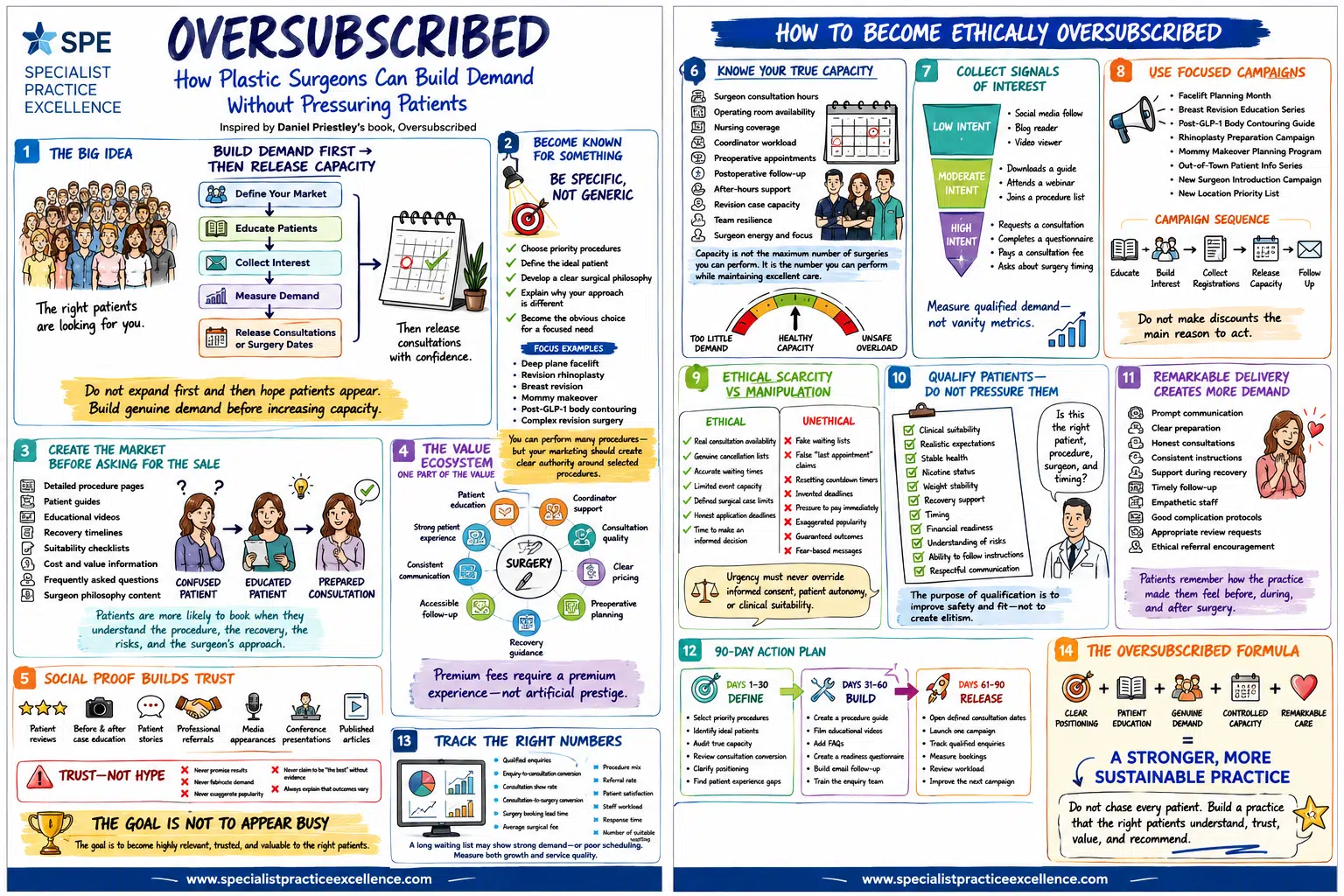
A successful plastic surgery practice does not need to perform the most procedures, offer the lowest fees, or appeal to every patient. It needs to become highly relevant to the right patients.
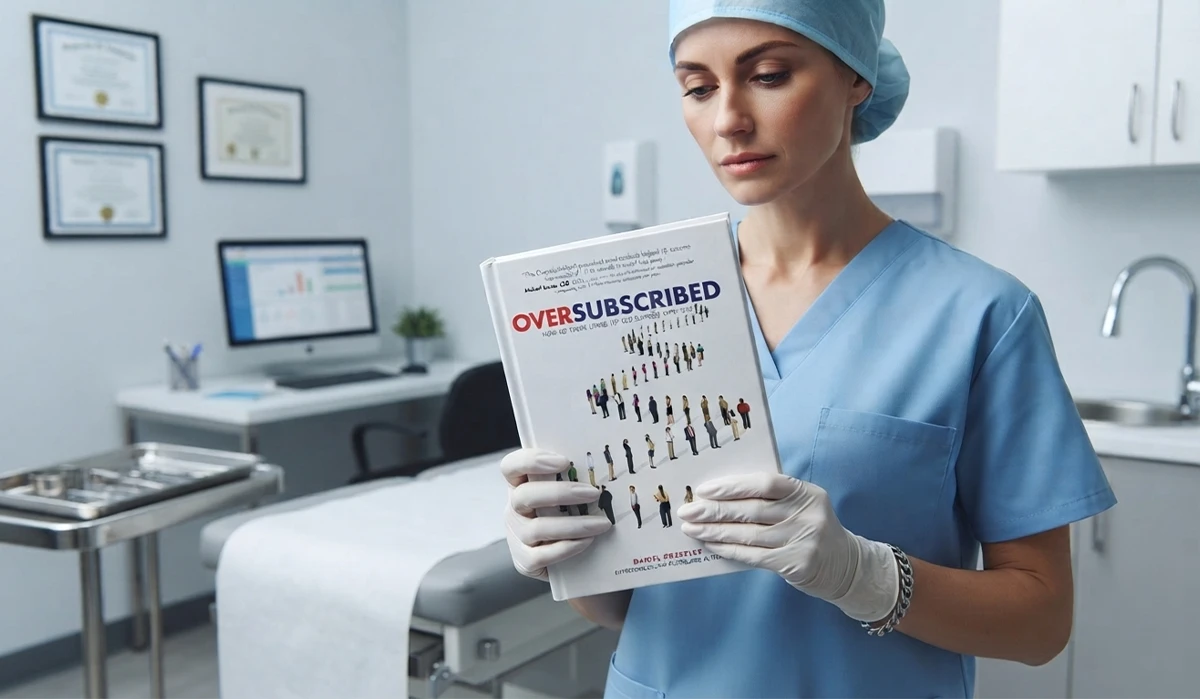
This is the central lesson behind Daniel Priestley’s book, Oversubscribed: How to Get People Lining Up to Do Business with You.
The book challenges a common business assumption: that a practice should first create more capacity and then search for enough customers to fill it.
Priestley recommends reversing the process. Build demand first. Measure that demand. Then release a controlled amount of capacity.
For an aesthetic plastic surgeon, this may mean creating more demand for:
- Facelift consultations
- Rhinoplasty assessments
- Breast revision surgery
- Mommy makeover consultations
- Post-weight-loss body contouring
- Post-GLP-1 surgery
- Revision procedures
- A new clinic location
- A newly recruited associate surgeon
- A limited number of operating dates
This does not mean manufacturing false scarcity or pushing patients into surgery.
Elective surgery requires informed consent, realistic expectations, careful clinical assessment, and adequate time for patients to consider their options.
The goal is not to make patients feel anxious about missing out.
The goal is to build a practice that is clear, trusted, differentiated, clinically responsible, and genuinely in demand.
What Is Oversubscribed About?
The first edition of Oversubscribed was published by John Wiley & Sons in 2015. An expanded second edition was published in 2020 with additional material intended for the modern digital marketplace. The original edition contains chapters on demand and supply, differentiation, buying environments, capacity, campaign building, delivery, and innovation.
Priestley opens the book with familiar examples.
- Why do people wait months for a reservation at a popular restaurant?
- Why do customers preorder products before they are available?
- Why do tickets for certain events sell out within hours?
- Why will someone wait six months for one hairdresser when there are hundreds of alternatives?
In each case, the customer has many possible choices. However, demand is concentrated around one particular provider, product, personality, or experience.
Priestley summarizes the idea with the phrase:
“Don’t fight for customers; let them fight over you.”
The wording is intentionally provocative. In healthcare, patients should not literally be encouraged to compete for care. However, the underlying business principle is useful.
A plastic surgeon should aim to create more interest from suitable patients than the practice can responsibly accommodate.
When this happens, the practice gains several advantages:
- It can be more selective about patient suitability.
- It can avoid depending on discounts.
- It can maintain appropriate fees.
- It can protect the surgeon’s time.
- It can invest more in patient experience.
- It can plan operating capacity more accurately.
- It can attract patients who value the surgeon’s specific expertise.
- It becomes less dependent on any one advertising platform.
- It can say no to cases that are unlikely to produce a safe or satisfactory outcome.
According to Priestley, an oversubscribed business has more qualified demand than available capacity. It understands its ideal customers, communicates a distinct point of view, collects signs of interest, and releases its offering through structured campaigns rather than making an unlimited offer to everyone at all times.
Why This Book Is Relevant to Plastic Surgeons
Plastic surgery is naturally capacity-constrained.
A surgeon has a limited number of:
- Consultation hours
- Operating days
- Procedures that can safely be performed
- Complex cases that can be accepted
- Patients who can be followed properly during recovery
- Staff members available to deliver support
- Revision cases that can be managed at one time
- Out-of-town patients who can be coordinated effectively
Unlike a digital product, surgical capacity cannot be expanded without consequences.
A surgeon cannot safely double production in the same way an online retailer can double inventory.
Operating room access, staffing, recovery support, patient communication, follow-up appointments, and complication management must all grow with surgical volume.
This makes Priestley’s principle particularly relevant.
The business challenge is not simply to generate the largest possible number of leads. It is to create the right level of demand from the right type of patient for the right procedures.
An oversubscribed practice is therefore not necessarily the busiest practice.
It is a practice where:
- Qualified patients understand the surgeon’s value.
- Demand is stronger than available capacity.
- The practice does not need to chase every inquiry.
- The surgeon can prioritize suitable patients.
- Fees reflect expertise, service, complexity, and capacity.
- Patients receive enough education to make informed decisions.
- The team can deliver a consistent experience.
- The schedule is full without becoming unsafe or chaotic.
The Most Important Lesson: Demand and Supply Influence Price
One of the book’s main chapter titles is:
“Demand and Supply Set the Price.”
The principle is simple.
When a service is widely available and demand is weak, providers tend to compete through price, promotions, convenience, or aggressive selling.
When demand is strong and capacity is limited, the provider has greater control over:
- Pricing
- Patient selection
- Scheduling
- Service standards
- Payment terms
- Practice policies
- The type of work accepted
This does not mean a surgeon should deliberately restrict care to raise prices.
It means the surgeon should understand that increasing capacity before demand exists often weakens the business.
Consider a surgeon who opens a second office, adds extra operating days, hires several new staff members, and buys an expensive device before confirming patient demand.
The practice now has higher overheads and more appointment availability.
The surgeon may feel pressure to fill that capacity by:
- Discounting procedures
- Accepting unsuitable patients
- Increasing advertising spend
- Offering unnecessary promotions
- Pressuring coordinators to close more cases
- Reducing consultation standards
- Promoting procedures that do not fit the surgeon’s core expertise
Priestley’s model suggests a better sequence:
- Identify the desired market.
- Develop a distinctive offer.
- Communicate the surgeon’s expertise.
- Educate prospective patients.
- Collect signs of interest.
- Measure qualified demand.
- Define safe capacity.
- Release appointments or operating dates.
- Deliver an exceptional experience.
- Expand only when demand remains strong.
For a plastic surgery practice, demand should be established before making major investments in new capacity.
First Make the Market, Then Make the Sale
Many practices begin marketing at the wrong point.
They immediately advertise:
- Book a consultation.
- Schedule your surgery.
- Reserve your operating date.
- Call today.
- Limited availability.
- Financing available.
These messages ask the patient to make a major decision before the practice has created enough understanding, trust, or perceived value.
Priestley argues that a business must first create its market.
In practical terms, a plastic surgeon creates a market by helping potential patients understand:
- What their concern may involve
- Which treatment options exist
- The differences between those options
- Who may or may not be a candidate
- What recovery is likely to involve
- What risks must be considered
- Why surgical approaches differ
- How to compare surgeons
- What questions to ask during a consultation
- Why the surgeon has chosen a particular approach
This is why educational marketing works so well for specialist medical practices.
A detailed article explaining deep plane facelift surgery may create more value than a generic advertisement saying, “Look younger today.”
A video comparing breast implant replacement, implant removal, and breast lift surgery may create more trust than a promotion offering reduced-price breast surgery.
A patient guide to post-GLP-1 body contouring may attract better-prepared patients than a broad “mommy makeover special.”
The practice is not merely promoting surgery.
It is helping create a more informed market.
The Only People Who Matter Are Your People
In his public explanation of the book’s principles, Priestley says that “the only people that matter are your people.” The point is not that other people have no value. It is that a business should focus its message on the people it is best equipped to serve.
Many plastic surgery practices weaken their positioning by trying to appeal to everyone.
Their websites list:
- Every facial procedure
- Every breast procedure
- Every body procedure
- Injectables
- Skin treatments
- Hair restoration
- Wellness
- Weight management
- Hormone services
- Medical spa treatments
A broad offering may make commercial sense for some large practices. However, a surgeon who wants to become highly sought after usually needs a clearer area of authority.
Examples include:
- Complex facelift and neck lift surgery
- Natural-result facial rejuvenation
- Primary rhinoplasty
- Revision rhinoplasty
- Breast revision surgery
- Breast implant removal and reshaping
- Post-pregnancy breast and body surgery
- Post-weight-loss body contouring
- High-definition body contouring
- Male chest contouring
- Revision body contouring
- Surgery for patients after significant GLP-1-related weight loss
A focused position makes it easier for prospective patients to answer a critical question:
Why should I choose this surgeon for my particular concern?
The surgeon does not need to stop performing other procedures.
The marketing focus simply becomes more precise.
Separate Yourself From the Market
One of the book’s core ideas is that oversubscribed businesses do not behave like interchangeable providers.
They establish their own position, language, standards, process, and point of view.
For plastic surgeons, this requires more than using words such as:
- Personalized
- Natural
- Caring
- Experienced
- Board-certified
- State-of-the-art
- Patient-centered
- Compassionate
- Bespoke
- World-class
These claims are so common that they rarely create meaningful separation.
Stronger differentiation is built through specifics.
A surgeon may explain:
- The types of patients they are best suited to treat
- The procedures they perform most often
- The cases they commonly decline
- Their approach to scars
- Their preferred anesthesia method
- Their philosophy on combining procedures
- Their approach to natural-looking results
- How they manage revisions
- Their safety protocols
- How they select techniques
- Their approach to follow-up
- How they handle out-of-town patients
- The limitations of surgery
- Their views on trends they do not support
Patients are more likely to remember a surgeon with a clear philosophy than one who provides a long list of generic claims.
Buying Environments Create Buyers
Another important idea in Oversubscribed is that people are influenced by the environment in which they make a decision.
The same service can appear more or less valuable depending on:
- Where it is presented
- How it is explained
- Who else is interested
- What evidence is available
- What process the patient experiences
- Whether the patient feels informed
- Whether the practice appears organized
- Whether the team communicates consistently
- Whether the surgeon’s expertise is easy to understand
For a plastic surgery practice, the buying environment includes much more than the consultation room.
It includes:
- Google search results
- The practice website
- Surgeon biography pages
- Online reviews
- Social media
- Videos
- Before-and-after photographs
- Phone calls
- Text messages
- Email follow-up
- Consultation guides
- Appointment confirmation
- The reception area
- The coordinator meeting
- The written quote
- Follow-up after consultation
A premium surgical fee presented through a poor website, rushed phone call, confusing quote, and inconsistent follow-up will feel expensive.
The same fee presented through a clear educational journey, professional team, detailed consultation, transparent quote, and strong postoperative program may feel more reasonable.
Price is interpreted within an environment.
People Buy What Other People Want
Patients are influenced by evidence that other people trust the surgeon.
This may include:
- Online reviews
- Word-of-mouth referrals
- Patient stories
- Before-and-after photographs
- Media interviews
- Speaking engagements
- Publications
- Professional leadership
- Peer referrals
- Conference presentations
- Long consultation waiting times
- Fully booked operating schedules
However, popularity is not proof of clinical quality.
A large social media following does not establish surgical competence.
A long waiting list does not guarantee an appropriate outcome.
Positive reviews cannot replace informed consent or an individualized clinical assessment.
The American Society of Plastic Surgeons requires advertising by its members to be truthful and accurate. Its guidance prohibits misleading claims, exaggerated statements, guarantees, appeals to emotional vulnerability, and unsubstantiated claims of superiority. It also addresses the responsible presentation of testimonials and before-and-after images.
Therefore, social proof should demonstrate trust without implying certainty.
Better examples include:
- “Read what patients say about their experience with our team.”
- “View examples of individual patient results.”
- “Results vary, and surgery may not be suitable for every patient.”
- “These photographs show individual outcomes and do not guarantee a similar result.”
- “The surgeon will discuss the likely benefits and limitations during your consultation.”
Poor examples include:
- “The best facelift surgeon in America.”
- “Guaranteed natural results.”
- “Our patients always love their outcome.”
- “The number one breast surgeon.”
- “You will look 20 years younger.”
- “Book now before it is too late.”
People Spend More to Solve an Important Problem
Patients do not evaluate every procedure in the same way.
A minor concern may create mild interest.
A problem that affects confidence, comfort, clothing, relationships, daily activities, or quality of life may carry greater emotional and practical importance.
This does not give the practice permission to intensify a patient’s insecurity.
It means the team should understand why the issue matters to the patient.
For example, a patient considering abdominal surgery may not simply want a flatter stomach. She may want to:
- Feel more comfortable in fitted clothing
- Address tissue changes after pregnancy
- Improve symptoms related to excess skin
- Feel more at ease during exercise
- Restore a sense of physical proportion
- Mark a new phase after major weight loss
A facelift patient may not simply want fewer wrinkles. She may feel that her face no longer reflects her energy or identity.
A male gynecomastia patient may have avoided swimming, changing rooms, or close-fitting clothing for years.
The consultation should explore these motivations without promising that surgery will transform the patient’s entire life.
Good questions include:
- What concerns you most?
- How long have you been considering surgery?
- What would a satisfactory improvement look like?
- Are there particular situations where this concern affects you?
- What worries you about having surgery?
- What would make you decide not to proceed?
- How would you feel if the result were an improvement rather than perfection?
Value Is Created in an Ecosystem
Priestley argues that value is not created by the main product alone.
It is created by the wider ecosystem surrounding it.
For a surgeon, the operation is the core clinical service. However, the patient evaluates the complete journey.
The practice ecosystem may include:
Before the consultation
- Educational articles
- Videos
- Downloadable procedure guides
- Price-range information
- Recovery information
- Patient suitability tools
- Frequently asked questions
- Telephone support
- Consultation preparation materials
During the consultation process
- A professional coordinator
- Medical history review
- Surgeon assessment
- Clear explanation of alternatives
- Imaging or photography
- Before-and-after case discussion
- Written information
- Transparent pricing
- Risk discussion
- Time to ask questions
Before surgery
- Preoperative instructions
- Medical clearance coordination
- Medication guidance
- Recovery planning
- Garment information
- Transportation guidance
- Caregiver instructions
- Hotel or travel support
- Anesthesia information
After surgery
- Accessible clinical support
- Scheduled follow-up
- Clear warning signs
- Recovery milestone guidance
- Scar care information
- Emotional reassurance
- Long-term photography
- Revision policies
- Ongoing patient communication
The patient is not buying only operating room time.
The patient is choosing an ecosystem of expertise, communication, planning, safety, and follow-up.
Know Your Capacity
This is one of the most useful parts of Oversubscribed for a surgical practice.
Before trying to create more demand, the surgeon must know the practice’s actual capacity.
Capacity is not simply the number of open spaces on the operating schedule.
It should include:
- Surgeon operating hours
- Surgeon consultation hours
- Operating room access
- Anesthesia availability
- Nursing coverage
- Recovery room capacity
- Patient coordinator capacity
- Preoperative appointment capacity
- Postoperative appointment capacity
- After-hours support
- Revision case management
- Clinical photography
- Instrument and equipment availability
- Staff resilience
- Surgeon energy and focus
A surgeon may technically be able to perform five major procedures in a week.
However, if the practice cannot provide timely follow-up, answer patient questions, prepare documentation, and manage recovery concerns, five cases may exceed responsible capacity.
Capacity should be based on the standard of care the practice intends to provide.
A Simple Plastic Surgery Capacity Calculation
A practice can begin with four numbers:
Maximum safe annual surgical capacity
How many procedures can the surgeon and team manage without weakening clinical care or patient experience?
Desired procedure mix
How many facelift, rhinoplasty, breast, or body cases should be included?
Consultation-to-surgery conversion rate
What percentage of completed consultations proceed to surgery?
Consultation show rate
What percentage of scheduled consultations attend?
For example, assume a surgeon wants to perform 180 major aesthetic procedures per year.
If 45% of completed consultations convert to surgery, the surgeon needs approximately 400 completed consultations.
If 85% of booked consultation patients attend, the practice needs approximately 471 consultation bookings.
This is not a sales target that should override clinical suitability.
It is a planning model.
The practice can then assess whether it has:
- Enough qualified inquiries
- Enough consultation availability
- Enough operating capacity
- Enough staffing
- Enough follow-up capacity
- The right procedure mix
Build Demand Before Releasing Capacity
Priestley recommends collecting signals of interest before asking for a sale.
A signal may include:
- Joining a waiting list
- Registering for an event
- Downloading a guide
- Completing a questionnaire
- Requesting an appointment
- Watching a webinar
- Replying to an email
- Attending a virtual information session
- Completing a patient readiness assessment
The second edition of Oversubscribed emphasizes signalling to the market and collecting signals back before a release.
For a plastic surgery practice, these signals should be separated by level of intent.
Low-intent signals
- Following the surgeon
- Reading a blog
- Watching a short video
- Opening an email
Moderate-intent signals
- Downloading a surgical guide
- Attending a webinar
- Completing a procedure quiz
- Joining a procedure-specific email list
High-intent signals
- Requesting a consultation
- Providing medical history information
- Submitting photographs through a secure process
- Paying a consultation fee
- Asking about specific operating dates
- Requesting financing information
A social media follower is not the same as a qualified surgical inquiry.
A qualified inquiry is not the same as a clinically suitable patient.
A suitable patient is not the same as a patient who is emotionally, financially, and practically ready for surgery.
Good demand measurement accounts for these differences.
Campaign-Driven Marketing
Many practices use constant, unfocused promotion.
Every week contains a new post, offer, email, or message, but nothing builds toward a specific outcome.
Priestley favors structured campaigns.
A campaign has:
- A defined audience
- A specific problem
- A clear educational theme
- A start date
- A period of audience building
- A genuine capacity limit
- A defined opportunity to act
- A follow-up process
- A delivery stage
- A review stage
For plastic surgery, a campaign should not be built around impulsive urgency.
It should be built around education and planning.
Ethical Campaign Ideas for Plastic Surgeons
Facelift Planning Campaign
Audience: Women and men considering facial rejuvenation within the next 6 to 18 months.
Educational content:
- Facelift versus nonsurgical treatment
- Deep plane versus other facelift approaches
- Neck lift considerations
- Recovery milestones
- Scarring
- Anesthesia
- How to choose a surgeon
- When to begin planning before a major event
Call to action: Request a consultation or join a future consultation notification list.
Post-GLP-1 Body Contouring Campaign
Audience: Patients who have lost significant weight with GLP-1 medications and have maintained a stable weight.
Educational content:
- Weight stability
- Nutrition
- Skin excess
- Staging procedures
- Breast and body changes
- Recovery planning
- Medical optimization
- Realistic expectations
Call to action: Complete a body-contouring readiness assessment.
Breast Revision Education Campaign
Audience: Patients experiencing implant concerns, changes over time, dissatisfaction, or uncertainty about future options.
Educational content:
- Implant replacement
- Implant removal
- Breast lift
- Capsular contracture
- Implant position
- Rupture
- Revision limitations
- Questions to ask during consultation
Call to action: Request a specialist breast revision consultation.
Rhinoplasty Preparation Campaign
Audience: Patients considering primary or revision rhinoplasty.
Educational content:
- Functional and aesthetic concerns
- Facial balance
- Skin thickness
- Healing time
- Swelling
- Revision risk
- Breathing
- Expectations
- Photography
Call to action: Join a rhinoplasty consultation priority list.
Mommy Makeover Planning Campaign
Audience: Patients who have completed pregnancy and may be considering breast and abdominal surgery.
Educational content:
- Family planning
- Weight stability
- Breastfeeding
- Procedure combinations
- Recovery support
- Childcare
- Lifting restrictions
- Timing
- Safety
Call to action: Download the planning guide and request a consultation.
Out-of-Town Patient Campaign
Audience: Patients traveling from another city or state.
Educational content:
- Virtual screening
- Required length of stay
- Caregiver needs
- Travel restrictions
- Hotel planning
- Follow-up
- Complication planning
- When flying may be permitted
Call to action: Submit an out-of-town inquiry.
New Surgeon Introduction Campaign
Audience: Existing patients and new prospects when an associate joins the practice.
Educational content:
- Qualifications
- Surgical interests
- Treatment philosophy
- Procedures offered
- Availability
- Relationship with the senior surgeon
- Oversight and practice standards
Call to action: Request an appointment with the new surgeon.
This can help build demand before the associate’s full schedule is opened.
New Location Campaign
Instead of opening a location and hoping patients arrive, the practice can:
- Announce the proposed location.
- Ask local prospects to register interest.
- Promote an educational event.
- Collect procedure interests.
- Measure qualified demand.
- Offer an initial block of consultations.
- Expand only when demand is demonstrated.
Release Capacity Only When the Market Is Ready
An oversubscribed campaign has a specific release stage.
For a plastic surgery practice, this might include:
- Opening a new block of consultation dates
- Releasing a limited number of operating dates
- Announcing a new surgeon’s schedule
- Opening registrations for a patient education event
- Inviting suitable candidates to an assessment day
- Offering cancellation appointments to a genuine waitlist
The release should be accurate and transparent.
Suitable wording includes:
- “We have opened additional facelift consultation dates for September.”
- “Patients on our priority notification list will receive the scheduling link first.”
- “The surgeon currently performs a defined number of revision cases each month.”
- “We have reached capacity for this educational event.”
- “Additional dates will be announced when confirmed.”
- “Joining the list does not guarantee candidacy or an appointment.”
Avoid false urgency, such as:
- “Only one appointment left” when more appointments are available.
- Countdown timers that reset.
- Repeated “final chance” emails.
- Claiming a schedule is full when it is not.
- Suggesting that a patient will lose access to care.
- Pressuring patients to pay immediately.
- Using a discount deadline to rush consent.
Remarkable Delivery Beats More Advertising
One of Priestley’s most valuable ideas is that businesses become more desirable when customers talk about them.
A larger advertising budget cannot permanently compensate for an average patient experience.
For plastic surgery practices, remarkable delivery does not mean offering luxury gifts or expensive décor.
It means managing the details that matter to patients.
Examples include:
- Returning inquiries promptly
- Explaining the process before discussing fees
- Preparing the patient for the consultation
- Starting appointments on time
- Giving clear written instructions
- Answering difficult questions honestly
- Coordinating medical clearance
- Checking in during early recovery
- Responding appropriately to concerns
- Avoiding contradictory advice
- Showing empathy without overpromising
- Maintaining privacy
- Remembering important personal details
- Making the patient feel supported after payment has been made
The objective is not merely a satisfied patient.
It is a patient who says:
- “The team was organized.”
- “I knew what to expect.”
- “They never pressured me.”
- “The surgeon was honest.”
- “The recovery information was excellent.”
- “I felt supported.”
- “The practice did what it said it would do.”
These comments create meaningful demand.
Ethical Scarcity Versus Manipulation
Scarcity is ethical when it reflects a real limitation.
Examples include:
- The surgeon has four consultation spaces available.
- Only 20 people can attend an in-person education event.
- The practice accepts a limited number of complex revisions.
- The operating room has no additional availability this month.
- The surgeon performs procedures only on defined days.
- The practice has opened a genuine cancellation appointment.
Manipulation occurs when scarcity is invented or exaggerated.
Examples include:
- Creating a false waiting list
- Claiming appointments are almost gone when they are not
- Giving patients an artificial deadline
- Hiding other available dates
- Using fear to encourage deposits
- Making surgery sound risk-free
- Suggesting that a patient needs to decide before obtaining another opinion
This distinction is especially important in aesthetic medicine because patients may be emotionally vulnerable.
ASPS advertiser guidance warns members against exaggerated claims, unjustified expectations, appeals to fear or anxiety, misleading images, and guarantees of favorable outcomes.
The FTC also requires endorsements and testimonials to reflect truthful experiences and not create a misleading overall impression. Material relationships or compensation connected with an endorsement must be disclosed appropriately.
HIPAA and Patient Marketing
Patient lists and medical information must be handled carefully.
The HIPAA Privacy Rule gives patients controls over how protected health information is used or disclosed for marketing. In many circumstances, written authorization is required before protected health information can be used for marketing, although the rules include exceptions for certain communications about a provider’s own services, treatment, and care coordination.
Practices should not assume that because a patient previously received care, every later promotional use of that patient’s information is permitted.
Before running a campaign, review:
- How the list was collected
- What the patient consented to receive
- Whether protected health information is being used
- Which CRM or email platform stores the data
- Whether appropriate business associate agreements are in place
- Whether patients can unsubscribe
- Whether text messaging consent was obtained
- Whether state privacy rules add further requirements
Marketing rules also vary by state. Practices should seek appropriate legal and compliance guidance for their particular location and campaign.
How to Build a Genuine Plastic Surgery Waiting List
A waiting list should not be a collection of unqualified names.
It should contain defined groups.
General education list
People who want articles, videos, practice news, and patient education.
Procedure interest list
People interested in one procedure, such as facelift or breast revision surgery.
Consultation notification list
People who want to know when new consultation dates become available.
Consultation cancellation list
Patients prepared to accept an earlier consultation if another patient cancels.
Surgical cancellation list
Clinically approved patients who have completed the required steps and may be able to take an earlier date.
Future surgery list
Patients planning surgery six months or more into the future.
Medical optimization list
Potential patients who must address smoking, weight stability, medical clearance, or another issue before candidacy can be reconsidered.
The practice should record:
- Procedure of interest
- Preferred timing
- Location
- Readiness
- Consultation status
- Clinical suitability status
- Communication consent
- Travel requirements
- Previous contact
- Next follow-up date
- Assigned team member
A waiting list should improve service, not merely create an appearance of popularity.
Patient Qualification Without Arrogance
Becoming oversubscribed allows a practice to select patients more carefully.
However, patient selection should be based on safety, suitability, expectations, and the surgeon’s scope of expertise.
It should not be based on status or social prestige.
Qualification factors may include:
- Medical history
- Smoking or nicotine use
- Weight stability
- Procedure goals
- Expectations
- Recovery support
- Ability to follow instructions
- Understanding of risks
- Psychological readiness
- Timing
- Travel plans
- Previous surgery
- Communication and behavior
- The surgeon’s ability to produce a meaningful improvement
Useful qualification questions include:
- What procedure are you considering?
- What concerns would you like the surgeon to assess?
- When are you hoping to have surgery?
- Have you previously consulted another surgeon?
- Have you had surgery in this area before?
- Are you currently using nicotine?
- Has your weight been stable?
- Do you have support during recovery?
- Are you planning around a major event?
- What outcome would you consider successful?
- Are there aspects of surgery or recovery that concern you?
The coordinator should not make a clinical decision.
The purpose of preliminary qualification is to prepare the surgeon and identify obvious logistical or policy issues.
How Enquiry Teams Should Communicate High Demand
A busy practice can easily sound arrogant.
Compare these two responses.
Poor response
“Dr. Smith is extremely popular. You will have to wait four months. That is just how it is.”
Better response
“Dr. Smith’s next standard consultation is currently in November. I understand that may be later than you hoped. I can reserve the next available appointment and also add you to our cancellation list. May I ask about your preferred timing so I can explain the most suitable options?”
High demand should be communicated as useful information, not as a status symbol.
When the patient asks why the surgeon is booked
“Dr. Smith limits the number of consultations and surgical procedures performed each month so the team can provide appropriate preparation and follow-up. I can explain the current timing and help you decide whether it fits your plans.”
When the patient asks for an earlier consultation
“I can add you to the cancellation list. Earlier appointments cannot be guaranteed, but we will contact you if an appropriate time becomes available.”
When the patient asks for a discount
“Our fees reflect the surgeon’s time, the operating facility, anesthesia, clinical support, and follow-up included in your treatment plan. We do not normally reduce the surgical fee, but I can review the quote with you and explain each component.”
When no surgical dates are currently available
“The current operating schedule is fully allocated. Once you have completed your consultation and the surgeon has confirmed that surgery is appropriate, we can discuss future dates and genuine cancellation options.”
Premium Pricing Without Artificial Prestige
An oversubscribed practice can often maintain higher fees because patients have more evidence of value and fewer concerns about whether the surgeon is the right choice.
Premium pricing may be supported by:
- Specialized expertise
- Complex case experience
- Board certification
- Advanced training
- Strong patient education
- High-quality facilities
- Experienced staff
- Detailed preoperative planning
- Comprehensive follow-up
- Limited surgeon capacity
- Consistent practice systems
- A strong reputation
- The ability to handle revisions
- A distinctive surgical philosophy
A high price alone does not create a premium practice.
Raising fees without improving the value ecosystem may simply reduce conversion.
Patients should understand what the fee includes and what makes the experience different.
The practice should avoid implying that the highest-priced surgeon always provides the best outcome.
A 90-Day Oversubscribed Practice Plan
Days 1–30: Define the Market and Capacity
Review:
- The five most important procedures
- The procedures the surgeon wants to grow
- Current inquiry volume
- Consultation volume
- Consultation show rate
- Conversion rate
- Operating room capacity
- Average lead time
- Cancellation rate
- Most profitable procedures
- Most satisfying procedures
- Cases the surgeon does not want
- Current patient experience gaps
Create:
- A clear ideal-patient profile
- A surgical capacity model
- A procedure priority list
- A positioning statement
- A list of common patient concerns
- A list of missing educational assets
Days 31–60: Build the Market
Create one focused campaign around a priority procedure.
Develop:
- A detailed procedure page
- A downloadable patient guide
- Five educational videos
- Ten frequently asked questions
- A patient readiness questionnaire
- A follow-up email sequence
- A consultation preparation guide
- A procedure-specific interest list
- Call and text response templates
Train the team to explain:
- Who may be suitable
- Typical consultation timing
- Consultation fees
- Recovery requirements
- Genuine availability
- The surgeon’s approach
- The next step
Days 61–90: Release and Measure
Open a defined number of:
- Consultations
- Virtual assessments
- Educational event seats
- New-surgeon appointments
- Future operating dates
Track:
- Campaign reach
- Guide downloads
- Questionnaire completions
- Qualified inquiries
- Consultation bookings
- Attendance
- Clinical suitability
- Surgery bookings
- Reasons patients do not proceed
- Patient feedback
- Staff workload
Then review whether the campaign created:
- More demand
- Better-qualified patients
- Stronger conversion
- Greater fee acceptance
- Better scheduling
- Excessive pressure on the team
- Service delays
- New capacity problems
Key Performance Indicators
An oversubscribed practice should monitor more than revenue.
Useful measures include:
- Qualified inquiries per month
- Inquiry response time
- Inquiry-to-consultation conversion
- Consultation show rate
- Consultation cancellation rate
- Consultation-to-surgery conversion
- Average surgical fee
- Average time from inquiry to consultation
- Average time from consultation to surgery
- Number of approved patients waiting for dates
- Operating room utilization
- Revenue per operating day
- Procedure mix
- Referral rate
- Review volume
- Website conversion rate
- Email engagement
- Campaign registration rate
- Event attendance
- Cost per qualified inquiry
- Staff overtime
- Patient satisfaction
- Complaint rate
- Postoperative communication response time
A long waiting time is not automatically a positive result.
It may indicate:
- Insufficient consultation capacity
- Poor scheduling
- Slow communication
- Inadequate staffing
- Limited operating room access
- Weak use of associate surgeons
- Too many unsuitable inquiries
- Poor patient segmentation
The goal is controlled demand, not operational dysfunction.
Common Mistakes When Applying Oversubscribed
Creating false scarcity
Only communicate real limits.
Confusing popularity with clinical quality
Use evidence of qualifications, experience, safety, and patient care.
Accepting too many patients
Protect follow-up capacity and surgeon energy.
Expanding before measuring demand
Test interest before adding major overhead.
Discounting to fill capacity
Improve positioning, education, and qualification first.
Trying to appeal to everyone
Choose priority procedures and patient groups.
Building demand without improving service
Prepare the team before increasing inquiry volume.
Treating every lead as equal
Separate general interest from high-intent, qualified inquiries.
Using aggressive urgency
Give patients time to consider elective surgery.
Making unsupported superiority claims
Avoid terms such as “best,” “number one,” or “leading” unless they can be properly substantiated and used in compliance with applicable rules.
Overusing testimonials
Patient stories should not imply guaranteed or typical results when that cannot be supported.
Failing to explain risks
Education should include limitations, recovery, risks, and alternatives.
Focusing only on new patients
Existing patients and referring professionals can be powerful sources of demand.
Ignoring team capacity
Marketing success can expose operational weaknesses.
Believing that a waiting list fixes every problem
A waiting list is useful only when it is accurate, organized, segmented, and actively managed.
The Best Ideas From the Book for Plastic Surgeons
The most useful lessons are:
- Build demand before adding capacity.
- Become known for something specific.
- Focus on the patients you are best able to serve.
- Create education before asking patients to book.
- Define the practice’s real capacity.
- Collect signals of interest.
- Use focused campaigns.
- Release genuine availability at defined times.
- Protect the patient experience.
- Make the complete care ecosystem remarkable.
- Use social proof responsibly.
- Avoid discount-driven demand.
- Expand only when demand is proven.
- Measure quality as well as volume.
- Give the team systems for managing increased interest.
A Balanced Assessment of Oversubscribed
Oversubscribed is a valuable strategy book for plastic surgeons, but its ideas must be adapted carefully.
The book is strongest when discussing:
- Demand and supply
- Differentiation
- Capacity
- Campaigns
- Positioning
- Market signals
- Patient selection
- Remarkable delivery
The ideas become riskier when scarcity, urgency, or social influence are applied without considering medical ethics.
A consumer may make an impulsive decision about a concert ticket.
A patient should not make an impulsive decision about surgery.
For that reason, plastic surgeons should use Priestley’s principles to improve:
- Education
- Market positioning
- Demand forecasting
- Patient qualification
- Capacity management
- Service delivery
They should not use the principles to weaken:
- Informed consent
- Clinical independence
- Patient autonomy
- Risk communication
- Cooling-off time
- The patient’s right to obtain another opinion
Frequently Asked Questions
A surgeon should not manufacture a waiting list. However, a genuine priority or cancellation list can help the practice manage limited availability and offer earlier appointments fairly.
Some patients may interpret a long wait as evidence of demand, but waiting time does not prove clinical quality. Excessive delays may damage patient experience and cause suitable patients to seek care elsewhere.
It can be ethical when the scarcity is genuine and communicated accurately. It becomes inappropriate when the practice invents deadlines, exaggerates demand, or pressures patients to decide quickly.
Yes, but the surgeon must first build a focused position, publish useful education, develop referral relationships, and demonstrate expertise. New surgeons should concentrate demand around a defined procedure or patient group.
Fees can be reviewed when demand, expertise, service, overhead, and capacity change. Increases should reflect real value rather than an attempt to make the practice appear more exclusive.
A reasonable consultation fee may reduce low-intent bookings and protect the surgeon’s time. The practice should clearly explain what the consultation includes and avoid presenting the fee as a status symbol.
Yes. Search visibility, patient referrals, professional referrals, educational articles, email communication, events, media coverage, and a strong reputation can all create demand.
Usually not. Marketing should continue to build authority, educate future patients, support priority procedures, and maintain the practice’s reputation. The focus may shift from immediate lead generation to long-term demand.
Use practical timelines rather than emotional pressure. Explain real consultation availability, recovery periods, travel requirements, and event planning while encouraging the patient to take enough time to decide.
Slow response times and poor communication may damage the practice. Capacity planning, automated education, defined ownership, call scripts, and CRM follow-up should be established before the campaign begins.
Yes. Demand is often procedure-specific. A surgeon may have a long wait for revision rhinoplasty while still having availability for other procedures.
This can be useful when the information is kept accurate. The practice should also explain cancellation options and avoid presenting the waiting time as proof of superior results.
Begin with patient education, suitability information, surgeon training, safety considerations, and expressions of interest. Do not buy large amounts of capacity or equipment until genuine demand has been tested.
Sometimes. A surgeon should decline patients who are unsuitable, have unrealistic expectations, require expertise the surgeon does not provide, or cannot safely undergo the planned procedure.
Choose one priority procedure, define the ideal patient, create a detailed educational guide, build a procedure-specific interest list, and measure demand before releasing additional consultation or operating capacity.
Final Thoughts
The objective of becoming oversubscribed is not to make patients compete for surgery.
It is to become the clear and trusted choice for a defined group of suitable patients.
For a plastic surgeon, this requires:
- Focused positioning
- Genuine expertise
- Patient education
- Accurate marketing
- Strong qualification
- Controlled capacity
- Transparent communication
- Excellent clinical care
- A remarkable patient experience
The practice should not attempt to create the appearance of being busy.
It should create enough real value that the right patients are willing to wait, travel, pay an appropriate fee, and follow the practice’s process.
When applied responsibly, the ideas in Oversubscribed can help a plastic surgeon move away from discounting, generic advertising, and constant lead chasing.
The result is a healthier practice with better-prepared patients, stronger demand, more control over capacity, and a team that can focus on delivering excellent care.
Specialist Practice Excellence helps plastic surgeons improve positioning, patient acquisition, consultation conversion, team performance, and the systems needed to support sustainable practice growth.
The strongest practices do not simply generate more leads.
They create more informed demand from patients they are genuinely equipped to help.