How Plastic Surgeons Can Create Standout Patient Experiences Without Compromising Care
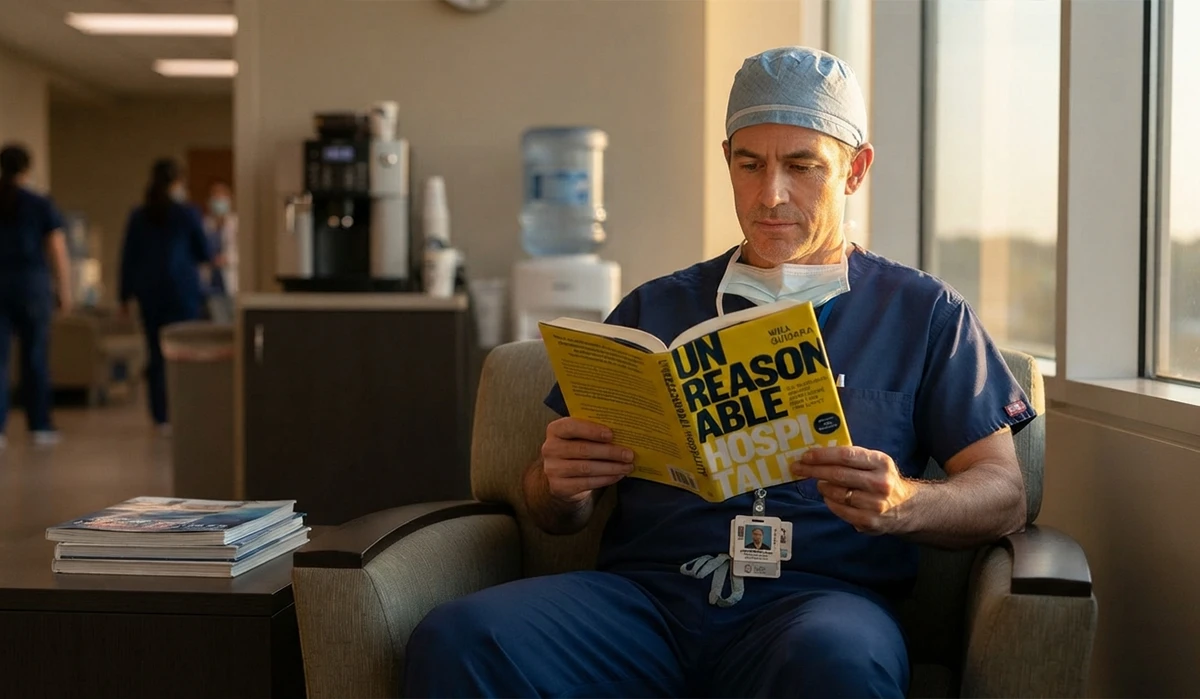
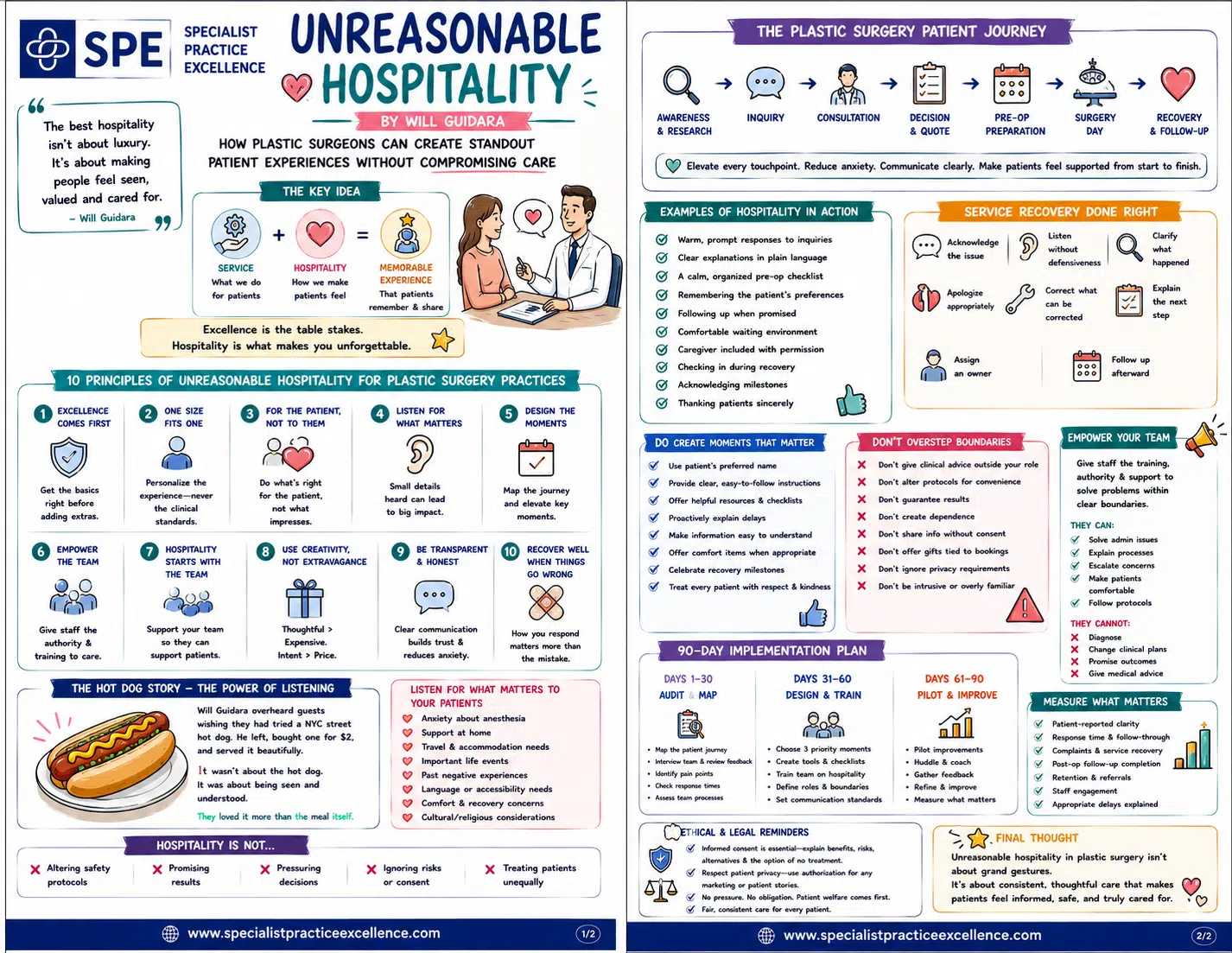
Unreasonable Hospitality by Will Guidara offers practical lessons for creating standout patient experiences through thoughtful, reliable and patient-centred care.
A plastic surgery practice may deliver technically excellent care and still provide an ordinary, inconsistent, or stressful patient experience.
The surgeon may be highly qualified. The facility may be well equipped. The procedure may be carefully planned. Yet patients can still feel overlooked when:
- Calls are not returned promptly.
- Staff give conflicting information.
- Instructions are difficult to understand.
- The practice forgets an important personal concern.
- Patients do not know whom to contact after surgery.
- Delays are not explained.
- The team treats the patient journey as a sequence of transactions rather than a human experience.
Will Guidara’s Unreasonable Hospitality: The Remarkable Power of Giving People More Than They Expect argues that organizations become memorable when they combine operational excellence with thoughtful, personal care.
Guidara developed the philosophy while leading Eleven Madison Park in New York. Under his leadership, the restaurant moved from an underperforming brasserie to an establishment named the best restaurant in the world. The book was published in 2022 and presents lessons that Guidara believes can be applied well beyond restaurants.
For plastic surgeons, the book is not a guide to providing extravagant gifts or turning healthcare into entertainment. Its strongest lesson is much simpler:
Every interaction is an opportunity to make a person feel seen, informed, supported, and cared for.
However, hospitality in a medical setting must operate within strict limits. Patient safety, informed consent, privacy, fairness, professional boundaries, and clinical judgment must always come before delight, convenience, marketing, or loyalty.
Used responsibly, the ideas in Unreasonable Hospitality can help a plastic surgery practice:
- Improve the patient journey
- Strengthen communication
- Reduce anxiety and uncertainty
- Create more consistent service
- Empower staff to solve problems
- Build a culture of thoughtful care
- Improve patient retention and referrals
- Differentiate the practice through experience rather than pressure
The objective is not to overwhelm patients with expensive surprises.
It is to design a practice where people consistently feel that the team noticed what mattered to them.
What Is Unreasonable Hospitality About?
The central argument of the book is that any organization can choose to behave like a hospitality business.
Hospitality is not limited to hotels or restaurants. It is the intentional act of making people feel welcome, known, valued, and cared for. Guidara’s current organization describes this philosophy as using creativity and intention to transform relationships with the people an organization serves and employs.
The book distinguishes between delivering the basic service and creating the emotional experience surrounding that service.
For a restaurant:
- Service is taking the order accurately and delivering the food.
- Hospitality is how the guest feels during the experience.
For a plastic surgery practice:
- Service includes answering an inquiry, booking a consultation, issuing a quotation, scheduling surgery, and providing instructions.
- Hospitality is whether the patient feels listened to, respected, prepared, safe, and supported throughout those interactions.
A practice can complete every administrative task and still leave the patient feeling confused or unimportant.
Conversely, small and thoughtful acts can make a complex medical journey feel far more manageable.
Who Is Will Guidara?
Will Guidara is a restaurateur, author, and former co-owner of Eleven Madison Park. He became its general manager at age 26 and helped lead its transformation into one of the world’s most highly recognized restaurants. He later wrote Unreasonable Hospitality, founded the Welcome Conference, and became involved as a co-producer of The Bear.
His experience was in hospitality rather than healthcare. This means his principles must be adapted rather than copied directly.
A luxury restaurant can improvise freely around food, gifts, entertainment, and celebrations. A medical practice must account for:
- Clinical suitability
- Patient vulnerability
- Privacy
- Documentation
- Regulatory obligations
- Informed consent
- Consistency of care
- Financial transparency
- Professional boundaries
The relevant question is not:
How can a clinic behave like a fine-dining restaurant?
It is:
How can a clinic apply the same level of attention, creativity, and intentional care while preserving medical professionalism?
The Hot Dog Story: Listen for What Matters
The most famous story in Unreasonable Hospitality involves four visitors dining at Eleven Madison Park.
Guidara overheard the group discussing their trip to New York. They had eaten at several leading restaurants but regretted that they had not tried a New York street hot dog.
Guidara left the restaurant, purchased a two-dollar hot dog, returned, and persuaded the kitchen to plate it carefully before serving it as a surprise. The diners reportedly reacted more enthusiastically to that simple, personal gesture than to many expensive dishes. Guidara describes the moment as a turning point in how he understood hospitality.
The lesson was not that every guest needed a hot dog.
The lesson was that the team had listened closely enough to recognize what would make those particular guests feel understood.
Application to Plastic Surgery
A plastic surgery practice should not attempt to create theatrical surprises during clinical care. It can apply the listening principle in quieter, more appropriate ways.
A patient may mention that:
- They are anxious about anesthesia.
- They have difficulty reading long instructions.
- English is not their first language.
- Their partner will manage postoperative care.
- They have young children at home.
- They are traveling from another state.
- They are worried about sleeping after surgery.
- They have an important cultural or religious consideration.
- They have previously felt dismissed by a medical practice.
The team can respond by adapting the experience.
Examples might include:
- Arranging a separate anesthesia discussion
- Providing a simplified recovery checklist
- Including the caregiver in approved education
- Preparing a travel timeline
- Highlighting medication instructions clearly
- Confirming accessibility needs
- Giving the patient one named contact for administrative questions
- Scheduling additional explanation where clinically appropriate
The “hot dog moment” in a medical practice is rarely an expensive gift.
It is often evidence that someone listened.
Service Versus Hospitality
Service is the technical delivery of what the patient is entitled to receive.
Hospitality is the care and consideration surrounding that delivery.
Service in a Plastic Surgery Practice
- Answering the phone
- Booking an appointment
- Sending forms
- Providing a quotation
- Taking photographs
- Scheduling surgery
- Giving postoperative instructions
- Conducting follow-up appointments
Hospitality in a Plastic Surgery Practice
- Explaining what will happen before the patient asks
- Using the patient’s preferred name
- Acknowledging anxiety rather than dismissing it
- Explaining a delay
- Checking whether the caregiver understands the plan
- Contacting the patient when promised
- Remembering the patient’s main concern
- Making complicated information easier to use
- Ensuring the patient knows where to seek help
Hospitality cannot compensate for weak clinical care.
A friendly team that provides inaccurate instructions is not delivering an excellent experience. The clinical and operational fundamentals must be reliable before the practice adds personal touches.
Principle 1: Excellence Comes Before Extras
A major risk in applying this book is focusing on memorable gestures before fixing basic service failures.
A handwritten card does not compensate for:
- A missed clinical call
- Incorrect instructions
- Poor documentation
- Confusing pricing
- Inconsistent risk information
- Long unexplained delays
- Inadequate postoperative follow-up
- Unreturned messages
The foundation of unreasonable hospitality is disciplined execution.
Before creating special moments, the practice must reliably deliver:
- Accurate communication
- Clear responsibilities
- Timely follow-up
- Consistent patient education
- Safe escalation procedures
- Transparent quotations
- Appropriate documentation
- Respectful interactions
The experience must be clinically and operationally sound before it becomes distinctive.
Principle 2: One Size Fits One
Guidara frequently uses the phrase:
“One size fits one.”
His official newsletter uses the phrase to describe a personalized gesture that mattered because it was chosen for one particular person rather than a generic audience.
For plastic surgery practices, personalization does not mean changing clinical standards according to preference.
It means adapting appropriate aspects of communication and support.
Personalization May Include
- Preferred name and pronouns
- Preferred communication method
- Language and accessibility needs
- Travel requirements
- Caregiver involvement
- Work and family commitments
- Information format
- Anxiety triggers
- Previous healthcare experiences
- Recovery concerns
Personalization Must Not Include
- Altering safety protocols
- Omitting risks because the patient is anxious
- Providing clinically inappropriate treatment
- Bypassing consent requirements
- Making unsupported promises
- Offering unequal standards of clinical care
- Ignoring documented processes
A patient journey can be personalized without becoming inconsistent or unsafe.
The distinction is:
- Standardize what protects care.
- Personalize what improves understanding and comfort.
Principle 3: Hospitality Happens for the Patient, Not to the Patient
In a 2026 newsletter, Guidara described a host who abandoned an elaborate evening plan after noticing that the guests were exhausted and preferred a quiet night. He used the story to distinguish hospitality that happens to guests from hospitality that happens for them.
This distinction is important in plastic surgery.
A practice may create an impressive experience that the patient does not actually want.
Examples include:
- Excessive gifts
- Elaborate photography
- Frequent promotional messages
- Public celebration of the patient
- Involving family members without permission
- Sharing information the patient preferred to keep private
- Encouraging social-media participation
- Overly familiar communication
The practice may intend these actions as thoughtful. The patient may experience them as uncomfortable, intrusive, or pressuring.
Ask Before Assuming
Useful questions include:
- How would you prefer us to contact you?
- Would you like your caregiver included in this discussion?
- Would a written checklist be helpful?
- Would you prefer detailed information now or in stages?
- Is there anything that would make the visit more comfortable?
- Would you like us to follow up, or would you prefer to contact us?
Hospitality should respond to the person, not display the creativity of the practice.
Principle 4: Listen for Recurring Moments
Extraordinary patient experience does not have to depend entirely on spontaneous creativity.
Practices can identify recurring moments where patients commonly need more support.
Recurring High-Anxiety Moments
- Making the first inquiry
- Paying a consultation fee
- Waiting for the consultation
- Receiving the surgical recommendation
- Reviewing the quotation
- Deciding whether to proceed
- Completing preoperative testing
- The evening before surgery
- Arriving at the facility
- The first night after surgery
- Seeing swelling or bruising
- Returning to work
- Waiting for final results
The practice can design thoughtful responses for each moment.
Example: The Night Before Surgery
A standard process may include:
- Confirmation of arrival time
- Fasting instructions
- Medication guidance
- Contact number
- Facility address
- Reminder about transport and support
A more hospitable version might present the same information in a calm, well-organized checklist with a clear heading:
Everything you need for tomorrow
The information is not clinically different. The experience is easier to understand.
Principle 5: Create a Patient-Journey Map
Guidara’s organization now encourages businesses to map their customer touchpoints and identify moments where the experience can be elevated.
A plastic surgery practice can map the journey from the patient’s perspective.
Possible Patient Journey
- Awareness
- Website research
- First inquiry
- Consultation booking
- Pre-consultation preparation
- Surgeon consultation
- Written recommendation and quotation
- Decision period
- Surgery booking
- Preoperative preparation
- Surgery day
- Early recovery
- Follow-up
- Long-term review
For every stage, ask:
- What is the patient trying to accomplish?
- What are they likely to feel?
- What information do they need?
- What could create confusion?
- Who owns this stage?
- What would make the experience easier?
- Which clinical or privacy safeguards apply?
Principle 6: Empower the Team to Create Thoughtful Moments
Guidara’s approach depended on team members noticing opportunities and having enough authority to respond.
At Eleven Madison Park, specialized staff sometimes helped execute personalized experiences. The broader principle is that hospitality cannot depend on the owner personally approving every small act.
In a plastic surgery practice, staff empowerment must have defined limits.
Staff May Be Empowered To
- Replace unclear written information
- Arrange a quieter waiting area when available
- Re-send instructions in the patient’s preferred format
- Organize an approved caregiver call
- Correct an administrative error
- Waive an appropriate minor administrative charge under policy
- Arrange a follow-up from the correct team member
- Offer water, blankets, or comfort items
- Escalate unresolved concerns promptly
Staff Must Not Independently
- Diagnose
- Change clinical instructions
- Advise whether symptoms are normal
- Confirm candidacy
- Promise outcomes
- Minimize risk
- Alter treatment plans
- Give medication advice outside their role
- Offer discounts in exchange for testimonials
Empowerment requires boundaries, escalation pathways, and training.
Principle 7: Hospitality Begins With the Team
A team cannot consistently care for patients when its members feel unsupported, confused, or unable to speak honestly.
Guidara’s current training programs emphasize hiring, daily team huddles, feedback, connection, creativity, and patient-journey analysis as foundations of hospitality.
Internal Hospitality Includes
- Clear expectations
- Respectful communication
- Reliable scheduling
- Appropriate staffing
- Recognition
- Useful feedback
- Psychological safety
- Training
- Access to leaders
- Support after difficult patient interactions
A practice that demands warmth from exhausted employees without improving working conditions is unlikely to sustain excellent hospitality.
Daily or Weekly Huddles
A short huddle can cover:
- Patients requiring additional support
- Schedule pressures
- Important caregiver arrangements
- Language or accessibility needs
- Service-recovery issues
- Clinical escalations
- Team responsibilities
- Positive feedback
Only necessary information should be shared, and privacy must be protected.
Principle 8: Use Creativity, Not Extravagance
The memorable gestures in the book are often highly creative, but the strongest ones are not necessarily expensive.
The hot dog story involved an inexpensive item that became valuable because it was personal and timely. Guidara’s “one size fits one” examples similarly emphasize thoughtfulness rather than price.
Low-Cost Plastic Surgery Examples
- A clearly labeled recovery folder
- A caregiver checklist
- A personalized travel timeline
- A reminder of the patient’s preferred pharmacy
- A card identifying who to call for each type of question
- A short video explaining how to prepare the home
- A comfortable garment-packing checklist
- A prompt follow-up after an administrative problem
- A written summary of the patient’s stated priorities
- A congratulatory message when the patient reaches a recovery milestone
The goal is usefulness and recognition – not luxury.
Principle 9: Make the Invisible Work Visible
Patients frequently do not see the work occurring behind the scenes.
They may not know that the team has:
- Reviewed medical records
- Coordinated with anesthesia
- Confirmed equipment
- Checked laboratory results
- Prepared medications
- Reviewed photography
- Coordinated the facility
- Scheduled postoperative calls
- Prepared individualized instructions
The practice should not boast excessively, but clear communication can help patients understand the preparation supporting their care.
Example:
“Your nurse has reviewed your medication list, the surgical facility has confirmed your arrival time, and your postoperative appointment is already scheduled.”
This reduces uncertainty and demonstrates organization.
Principle 10: Recover Well When Something Goes Wrong
Hospitality is especially important after a mistake, delay, or misunderstanding.
Patients often judge a practice not only by the original problem but by how the team responds.
Effective Service Recovery
- Acknowledge the issue
- Listen without becoming defensive
- Clarify what happened
- Apologize appropriately
- Correct what can be corrected
- Explain the next step
- Assign an owner
- Follow up afterward
Example: A Delayed Consultation
Weak response:
“The doctor is running behind.”
Better response:
“Dr. Smith is approximately 30 minutes behind because an earlier clinical issue required additional attention. I apologize that we did not update you sooner. Would you prefer to wait, reschedule, or have us call you when the doctor is ready?”
The practice cannot eliminate every delay. It can reduce uncertainty and give the patient choices.
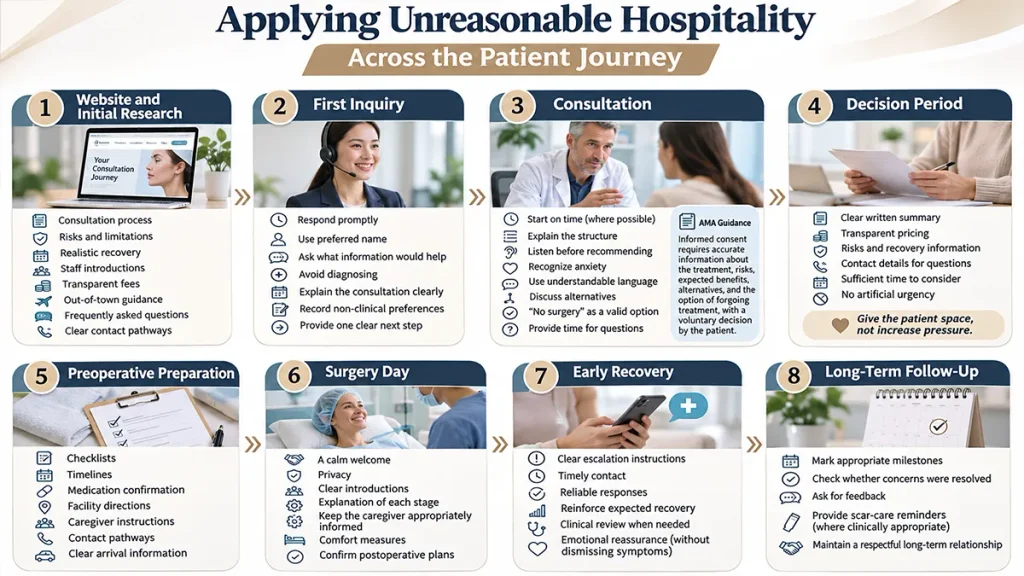
Applying Unreasonable Hospitality Across the Patient Journey
1. Website and Initial Research
The website should help patients feel oriented rather than sold to.
Useful improvements include:
- Clear descriptions of the consultation process
- Balanced discussion of risks and limitations
- Realistic recovery information
- Staff introductions
- Transparent fees where appropriate
- Guidance for out-of-town patients
- Frequently asked questions
- Clear contact pathways
2. First Inquiry
The inquiry team should:
- Respond promptly
- Use the patient’s preferred name
- Ask what information would help
- Avoid diagnosing
- Explain the consultation clearly
- Record important non-clinical preferences
- Provide one clear next step
3. Consultation
Hospitality during consultation includes:
- Starting on time where possible
- Explaining the structure
- Listening before recommending
- Recognizing anxiety
- Using understandable language
- Discussing alternatives
- Making “no surgery” a legitimate option
- Providing time for questions
AMA guidance states that informed consent requires accurate information about the nature of treatment, risks, expected benefits, alternatives, and the option of forgoing treatment, with a voluntary decision by the patient.
4. Decision Period
The patient should receive:
- A clear written summary
- Transparent pricing
- Risks and recovery information
- Contact details for questions
- Sufficient time to consider
- No artificial urgency
Hospitality during this stage means giving the patient space, not increasing pressure.
5. Preoperative Preparation
The team can reduce anxiety through:
- Checklists
- Timelines
- Medication confirmation
- Facility directions
- Caregiver instructions
- Contact pathways
- Clear arrival information
6. Surgery Day
Appropriate hospitality may include:
- A calm welcome
- Privacy
- Clear introductions
- Explanation of each stage
- Keeping the caregiver appropriately informed
- Comfort measures
- Confirming postoperative plans
7. Early Recovery
Patients need:
- Clear escalation instructions
- Timely contact
- Reliable responses
- Reinforcement of expected recovery
- Clinical review when needed
- Emotional reassurance without dismissing symptoms
8. Long-Term Follow-Up
The practice may:
- Mark appropriate milestones
- Check whether concerns were resolved
- Ask for feedback
- Provide scar-care reminders where clinically appropriate
- Maintain a respectful long-term relationship
Eight Hypothetical Plastic Surgery Scenarios
These scenarios are hypothetical and are not real patient cases.
Scenario 1: The Anxious First-Time Patient
Situation
The patient has never undergone surgery and is particularly anxious about anesthesia.
Hospitable response
Arrange approved anesthesia information before the procedure, provide a clear explanation of the surgery-day sequence, and document the concern for the clinical team.
Boundary
Administrative staff should not give clinical reassurance beyond their scope.
Scenario 2: The Out-of-State Patient
Situation
The patient is coordinating flights, accommodation, a caregiver, and follow-up.
Hospitable response
Provide one travel-planning guide containing timing requirements, facility location, recommended local stay, and postoperative appointment expectations.
Boundary
Do not imply that travel convenience should override medical readiness.
Scenario 3: The Consultation Is Delayed
Situation
The surgeon is running 40 minutes late.
Hospitable response
Explain the delay honestly, apologize, provide options, and keep the patient updated.
Measure
Track how quickly delays are communicated, not only average waiting time.
Scenario 4: The Patient Has Limited Support
Situation
The patient reveals that nobody is available to assist during early recovery.
Hospitable response
Pause planning and clarify the support requirements.
Appropriate outcome
Delay surgery if adequate recovery support cannot be arranged.
Hospitality means protecting the patient, not finding a way to preserve the booking.
Scenario 5: Conflicting Instructions
Situation
The nurse and coordinator give different information.
Hospitable response
Acknowledge the inconsistency, identify the correct clinical guidance, correct all materials, and follow up with the patient.
Root improvement
Establish one approved source for current instructions.
Scenario 6: A Patient Is Disappointed During Recovery
Situation
The patient is distressed by swelling and fears the result is poor.
Hospitable response
Ensure appropriate clinical review, acknowledge the concern, explain the expected recovery range where clinically appropriate, and set a clear next contact.
Boundary
Do not dismiss the concern by saying, “Everyone feels that way.”
Scenario 7: The Practice Wants a Signature Gift
Situation
The team proposes giving every surgical patient the same expensive gift.
Better application
First identify whether patients consistently need clearer support, easier instructions, or better caregiver education.
Lesson
A useful, personal resource may be more hospitable than a generic luxury item.
Scenario 8: A Patient Offers to Share Their Story
Situation
A satisfied patient offers photographs and a testimonial.
Hospitable response
Thank them without pressure and use a formal authorization and review process before using any identifiable information.
HHS explains that uses or disclosures of protected health information for marketing generally require a valid authorization, subject to limited exceptions.
Ten Best Lessons from Unreasonable Hospitality by Will Guidara for Plastic Surgeons
1. Make Patients Feel Seen
Record and respond to what genuinely matters to the individual.
2. Fix the Basics First
Reliable service is the foundation of memorable hospitality.
3. Personalize Communication, Not Clinical Standards
Adapt the experience without weakening safety or consistency.
4. Listen for Small Opportunities
The most meaningful gesture may be simple.
5. Design for Recurring Moments
Do not rely only on spontaneous acts of kindness.
6. Empower Staff Within Boundaries
Give employees authority to solve appropriate non-clinical problems.
7. Care for the Team
Supported employees are better able to support patients.
8. Explain Delays and Problems Honestly
Silence usually increases anxiety.
9. Make “No Surgery” Hospitable
Protecting an unsuitable patient is an act of care.
10. Create Experiences for Patients, Not at Them
Ask what is useful before adding more.
A 90-Day Implementation Plan
Days 1–30: Map and Audit
Map the patient journey
Document every major touchpoint from website visit to long-term follow-up.
Interview the team
Ask:
- Where do patients become confused?
- Which questions repeat?
- Where do errors occur?
- What creates anxiety?
- Which steps feel impersonal?
- Where does staff authority remain unclear?
Review patient feedback
Look for recurring comments involving:
- Communication
- Waiting
- Instructions
- Responsiveness
- Courtesy
- Coordination
- Billing
- Postoperative support
Identify the fundamentals
Correct serious service gaps before adding creative initiatives.
Days 31–60: Design and Train
Select three priority moments
Examples:
- First inquiry
- Consultation preparation
- First postoperative night
Create standard support tools
Develop:
- Clear checklists
- Named ownership
- Escalation pathways
- Approved communication templates
- Caregiver materials
- Delay-response procedures
Train the team
Cover:
- Listening
- Empathy
- Privacy
- Professional boundaries
- Service recovery
- Appropriate personalization
- Clinical escalation
Days 61–90: Pilot and Measure
Test the redesigned experience
Pilot improvements with one procedure pathway or one clinical location.
Hold short huddles
Review:
- Patient needs
- operational pressure points
- Service-recovery cases
- Positive feedback
- Process failures
- Opportunities for appropriate personalization
Measure outcomes
Track:
- Patient-reported clarity
- Response time
- Complaints
- Unresolved questions
- Instruction-related errors
- Waiting-time communication
- Follow-up completion
- Patient retention
- Staff feedback
- Referral sources
Do not measure hospitality only through reviews or bookings.
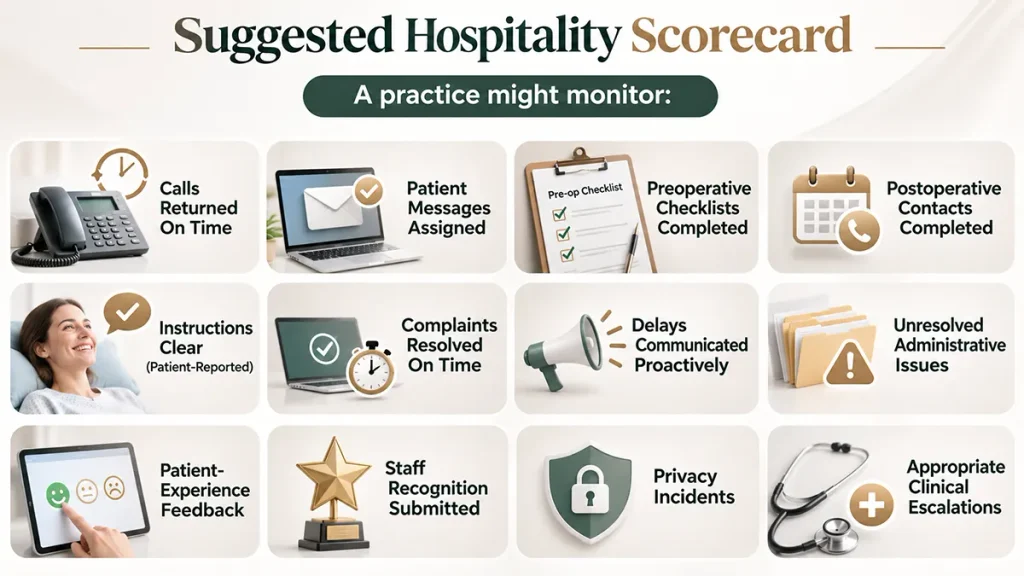
Suggested Hospitality Scorecard
A practice might monitor:
- Calls returned within the promised timeframe
- Patient messages assigned to an owner
- Preoperative checklists completed
- Postoperative contacts completed
- Patients reporting that instructions were clear
- Complaints resolved within target time
- Delays communicated proactively
- Unresolved administrative issues
- Patient-experience feedback
- Staff recognition submitted
- Privacy incidents
- Appropriate clinical escalations
These measurements should support – not replace – clinical quality and safety measures.
Ethical and Regulatory Boundaries
Patient Choice
Hospitality must never be used to create obligation.
A gift, personal gesture, or exceptional service should not make patients feel that they owe the practice a booking, positive review, testimonial, or referral.
Informed Consent
Patients must receive relevant information about the intervention, burdens, risks, expected benefits, alternatives, and the option of no treatment. They must be able to make an independent and voluntary decision.
Privacy
A memorable patient moment should not automatically become marketing content.
HIPAA distinguishes ordinary consent from the more detailed authorization required for many uses of protected health information outside treatment, payment, or healthcare operations.
Fairness
Personalization should not create unequal clinical treatment based on influence, wealth, visibility, or social status.
Professional Boundaries
The team should remain warm without becoming intrusive, dependent, overly familiar, or emotionally manipulative.
Common Mistakes
Confusing Hospitality With Gifts
Experience is created primarily through attention, clarity, and reliability.
Adding Extras Before Fixing Failures
Patients value accurate information and reliable follow-up more than decorative gestures.
Making Every Moment Elaborate
Constant surprise becomes exhausting and unsustainable.
Personalizing Without Permission
Not every patient wants the practice to involve family, celebrate publicly, or communicate frequently.
Allowing Hospitality to Override Policy
Clinical, safety, privacy, and documentation requirements remain mandatory.
Expecting Staff to Fund or Organize Gestures Personally
Hospitality should be supported by systems and budgets rather than employee sacrifice.
Rewarding Only Public Praise
The most important acts of care may occur privately and never generate reviews.
Limitations of Unreasonable Hospitality
It Comes From Luxury Dining
Many examples were developed in an elite restaurant with resources and creative freedom that smaller medical practices may not have.
Medical Care Is Not Entertainment
Patients are often anxious, vulnerable, or in discomfort. They may value calm predictability more than surprise.
Extravagance Can Become Unsustainable
An expectation of continual overdelivery can increase cost, workload, and burnout.
A 2025 critique from the restaurant industry argued that publicity around “unreasonable hospitality” can sometimes create unrealistic customer expectations and that sustainable, modest acts may be more valuable than constant spectacle.
Personalization Can Threaten Consistency
Important instructions and clinical protocols must remain standardized.
Hospitality Cannot Correct Poor Care
No experience strategy can compensate for weak clinical assessment, poor consent, inadequate follow-up, or unsuitable treatment.
Not Every Patient Wants Familiarity
Some patients prefer privacy, formality, and minimal contact.
Team Capacity Matters
The practice must not create an experience that depends on employees performing unpaid emotional or administrative labor.
FAQs About Unreasonable Hospitality by Will Guidara for Plastic Surgeons
Does unreasonable hospitality mean giving expensive gifts?
No. The strongest examples are often inexpensive but personal, timely, and useful.
Is hospitality appropriate in a medical practice?
Yes, when it improves communication, comfort, dignity, and support without compromising safety, consent, privacy, or professional boundaries.
What should a small practice improve first?
Begin with communication reliability, clear instructions, defined ownership, postoperative contact, and honest delay management.
How can staff personalize care safely?
Personalize communication format, practical support, caregiver education, and service recovery while keeping clinical standards consistent.
Should every patient receive a surprise?
No. Predictability may be more valuable than surprise in healthcare.
Can hospitality improve referrals?
A thoughtful experience may strengthen loyalty and word-of-mouth, but referrals should not be the sole purpose. The primary objective is better care and communication.
Can patient coordinators create special moments?
Yes, within approved non-clinical boundaries and budgets. Clinical questions must still be escalated appropriately.
Is a patient gift allowed?
The practice should obtain legal and compliance guidance applicable to its setting. Gifts should never be tied to booking, referrals, reviews, or testimonials.
How should the practice use patient stories?
Only through an appropriate authorization and review process. Informal agreement may not satisfy HIPAA requirements for marketing use.
What is the most important lesson?
Make the patient feel understood without allowing experience design to override sound medical care.
Key Takeaways from Unreasonable Hospitality by Will Guidara
- Service completes the task; hospitality shapes how the experience feels.
- Clinical and operational excellence must come before extras.
- Personalization should improve communication, not alter safety standards.
- The best gestures are thoughtful rather than expensive.
- Listen for what matters to the individual patient.
- Design support around recurring moments of uncertainty.
- Empower staff within clear clinical and administrative boundaries.
- Hospitality starts with a supported and well-trained team.
- Handle problems honestly and give patients choices.
- Informed consent, privacy, patient welfare, and voluntary decisions remain paramount.
Final Thought
Unreasonable Hospitality is valuable for plastic surgeons because it asks practices to look beyond the procedure.
Patients may not remember every detail of the scheduling system or every sentence in their instructions.
They are likely to remember:
- Whether the team listened
- Whether someone explained what would happen
- Whether messages were returned
- Whether their fears were taken seriously
- Whether they felt pressured
- Whether the practice admitted mistakes
- Whether support was available when recovery felt difficult
- Whether they were treated as an individual
The lesson is not to make every interaction extravagant.
It is to make every interaction intentional.
In plastic surgery, the most unreasonable form of hospitality may be remarkably simple:
Deliver reliable care, communicate clearly, notice what matters, and treat every patient as a person rather than a transaction.