
How Plastic Surgeons Can Build Trust and Guide Decisions Without Manipulating Patients
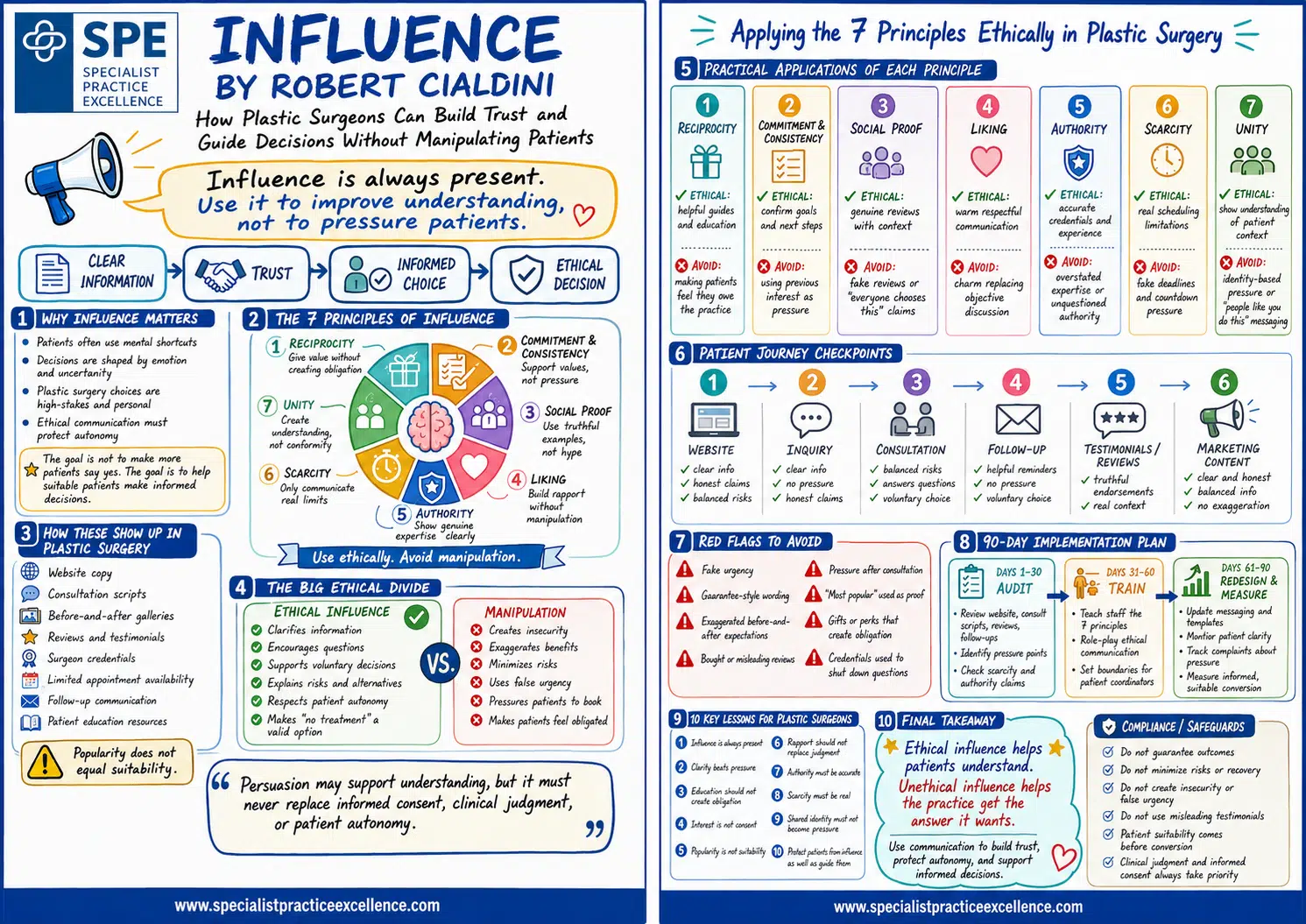
Influence by Robert Cialdini explains how people make decisions and why plastic surgery practices influence patient decisions every day.
A website influences whether someone makes an inquiry. A receptionist influences whether the caller feels welcomed. A surgeon’s credentials influence confidence. Reviews influence expectations. Consultation language influences whether a patient feels informed, reassured, rushed, or pressured.
Influence itself is not automatically unethical. Patients need clear information, credible professional guidance, and help understanding complex choices.
The ethical problem begins when influence is used to:
- Create insecurity
- Exaggerate appearance concerns
- Manufacture urgency
- Hide material information
- Minimize risk
- Present unusual outcomes as typical
- Pressure patients to commit
- Make treatment feel more popular, scarce, or certain than it really is
Robert Cialdini’s Influence: The Psychology of Persuasion explains why people often rely on mental shortcuts when making decisions and how those shortcuts can affect whether they agree to a request.
The expanded edition presents seven principles:
- Reciprocity
- Commitment and Consistency
- Social Proof
- Liking
- Authority
- Scarcity
- Unity
Cialdini’s official materials emphasize that these principles should be applied ethically and that understanding them also helps people defend themselves against dishonest influence attempts.
For plastic surgeons, the book is useful only when its ideas are placed inside a stricter framework:
Persuasion may support understanding, but it must never replace patient autonomy, informed consent, clinical judgment, or suitability.
The AMA describes informed consent as a communication process in which patients receive accurate information about the proposed intervention, its risks, expected benefits, alternatives, and the option of forgoing treatment so they can make an independent and voluntary decision.
Used responsibly, Cialdini’s principles can help a practice:
- Communicate more clearly
- Build legitimate trust
- Improve patient education
- Make administrative processes easier
- Reduce uncertainty
- Strengthen team consistency
- Improve follow-up without pressure
- Help suitable patients make informed decisions
Used poorly, the same principles can become manipulation.
That difference is the central issue for medical practices.
What Is Influence About?
Cialdini’s central argument is that people do not evaluate every decision through exhaustive analysis.
When information is complex, time is limited, or uncertainty is high, people often rely on familiar shortcuts.
These shortcuts are not necessarily irrational. They help people make decisions efficiently.
For example:
- People may trust recognized expertise.
- They may look at what similar people have done.
- They may respond more positively to someone they like.
- They may want to remain consistent with previous choices.
- They may value something more when it is genuinely limited.
- They may feel an obligation to respond when someone has helped them first.
Cialdini’s official explanation describes these principles as recurring behavioral shortcuts that guide responses to requests.
The book is not simply about persuading others. It also explains how people can recognize when these shortcuts are being activated against their interests.
That defensive aspect is especially relevant to medicine.
A practice should understand how influence works so it can avoid accidentally-or deliberately-creating an environment in which patients agree for the wrong reasons.
Who Is Robert Cialdini?
Robert Cialdini is a social psychologist whose work has focused on why people agree to requests and how influence operates in real situations.
His official biography describes a career devoted to researching the conditions that lead people to say yes, and his books have been widely used in business, communication, and persuasion training.
The expanded edition of Influence adds Unity to the six principles found in earlier editions. The official book page identifies the full framework as:
- Reciprocation
- Commitment and Consistency
- Social Proof
- Liking
- Authority
- Scarcity
- Unity
For plastic surgery practices, the framework is most useful when treated as a guide to communication design-not as a collection of tactics for increasing bookings.
Why Influence Matters in Plastic Surgery
Plastic surgery decisions commonly involve:
- Uncertainty
- High emotional significance
- Financial cost
- Fear of complications
- Concern about appearance
- Long recovery periods
- Irreversible changes
- Comparison between different options
- Trust in the surgeon
- Advice from family and friends
- Online reviews and photographs
- Anxiety about making the wrong choice
These conditions make patients more likely to look for shortcuts.
A patient may think:
- This surgeon has many qualifications, so they must be right for me.
- Hundreds of patients chose this procedure, so it must be suitable.
- I like the surgeon, so I feel more comfortable proceeding.
- The surgery date is limited, so I should decide now.
- I already paid the consultation fee, so perhaps I should continue.
- The coordinator gave me a helpful guide, so I feel I should respond.
- The practice says patients “like me” usually choose this option.
None of these thoughts proves that surgery is clinically appropriate.
A well-run practice should therefore use influence principles to make communication clearer while also creating safeguards against automatic decision-making.
The Seven Principles of Influence
1. Reciprocity
Reciprocity is the tendency to feel that we should return a favor, gift, service, or helpful action.
Cialdini describes it as the internal pull to repay what another person has first provided.
Ethical Use in a Plastic Surgery Practice
A practice can give valuable information before asking for anything.
Examples include:
- A realistic recovery guide
- A consultation preparation checklist
- A guide to comparing surgeons
- A list of questions patients should ask
- Clear explanations of risks
- Educational webinars
- Postoperative planning resources
- Instructions for arranging help at home
The aim should be genuinely helpful education.
For example:
“Before booking a consultation, here is a guide explaining the questions you may wish to ask any surgeon you meet.”
This supports the patient even if they choose another practice.
Misuse of Reciprocity
Reciprocity becomes problematic when a gift is designed to create psychological obligation.
Examples include:
- Giving an expensive item before asking for a deposit
- Offering free treatment in exchange for praise
- Providing a “complimentary” consultation while aggressively pushing surgery
- Making a patient feel guilty for taking staff time
- Repeatedly mentioning how much free support has been provided
- Offering benefits that are conditional on immediate commitment
A patient should never feel:
“They have done so much for me, so I should book.”
Better Practice
Give information without requiring a booking.
Use language such as:
“This guide is for your education. There is no obligation to proceed.”
2. Commitment and Consistency
People generally prefer to act consistently with positions, values, or commitments they have already expressed.
Cialdini’s official materials explain that once people make a choice or take a stand, they often feel motivated to behave consistently with it.
Ethical Use in a Plastic Surgery Practice
This principle can support administrative follow-through.
Examples:
- Asking patients to write down their appointment
- Inviting them to identify their consultation goals
- Confirming the information they want to review
- Asking them to choose their preferred contact method
- Encouraging them to write questions before the consultation
- Agreeing on the next non-clinical step
A useful consultation question might be:
“You mentioned that having enough recovery support is important to you. Would you like us to give you a checklist so you can assess whether your current timing is realistic?”
The patient’s previous statement guides the next step without locking them into surgery.
Misuse of Consistency
The principle becomes unethical when previous behavior is used to trap the patient.
Examples include:
- “You already came for a consultation, so you are clearly serious.”
- “You said this has bothered you for years, so why wait?”
- “You paid a deposit, so you should continue even if you are uncertain.”
- “You told us you wanted change, so declining surgery would be inconsistent.”
- Using signed forms as psychological pressure rather than documentation
Patients are allowed to change their minds.
A previous statement of interest is not consent.
Better Practice
Reinforce consistency with the patient’s values, not with the practice’s sales objective.
For example:
“You said you want to make a careful decision and avoid feeling rushed. Taking time to review the information is consistent with that.”
3. Social Proof
Social proof is the tendency to look at the behavior of other people when deciding what is appropriate-especially when uncertain.
Cialdini’s official explanation emphasizes that people often look to similar others when they are unsure how to act.
This principle is highly visible in plastic surgery marketing through:
- Reviews
- Testimonials
- Before-and-after galleries
- Procedure popularity
- Patient stories
- Social media engagement
- Celebrity discussions
- “Most requested” treatments
Ethical Use in a Plastic Surgery Practice
Social proof can reassure patients about the practice’s communication and service.
Examples include verified feedback about:
- Responsiveness
- Courtesy
- Clarity
- Organization
- Postoperative communication
- Whether patients felt listened to
A practice may also provide general information such as:
“Many patients ask about scar placement and recovery during their consultation.”
This normalizes a question without implying that many patients chose surgery.
Misuse of Social Proof
Social proof can become misleading when a practice:
- Buys fake reviews
- Suppresses negative reviews
- Uses only highly unusual outcomes
- Edits testimonials to change their meaning
- Presents popularity as proof of suitability
- Claims that “everyone chooses” a procedure
- Uses followers or views as evidence of clinical quality
- Suggests that a patient should proceed because others did
The FTC requires endorsements to be truthful and not misleading. Material connections must be disclosed clearly, and testimonials cannot be used to make claims that the advertiser could not legally make directly.
The FTC’s Consumer Reviews and Testimonials Rule also addresses fake and deceptive reviews and testimonials.
Before-and-After Images
Photographs may show examples, but they do not prove what another patient will achieve.
A responsible presentation should make clear that:
- Results vary
- The images represent individual patients
- Similar anatomy does not guarantee similar results
- Photographs do not replace individualized assessment
- Exceptional outcomes should not be presented as typical
Better Practice
Use social proof to demonstrate the practice experience-not to imply guaranteed results.
4. Liking
People are generally more receptive to people they like.
Cialdini identifies factors such as similarity, genuine appreciation, and cooperation toward shared goals as contributors to liking.
Ethical Use in a Plastic Surgery Practice
Rapport matters.
Patients may feel more comfortable when the surgeon:
- Listens without interrupting
- Uses understandable language
- Shows respect
- Acknowledges concerns
- Does not dismiss fears
- Demonstrates warmth without becoming overly familiar
- Works collaboratively
- Shows that their goal is an appropriate decision, not simply a booking
A surgeon can build liking by communicating as a supportive professional.
For example:
“You have raised an important concern. Let us look at the realistic benefits and trade-offs together.”
Misuse of Liking
Problems arise when friendliness becomes a substitute for objective assessment.
Examples include:
- Flattery about appearance
- Excessive compliments designed to lower resistance
- Pretending to share interests
- Using personal disclosure strategically
- Encouraging emotional attachment
- Allowing charm to overshadow qualifications or risks
- Making the patient feel they are joining the surgeon’s inner circle
A likable surgeon is not automatically the most suitable surgeon.
Patients should be encouraged to evaluate:
- Qualifications
- Experience
- Facility standards
- Communication
- Risks
- Alternatives
- Clinical recommendations
Better Practice
Be genuinely warm, but keep professional boundaries clear.
5. Authority
People are more likely to follow credible experts.
Cialdini describes authority as the influence associated with knowledge, experience, and expertise.
Authority is especially powerful in medicine.
Patients may rely on:
- Medical qualifications
- Board certification
- Professional memberships
- Hospital appointments
- Years of experience
- Academic titles
- Publications
- Awards
- Media appearances
- The appearance of the clinic
Ethical Use in a Plastic Surgery Practice
Authority should help patients evaluate competence.
A practice should clearly explain:
- The surgeon’s qualifications
- The relevance of those qualifications
- The procedures within their scope
- Where surgery is performed
- Who provides anesthesia
- Which facilities are accredited
- The surgeon’s experience with the procedure
- When another specialist may be more appropriate
The credentials should be accurate, current, and understandable.
Misuse of Authority
Authority becomes misleading when a practice:
- Uses titles patients may misunderstand
- Overstates membership significance
- Displays unrelated credentials
- Implies expertise beyond training
- Uses awards that were purchased
- Uses media appearances as proof of clinical superiority
- Presents the surgeon’s opinion as certainty
- Discourages second opinions
- Suggests patients should not question the recommendation
ASPS advertising policy states that advertising should not be deceptive or misleading and that clinical or statistical claims should be supportable.
Better Practice
Use authority to establish competence, then invite questions.
For example:
“Here is my experience with this procedure, but your individual recommendation depends on your anatomy, health, goals, and tolerance for the trade-offs.”
6. Scarcity
Scarcity is the tendency to value something more when it is limited or less available.
Cialdini describes it as wanting more of what is less available.
In plastic surgery, scarcity can involve:
- Limited consultation appointments
- Surgical dates
- Seasonal availability
- Surgeon capacity
- Promotions
- Pricing deadlines
- Cancellation lists
Legitimate Use of Scarcity
A practice may communicate genuine availability accurately.
Examples:
- “The next available consultation is in October.”
- “There are two remaining operating lists before the holiday closure.”
- “This price estimate is valid for 30 days because facility fees may change.”
- “A cancellation appointment is available on Tuesday.”
This is useful logistical information.
Misuse of Scarcity
Scarcity is dangerous when manufactured.
Examples:
- False countdown timers
- Invented “last chance” promotions
- Claiming high demand without evidence
- Repeatedly extending “final” deadlines
- Telling patients another person will take their date unless they decide immediately
- Creating a fake waiting list
- Suggesting delay will worsen the outcome without clinical evidence
- Using limited availability to bypass careful decision-making
A patient should not feel forced to decide because the practice has made time appear artificially scarce.
Better Practice
Communicate genuine limits, then protect decision time.
For example:
“This date is available, but you should not reserve it until you are comfortable with the recommendation and have reviewed the risks, recovery, and alternatives.”
7. Unity
Unity relates to a sense of shared identity-seeing someone as “one of us.”
The expanded edition identifies Unity as the seventh principle.
In a practice, unity may arise through:
- Shared values
- Community connection
- Cultural understanding
- Professional identity
- Shared experiences
- Patient groups
- Local involvement
Ethical Use in a Plastic Surgery Practice
A practice may build legitimate connection by demonstrating:
- Respect for the local community
- Understanding of culturally specific concerns
- Support for patients traveling from another region
- Sensitivity to different family structures
- Inclusive communication
- Shared commitment to realistic decision-making
A practice might say:
“Many of our patients balance surgery with demanding professional and family responsibilities, so we spend time planning recovery realistically.”
This communicates understanding without claiming every patient is the same.
Misuse of Unity
Unity becomes manipulative when the practice:
- Creates an exclusive “club” around surgery
- Implies that attractive or successful people choose treatment
- Uses identity pressure
- Suggests that “people like us” proceed
- Exploits cultural or community trust
- Makes declining surgery feel like rejecting the group
- Encourages patients to see treatment as proof of belonging
Better Practice
Use shared identity to create understanding, not conformity.
How the Principles Work Together
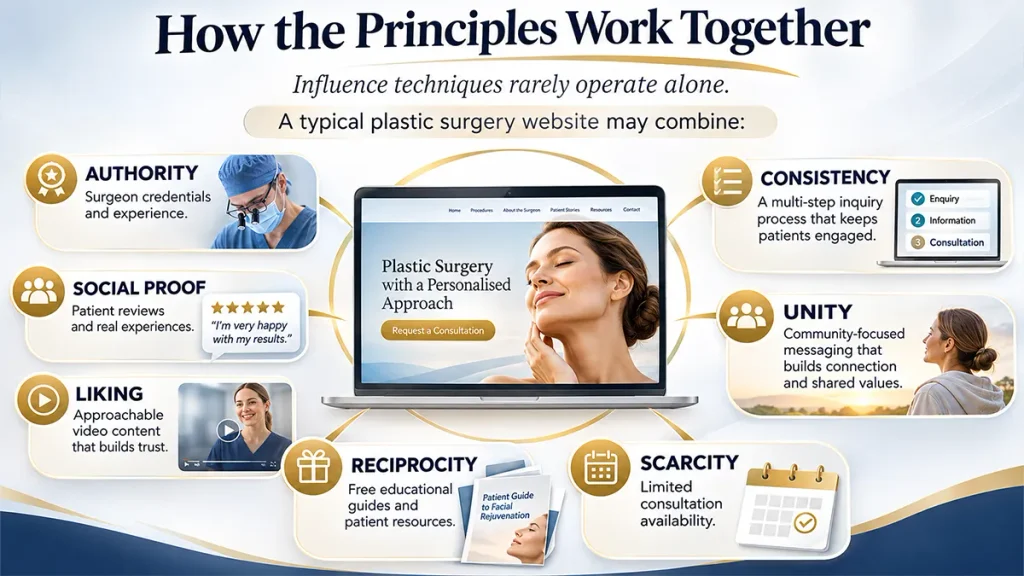
Influence techniques rarely operate alone.
A typical plastic surgery website may combine:
- Authority: surgeon credentials
- Social Proof: patient reviews
- Liking: approachable video content
- Reciprocity: free educational guides
- Scarcity: limited consultation availability
- Consistency: a multi-step inquiry process
- Unity: community-focused messaging
This combination can be helpful-or highly pressuring.
The key question is:
Does the communication help the patient understand, or does it push the patient toward a decision they might not otherwise make?
A responsible practice should review the total effect of its marketing and consultation journey, not only each element separately.
Ethical Influence Across the Patient Journey
1. Website
A responsible website should:
- Explain the procedure clearly
- Describe risks and limitations
- Identify appropriate qualifications
- Avoid guaranteed outcomes
- Avoid false urgency
- Avoid implying that popularity equals suitability
- Use patient images only with appropriate authorization
- Present the consultation as an assessment, not a sales appointment
2. Inquiry Handling
Staff should:
- Be helpful
- Explain the consultation process
- Answer administrative questions
- Avoid diagnosing
- Avoid telling callers they are ideal candidates
- Avoid pressuring callers to secure a date
- Avoid exaggerating demand
3. Consultation
The surgeon should:
- Assess suitability
- Explain risks, benefits, and alternatives
- Discuss the option of no treatment
- Correct unrealistic expectations
- Encourage questions
- Allow reflection
- Avoid relying on credentials or confidence alone
This aligns with AMA guidance on informed consent and voluntary decision-making.
4. Follow-Up
Follow-up should:
- Clarify unanswered questions
- Provide requested information
- Confirm whether the patient wants further contact
- Avoid repetitive booking pressure
- Respect a decision to delay or decline
- Avoid creating artificial deadlines
5. Testimonials and Reviews
The practice should:
- Use genuine feedback
- Obtain appropriate permission
- Avoid editing meaning
- Disclose material relationships
- Avoid paying for positive sentiment
- Avoid presenting rare outcomes as typical
The FTC states that endorsements must reflect honest opinions and that unexpected material connections must be clearly disclosed.
6. Patient Information and Marketing
HIPAA generally requires valid authorization when protected health information is used or disclosed for marketing, subject to limited exceptions. HHS distinguishes authorization from general consent and requires authorization documents to identify the information, parties, purpose, and expiration details.
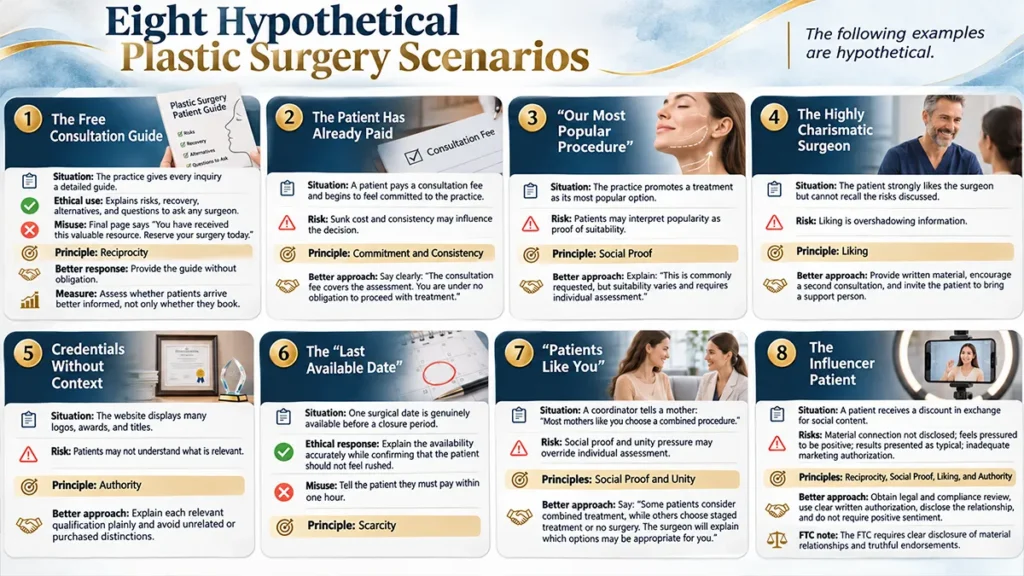
Eight Hypothetical Plastic Surgery Scenarios
The following examples are hypothetical.
Scenario 1: The Free Consultation Guide
Situation
The practice gives every inquiry a detailed guide.
Ethical use
The guide explains risks, recovery, alternatives, and questions to ask any surgeon.
Misuse
The final page says:
“You have received this valuable resource. Reserve your surgery today.”
Principle
Reciprocity
Better response
Provide the guide without obligation.
Measure
Assess whether patients arrive better informed, not only whether they book.
Scenario 2: The Patient Has Already Paid
Situation
A patient pays a consultation fee and begins to feel committed to the practice.
Risk
Sunk cost and consistency may influence the decision.
Better approach
Say clearly:
“The consultation fee covers the assessment. You are under no obligation to proceed with treatment.”
Principle
Commitment and Consistency
Scenario 3: “Our Most Popular Procedure”
Situation
The practice promotes a treatment as its most popular option.
Risk
Patients may interpret popularity as proof of suitability.
Better approach
Explain:
“This is commonly requested, but suitability varies and requires individual assessment.”
Principle
Social Proof
Scenario 4: The Highly Charismatic Surgeon
Situation
The patient strongly likes the surgeon but cannot recall the risks discussed.
Risk
Liking is overshadowing information.
Better approach
Provide written material, encourage a second consultation, and invite the patient to bring a support person.
Principle
Liking
Scenario 5: Credentials Without Context
Situation
The website displays many logos, awards, and titles.
Risk
Patients may not understand what is relevant.
Better approach
Explain each relevant qualification plainly and avoid unrelated or purchased distinctions.
Principle
Authority
Scenario 6: The “Last Available Date”
Situation
One surgical date is genuinely available before a closure period.
Ethical response
Explain the availability accurately while confirming that the patient should not feel rushed.
Misuse
Tell the patient they must pay within one hour.
Principle
Scarcity
Scenario 7: “Patients Like You”
Situation
A coordinator tells a mother:
“Most mothers like you choose a combined procedure.”
Risk
Social proof and unity pressure may override individual assessment.
Better approach
Say:
“Some patients consider combined treatment, while others choose staged treatment or no surgery. The surgeon will explain which options may be appropriate for you.”
Principles
Social Proof and Unity
Scenario 8: The Influencer Patient
Situation
A patient receives a discount in exchange for social content.
Risks
- Material connection is not disclosed
- The patient feels pressured to be positive
- Results are presented as typical
- Marketing authorization is inadequate
Better approach
Obtain legal and compliance review, use clear written authorization, disclose the relationship, and do not require positive sentiment.
Principles
Reciprocity, Social Proof, Liking, and Authority
The FTC requires clear disclosure of material relationships and truthful endorsements.
Ten Best Lessons from Influence by Robert Cialdini for Plastic Surgeons
1. Influence Is Always Present
Even neutral-looking details can influence decisions.
Review the complete patient journey.
2. Ethical Influence Clarifies Rather Than Controls
Good communication helps patients understand.
Manipulation narrows their freedom.
3. Education Should Not Create Obligation
Give useful information because it helps patients-not because it produces psychological debt.
4. Previous Interest Is Not Consent
Patients may change their minds at any stage.
5. Popularity Does Not Prove Suitability
Reviews and patient stories should support trust, not replace assessment.
6. Liking Should Not Replace Evaluation
A warm relationship is valuable, but decisions should still rest on competence, risks, and suitability.
7. Authority Must Be Accurate
Credentials should be relevant, current, and understandable.
8. Scarcity Must Be Real
Never manufacture urgency.
9. Shared Identity Must Not Become Group Pressure
Connection should make patients feel understood, not compelled.
10. Patients Should Be Protected from Influence as Well as Guided by It
The team should actively identify moments when automatic decision-making may be replacing thoughtful consent.
A 90-Day Implementation Plan
Days 1-30: Audit the Patient Journey
Review:
- Website copy
- Social media
- Inquiry scripts
- Consultation materials
- Follow-up messages
- Testimonial use
- Pricing deadlines
- Cancellation lists
- Promotions
- Consent and authorization forms
Identify where each principle appears.
Ask:
- Is the claim accurate?
- Is the limitation clear?
- Could the patient feel obligated?
- Is urgency genuine?
- Is the testimonial representative?
- Are credentials explained?
- Is the patient free to decline?
Days 31-60: Train the Team
Teach staff to recognize:
- Reciprocity pressure
- Commitment pressure
- Misleading social proof
- Authority overreach
- False scarcity
- Inappropriate familiarity
- Identity-based pressure
Role-play examples such as:
- “I need to think about it.”
- “Everyone online seems to have this.”
- “The surgeon says I am a good candidate, so I suppose I should proceed.”
- “I have already paid a deposit.”
- “I do not want to lose the date.”
Create approved language that supports patient choice.
Days 61-90: Redesign and Measure
Update:
- Educational resources
- Credential explanations
- Testimonial disclosures
- Scarcity language
- Appointment reminders
- Follow-up messages
- Website disclaimers
- Review-request processes
Measure:
- Patient-reported clarity
- Complaints about pressure
- Requests to cancel
- Refund disputes
- Misunderstanding of risks
- Consultation preparedness
- Staff compliance with approved language
- Conversion among suitable, informed patients
Do not judge the program only by whether bookings rise.
Suggested Influence Audit
For each communication, score the following:
Reciprocity
- Is something useful being offered?
- Is the patient made to feel obligated?
Consistency
- Is the next step voluntary?
- Is previous behavior being used as pressure?
Social Proof
- Is the evidence genuine?
- Is it presented as typical?
- Are material connections disclosed?
Liking
- Is rapport genuine?
- Are professional boundaries maintained?
Authority
- Are credentials accurate and relevant?
- Are patients encouraged to ask questions?
Scarcity
- Is the limitation real?
- Is adequate decision time preserved?
Unity
- Does shared identity create understanding?
- Could it create conformity pressure?
Common Mistakes
Treating Influence as a Sales Toolkit
The principles should not be used as seven ways to make patients agree.
Combining Too Many Principles
A free guide, testimonial, countdown timer, celebrity endorsement, and “most popular” label on one page may create excessive pressure.
Ignoring Vulnerability
Patients concerned about appearance may be especially sensitive to emotional framing.
Presenting Testimonials Without Context
One positive story cannot predict another person’s result.
Using Authority to End Discussion
Expertise should support the conversation, not silence it.
Calling False Scarcity “Marketing”
Invented deadlines are deceptive, not strategic.
Assuming Legal Compliance Equals Ethical Practice
A message may technically satisfy a rule and still create inappropriate pressure.
Measuring Only Conversion
A higher booking rate is not success if it produces:
- Poor selection
- Regret
- Cancellations
- Complaints
- Unrealistic expectations
- Dissatisfied patients
Limitations of Influence
The Book Is Not Written for Medical Consent
Its principles come from persuasion and social psychology, not a clinical consent framework.
General Principles Do Not Predict Every Individual
People vary in culture, personality, experience, and decision style.
Techniques Can Be Misused Easily
The same principle can support education or manipulation.
Some Examples Are Commercial
Lessons from restaurants, retail, fundraising, and advertising require substantial adaptation before use in healthcare.
The Framework May Oversimplify Decision-Making
Patients do not make elective surgery decisions through only seven shortcuts.
They may also be influenced by:
- Health
- Family
- finances
- Mental well-being
- Past treatment
- Personal values
- Risk tolerance
- Cultural expectations
Influence Cannot Correct Poor Clinical Practice
Persuasive communication cannot compensate for:
- Weak assessment
- Inadequate consent
- Poor follow-up
- Misleading advertising
- Inappropriate treatment
- Poor outcomes
FAQs About Influence by Robert Cialdini for Plastic Surgeons
Is persuasion unethical in a medical consultation?
Not automatically. Clear explanation, professional recommendations, and well-designed patient education all influence decisions. The ethical test is whether the patient remains informed, voluntary, and free to decline.
Which principle is most dangerous in plastic surgery?
Scarcity can be especially risky because it creates urgency. Social proof and authority can also be powerful when patients are uncertain.
Can a practice use patient testimonials?
Yes, subject to applicable authorization, advertising, privacy, and endorsement requirements. Testimonials should be truthful, appropriately permitted, and not presented in a misleading way.
Is it ethical to say that a procedure is popular?
Only when true and relevant. Popularity must not be presented as evidence that the procedure is right for the individual.
Can a surgeon mention limited availability?
Yes, when the limitation is genuine. The patient should still have adequate time to decide.
Should the practice give free educational resources?
Yes. They should be provided without creating obligation or linking the gift to immediate commitment.
Are credentials a form of influence?
Yes. Credentials help patients assess authority, but they must be accurate, relevant, and clearly explained.
Can a patient coordinator use influence principles?
They may use ethical communication practices, but they should not diagnose, recommend treatment, minimize risk, or pressure patients.
What is the best way to use social proof?
Use genuine feedback to demonstrate communication and service quality while making clear that individual outcomes and suitability vary.
What is the main lesson for plastic surgeons?
Understand the forces affecting the patient’s decision-and make sure those forces support reflection rather than pressure.
Key Takeaways from Influence by Robert Cialdini
- Patients use mental shortcuts when decisions are complex.
- Reciprocity should provide value without creating obligation.
- Commitment should support patient values, not trap the patient.
- Social proof should be truthful and not presented as proof of suitability.
- Liking should support rapport without replacing objective evaluation.
- Authority should be accurate, relevant, and open to questions.
- Scarcity must be genuine and should never override reflection.
- Unity should create understanding, not conformity.
- Reviews, testimonials, and patient stories require careful disclosure and authorization.
- Informed consent, suitability, and autonomy take priority over conversion.
Final Thought
Influence is valuable to plastic surgeons because it explains that decisions are shaped by more than facts.
Patients are affected by:
- How information is framed
- Who delivers it
- What other people appear to have done
- Whether availability feels limited
- Whether they like and identify with the practice
- Whether they feel they have already committed
- Whether the practice has provided something valuable
A responsible practice should not pretend these forces do not exist.
It should make them visible, review them carefully, and prevent them from overpowering patient judgment.
The best use of Cialdini’s principles in plastic surgery is not to make patients say yes more often.
It is to create communication that is:
- Clear
- Credible
- Helpful
- Honest
- Respectful
- Easy to understand
- Free from false pressure
Ethical influence helps a suitable patient make a confident, informed decision.
Unethical influence helps the practice get the answer it wants.
That distinction should guide every website page, consultation, follow-up message, testimonial, and booking conversation.