
Part 1: Content, Training, Communication and Marketing
Plastic surgery practices produce an extraordinary amount of written material.
A surgeon may need to review procedure pages, patient guides, consent-related information, postoperative instructions, staff scripts, marketing campaigns, meeting notes, policies and hundreds of patient questions. The practice manager must keep systems consistent. Patient coordinators need clear answers. Marketing teams need accurate, useful content without making unsafe or misleading claims.
Claude AI from Anthropic can assist with much of this work.
It is particularly useful for assignments that involve long documents, detailed instructions, structured writing, summarisation and maintaining a consistent voice. Claude Projects can also organise relevant source material and custom instructions around a specific body of work, while Claude Artifacts provides a separate space in which users can review and refine generated documents. (Anthropic)
However, Claude should not be treated as:
- A plastic surgeon
- A clinical decision-maker
- A compliance officer
- A privacy adviser
- A substitute for a skilled patient coordinator
- A source of guaranteed medical accuracy
- An autonomous patient communication system
Claude works best as a capable drafting and organisation assistant. It can help a team turn approved knowledge into useful content, but qualified people must still verify every clinical statement, advertising claim and patient-facing instruction. Practices that want multiple team members to collaborate efficiently may also benefit from learning about Best Claude Cowork Use Cases for Plastic Surgeons.
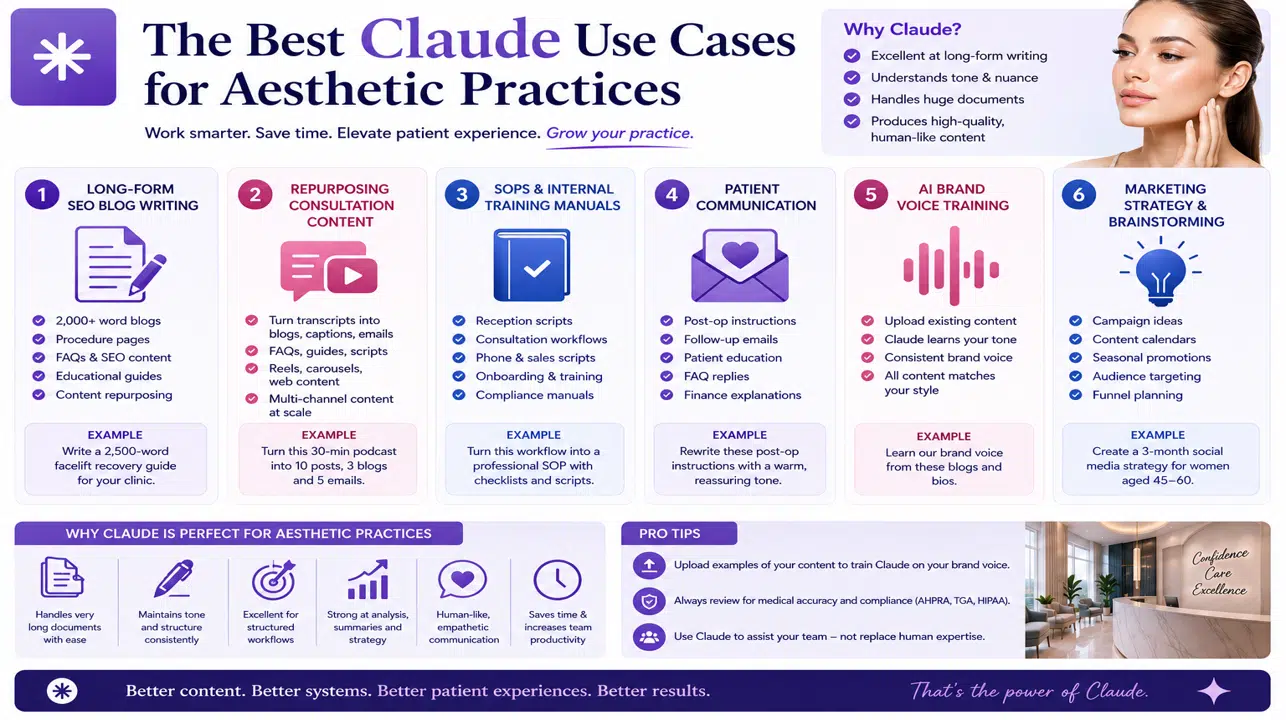
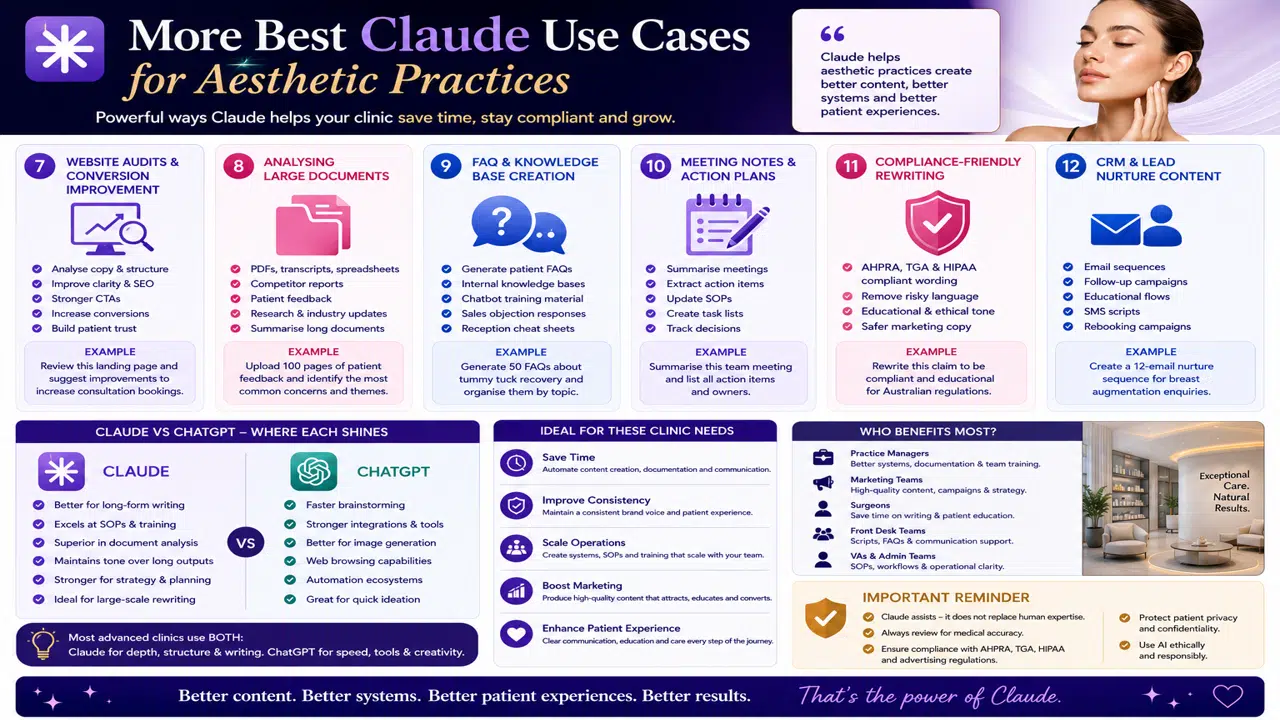
This guide examines the 12 best Claude use cases for plastic surgeons:
- Long-form SEO writing
- Repurposing consultation and educational content
- SOPs and training manuals
- Patient communication
- Brand voice development
- Marketing strategy and brainstorming
- Website audits and conversion improvement
- Analysis of large documents
- FAQ and knowledge base creation
- Meeting notes and action plans
- Compliance-friendly rewriting
- CRM and lead nurture content
The first six use cases are covered below.
Before Using Claude: Establish Your Privacy and Compliance Rules
A plastic surgery clinic should decide what information staff may enter into an AI tool before anyone begins experimenting with prompts.
Do not assume that every Claude account, plan or configuration is suitable for protected or sensitive health information. Anthropic’s Trust Center lists HIPAA-related controls within the scope of certain products, but a clinic still needs to confirm the exact product, configuration, contract, business associate agreement and data-handling conditions that apply to its account. (Anthropic Trust Center)
A US clinic must consider its responsibilities under the HIPAA Privacy and Security Rules. HHS states that regulated organisations must use appropriate administrative, physical and technical safeguards to protect electronic protected health information. (HHS.gov)
Australian clinics should be equally cautious. The Office of the Australian Information Commissioner advises organisations not to enter personal information, particularly sensitive information, into publicly available generative AI tools. It also recommends due diligence, human oversight, documented policies and privacy-by-design controls when adopting commercial AI products. (OAIC)
As a practical starting rule, staff should not upload:
- Patient names
- Dates of birth
- Addresses or contact details
- Identifiable photographs or videos
- Consultation recordings
- Medical histories
- Operative notes
- Pathology or imaging reports
- Billing or finance records
- Unredacted complaint correspondence
- Any combination of details that could identify a patient
Use fictional scenarios, approved templates and carefully de-identified information unless the practice has formally approved a more advanced workflow.
1. Long-Form SEO Blog and Procedure Writing
One of the strongest Claude use cases for plastic surgeons is developing long-form educational content.
This may include:
- Procedure pages
- Recovery guides
- Blog articles
- Surgeon philosophy pages
- Frequently asked questions
- Comparison guides
- Local service pages
- Patient preparation resources
- Email education
- Video scripts
Claude is well suited to work that requires a large amount of source information to be organised into a coherent document. The important distinction is that Claude should not be asked to invent the surgeon’s approach. It should be given the surgeon’s real knowledge and help structure it.
Why This Matters
A generic article on tummy tuck surgery may explain the broad concept of removing excess skin and repairing abdominal muscles. That information is available on thousands of websites.
A valuable article explains:
- How this particular surgeon assesses abdominal anatomy
- When muscle repair may or may not be considered
- How liposuction may fit into the operation
- What factors affect scar placement
- How the surgeon approaches post-weight-loss patients
- What recovery guidance the practice provides
- How candidacy decisions are made
- What outcomes the surgeon considers realistic
- When surgery should be postponed
- What the consultation process involves
These details create differentiation. They also make the content more useful to prospective patients and more representative of the actual practice.
Who Can Use It?
- The surgeon
- Marketing manager
- SEO writer
- Practice manager
- Content coordinator
- External agency
- Virtual assistant working from approved instructions
Example
A facial plastic surgeon wants a 2,500-word guide called:
What to Expect During Deep Plane Facelift Recovery
The practice gives Claude:
- A transcript of the surgeon explaining recovery
- The clinic’s existing postoperative instructions
- An approved week-by-week recovery timeline
- The surgeon’s advice about swelling and bruising
- Activity restrictions
- Appointment schedules
- Warning signs that require contact with the clinic
- The clinic’s preferred tone
- Topics that must not be discussed
- The city and target audience
- SEO phrases
Claude then creates a structured draft. The surgeon or clinical reviewer verifies every recovery statement before publication.
Suggested Workflow
Step 1: Define the Search Intent
Identify the main patient question.
Examples:
- How long does facelift recovery take?
- What happens during a mommy makeover consultation?
- Am I suitable for a breast lift?
- How does a deep neck lift differ from neck liposuction?
- What should I expect after blepharoplasty?
Step 2: Assemble Approved Sources
Give Claude information from:
- Surgeon interviews
- Existing clinical instructions
- Approved website content
- Peer-reviewed or authoritative references
- Practice policies
- Procedure questionnaires
- Common consultation questions
- Brand voice examples
Step 3: Specify the Boundaries
Tell Claude:
- Which market the article is for
- Which spelling convention to use
- Which services the surgeon does and does not provide
- Which claims are prohibited
- Which terms the practice avoids
- Whether prices may be discussed
- Which complications should be covered
- What requires a disclaimer
- Whether the article should invite a consultation
Step 4: Create an Outline First
Review the proposed structure before generating the full article.
This helps catch:
- Missing topics
- Repetition
- Incorrect assumptions
- Weak sequencing
- Irrelevant sections
Step 5: Draft in Sections
Long articles are usually easier to review when created in stages.
For example:
- Introduction and candidacy
- Procedure overview
- Preparation
- Recovery timeline
- Risks and limitations
- FAQs
- Consultation call to action
Step 6: Conduct Three Reviews
The final draft should receive:
- A clinical accuracy review
- A marketing and readability review
- A compliance review appropriate to the jurisdiction
What Claude Needs
A useful prompt should include:
- Surgeon name
- Procedure
- Country and city
- Intended reader
- Search intent
- Primary and secondary keyphrases
- Surgeon-specific information
- Procedure boundaries
- Approved source material
- Required sections
- Desired length
- Tone
- Reading level
- Prohibited claims
What the Practice Must Review
Check:
- Clinical accuracy
- Recovery statements
- Risks and complications
- Candidacy criteria
- Anaesthesia information
- Claims about results
- Statements about pain
- References to scars
- Prices or finance
- Surgeon qualifications
- Calls to action
- Regulatory compliance
Australian practices must pay particular attention to the National Law and specific cosmetic surgery advertising guidance. Ahpra’s advertising framework applies to websites, social media and other promotional material, and Australian advertisers remain responsible for the content they publish, regardless of whether an AI system helped write it. (AHPRA)
Risks and Limitations
Claude may:
- Add a procedure the surgeon does not offer
- Overstate benefits
- Understate risks
- Produce an inaccurate recovery timeline
- Invent a credential
- Refer to outdated technology
- Confuse one surgeon’s technique with another
- Repeat common internet claims without evidence
- Create content that sounds authoritative but is wrong
The more precise the source material, the more useful the draft is likely to be.
Example Prompt
Act as an experienced medical content writer working with an aesthetic plastic surgery practice in [COUNTRY].
Write a 2,500-word patient guide titled Deep Plane Facelift Recovery: What to Expect Week by Week for [SURGEON NAME] in [CITY].
The target reader is a woman aged 45–70 who is researching facelift surgery and wants practical, realistic information about recovery. Write in a calm, professional and reassuring tone at approximately Grade 7 reading level.
Use the following source material as the primary authority:
[PASTE SURGEON INTERVIEW]
[PASTE APPROVED RECOVERY INSTRUCTIONS]
[PASTE CLINIC FAQS]Do not invent techniques, qualifications, timelines, medications or practice policies. Where the source information is incomplete, insert: [CLINIC TO CONFIRM].
Include:
- What recovery means
- The first 24–72 hours
- The first week
- Weeks two to four
- Returning to work
- Exercise
- Swelling and bruising
- Incision care
- Follow-up appointments
- Emotional changes during recovery
- General warning signs that require direct contact with the clinic
- Twelve FAQs
Do not promise results or describe recovery as easy, painless or risk-free. Do not provide individual medical advice.
Use the keyphrase deep plane facelift recovery naturally. Conclude with a measured invitation to arrange a consultation.
Start Small
Begin with one article based on an existing surgeon interview.
Do not ask Claude to create an entire website before the practice has assessed:
- Accuracy
- Editing time
- Tone
- Compliance risks
- Search performance
- Patient response
2. Repurposing Consultations and Educational Content
Plastic surgeons often explain the same valuable concepts repeatedly.
A surgeon may discuss implant selection, facelift longevity, scar placement, postoperative swelling or revision surgery during:
- Consultations
- Webinars
- Podcasts
- Staff training
- Conference presentations
- Videos
- Media interviews
- Recorded question-and-answer sessions
Claude can help convert approved source material into several formats.
Why This Matters
The most useful content often already exists inside the practice.
It may be hidden in:
- Recorded interviews
- Consultation explanations
- Staff meeting transcripts
- Presentation notes
- Old articles
- Patient seminars
- Frequently sent emails
Repurposing allows the practice to extract more value from the surgeon’s expertise without asking the surgeon to start from a blank page each time.
Who Can Use It?
- Marketing teams
- Surgeons
- Practice managers
- Video editors
- Social media coordinators
- Copywriters
- Virtual assistants
Example
A surgeon records a 30-minute interview about breast augmentation.
Claude could help turn the approved transcript into:
- One 2,500-word procedure guide
- Three supporting articles
- Ten social media posts
- Five educational emails
- Ten short video scripts
- A patient FAQ sheet
- A reception cheat sheet
- A consultation preparation email
- A downloadable guide
- A staff training quiz
The outputs should all remain consistent with the original interview.
Suggested Workflow
Step 1: Obtain Permission and Remove Patient Details
Do not upload a consultation transcript containing identifiable patient information without an approved privacy process.
A safer approach is to record a separate surgeon education session using fictional questions.
Step 2: Clean the Transcript
Remove:
- Names
- Personal stories that are not approved for publication
- Off-the-record comments
- Unverified claims
- Repeated filler
- Confidential commercial details
Step 3: Identify Core Themes
Ask Claude to identify:
- Main educational ideas
- Common patient concerns
- Quotable surgeon insights
- Potential article topics
- FAQ questions
- Areas requiring fact-checking
Step 4: Create a Content Map
Match each idea to a suitable format.
For example:
| Source idea | Best format |
|---|---|
| Implant size misconceptions | Short video |
| Implant selection process | Long-form article |
| Consultation preparation | |
| Recovery milestones | Patient guide |
| Five common fears | Social carousel |
| Questions to ask a surgeon | Downloadable checklist |
Step 5: Develop One Master Resource
Create the long-form article first. Use that approved article as the source for shorter content.
Step 6: Adapt Rather Than Duplicate
A social post should not simply be a paragraph copied from the article.
Each format requires:
- A different opening
- Appropriate length
- A clear purpose
- Suitable visual support
- A platform-specific call to action
What Claude Needs
Provide:
- Clean transcript
- Intended audiences
- Platforms
- Brand tone
- Procedure terminology
- Compliance restrictions
- Preferred calls to action
- List of content formats
- Maximum lengths
- Words and claims to avoid
What the Practice Must Review
Review:
- Whether quotations reflect what the surgeon meant
- Whether patient stories require consent
- Whether the surgeon has approved being quoted
- Whether the repurposed content changes the clinical meaning
- Whether a short format removes an important qualification
- Whether the call to action creates inappropriate pressure
- Whether platform-specific advertising rules apply
In Australia, social media content that promotes therapeutic goods may constitute advertising, and businesses can remain responsible for promotional posts, comments and associated user-generated content. (Therapeutic Goods Administration (TGA))
Risks and Limitations
Repurposing can create problems when:
- The original material is inaccurate
- A nuanced explanation is compressed into an absolute statement
- A surgeon’s words are made more promotional
- A patient story is used without adequate permission
- Ten near-identical pieces are published across different channels
- A statement is removed from its context
Example Prompt
Analyse the approved transcript below from a plastic surgeon discussing breast augmentation.
First, extract:
- Ten main educational themes
- Twenty patient questions answered in the transcript
- Any statements that need clinical clarification
- Any sentences that may create advertising or compliance concerns
Then create:
- One detailed article outline
- Three supporting blog topics
- Ten short video topics
- Five patient education emails
- Ten social media caption concepts
- One reception FAQ sheet
Preserve the surgeon’s meaning. Do not add claims, statistics, qualifications, product names or procedural details that are not present in the transcript. Mark missing information as [CONFIRM WITH SURGEON].
Target market: [COUNTRY]
Target patient: [DESCRIPTION]
Brand tone: [TONE]
Source transcript: [TRANSCRIPT]
Start Small
Use one approved surgeon interview to produce:
- One article
- Three emails
- Five social posts
Review the quality before creating a larger content system.
3. SOPs and Internal Training Manuals
Plastic surgery practices depend on repeatable processes.
Patients expect a consistent experience whether they speak with the receptionist, patient coordinator, nurse or practice manager. Inconsistent systems can lead to:
- Missed enquiries
- Confusing advice
- Delayed follow-up
- Poor documentation
- Quotation errors
- Inconsistent escalation
- Staff frustration
- Patient dissatisfaction
Claude can help turn informal knowledge into structured documents.
Suitable SOP Topics
- Answering new enquiries
- Booking consultations
- Processing deposits
- Sending patient forms
- Following up unbooked leads
- Handling cancellations
- Preparing consultation rooms
- Managing photography
- Issuing quotations
- Scheduling surgery
- Preoperative calls
- Postoperative calls
- Handling after-hours concerns
- Responding to complaints
- Requesting reviews
- Managing referrals
- Onboarding staff
Why This Matters
Many practices rely on verbal training.
A new receptionist may be told:
“Listen to how Sarah answers the phone.”
A new patient coordinator may receive old scripts, several emails and a few shadowing sessions. The result is often uneven performance.
Claude can help convert the practice’s real workflow into:
- A formal SOP
- A checklist
- A telephone script
- A decision tree
- A quick-reference sheet
- A training quiz
- A competency checklist
- A manager observation form
Who Can Use It?
- Practice manager
- Operations manager
- Clinical manager
- Patient coordinator
- Training manager
- Surgeon
- Compliance adviser
Example: A New Tummy Tuck Enquiry
The practice explains its current workflow:
- Reception answers the call.
- The team asks how the patient heard about the practice.
- The patient’s main concern is recorded.
- Basic eligibility questions are asked.
- The consultation process is explained.
- The consultation fee and deposit policy are stated.
- The patient receives an email and forms.
- The coordinator follows up if the consultation is not booked.
- Clinical questions are escalated to a nurse or surgeon.
Claude can structure this into an SOP with:
- Purpose
- Scope
- Responsibilities
- Required systems
- Procedure
- Approved wording
- Escalation criteria
- Documentation requirements
- Quality measures
- Training requirements
- Review date
Suggested Workflow
Step 1: Capture the Current Process
Ask the person who does the task to explain it from beginning to end.
Do not start by asking Claude to create an “ideal” process. Document what actually happens first.
Step 2: Identify Variations
Record what changes when:
- The patient is local or travelling
- The enquiry is urgent
- The patient is underage
- The patient wants medical advice
- The patient has had previous surgery
- The patient is dissatisfied with another surgeon
- The patient cannot pay the consultation fee
- The patient asks for a guaranteed price
Step 3: Define Escalation Rules
State clearly when staff should stop and seek help.
For example:
- Clinical symptom questions
- Medication questions
- Suspected complications
- Threats or aggressive behaviour
- Privacy concerns
- Refund disputes
- Media enquiries
- Legal correspondence
Step 4: Ask Claude to Structure the SOP
Claude should organise the information rather than invent the workflow.
Step 5: Test the SOP
Have a staff member who did not write it follow the procedure.
Record:
- Missing steps
- Confusing instructions
- Duplicate tasks
- Unclear responsibilities
- System access issues
Step 6: Approve and Version the Document
Include:
- Version number
- Author
- Reviewer
- Approval date
- Next review date
- Related documents
What Claude Needs
- Existing workflow
- Staff roles
- Systems used
- Approved scripts
- Escalation criteria
- Required documentation
- Legal and clinical boundaries
- Exceptions
- Quality standards
What the Practice Must Review
Clinical workflows require review by an appropriately qualified clinician.
Check:
- Whether non-clinical staff are asked to give medical advice
- Whether escalation is fast enough
- Whether documentation requirements are complete
- Whether privacy is protected
- Whether the process reflects current software
- Whether staff roles are accurate
- Whether the SOP conflicts with another policy
Risks and Limitations
Claude may produce a polished SOP that is operationally unrealistic.
A document can look complete while still containing:
- Steps the practice cannot perform
- Incorrect job titles
- Software functions that do not exist
- Unsafe escalation delays
- Missing exceptions
- Generic scripts that do not suit the practice
Formatting quality is not the same as procedural accuracy.
Example Prompt
Convert the workflow below into a formal SOP titled Handling a New Tummy Tuck Enquiry.
The SOP is for reception and patient coordination staff at [PRACTICE NAME] in [COUNTRY].
Include:
- Purpose
- Scope
- Definitions
- Staff responsibilities
- Required systems
- Step-by-step procedure
- Approved telephone questions
- Information staff may provide
- Information staff must not provide
- Clinical escalation triggers
- Follow-up timeframes
- Documentation requirements
- Quality checks
- Training requirements
- Version control
Do not invent practice policies. Where information is missing, insert [MANAGER TO CONFIRM].
After the SOP, create:
- A one-page checklist
- A telephone script
- A ten-question training quiz
- A manager competency assessment
Current workflow: [PASTE WORKFLOW]
Start Small
Begin with a low-risk administrative process, such as:
- Booking a consultation
- Preparing a meeting agenda
- Sending new patient forms
- Following up a missed call
Do not begin with emergency clinical protocols.
4. Patient Communication
A plastic surgery practice sends hundreds of recurring messages.
These include:
- Consultation confirmations
- Appointment reminders
- Preparation emails
- Finance explanations
- Preoperative instructions
- Postoperative instructions
- Recovery milestone messages
- Rescheduling notices
- Follow-up emails
- Review requests
- Long-term check-ins
Claude can help improve the clarity, structure and tone of these messages.
Why This Matters
Patients may be anxious, distracted or overwhelmed.
A message that appears clear to a staff member may be confusing to a patient because it:
- Contains too much information
- Uses medical jargon
- Hides the required action
- Sounds cold
- Lacks dates or deadlines
- Mixes clinical and administrative instructions
- Fails to explain what happens next
Claude can rewrite an approved message while preserving the underlying meaning.
Who Can Use It?
- Nurses
- Patient coordinators
- Reception teams
- Practice managers
- Marketing teams
- Surgeons reviewing patient resources
Example
The practice has a dense postoperative instruction sheet.
Claude is asked to:
- Preserve every clinical instruction
- Use shorter sentences
- Add headings
- Place urgent actions near the top
- Convert suitable content into bullets
- Remove unnecessary repetition
- Maintain a calm tone
- Highlight where the patient should call the clinic
The revised document still requires clinical approval.
Useful Tone Adaptations
Claude can convert the same approved information into a tone that is:
- Warm and reassuring
- Premium and polished
- Clear and direct
- Calm and supportive
- Concise and practical
The tone should never dilute a safety instruction.
For example:
Weak:
“Some swelling might happen, so do not worry.”
Better:
“Swelling is expected after surgery. Follow the instructions provided by your surgical team. Contact the clinic promptly if your swelling suddenly increases, affects one side more than the other, or is accompanied by another concerning symptom.”
The exact escalation wording must be approved by the treating practice.
Suggested Workflow
- Start with an approved clinical or administrative message.
- State what Claude may change.
- State what it must preserve.
- Ask Claude to flag unclear instructions rather than guess.
- Compare the draft with the original.
- Obtain clinical approval where required.
- Save the approved version in the practice system.
- Record a review date.
What Claude Needs
- Original approved message
- Recipient type
- Communication channel
- Desired tone
- Reading level
- Required action
- Mandatory wording
- Details that must not change
- Contact instructions
- Country
What the Practice Must Review
Check:
- Dates
- Dosages
- Medication names
- Fasting instructions
- Activity limits
- Wound care
- Compression garments
- Follow-up appointments
- Emergency contact instructions
- Telephone numbers
- Whether the message could delay urgent care
Claude must not independently assess postoperative symptoms or decide whether a patient needs urgent review.
Risks and Limitations
Problems arise when staff use Claude to generate a personalised reply to a clinical concern without clinician involvement.
For example:
“My left breast is much more swollen than my right breast. Is this normal?”
That should not be treated as an ordinary rewriting task. It should be escalated according to the clinic’s clinical protocol.
Example Prompt
Rewrite the approved postoperative instructions below for an adult plastic surgery patient.
Requirements:
- Preserve every clinical instruction
- Do not alter medication, wound care, garment or activity guidance
- Use plain language and short sentences
- Add clear headings
- Place important contact instructions near the top
- Keep the tone calm and reassuring
- Do not minimise risk
- Do not add new clinical advice
- Mark any unclear or contradictory instruction as [CLINICAL TEAM TO REVIEW]
Produce:
- A full patient handout
- A concise email version
- A short SMS reminding the patient to read the full instructions
Approved source: [PASTE INSTRUCTIONS]
Start Small
Begin with administrative communication, such as:
- Consultation preparation
- Parking instructions
- Appointment confirmations
- Form reminders
Move into clinical education only after a review and approval system is in place.
5. AI Brand Voice Development
Plastic surgery practices often struggle to maintain a consistent voice.
One website page may sound clinical. Another may be highly promotional. Emails may sound abrupt. Social posts may use language the surgeon dislikes.
Claude can help analyse approved examples and develop a practical brand voice framework.
Why This Matters
A strong plastic surgery brand voice should reflect the practice’s actual position.
Possible qualities include:
- Calm
- Refined
- Precise
- Warm
- Educational
- Conservative
- Reassuring
- Direct
- Premium
- Evidence-informed
The voice should remain consistent without making every message sound identical.
Suitable Source Material
Upload approved examples such as:
- Surgeon biography
- Website pages
- Blog articles
- Patient guides
- Emails
- Consultation scripts
- Social captions
- Practice values
- Media interviews
- Presentation transcripts
Projects can be used to organise source material and apply custom instructions to a defined body of work. Anthropic states that Projects can be grounded in internal knowledge such as style guides, transcripts and previous work. (Anthropic)
What a Brand Voice Guide Should Include
- Core personality traits
- Tone by communication type
- Sentence structure
- Reading level
- Medical terminology
- Preferred words
- Words to avoid
- Emotional boundaries
- Calls to action
- Approach to risk
- Approach to results
- How to discuss fees
- How to discuss competitors
- How to handle uncertainty
- Examples of suitable and unsuitable wording
Who Can Use It?
- Marketing team
- External writers
- Patient coordinators
- Reception staff
- Social media agency
- Virtual assistants
- Surgeon reviewing content
Example
A premium facial surgery practice wants to sound:
- Expert but not arrogant
- Warm but not overly familiar
- Aspirational but not glamorous
- Reassuring but not dismissive
- Confident but not absolute
Claude analyses ten approved articles and identifies patterns such as:
- Short introductory paragraphs
- Limited adjectives
- Frequent explanation of decision-making
- Preference for “appropriate” over “perfect”
- Avoidance of “transformation”
- Clear acknowledgement of limitations
- Soft calls to action
These observations become a brand voice guide.
Suggested Workflow
- Select 10–20 examples the surgeon approves.
- Remove content that no longer reflects the practice.
- Ask Claude to identify repeated language patterns.
- Review whether the patterns are intentional.
- Define the desired voice.
- Create examples for different communication channels.
- Test the guide on a real article and email.
- Refine it after surgeon feedback.
What Claude Needs
- Approved examples
- Target patient
- Market position
- Practice values
- Desired emotional impression
- Words to avoid
- Regulatory boundaries
- Competitor differentiation
- Preferred reading level
What the Practice Must Review
Check that the guide does not:
- Fabricate a surgeon personality
- Overstate warmth or luxury
- Encourage absolute claims
- Recommend language inconsistent with regulations
- Make the surgeon sound like another brand
- Attribute opinions the surgeon has not approved
Risks and Limitations
Brand voice analysis can become imitation.
The goal is not to copy a competitor or public figure. It is to identify the practice’s own communication principles.
Claude should also not be instructed to “write exactly like” a living surgeon, writer or competitor.
Example Prompt
Analyse the approved writing samples below and create a brand voice guide for [PRACTICE NAME], an aesthetic plastic surgery practice in [LOCATION].
Identify:
- Tone
- Level of formality
- Sentence length
- Vocabulary
- Emotional qualities
- Use of medical terminology
- How uncertainty is explained
- How risks are discussed
- How calls to action are written
- Phrases used repeatedly
- Words and styles that appear inconsistent
Then create:
- Six brand voice principles
- A list of words to use
- A list of words to avoid
- Tone guidance for website pages, emails, SMS, social media and staff scripts
- Ten examples of “on-brand” wording
- Ten examples of “off-brand” wording with improved alternatives
Do not invent clinical beliefs or personal opinions. Base the analysis only on the approved examples.
Approved samples: [PASTE CONTENT]
Start Small
Create a one-page voice guide covering:
- Five qualities
- Ten preferred phrases
- Ten prohibited phrases
- Three call-to-action examples
Test it before producing a large manual.
6. Marketing Strategy and Brainstorming
Claude can assist plastic surgery practices with campaign planning, content ideas and marketing structure.
It can be useful for:
- Campaign themes
- Content calendars
- Patient personas
- Video topics
- Email sequences
- Referral ideas
- Local awareness campaigns
- Consultation funnels
- Audience segmentation
- Seasonal content
- Procedure education
- Competitive positioning
The most effective use is structured brainstorming based on real practice objectives.
Why This Matters
Many practices create content without a clear strategic purpose.
They post:
- Random before-and-after photographs
- Procedure facts
- Holiday messages
- Repeated surgeon introductions
- Generic inspirational quotes
- Promotions with little education
Claude can help connect content to the patient journey.
For example:
- The patient becomes aware of an ageing concern.
- She learns that several treatment options exist.
- She compares non-surgical and surgical approaches.
- She investigates recovery.
- She evaluates surgeons.
- She discusses the decision with family.
- She considers timing and cost.
- She books a consultation.
A good campaign creates useful content for several of these stages.
Who Can Use It?
- Practice owner
- Marketing manager
- Agency
- Content strategist
- Patient coordinator
- Business development manager
Example: Facial Rejuvenation Campaign
The practice wants a three-month campaign for women aged 45–65.
The goal is not simply to promote facelifts. It is to help potential patients understand:
- Signs of facial ageing
- Facial anatomy
- Non-surgical limitations
- Facelift options
- Neck concerns
- Eyelid ageing
- Recovery planning
- Choosing a surgeon
- Natural-looking outcomes
- Consultation preparation
Claude can organise these themes into:
- Weekly articles
- Emails
- Short videos
- Social posts
- Consultation resources
- Staff talking points
Suggested Workflow
Step 1: Define the Commercial Goal
Examples:
- Increase qualified facelift consultations
- Grow Motiva breast augmentation enquiries
- Improve conversion for tummy tuck leads
- Attract post-GLP-1 body contouring patients
- Build awareness of revision breast surgery
Step 2: Define the Patient
Include:
- Age
- Life stage
- Main concerns
- Motivations
- Fears
- Research habits
- Common objections
- Geographic location
- Typical timeline
Step 3: Map the Decision Journey
Ask what the patient needs to know before booking.
Step 4: Identify Proof and Trust Assets
Examples:
- Surgeon credentials
- Consultation explanation
- Patient education
- Recovery guidance
- Practice facilities
- Team introductions
- Before-and-after education
- Surgical philosophy
- Independent information
Step 5: Create a Campaign Structure
Determine:
- Weekly theme
- Core article
- Supporting email
- Video topic
- Social content
- Call to action
- Measurement
Step 6: Review Compliance
Do not allow AI to create:
- Fake testimonials
- Fake scarcity
- Unsupported “best surgeon” claims
- Guaranteed outcomes
- Invented success rates
- False awards
- Misleading comparisons
- Unrealistic recovery promises
Australian practices must be especially careful about testimonials relating to clinical aspects of regulated health services. Ahpra states that patient stories or positive statements about treatment, outcomes or practitioner skills can constitute prohibited testimonials when used in advertising. (AHPRA)
What Claude Needs
- Business objective
- Procedure
- Target patient
- Geographic market
- Brand position
- Marketing channels
- Existing content
- Competitors
- Budget range
- Team capacity
- Compliance constraints
- Measurement criteria
What the Practice Must Review
Check whether:
- The campaign reflects the surgeon’s real services
- The audience is appropriate
- Claims can be supported
- Patient vulnerability is respected
- The language creates undue pressure
- Before-and-after content meets relevant rules
- Product references comply with therapeutic goods advertising laws
- Calls to action remain measured
Risks and Limitations
Claude does not know the practice’s:
- Real lead volume
- Consultation conversion rate
- Marketing budget
- Staff capacity
- Profit margin
- Search visibility
- Patient demographics
- Competitive position
unless those details are provided.
It may generate an impressive campaign that is too large to execute or unrelated to the practice’s actual priorities.
Example Prompt
Create a three-month educational marketing campaign for [PRACTICE NAME], a plastic surgery practice in [LOCATION].
Primary objective: Increase qualified consultations for [PROCEDURE].
Target patient: [DETAILED DESCRIPTION].
Brand position: [POSITIONING].
Main patient concerns: [LIST].
Common objections: [LIST].
Available channels: website, email, Instagram, Facebook, YouTube and consultation resources.
Team capacity: [DETAILS].Develop:
- One central campaign theme
- Twelve weekly subthemes
- Six long-form article topics
- Twelve emails
- Twenty-four short video topics
- Thirty-six social content concepts
- Three downloadable patient resources
- Three consultation support tools
- A simple measurement dashboard
Organise the content around awareness, education, comparison, trust, recovery preparation and consultation readiness.
Do not invent qualifications, patient stories, success rates or clinical claims. Avoid pressure, false urgency, guaranteed outcomes and unsupported superiority claims. Flag any concept that may require legal, medical or advertising review.
Start Small
Plan one four-week campaign around a single patient concern.
For example:
“Planning for a Facelift: What Patients Need to Know Before Booking a Consultation.”
Measure:
- Article traffic
- Email engagement
- Video viewing
- Qualified enquiries
- Consultation bookings
- Questions patients ask
Then refine the next campaign using real results.
Key Principle From Part 1
Claude’s best use is not to replace the expertise inside the plastic surgery practice.
Its role is to help the team:
- Capture knowledge
- Structure it
- Reuse it
- Clarify it
- Standardise it
- Turn it into practical resources
The quality of the output depends on the quality of the source material and the strength of the review process.
Part 2: Website Audits, Document Analysis, Knowledge Bases, Compliance and Lead Nurture
The first six Claude use cases focused on writing, content repurposing, staff training, patient communication, brand voice and marketing strategy.
The next six use cases are more operational. They show how Claude can help a plastic surgery practice review existing information, organise large amounts of knowledge, improve internal accountability and create more consistent patient follow-up.
These applications can be valuable, but they also require careful supervision. Claude may identify patterns, suggest improvements and produce polished drafts. It cannot confirm that a website is technically sound, approve medical advertising, interpret a possible complication or decide which communication is appropriate for an individual patient.
7. Website Audits and Conversion Improvement
A plastic surgery website needs to do more than look attractive.
It should help a prospective patient understand:
- Who the surgeon is
- What the surgeon specialises in
- Which procedures are offered
- Whether the practice may be suitable for them
- What the consultation involves
- What recovery may require
- What differentiates the surgeon
- What the next step should be
Claude can review website copy and identify areas where the message is unclear, incomplete, repetitive or weak.
It can also examine a page from the perspective of a prospective patient and identify questions that remain unanswered.
What Claude Can Review
Claude can assist with the review of:
- Homepages
- Surgeon biography pages
- Procedure pages
- Consultation pages
- Pricing and finance pages
- Recovery guides
- Frequently asked questions
- Contact pages
- Landing pages
- Location pages
- Patient coordinator pages
- Blog articles
- Before-and-after gallery introductions
- Downloadable patient guides
Why This Matters
Many plastic surgery websites contain a large amount of information but still fail to answer the patient’s most important questions.
Common weaknesses include:
- A generic homepage headline
- No clear explanation of the surgeon’s focus
- Long sections about the practice rather than the patient
- Procedure pages that sound identical to competitors
- Thin surgeon biographies
- Weak calls to action
- Missing recovery information
- No explanation of the consultation
- Confusing contact options
- Overly technical language
- Unsupported claims
- Repeated content across pages
- Important information buried near the bottom
Claude can help identify these problems quickly.
Who Can Use It?
- Plastic surgeons
- Practice managers
- Marketing managers
- SEO writers
- Website agencies
- Conversion consultants
- Content strategists
Example: Reviewing a Facelift Landing Page
A practice creates a landing page to generate facelift consultation enquiries.
The page contains:
- A headline
- A brief description of facelift surgery
- A surgeon biography
- Several benefits
- A call to book
- Before-and-after photographs
Claude reviews the page and identifies that it does not explain:
- Who may be a suitable candidate
- What areas of the face and neck may be addressed
- Whether the surgeon performs one or several facelift techniques
- What the consultation includes
- How long recovery may take
- What patients commonly misunderstand
- What natural-looking results mean to this surgeon
- Whether surgery is performed in an accredited facility
- What happens after an enquiry is submitted
These gaps can then be addressed by the surgeon and website team.
A Practical Website Review Framework
Ask Claude to analyse a page across several categories.
1. Message Clarity
Can a visitor understand within a few seconds:
- What the practice offers
- Where it is located
- Who it serves
- What makes it different
- What action to take next
2. Patient Relevance
Does the page speak to:
- The patient’s concern
- The patient’s desired outcome
- The patient’s fears
- The patient’s decision process
- The patient’s practical questions
3. Trust
Does the page provide accurate information about:
- Surgeon qualifications
- Professional registration
- Experience
- Hospital or facility arrangements
- Safety philosophy
- Consultation process
- Follow-up care
- Team support
4. Education
Does it explain:
- The procedure
- Candidacy
- Limitations
- Recovery
- Risks
- Alternatives
- Consultation decisions
5. Conversion
Does the page make it easy to:
- Request an appointment
- Call the practice
- Submit an enquiry
- Find the location
- Understand the next step
- Access related information
6. Readability
Does the content use:
- Short paragraphs
- Clear headings
- Useful bullet points
- Plain language
- Descriptive links
- Mobile-friendly sections
7. Compliance Risk
Does the page include wording that may require further review, such as:
- “Best”
- “Safest”
- “Risk-free”
- “Guaranteed”
- “Perfect”
- “Pain-free”
- “No downtime”
- “Permanent”
- “Scarless”
- “Life-changing”
Not every use of these words automatically creates a violation, but they deserve close scrutiny.
Suggested Workflow
Step 1: Select One Page
Begin with a commercially important page such as:
- Facelift
- Tummy tuck
- Breast augmentation
- Mommy makeover
- Rhinoplasty
Step 2: Provide Context
Tell Claude:
- The intended audience
- The page objective
- The surgeon’s position
- The location
- The primary procedure
- The desired call to action
- The regulatory market
Step 3: Ask for a Diagnostic Audit
Request findings before requesting rewritten copy.
Step 4: Prioritise the Issues
Classify recommendations as:
- Critical
- High priority
- Medium priority
- Optional
Step 5: Confirm the Facts
The surgeon or practice manager should verify all missing information.
Step 6: Rewrite in Sections
Improve the page section by section rather than replacing everything at once.
Step 7: Measure Performance
Review:
- Enquiry rate
- Consultation bookings
- Time on page
- Scroll depth
- Form completion
- Calls
- Search visibility
- Patient questions
What Claude Needs
Provide:
- Existing page copy
- Page objective
- Target patient
- Surgeon positioning
- Main procedure
- Key differentiators
- Desired action
- Country
- Approved claims
- Prohibited phrases
- Related pages
What the Practice Must Review
Check:
- Surgeon credentials
- Procedure availability
- Clinical descriptions
- Recovery statements
- Anaesthesia references
- Risks
- Facility information
- Calls to action
- Before-and-after wording
- Regulatory compliance
What Claude Cannot Replace
Claude is not a full technical SEO platform.
It cannot reliably diagnose all issues involving:
- Website crawling
- Broken links
- Page speed
- Core Web Vitals
- Canonical tags
- Indexation
- XML sitemaps
- Structured data validation
- Backlinks
- Search volume
- Keyword rankings
- Mobile rendering
- Server errors
These areas require technical tools and specialist review.
Example Prompt
Audit the following facelift landing page for a plastic surgery practice in [LOCATION].
Page objective: Generate qualified consultation enquiries.
Target patient: Women aged 45–70 who want natural-looking facial rejuvenation and are comparing experienced surgeons.
Practice position: [POSITIONING].
Primary procedure: [PROCEDURE].Review the page for:
- Message clarity
- Patient relevance
- Trust
- Differentiation
- Clinical education
- Recovery information
- Consultation information
- Objection handling
- Calls to action
- Readability
- SEO content gaps
- Potential advertising or compliance concerns
Present the findings in a table with:
- Issue
- Why it matters
- Priority
- Recommended improvement
- Information the practice must confirm
Do not invent qualifications, techniques, outcomes or patient policies. Mark all missing factual information as [PRACTICE TO CONFIRM].
Existing page copy: [PASTE COPY]
Start Small
Audit the five pages that contribute most directly to consultations.
Do not begin by rewriting the entire website.
8. Analysing Large Documents
Plastic surgery practices collect large amounts of information but often lack the time to review it systematically.
Claude can help organise, summarise and compare substantial documents, including:
- Patient feedback
- Staff surveys
- Call transcripts
- Consultation transcripts
- Marketing reports
- Website exports
- Competitor content
- Meeting records
- Policies
- Research papers
- Clinical guidelines
- Training materials
- Review platform exports
- Complaint records
- Frequently asked questions
Why This Matters
Important insights may be hidden across hundreds of pages.
For example, patients may repeatedly say that:
- They did not understand the consultation fee
- They wanted more information about recovery
- The quotation felt difficult to interpret
- They were unsure who would call them after surgery
- They could not find finance information
- They waited too long for a response
- They did not understand the difference between procedures
A structured analysis can help the practice identify these patterns.
Who Can Use It?
- Practice managers
- Surgeons
- Marketing teams
- Patient experience managers
- Operations consultants
- Quality improvement teams
- Researchers
- Administrative staff
Example: Analysing 100 Pages of Patient Feedback
A practice has collected:
- Online reviews
- Post-consultation surveys
- Postoperative feedback
- Complaint themes
- Cancellation reasons
- Unbooked lead comments
Claude can help group the feedback into themes such as:
- Initial response
- Reception experience
- Consultation
- Surgeon communication
- Fees
- Scheduling
- Preoperative preparation
- Surgery day
- Recovery support
- Follow-up
- Results
- Facilities
It can then identify:
- Frequently repeated concerns
- Positive patterns
- Differences between locations
- Questions patients ask repeatedly
- Areas requiring management review
- Potential content opportunities
A Recommended Analysis Process
Step 1: Define the Question
Do not simply ask Claude to “analyse this document.”
Use a precise objective such as:
- Identify the main reasons patients do not proceed after consultation.
- Find the ten most common recovery concerns.
- Compare feedback about reception and patient coordination.
- Identify gaps in the current consultation process.
- Extract recurring questions about pricing.
Step 2: Prepare the Information
Where appropriate:
- Remove patient identifiers
- Remove duplicate records
- Add dates
- Add categories
- Separate locations
- Indicate the source
- Distinguish complaints from general feedback
Step 3: Ask for an Initial Classification
Claude can group information into themes.
Step 4: Review the Classification
A human reviewer should check whether comments have been placed in the correct category.
Step 5: Quantify Carefully
Claude may help count themes, but important numerical analysis should be verified.
A spreadsheet or statistical tool may be more suitable when exact calculations are required.
Step 6: Extract Representative Examples
Use short, de-identified examples to explain each theme.
Step 7: Convert Insights Into Actions
Every major finding should connect to:
- An owner
- An action
- A deadline
- A measure
- A review date
What Claude Needs
Provide:
- The document or data
- The analysis objective
- Desired categories
- Required output
- Time period
- Location
- Definitions
- Exclusions
- Whether exact counting is required
- Whether direct quotations may be used
What the Practice Must Review
Check for:
- Incorrect classifications
- Missing context
- Duplicate comments
- Conflicting findings
- Statistical errors
- Overinterpretation
- Privacy concerns
- Conclusions based on a small sample
Risks and Limitations
Claude may create a plausible theme that is not strongly supported by the source material.
It may also:
- Treat several similar comments as separate issues
- Miss sarcasm or unusual phrasing
- Confuse clinical and administrative concerns
- Give too much weight to highly emotional feedback
- Lose important context
- Produce counts that require verification
Summaries should support human analysis rather than replace it.
Example Prompt
Analyse the de-identified patient feedback below for a plastic surgery practice.
Objective: Identify the most common factors that influence patient satisfaction and consultation conversion.
Classify the feedback into:
- Initial enquiry
- Reception
- Appointment booking
- Consultation
- Surgeon communication
- Patient coordinator communication
- Pricing
- Finance
- Scheduling
- Preoperative preparation
- Surgery day
- Recovery
- Follow-up
- Results
- Facilities
For each category, provide:
- Main positive themes
- Main concerns
- Frequently repeated questions
- Possible root causes
- Recommended management actions
- Content or training opportunities
Do not infer facts that are not present. Separate direct evidence from possible interpretations. Clearly label interpretations as hypotheses requiring further review.
Source material: [PASTE FEEDBACK]
Start Small
Begin with one source, such as:
- Post-consultation surveys
- One month of call transcripts
- Recent online reviews
- Ten staff interviews
Use the findings to improve one workflow.
9. FAQ and Knowledge Base Creation
Plastic surgery practices answer many of the same questions each day.
These questions may relate to:
- Consultation fees
- Procedure costs
- Surgeon availability
- Recovery
- Anaesthesia
- Incisions
- Scars
- Garments
- Finance
- Travel
- Candidacy
- Scheduling
- Follow-up
- Photography
- Revision policies
- Postoperative concerns
Claude can help organise approved answers into a structured knowledge base.
Why This Matters
Without a reliable knowledge base, staff may give different answers.
One receptionist may say a patient can return to work after one week. Another may say two weeks. A coordinator may describe the consultation fee differently from the website. An old email may contain information that is no longer correct.
A well-managed knowledge base improves:
- Consistency
- Staff confidence
- Training
- Response speed
- Patient preparation
- Content quality
- Chatbot accuracy
- Website FAQs
Internal and External Knowledge Bases
A practice may need two versions.
Internal Knowledge Base
This may include:
- Staff instructions
- Pricing policies
- Escalation rules
- Scheduling details
- Internal contacts
- Deposit requirements
- Facility arrangements
- Approved scripts
- Documentation steps
External Knowledge Base
This may include:
- Patient FAQs
- Procedure information
- Consultation preparation
- Recovery information
- General finance guidance
- Travel information
- Contact instructions
Internal information should not automatically be published externally.
Who Can Use It?
- Reception
- Patient coordinators
- Nurses
- Practice managers
- Marketing teams
- Virtual assistants
- Chatbot administrators
- New employees
Example: Tummy Tuck Recovery Knowledge Base
A practice collects 50 common questions and groups them into:
- Preparation
- Surgery day
- First 72 hours
- Week one
- Returning to work
- Exercise
- Compression garments
- Showering
- Swelling
- Scars
- Sleep
- Driving
- Follow-up appointments
- Warning signs
- Long-term recovery
Claude can turn the approved answers into:
- Website FAQs
- Patient coordinator scripts
- Reception cheat sheets
- Postoperative email content
- Staff training quizzes
- Chatbot knowledge articles
Building the Knowledge Base
Step 1: Gather Real Questions
Sources may include:
- Telephone calls
- Emails
- Consultation notes
- Website search data
- Patient surveys
- Online reviews
- Staff interviews
- Social media questions
Step 2: Identify the Authoritative Answer
Each answer should come from an approved source.
Possible owners include:
- Surgeon
- Nurse
- Practice manager
- Finance team
- Anaesthetist
- Hospital
- Patient coordinator
Step 3: Define Audience and Access
Decide whether the answer is:
- Public
- Patient-only
- Staff-only
- Clinical
- Administrative
- Restricted
Step 4: Standardise the Format
Each entry may include:
- Question
- Short answer
- Detailed answer
- Staff notes
- Escalation rule
- Source
- Owner
- Approval date
- Review date
Step 5: Add Version Control
The knowledge base must be updated when:
- Recovery protocols change
- Fees change
- A facility changes
- A surgeon changes technique
- New technology is introduced
- Regulations change
- Staff responsibilities change
What Claude Needs
Provide:
- Questions
- Approved answers
- Target audience
- Procedure
- Tone
- Access level
- Escalation rules
- Source documents
- Required format
What the Practice Must Review
Check:
- Clinical accuracy
- Consistency with current protocols
- Pricing
- Policy wording
- Staff responsibilities
- Contact details
- Escalation instructions
- Public versus internal information
Risks and Limitations
A knowledge base can become dangerous if it is not maintained.
Outdated answers may be repeated across:
- Staff scripts
- Website pages
- Chatbots
- Emails
- Patient guides
Every entry should have an owner and review date.
Example Prompt
Create a structured FAQ and staff knowledge base for [PROCEDURE] using only the approved source material below.
Group the questions into:
- Candidacy
- Consultation
- Preparation
- Surgery
- Anaesthesia
- Recovery
- Returning to work
- Exercise
- Scars
- Risks
- Costs and finance
- Travel
- Follow-up
- Urgent concerns
For each question, provide:
- Public short answer
- Detailed patient answer
- Internal staff note
- Escalation requirement
- Source reference
- Information requiring confirmation
Do not create new clinical advice. Where the source material does not answer the question, write [ANSWER REQUIRED FROM CLINICAL TEAM].
Approved source material: [PASTE SOURCES]
Start Small
Build one knowledge base for the practice’s highest-volume procedure.
Test it with reception and patient coordinators before expanding.
10. Meeting Notes and Action Plans
Plastic surgery practices hold many meetings but often fail to convert discussion into action.
Common meetings include:
- Weekly leadership meetings
- Marketing meetings
- Staff meetings
- Conversion reviews
- Website meetings
- Training sessions
- Quarterly planning meetings
- Supplier meetings
- Patient experience reviews
- Clinical governance meetings
Claude can help convert an approved transcript or set of notes into a structured summary.
Why This Matters
Traditional meeting notes often record what was discussed but not what must happen next.
A useful action plan should clarify:
- What was decided
- What remains unresolved
- Who owns each task
- When it is due
- What dependencies exist
- What risks were identified
- What should be reviewed next time
Who Can Use It?
- Practice managers
- Surgeons
- Operations managers
- Marketing managers
- Executive assistants
- Team leaders
- Project managers
Example
A 60-minute marketing meeting discusses:
- A new facelift campaign
- Website photography
- Patient guide updates
- Email follow-up
- Consultation conversion
- Staff video training
Claude can produce:
- Executive summary
- Decisions made
- Action register
- Owners
- Deadlines
- Open questions
- Risks
- Proposed agenda for the next meeting
Suggested Workflow
Step 1: Use an Approved Recording Process
Participants should know whether a meeting is being recorded or transcribed.
Step 2: Remove Sensitive Information
Do not upload identifiable patient discussions without an approved process.
Step 3: Provide a Standard Output Format
Use the same headings for every meeting.
Step 4: Verify the Summary
The chair or practice manager should confirm:
- Decisions
- Task owners
- Deadlines
- Financial figures
- Clinical comments
Step 5: Distribute Promptly
Send approved notes while the discussion is still current.
Step 6: Track Completion
Meeting notes should connect to a task system, not remain in an email folder.
Recommended Meeting Summary Format
Meeting Details
- Meeting title
- Date
- Attendees
- Purpose
Executive Summary
A concise overview of the meeting.
Decisions
A list of decisions that were made.
Action Register
| Action | Owner | Due Date | Priority | Status |
|---|
Open Questions
Issues requiring further discussion or information.
Risks
Potential barriers or concerns.
Next Meeting
Suggested agenda and preparation.
What Claude Needs
Provide:
- Transcript or notes
- Meeting purpose
- Attendees and roles
- Desired output
- Known project names
- Deadline format
- Priority system
- Terms that require exact transcription
What the Practice Must Review
Check:
- Names
- Task ownership
- Due dates
- Decisions
- Figures
- Clinical statements
- Legal or HR matters
- Confidentiality
Risks and Limitations
Claude may:
- Interpret a suggestion as a decision
- Assign an action to the wrong person
- Miss disagreement
- Create a deadline that was not stated
- Simplify a complex issue
- Mishear names in a transcript
All action plans must be verified.
Example Prompt
Convert the meeting transcript below into a concise action-focused summary.
Include:
- Meeting purpose
- Attendees
- Executive summary
- Decisions made
- Actions
- Owners
- Due dates
- Priorities
- Dependencies
- Risks
- Open questions
- Items deferred
- Proposed agenda for the next meeting
Do not treat suggestions as confirmed decisions. Where the owner or due date is unclear, write [TO BE ASSIGNED].
Present the action register in a table.
Transcript: [PASTE TRANSCRIPT]
Start Small
Use Claude for one recurring internal meeting, such as the weekly marketing meeting.
Compare its summary with the manager’s manual notes.
11. Compliance-Friendly Rewriting
Plastic surgery advertising is a high-risk area.
Claude can assist by identifying words or claims that deserve further review and by suggesting more measured alternatives.
It cannot determine that an advertisement is legally compliant.
Potentially Risky Wording
Examples include:
- Guaranteed results
- Risk-free surgery
- Pain-free recovery
- Scarless surgery
- Permanent results
- The safest technique
- The best plastic surgeon
- Perfect breasts
- Flawless body
- Instant confidence
- Transform your life
- Limited places remaining
- Book now before it is too late
- No downtime
- No complications
- Suitable for everyone
Some wording may be inappropriate because it:
- Overstates outcomes
- Minimises risk
- Creates unrealistic expectations
- Uses emotional pressure
- Implies certainty
- Trivialises surgery
- Makes unsupported comparisons
- Encourages rushed decisions
What Claude Can Do
Claude can help:
- Highlight claims that need evidence
- Identify absolute language
- Reduce unnecessary hype
- Clarify qualifications
- Separate education from promotion
- Suggest neutral wording
- Find inconsistencies
- Flag language requiring legal review
- Rewrite material in a more balanced tone
What Claude Cannot Do
Claude cannot:
- Approve an advertisement
- Interpret all local regulations
- Confirm that evidence supports a claim
- Decide whether an image is compliant
- Confirm whether a testimonial is permitted
- Verify consent
- Determine whether a product reference breaches therapeutic goods rules
- Replace specialist legal advice
Examples of Safer Rewriting
Example 1
Risky:
“Our revolutionary facelift gives permanent, natural results with minimal downtime.”
More measured:
“Facelift surgery may improve visible signs of facial ageing. Recovery and the longevity of results vary between patients.”
Example 2
Risky:
“Get the perfect body you have always wanted.”
More measured:
“Body contouring surgery may address selected areas of excess skin or tissue. Suitability, risks and expected outcomes are discussed during consultation.”
Example 3
Risky:
“Our surgeon is the best breast surgeon in the city.”
More measured:
“Dr [NAME] has a focused interest in breast surgery and provides individualised consultations for patients considering augmentation, lift, reduction or revision procedures.”
Example 4
Risky:
“Book now. Only three surgery dates remain.”
More measured:
“Contact the practice to discuss current consultation and surgery availability.”
Who Can Use It?
- Marketing teams
- Practice managers
- Surgeons
- Website writers
- Social media managers
- Advertising agencies
- Patient coordinators
Suggested Workflow
- Give Claude the original material.
- State the jurisdiction.
- Ask it to flag, not approve.
- Separate findings into clinical, advertising and privacy concerns.
- Request suggested rewrites.
- Have the practice review the facts.
- Obtain specialist advice where required.
- Keep a record of approval.
What Claude Needs
Provide:
- Original copy
- Country
- Communication channel
- Intended audience
- Procedure
- Evidence available
- Approved terminology
- Prohibited claims
- Desired tone
What the Practice Must Review
Check:
- Qualifications
- Outcome claims
- Risk descriptions
- Recovery promises
- Superiority claims
- Testimonials
- Product references
- Before-and-after context
- Financial inducements
- Urgency
- Consent
- Vulnerable audience concerns
Risks and Limitations
Claude may make wording sound safer while leaving the underlying claim unsupported.
For example:
“Clinically proven to provide exceptional results”
may remain misleading if the practice cannot identify the evidence and explain what “exceptional” means.
Changing tone does not solve an evidence problem.
Example Prompt
Review the following breast augmentation advertisement for a plastic surgery practice in [COUNTRY].
Do not determine that the advertisement is compliant. Instead:
- Identify phrases that may require legal, medical or regulatory review
- Explain the concern in plain language
- State what evidence or clarification may be needed
- Suggest a more measured alternative
- Flag any unsupported superiority, certainty, urgency, safety or outcome claims
- Flag any wording that may minimise the seriousness of surgery
Preserve accurate factual information. Do not invent disclaimers or legal conclusions.
Advertisement: [PASTE COPY]
Start Small
Review one existing procedure page and five social posts.
Create a practice-specific list of words and claim types that always require senior approval.
12. CRM and Lead Nurture Content
Most plastic surgery patients do not book surgery after one email or telephone call.
They may need time to:
- Research the procedure
- Compare surgeons
- Discuss the decision with family
- Plan leave
- Arrange finance
- Understand recovery
- Build confidence in the practice
- Decide whether surgery is right for them
Claude can help draft educational follow-up content for a customer relationship management system.
It does not replace the CRM itself.
Suitable Campaigns
Claude can assist with:
- New enquiry sequences
- Consultation preparation
- Unbooked enquiry follow-up
- Unbooked consultation follow-up
- Quote follow-up
- Long-term nurture
- Rebooking
- Dormant lead reactivation
- Procedure education
- Seminar follow-up
- Referral campaigns
- Post-consultation education
- Surgery preparation
- Review requests
Why This Matters
Many practices rely on inconsistent manual follow-up.
A patient coordinator may follow up diligently when the practice is quiet but have little time during a busy week. Some patients receive useful education. Others receive only:
“Are you ready to book?”
A structured nurture sequence can provide value without creating pressure.
Who Can Use It?
- Patient coordinators
- Practice managers
- CRM managers
- Marketing teams
- Sales trainers
- Surgeons approving content
- Virtual assistants
Example: A 12-Email Breast Augmentation Nurture Sequence
A useful sequence may include:
Email 1: Choosing a Qualified Surgeon
Explain credentials, consultation quality and questions to ask.
Email 2: Preparing for the Consultation
Help the patient organise:
- Goals
- Medical history
- Previous surgery information
- Questions
- Photographs or examples
Email 3: Understanding Implant Options
Discuss broad categories without recommending an implant to an individual patient.
Email 4: Size and Proportion
Explain why implant choice is based on anatomy, tissue and patient goals rather than cup size alone.
Email 5: Incision Options
Provide a balanced overview of common incision locations.
Email 6: Anaesthesia and Facility
Explain how the practice approaches surgical facilities and anaesthesia, using approved information.
Email 7: Recovery
Set realistic expectations about work, driving, exercise and support.
Email 8: Scars
Explain scar maturation and why scars vary.
Email 9: Risks
Encourage informed decision-making.
Email 10: Costs and Finance
Explain what may be included in a quotation and what the patient should clarify.
Email 11: Questions to Ask
Provide a consultation checklist.
Email 12: Booking a Consultation
Invite the patient to take the next step without pressure.
Building a Lead Nurture Sequence
Step 1: Define the Audience
Examples:
- New breast augmentation enquiry
- Facelift lead who downloaded a guide
- Tummy tuck patient who has not booked a consultation
- Consultation patient who has not selected a surgery date
- Previous enquiry who has been inactive for six months
Step 2: Define the Stage
The content should match the patient’s stage.
A person who has only downloaded a guide should not receive the same message as someone who has attended a consultation.
Step 3: Identify the Questions
Build the sequence around real patient concerns.
Step 4: Define the Objective
Possible objectives include:
- Encourage consultation
- Improve consultation preparation
- Reduce uncertainty
- Explain recovery
- Re-engage a dormant lead
- Help the patient make an informed decision
Step 5: Determine Frequency
Avoid sending so many messages that the practice appears intrusive.
Step 6: Write the Content
Claude can create:
- Subject lines
- Emails
- SMS messages
- Call tasks
- Coordinator notes
- Branching content concepts
Step 7: Review and Approve
Check every clinical and advertising statement.
Step 8: Build in the CRM
The CRM or marketing automation platform must handle:
- Segmentation
- Triggers
- Scheduling
- Personalisation
- Opt-outs
- Reporting
- Lead status
- Staff tasks
- Attribution
Step 9: Measure
Track:
- Open rates
- Click rates
- Replies
- Consultation bookings
- Unsubscribes
- Patient questions
- Conversion
- Time to booking
What Claude Needs
Provide:
- Procedure
- Lead stage
- Target patient
- Main concerns
- Common objections
- Practice position
- Approved educational material
- Communication frequency
- Desired call to action
- Country
- Compliance restrictions
What the Practice Must Review
Check:
- Clinical claims
- Surgeon details
- Pricing
- Recovery
- Risks
- Calls to action
- Urgency
- Consent and opt-outs
- CRM privacy settings
- Personalisation
- Links
- Contact information
Risks and Limitations
Poor lead nurture can feel like automated pressure.
Common errors include:
- Sending the same campaign to every patient
- Repeatedly asking the patient to book
- Creating false urgency
- Ignoring the patient’s procedure
- Using a casual tone for serious surgery
- Sending messages after the patient opted out
- Continuing sales emails after surgery was booked
- Providing medical advice through automated email
- Referring to an outdated price
Example Prompt
Create a 12-email educational nurture sequence for adults considering breast augmentation at [PRACTICE NAME] in [LOCATION].
Audience: People who have made an enquiry but have not yet booked a consultation.
Objective: Help them understand the procedure, prepare useful questions and decide whether a consultation is appropriate.
Tone: Professional, warm, calm and educational.Cover:
- Choosing a qualified surgeon
- Preparing for consultation
- Implant options
- Size and proportion
- Incisions
- Anaesthesia and facility
- Recovery
- Scars
- Risks
- Costs and quotation questions
- Questions to ask
- Booking a consultation
For each email, provide:
- Subject line
- Preview text
- 250–400-word email
- Educational objective
- Soft call to action
- Suggested CRM timing
Use only the approved source material below. Do not recommend a treatment, implant or surgical plan to an individual patient. Do not promise outcomes or minimise risk. Mark missing information as [PRACTICE TO CONFIRM].
Approved information: [PASTE SOURCES]
Start Small
Build a five-email sequence for one high-volume procedure.
Review the responses before expanding it into a 12-month nurture system.
What the 12 Claude Use Cases Have in Common
The strongest Claude applications share five characteristics.
1. They Begin With Real Practice Information
Claude performs better when it receives:
- Surgeon interviews
- Approved clinical guidance
- Existing workflows
- Patient questions
- Brand examples
- Practice policies
- Verified facts
2. They Have a Clear Purpose
A prompt should define the outcome.
Examples:
- Improve a facelift landing page
- Create a reception SOP
- Analyse consultation objections
- Build a tummy tuck FAQ
- Draft a breast augmentation nurture sequence
3. They Separate Drafting From Approval
Claude may draft and organise.
The practice must approve.
4. They Use Role-Based Review
Different materials require different reviewers:
- Clinical content: surgeon or qualified clinician
- Operational content: practice manager
- Advertising: marketing and compliance reviewer
- Privacy: privacy, legal or IT adviser
- CRM content: coordinator and marketing manager
5. They Are Measured
The practice should assess whether the workflow improves:
- Accuracy
- Consistency
- Staff efficiency
- Patient understanding
- Response time
- Content quality
- Consultation preparation
- Conversion
- Compliance control
The objective is not to produce more material. It is to produce more useful, accurate and consistent material.
FAQs about Claude Use Cases for Plastic Surgeons
Claude is often effective for long-form writing, document analysis and maintaining a consistent tone. ChatGPT may be more useful for rapid brainstorming, research, data tasks and broader tool integrations.
Claude can draft a detailed procedure page using verified information about the surgeon, technique, candidacy, recovery and risks. All clinical statements and advertising claims must be reviewed before publication.
Claude can help create comprehensive content that answers real patient questions and supports relevant search topics. Rankings also depend on technical SEO, website authority, local relevance, backlinks and user experience.
Claude can organise surgeon-specific knowledge into clear FAQs, procedure pages and structured content that AI systems can understand. Visibility still depends on accuracy, authority, consistency and third-party corroboration.
Claude can identify weak headlines, unanswered questions, thin content, unclear calls to action and possible compliance concerns. Technical problems such as indexing, speed and structured data require specialist SEO tools.
Claude can extract repeated questions, objections, concerns and content opportunities from appropriately de-identified transcripts. Identifiable patient conversations should not be uploaded without an approved privacy process.
An approved interview can be repurposed into articles, emails, FAQs, short videos, social posts and staff resources. Every format should preserve the surgeon’s meaning and avoid introducing unsupported claims.
Claude can draft enquiry, consultation follow-up and objection-handling scripts based on the practice’s approved approach. The scripts should educate and support patients rather than create pressure or false urgency.
Claude can turn rough workflows into structured SOPs, checklists, scripts, quizzes and training manuals. Clinical workflows and escalation rules must be reviewed by appropriately qualified team members.
Claude should not independently assess symptoms or decide whether a patient requires urgent medical care. It can help draft approved general information, but individual concerns must be escalated to the clinical team.
Claude can analyse approved articles, biographies, emails and scripts to identify tone, vocabulary and writing patterns. This can help staff and agencies produce more consistent communication across multiple channels.
Claude can flag guarantees, exaggerated benefits, unsupported superiority claims and language that minimises surgery. It cannot legally approve advertising or replace medical, regulatory or legal review.
Claude can organise approved information into FAQs, staff answers and chatbot training material. Each answer should have a verified source, responsible owner, approval date and scheduled review date.
Claude can draft educational email and SMS sequences for different procedures and stages of the patient journey. A CRM is still required to manage triggers, timing, consent, opt-outs and performance reporting.
Begin with a low-risk task such as summarising meetings, formatting an administrative SOP or repurposing an approved article. Review accuracy and editing time before expanding into clinical or patient-facing workflows.