Economic downturns do not remove the desire for plastic surgery. They change how patients make decisions.
Prospective patients may still want a facelift, breast augmentation, tummy tuck or body contouring procedure. However, they are more likely to:
- Research for longer
- Compare more surgeons
- Question the total cost
- Seek reassurance from a partner
- Delay committing
- Request financing information
- Worry about taking time away from work
- Become more cautious about choosing the wrong surgeon
For a plastic surgery practice, this creates a dangerous temptation to panic.
The surgeon may cut marketing, reduce staff, offer aggressive discounts or blame the economy. The team may lose confidence. Patient coordinators may stop asking for the booking because they assume everyone is financially constrained.
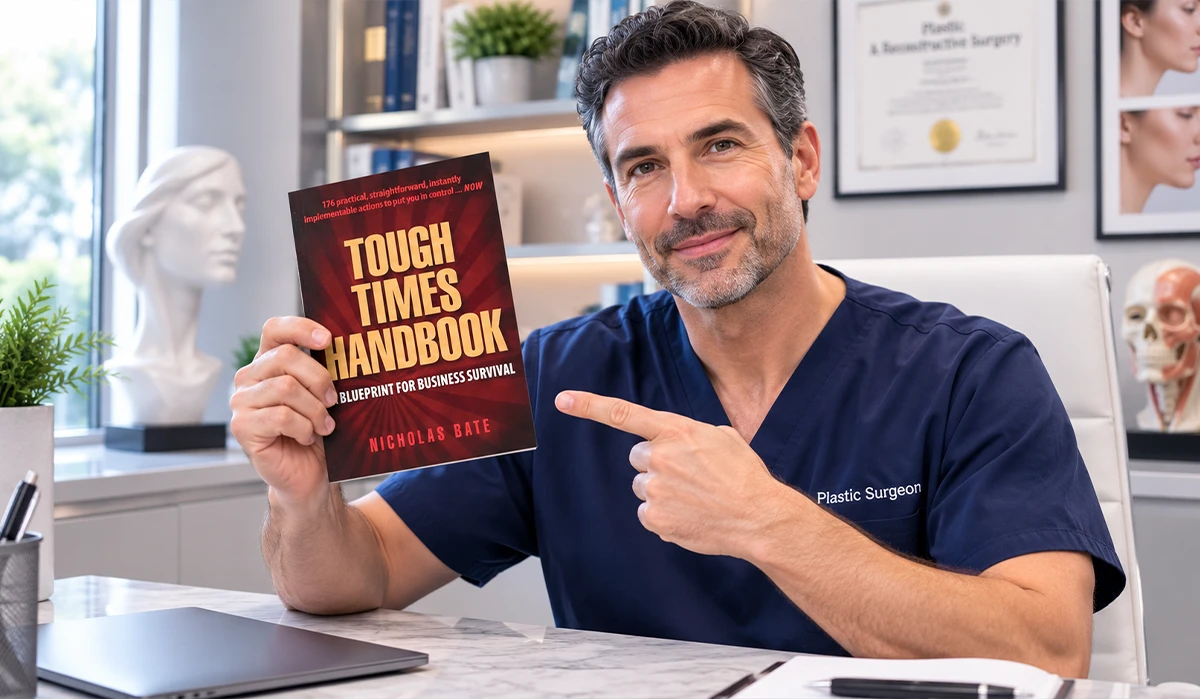
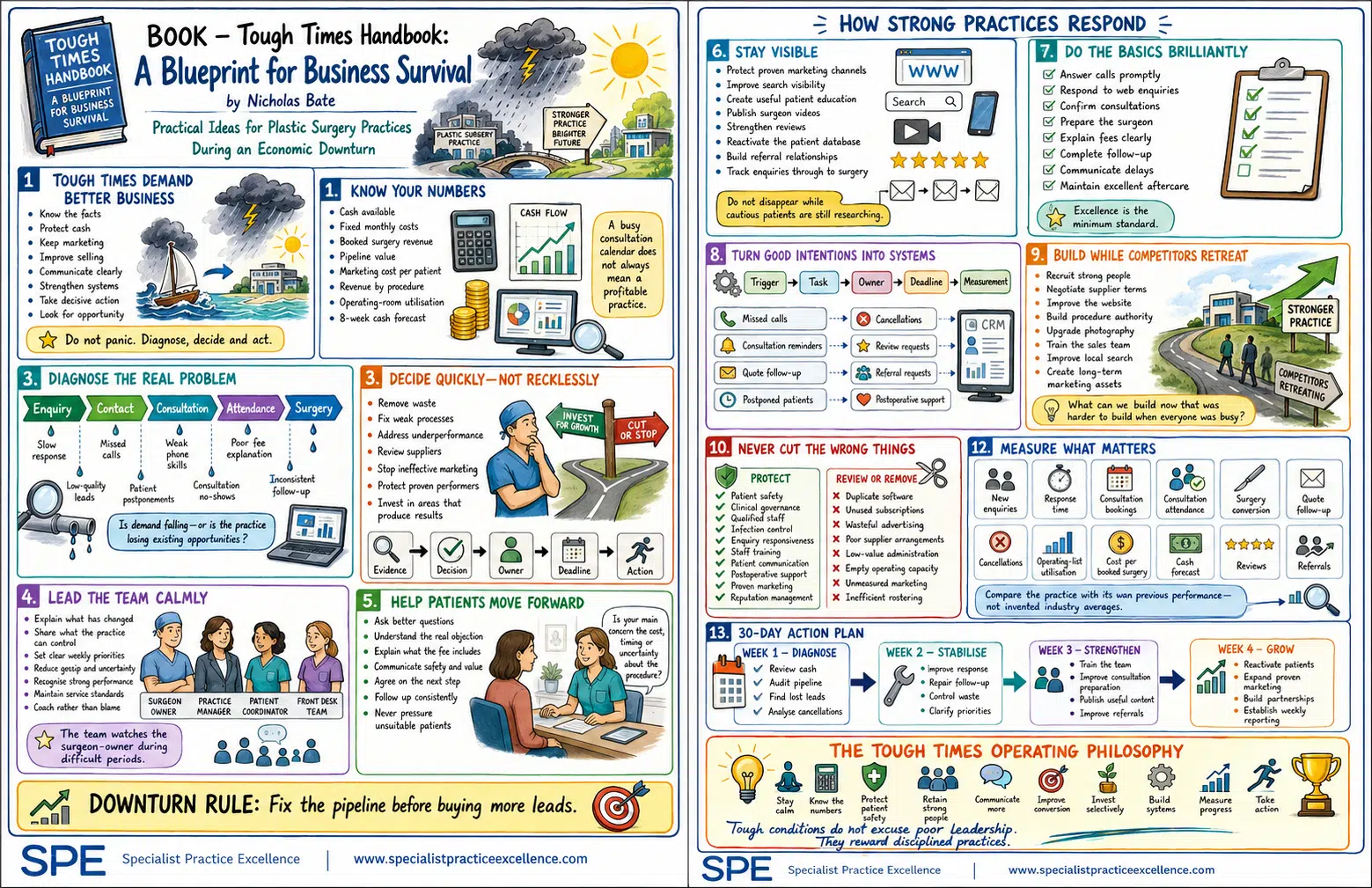
Nicholas Bate’s Tough Times Handbook offers a more useful response: understand the facts, protect cash, improve the basics, communicate clearly, keep selling, retain good people and take decisive action.
The ideas are simple. Their value comes from applying them consistently.
The Central Argument of Tough Times Handbook
The book’s central message can be summarised as follows:
Tough conditions demand clearer facts, better leadership, stronger selling, tighter systems and faster execution—not panic.
The book does not argue that optimism alone will save a business. Nor does it suggest ignoring a genuine fall in demand.
Instead, it encourages business owners to:
- Understand their financial position.
- Make difficult decisions promptly.
- Communicate honestly with employees.
- Strengthen sales and marketing.
- Return to basic operating standards.
- Improve systems and processes.
- invest selectively in future growth.
- Look for opportunities created by disruption.
- Act rather than endlessly discuss.
- Retain a sense of perspective.
This approach is particularly relevant to plastic surgery because aesthetic medicine sits between healthcare and discretionary consumer spending.
The clinical decision must always be based on patient suitability, safety and informed consent. However, the practice still needs commercial discipline. It must generate enquiries, communicate value, manage capacity, collect fees, maintain margins and employ a capable team.
Why Economic Conditions Matter to Aesthetic Surgery
Research supports the premise that aesthetic surgery demand is connected to economic performance.
A 2024 analysis of US aesthetic surgery data from 2006 to 2022 found that changes in GDP per capita were positively associated with numerous procedure-volume and expenditure measures. The authors concluded that economic indicators can provide useful signals for aesthetic practices, although they cannot predict demand perfectly. (PubMed)
A separate longitudinal study found that unemployment was inversely associated with aesthetic surgery expenditure, while major stock indices were positively related to expenditure across most procedure categories studied. The relationships varied by procedure, illustrating that economic pressure does not affect every service in the same way. (PubMed)
Earlier research also found that plastic surgery revenue tracked several economic indicators while online interest in plastic surgery remained relatively persistent during a downturn. This distinction is important: interest may remain high even when immediate purchasing capacity falls. (PubMed)
The likely practice implication is:
A downturn may create a conversion and timing problem rather than a complete disappearance of demand.
Patients may still research procedures, watch surgeon videos, view before-and-after photographs and request guides. However, fewer may be ready to proceed immediately.
That makes nurturing, follow-up, education and trust more important.
The 17 Core Themes
A detailed practitioner summary of the book groups its recommendations into 17 themes. These themes align with the publisher’s description of the work as a broad collection of financial, marketing, leadership and motivational actions. (David Staughton)
1. Focus on the Money
Bate’s first priority is financial clarity.
A business cannot respond intelligently to pressure if the owner does not know:
- How much cash is available
- What is owed
- What must be paid
- Which products or services are profitable
- Which costs are increasing
- Where waste is occurring
- How long existing cash will last
Application to a Plastic Surgery Practice
The surgeon-owner and practice manager should know:
- Revenue by procedure
- Gross contribution by procedure
- Surgeon utilisation
- Operating-room utilisation
- Consultation conversion
- Cancellation and postponement rates
- Marketing cost per booked consultation
- Marketing cost per surgery
- Payroll as a percentage of revenue
- Deposits held
- Outstanding patient balances
- Fixed monthly overhead
- Cash runway
A practice can have a full consultation calendar and still be financially weak if few patients proceed to surgery.
Similarly, high revenue does not guarantee strong profitability. A complex procedure may generate a large fee but also require greater operating-room time, implants, anaesthesia, staffing and postoperative support.
Seven-Day Action
Prepare a one-page financial dashboard showing:
- Cash available
- Expected cash receipts
- Fixed costs
- Variable costs
- Booked surgery revenue
- Unconfirmed pipeline value
- Outstanding balances
- Eight-week cash forecast
2. Get the Knowledge and Facts
Fear grows when facts are absent.
During a downturn, practice owners may rely on comments such as:
- “No one is spending.”
- “Every patient says we are too expensive.”
- “Social media has stopped working.”
- “Everyone is going overseas.”
- “Patients only want discounts.”
These statements may be based on a handful of conversations rather than reliable data.
Application to a Plastic Surgery Practice
The practice should investigate:
- Which procedures have declined
- Which procedures remain stable
- Which lead sources still convert
- Which patient coordinators achieve stronger results
- Which objections are increasing
- How many enquiries are never contacted
- How many consultations fail to attend
- How many quotes receive no structured follow-up
- Why patients postpone
- Why patients select another surgeon
A falling revenue number does not identify the problem.
The weakness may be:
- Fewer enquiries
- Slow response time
- Weak telephone skills
- Poor consultation preparation
- Inconsistent surgeon recommendations
- Inadequate follow-up
- Price positioning
- Reputation problems
- Scheduling delays
- Low-quality leads
- Reduced patient confidence
Seven-Day Action
Review the last 50 lost or postponed surgical opportunities and classify the documented reason for each outcome.
3. Make Tough Decisions
A recurring principle is that decisions must lead to action.
A decision that remains vague, unassigned and undated is merely an intention.
Application to a Plastic Surgery Practice
Potential difficult decisions include:
- Ending an unproductive marketing contract
- Changing the role of an underperforming coordinator
- Removing an unprofitable service
- Consolidating software systems
- Changing operating-room allocation
- Reducing unnecessary opening hours
- Reworking the consultation process
- Increasing fees where margins are inadequate
- Stopping indiscriminate discounting
- Replacing weak suppliers
- Investing more in a proven marketing channel
- Addressing a surgeon’s own contribution to poor conversion
Tough decisions should not become impulsive decisions.
Before acting, assess:
- Patient safety
- Clinical quality
- Legal obligations
- Employment requirements
- Financial effect
- Brand effect
- Patient experience
- Reversibility
- Opportunity cost
Seven-Day Action
Create a decision register with five columns:
| Decision | Evidence | Owner | Deadline | First action |
|---|
4. Engage Your People
Employees watch the surgeon-owner closely during difficult periods.
If the surgeon appears frightened, secretive or erratic, the team is likely to become anxious. Anxiety can produce gossip, poor service, defensive behaviour and avoidance of responsibility.
Application to a Plastic Surgery Practice
The team needs an honest but calm explanation of:
- What has changed
- What remains strong
- What the practice is measuring
- What the leadership team is doing
- What each employee can control
- What standards cannot decline
- How progress will be communicated
The team does not need access to every confidential financial detail. It does need enough context to understand why priorities are changing.
What Employees Can Control
- Speed of response
- Quality of phone conversations
- Consultation attendance
- Follow-up completion
- Database accuracy
- Patient education
- Handover quality
- Review requests
- Referral requests
- Expense awareness
- Schedule utilisation
Seven-Day Action
Hold a 30-minute meeting called What We Can Control, with one measurable commitment from each role.
5. Get Selling
Bate argues that businesses must return to selling rather than assuming products or services will sell themselves.
In a medical setting, selling must remain ethical, informed and patient-centred.
The goal is not to pressure an unsuitable patient. It is to help an appropriate patient understand:
- Their options
- The surgeon’s recommendation
- The likely process
- Risks and limitations
- Total fees
- Recovery requirements
- What differentiates the practice
- What the next step involves
The Downturn Sales Error
A coordinator hears that a patient is worried about money and immediately becomes apologetic.
The coordinator may:
- Avoid explaining the fee
- Offer a discount too early
- Fail to ask what is concerning the patient
- End the conversation quickly
- Fail to schedule follow-up
- Assume the patient cannot afford surgery
This denies the patient a proper value discussion.
A Better Approach
Ask:
- “Which part of the decision feels most difficult?”
- “Is your main concern the total investment, the timing or uncertainty about the procedure?”
- “What would you need to feel comfortable taking the next step?”
- “Would it help if I explained what is included in the surgical fee?”
- “Is anyone else involved in your decision?”
Seven-Day Action
Audit ten recorded or observed enquiry calls and identify whether the coordinator:
- Built rapport
- Asked relevant questions
- Explained the next step
- Communicated value
- Requested the booking
- Agreed on follow-up
6. Improve Your Marketing Effort
One of the worst responses to a downturn is to stop marketing without analysing which channels produce profitable patients.
Marketing is not merely advertising. It includes:
- Positioning
- Reputation
- Patient education
- Website quality
- Search visibility
- Reviews
- Email communication
- Videos
- Referral relationships
- Database reactivation
- Patient experience
- Follow-up
Application to Plastic Surgery
A practice should separate marketing channels into:
- Proven: Consistently generates suitable, converting patients
- Promising: Produces signals but needs improvement
- Unproven: Lacks adequate tracking
- Unproductive: Has sufficient data showing poor results
The answer is not necessarily to spend more. It is to spend with greater accountability.
Seven-Day Action
For every significant marketing channel, document:
- Monthly cost
- Number of enquiries
- Number of consultations
- Number of surgeries
- Revenue
- Approximate contribution
- Lead quality
- Strategic value
7. Get Back to Basics
A major downturn strategy is to become excellent at activities that should already be routine.
For a plastic surgery practice, the basics include:
- Answering the phone professionally
- Responding quickly
- Using the patient’s preferred name
- Recording the correct procedure interest
- Sending consultation information
- Confirming appointments
- Preparing the surgeon
- Providing clear quotes
- Completing follow-up
- Returning calls
- Maintaining a clean environment
- Protecting privacy
- Communicating delays
- Giving accurate recovery information
- Following postoperative protocols
A practice often seeks a new campaign when the real problem is inconsistent execution.
Seven-Day Action
Mystery-shop the practice by phone, website form and text message.
Measure:
- Response time
- Warmth
- Accuracy
- Personalisation
- Clarity
- Confidence
- Follow-up
8. Communicate More
During uncertainty, silence creates its own story.
Patients may interpret poor communication as:
- Disorganisation
- Lack of interest
- Inexperience
- Excessive demand
- Weak aftercare
- Financial instability
Employees may interpret silence as evidence that their jobs are at risk.
Patient Communication Priorities
Communicate clearly about:
- Surgeon credentials
- Procedure suitability
- Expected outcomes
- Risks
- Recovery
- Costs
- Financing arrangements
- Preoperative preparation
- Postoperative support
- What happens next
Seven-Day Action
Map every automated and manual patient communication from first enquiry to the 12-month postoperative review. Remove gaps, contradictions and outdated information.
9. Look for Opportunities
A downturn is not equally damaging to every competitor.
Some practices will:
- Reduce visibility
- Stop publishing
- Lose key employees
- Respond slowly
- Cut patient service
- Become discount-driven
- Delay improving technology
- Neglect their websites
- Abandon follow-up
A disciplined practice may gain share without reducing standards.
Potential Opportunities
- Recruit an experienced coordinator
- Negotiate better supplier terms
- Improve website content
- Build procedure authority
- Obtain more patient reviews
- Develop referring-provider relationships
- Upgrade photography
- Improve video education
- Purchase useful equipment at better terms
- Create stronger systems
- Expand into underserved procedures
- Strengthen the past-patient community
Seven-Day Action
Ask the leadership team:
What can we build now that was harder to build when everyone was busy?
10. Make the Most of Time
A downturn can create extra capacity.
The danger is allowing this capacity to disappear into:
- Unstructured meetings
- Social media browsing
- Repeated discussion
- Low-value administration
- Excessive reporting
- Reacting to every minor issue
Productive Uses of Extra Capacity
- Call postponed patients
- Improve procedure guides
- Record surgeon videos
- Update FAQs
- Train coordinators
- Improve CRM data
- Contact former patients
- Build referral lists
- Audit expenses
- Review consultation notes
- Improve recovery instructions
- Refresh before-and-after libraries
Seven-Day Action
Create a weekly “growth block” of at least two protected hours for every nonclinical leader.
11. Keep Some Fun
Bate includes morale and enjoyment as business disciplines rather than luxuries.
This does not require expensive events.
Useful actions include:
- Celebrating a positive review
- Sharing a patient compliment
- Recognising a well-handled enquiry
- Providing lunch after a demanding clinic
- Marking team milestones
- Holding a light-hearted quiz
- Recognising a process improvement
- Thanking someone publicly
The purpose is not forced cheerfulness. It is to prevent pressure from removing every positive feature of the workplace.
Seven-Day Action
Introduce a five-minute “wins” segment at the beginning of the weekly team meeting.
12. Be Creative and Innovative
Creativity becomes valuable when previous methods stop producing the same results.
Innovation does not always mean purchasing new technology. It may mean changing:
- The consultation format
- How fees are explained
- When follow-up occurs
- Which patients receive video education
- How the surgeon is introduced
- How postponed patients are nurtured
- How operating lists are structured
- How patient questions are collected
- How reviews are requested
Useful Questions
- What are patients repeatedly confused about?
- Which step causes the most delay?
- Which task is performed manually but could be automated?
- Which patient segment is poorly served?
- What would make the consultation easier to attend?
- What would remove uncertainty without creating pressure?
- Which existing resource could be repackaged?
Seven-Day Action
Run a 45-minute team session focused on one question:
How could we make it easier for a suitable patient to move forward?
13. Build Processes and Systems
Good intentions are unreliable without systems.
A coordinator may intend to follow up every quote. Unless the CRM creates tasks, assigns ownership and records completion, patients will be forgotten.
Essential Systems
A plastic surgery practice should have documented systems for:
- New enquiries
- Missed calls
- Consultation booking
- Deposit collection
- Consultation reminders
- No-shows
- Quote creation
- Quote follow-up
- Finance enquiries
- Postponed patients
- Cancellations
- Preoperative preparation
- Postoperative concerns
- Review requests
- Referral requests
- Complaint handling
- Data security
- Marketing consent
- Emergency escalation
Seven-Day Action
Select the highest-value broken process and document:
- Trigger
- Steps
- Owner
- Deadline
- Template
- Escalation
- Measurement
14. Improve Management and Leadership
Leadership becomes more visible when results deteriorate.
The surgeon-owner must move beyond issuing instructions and hoping employees comply.
Effective downturn leadership includes:
- Setting fewer priorities
- Assigning clear ownership
- Reviewing results regularly
- Coaching employees
- Addressing poor performance
- Listening to patient feedback
- Remaining visible
- Maintaining standards
- Avoiding emotional overreaction
Nicholas Bate’s public materials describe excellence as a necessary minimum standard and emphasise raising standards, maintaining momentum and leading through action.
Seven-Day Action
Every leader should ask each direct report:
- What are you working on?
- What result are you responsible for?
- What is blocking you?
- What help do you need?
- What will be completed by next week?
15. Invest for Success
The book does not recommend indiscriminate spending. It argues against attempting to cut a business into long-term strength.
Strategic investment may be appropriate in:
- High-performing employees
- Sales training
- CRM improvement
- Patient education
- Website content
- Search visibility
- Photography
- Data reporting
- Cybersecurity
- Equipment maintenance
- Clinical quality
- Surgeon development
- Reputation building
What Not to Cut
A plastic surgery practice should be extremely cautious about reducing:
- Patient safety measures
- Clinical governance
- Infection control
- Qualified clinical staff
- Staff training
- Postoperative support
- Enquiry response capacity
- Proven marketing
- Data security
- Review and reputation management
Seven-Day Action
Divide expenditure into four groups:
| Category | Meaning |
|---|---|
| Protect | Essential to safety, quality or proven growth |
| Improve | Useful but currently inefficient |
| Pause | Can be delayed without significant harm |
| Remove | Wasteful, duplicated or unproductive |
16. Talk Is Cheap – Take Action
A practice may conduct meetings, commission reports and create strategy documents without changing patient outcomes.
Execution requires:
- One owner
- One deadline
- One measurable result
- One next action
A large strategic plan should be converted into weekly tasks.
Seven-Day Action
End every meeting by documenting:
- What will happen
- Who will do it
- When it will be complete
- How completion will be verified
17. Relax and Retain Perspective
The final theme is not an invitation to become complacent.
It is a reminder that leaders make poorer decisions when they are exhausted, isolated or panicked.
The surgeon-owner should protect:
- Sleep
- Exercise
- Family time
- Thinking time
- Peer support
- Professional advice
- Time away from constant financial news
A calm leader is better able to distinguish a temporary decline from a structural problem.
Seven-Day Action
Schedule one uninterrupted weekly review away from the clinic, phone and inbox.
Verified Nicholas Bate Phrases
The following phrases are publicly verifiable in Nicholas Bate’s official speaking material. They are consistent with the book’s philosophy, although they should not be represented as page-verified quotations from the Australian edition.
“Excellence is the new minimum standard.”
For a plastic surgery practice, this means ordinary service is insufficient when patients are cautious. Responsiveness, clarity and continuity become competitive advantages.
“It’s never about price.”
This should not be interpreted literally. Price matters. The point is that a price objection often includes questions about trust, difference, risk, confidence and perceived value.
“Every objection is your next objective.”
An objection identifies the next subject that requires clarification. It is not an invitation to overpower the patient.
“Practical steps that can be done immediately.”
This reflects the action-oriented nature of Bate’s recession material.
Stories and Case Studies
Why There Are Few Book Stories
The related edition was marketed as containing no pictures, stories or case studies. Its value lies in short actions rather than extended narratives. (Amazon)
One publicly documented recession story comes from business consultant David Staughton rather than Nicholas Bate. Staughton recalls working with struggling businesses after an earlier recession. Sales had fallen and morale was poor. His approach was to redirect attention towards controllable activities, identify what was still working and recognise small wins. (David Staughton)
The lesson for a plastic surgery practice is significant:
When results lag, the team needs evidence of progress before final revenue recovers.
Early positive indicators may include:
- Faster response time
- More conversations
- Higher consultation attendance
- More completed follow-up
- More reactivated patients
- Better online reviews
- More referrals
- Increased video engagement
These leading indicators help maintain momentum.
Five Hypothetical Plastic Surgery Case Studies
Case Study 1: The Premium Facelift Practice
Situation
A premium facial plastic surgeon experiences a 25% reduction in new facelift enquiries over six months.
The immediate proposal is to reduce facelift fees.
Diagnosis
The practice discovers:
- Response time has increased from 15 minutes to four hours.
- Several calls are reaching voicemail.
- The website has not published a new facelift resource in 14 months.
- Consultation follow-up varies by coordinator.
- Nearly 40 postponed patients have received no recent communication.
Bate Principles Applied
- Get the facts
- Return to basics
- Improve marketing
- Build systems
- Take action
Actions
- Restore rapid enquiry response.
- Create a structured missed-call workflow.
- Contact postponed patients with educational updates.
- Publish detailed facelift recovery content.
- Introduce a seven-touch follow-up process.
- Record a surgeon video explaining natural-result planning.
Lesson
The problem was not proven to be the fee. Cutting the price first would have reduced margin without repairing the conversion system.
Case Study 2: The Busy Breast and Body Practice
Situation
The practice receives substantial enquiry volume but surgery bookings have fallen.
Diagnosis
The team measures:
- High enquiry numbers
- Acceptable consultation bookings
- Poor consultation attendance
- Weak post-consultation follow-up
- Inconsistent explanation of what fees include
Actions
- Improve consultation confirmation.
- Send preparation videos before the visit.
- Confirm the patient’s goals before the consultation.
- Introduce a same-day coordinator debrief.
- Schedule the first follow-up before the patient leaves.
- Create a clear fee inclusion sheet.
Lesson
A marketing increase would have placed more patients into a leaking pipeline.
Case Study 3: The Discounting Competitor
Situation
A nearby clinic launches heavily discounted breast augmentation promotions.
The practice fears losing market share.
Response
Rather than matching the discount, the practice strengthens communication around:
- Surgeon qualifications
- Implant selection
- Anaesthesia
- Accredited facilities
- Surgical planning
- Aftercare
- Complication management
- Long-term follow-up
- Revision policy
Lesson
The practice competes by making the total care pathway more visible, not by attacking the competitor or guaranteeing better results.
ASPS advertising guidance requires communications to remain truthful and accurate and prohibits misleading claims, unjustified expectations, unsubstantiated superiority and appeals to patient fear. (American Society of Plastic Surgeons)
Case Study 4: Underused Operating Capacity
Situation
A surgeon has unused operating days but continues paying for reserved capacity.
Actions
- Review list profitability.
- Consolidate low-volume operating days.
- Introduce an ethical short-notice list for already-consented patients.
- Improve cancellation prevention.
- Maintain a list of patients who have asked for an earlier date.
- Negotiate more flexible facility arrangements.
- Analyse which procedures fit unused blocks safely and efficiently.
Lesson
Capacity should be managed deliberately. The practice should not create inappropriate urgency merely to fill an operating day.
Case Study 5: Investing While Competitors Retreat
Situation
A financially stable surgeon notices competitors reducing marketing and staff.
Actions
- Recruit an experienced patient coordinator.
- Build comprehensive procedure content.
- Improve local search visibility.
- Record a library of patient education videos.
- Improve CRM automation.
- Strengthen referring-provider outreach.
- Upgrade before-and-after photography standards.
Lesson
A downturn may be an opportunity to build assets that compound after conditions improve.
Selling Without Discounting
What Patients May Mean by “It Is Too Expensive”
The statement may mean:
- “I do not understand the difference.”
- “I did not expect the total fee.”
- “I am afraid of making a poor decision.”
- “I need to speak with my partner.”
- “I cannot proceed now.”
- “Another quote is lower.”
- “I am unsure the result will justify the cost.”
- “I need more time.”
- “I do not yet trust the practice.”
The coordinator should clarify rather than assume.
Fee Objection Script
“Thank you for telling me. It is a significant decision, and we do not expect you to make it casually. Is your concern mainly the total fee, the timing, or understanding what is included?”
Cheaper Competitor Script
“It makes sense to compare your options. Fees can differ because the surgeon’s approach, facility, anaesthesia, procedure plan and aftercare may differ. I can take you through exactly what is included here so you can make a fair comparison.”
“I Need to Think” Script
“Of course. Which part would be most useful to think through—the procedure itself, recovery, timing, cost or choosing the surgeon?”
Partner Objection Script
“Would it help if we gave you a clear summary to discuss together? We can also arrange a follow-up call after you have both had time to review the information.”
Downturn Concern Script
“That is understandable. This is an elective decision and it should fit your circumstances. We can explain the available timing and payment arrangements, but there is no need to proceed until you feel comfortable.”
Follow-Up Script
“I am checking in because you asked us to contact you after you had time to consider the procedure. What questions have come up since your consultation?”
These scripts should be adapted to applicable laws, financing rules and medical-advertising requirements.
Marketing During a Downturn
1. Increase Education
Patients require more confidence before making a large discretionary commitment.
Develop content answering:
- Am I a suitable candidate?
- What is included in the fee?
- How much time will I need away from work?
- What help will I need at home?
- What happens if I have a concern?
- How long do results typically last?
- What are the limitations?
- How does the surgeon plan the procedure?
- What questions should I ask during consultations?
- How should I compare surgeons?
2. Improve Search and AI Visibility
Create authoritative, structured procedure information covering:
- Candidacy
- Alternatives
- Risks
- Recovery
- Scars
- Anaesthesia
- Facility
- Aftercare
- Revision considerations
- Frequently asked questions
The goal is not merely traffic. It is helping the right patient arrive better informed.
3. Use the Existing Database
Segments may include:
- Enquired but never booked
- Booked but cancelled
- Consulted but undecided
- Postponed for financial reasons
- Postponed for timing
- Past surgical patients
- Nonsurgical patients
- Referring professionals
Messages should be helpful and relevant. Repeated generic promotions can weaken trust.
4. Protect Reputation
Reviews become more influential when patients compare practices carefully.
The FTC’s Consumer Reviews and Testimonials Rule addresses deceptive review practices, including fake reviews and certain undisclosed relationships. Practices must use authentic feedback and avoid misleading review-generation methods. (Federal Trade Commission)
5. Show the Complete Experience
Premium positioning should demonstrate:
- Expertise
- Safety
- Planning
- Consistency
- Personalisation
- Clear communication
- Facility quality
- Team support
- Recovery guidance
- Long-term care
The Downturn Patient Experience Standard
Initial Enquiry
- Respond promptly.
- Use the patient’s name.
- Confirm the procedure of interest.
- Ask what prompted the enquiry.
- Identify the patient’s main question.
- Explain the next step.
- Record the preferred contact method.
- Obtain appropriate marketing consent.
Consultation Booking
- Explain the consultation format.
- Clarify the fee and cancellation policy.
- Send preparation information.
- Confirm location and parking.
- Explain who the patient will meet.
- Ask whether another decision-maker should attend.
- Remind the patient without excessive messaging.
Consultation
- Demonstrate understanding of the patient’s goals.
- Assess clinical suitability.
- Explain realistic options.
- Discuss risks and limitations.
- Avoid guarantees.
- Provide sufficient decision time.
- Present fees clearly.
- Agree on the next contact.
Quote Follow-Up
- Contact the patient as agreed.
- Ask which questions have emerged.
- Avoid repeated “just checking in” messages.
- Provide relevant information.
- Record the outcome.
- Obtain permission for future follow-up.
Preoperative Period
- Provide clear instructions.
- Confirm responsibilities.
- Explain medications and testing.
- Clarify arrival and discharge.
- Ensure the patient knows who to call.
- Identify anxiety early.
Recovery
- Follow clinical protocols.
- Communicate expected milestones.
- Provide escalation instructions.
- Respond promptly to concerns.
- Document communication.
- Avoid replacing clinical judgement with automation.
Weekly Downturn Scorecard
| Area | Metric | Why It Matters |
|---|---|---|
| Demand | New qualified enquiries | Shows current opportunity volume |
| Responsiveness | Median first-response time | Measures access and urgency |
| Contact | Percentage successfully contacted | Finds leakage before consultation |
| Booking | Enquiry-to-consultation rate | Tests phone and enquiry handling |
| Attendance | Consultation show rate | Measures commitment and reminders |
| Conversion | Consultation-to-surgery rate | Indicates suitability, trust and value |
| Follow-up | Quotes followed up on time | Measures process discipline |
| Pipeline | Value of undecided opportunities | Shows potential future revenue |
| Timing | Days from consultation to booking | Reveals longer decision cycles |
| Cancellation | Cancellation and postponement rate | Shows confidence and financial pressure |
| Capacity | Operating-room utilisation | Measures use of expensive resources |
| Marketing | Cost per qualified enquiry | Evaluates channel efficiency |
| Acquisition | Cost per booked surgery | Links marketing with revenue |
| Reputation | New genuine reviews | Supports trust and comparison |
| Referrals | Patient and professional referrals | Measures advocacy |
| Cash | Eight-week cash projection | Protects solvency |
Universal benchmarks should not be invented. Practices should first compare:
- Current performance with their own prior periods
- Procedure with procedure
- Coordinator with coordinator
- Channel with channel
- Surgeon with surgeon, where applicable
30-Day Tough Times Plan
Week One: Diagnose
Finance
- Prepare an eight-week cash-flow forecast.
- Calculate fixed monthly overhead.
- Identify duplicated and unnecessary expenses.
- Review procedure contribution.
- Review deposits, refunds and outstanding balances.
Pipeline
- Audit the last 50 lost or postponed opportunities.
- Measure response time.
- Measure consultation attendance.
- Measure consultation conversion.
- Review quote follow-up.
Marketing
- Identify proven, promising and weak channels.
- Check tracking accuracy.
- Review website conversion paths.
- Review online reputation.
Week Two: Stabilise
- Repair missed-call handling.
- Introduce response-time standards.
- Assign every undecided patient an owner.
- Confirm every consultation.
- Contact postponed patients appropriately.
- Pause clearly wasteful expenditure.
- Protect patient-facing capacity.
- Explain priorities to the team.
Week Three: Strengthen
- Train coordinators on value conversations.
- Improve the fee explanation.
- Build objection-handling resources.
- Update consultation preparation.
- Improve quote follow-up.
- Refresh key procedure content.
- Increase review requests using compliant methods.
- Document one critical workflow.
Week Four: Grow
- Launch segmented database reactivation.
- Build a referral campaign.
- Record surgeon education videos.
- Expand proven marketing.
- Improve local search profiles.
- Recruit strategically where appropriate.
- Establish a weekly scorecard meeting.
- Create a 90-day improvement plan.
90-Day Resilience Plan
Days 1–30: Control
The purpose is to understand the practice and stop avoidable leakage.
Priorities:
- Cash visibility
- Expense control
- Rapid response
- Pipeline accuracy
- Follow-up
- Consultation attendance
- Team communication
Days 31–60: Improve
The purpose is to increase the value of existing demand.
Priorities:
- Coordinator coaching
- Consultation improvement
- Better patient education
- Stronger fee communication
- Review generation
- Referral development
- Website optimisation
- Process documentation
Days 61–90: Expand
The purpose is to capture market share responsibly.
Priorities:
- Invest in proven channels
- Recruit high-quality talent
- Develop procedure authority
- Build local partnerships
- Improve AI and search visibility
- Strengthen past-patient relationships
- Negotiate supplier arrangements
- Develop the next six-month plan
What the Book Gets Right
Action Matters
The book correctly emphasises that fear and discussion do not replace execution.
Financial Literacy Is Essential
A surgeon does not need to become an accountant, but must understand the economic drivers of the practice.
Marketing Should Not Stop Automatically
Reducing ineffective spending is rational. Becoming invisible while demand is more difficult to capture is dangerous.
Good Employees Become More Valuable
Experienced coordinators, nurses, managers and front-desk staff protect revenue and patient experience.
Systems Reduce Leakage
When fewer opportunities are available, losing patients through weak administration becomes more expensive.
Standards Matter More During Pressure
Competitors may become slow, distracted or discount-driven. Consistent service can create differentiation.
Opportunity Exists
A downturn may make employees, suppliers, advertising inventory and market attention more accessible.
What Requires Modern Adaptation
The book was created during the 2008–2009 economic crisis. Several areas require updating.
Digital Patient Behaviour
Modern patients may move across:
- AI assistants
- YouTube
- TikTok
- RealSelf
- Review platforms
- Online communities
- Surgeon websites
Practices need consistent information across these channels.
CRM and Automation
Modern follow-up can be systematised through:
- Task automation
- Email nurturing
- SMS reminders
- Pipeline management
- Call tracking
- Attribution
- Reporting
Automation must support human care rather than replace it.
Privacy and Cybersecurity
Modern practices hold extensive clinical, financial and identity data. Cybersecurity is now a core business-continuity issue.
Online Reviews
Review platforms are more influential and more regulated. Fake, misleading or improperly incentivised reviews can create significant reputational and regulatory risk. (Federal Trade Commission)
Medical Advertising
General business advice must be modified for healthcare.
ASPS guidance prohibits misleading communications, exaggerated claims, unjustified expectations, unsubstantiated superiority, guarantees and certain uses of imagery or testimonials. (American Society of Plastic Surgeons)
Australian practices must also review all tactics against AHPRA, Medical Board of Australia and TGA requirements. UK practices should consider GMC, ASA, CAP and applicable healthcare advertising requirements.
Ten Most Important Lessons for Plastic Surgery Practices
- Know the numbers before making cuts.
- Distinguish reduced demand from poor conversion.
- Protect clinical quality, patient safety and proven performers.
- Make every genuine enquiry count.
- Improve value communication before reducing fees.
- Continue marketing, but demand stronger accountability.
- Use spare capacity to build durable assets.
- Communicate more with patients and employees.
- Turn plans into owned, dated actions.
- Remain calm enough to identify opportunity.
Five Immediate Actions for the Surgeon-Owner
- Review the eight-week cash forecast.
- Identify the three procedures that deserve the greatest focus.
- Clarify the practice’s differentiation.
- Meet with the patient coordinator to review lost cases.
- Record one useful patient education video.
Five Immediate Actions for the Practice Manager
- Build the weekly scorecard.
- Audit expenses.
- Measure response and follow-up.
- Repair the weakest patient process.
- Hold a clear team briefing.
Five Immediate Actions for the Patient Coordinator
- Review every undecided consultation.
- Call patients according to their agreed follow-up dates.
- Improve documentation of objections.
- Practise value-based fee conversations.
- Ensure every interaction ends with a defined next step.
Five Mistakes to Avoid
- Cutting all marketing indiscriminately
- Discounting before diagnosing the problem
- Reducing patient support
- Allowing team anxiety to go unaddressed
- Confusing planning with action
Tough Times Operating Philosophy for Plastic Surgery Practices
We will not deny economic reality, but we will not be controlled by panic.
We will understand our numbers, protect patient safety, retain strong people and use our resources carefully.
We will communicate clearly, respond promptly and help patients make informed decisions without pressure.
We will not damage our reputation through desperate discounts, misleading claims or artificial urgency.
We will improve our systems, strengthen our skills and invest selectively in the parts of the practice that create lasting value.
We will measure what matters, learn quickly and act decisively.
We will use difficult conditions to become a better-led, better-managed and more patient-centred practice.
Final Perspective
The most useful message from Nicholas Bate’s Tough Times Handbook is not that a business can ignore a recession.
It is that a downturn does not excuse poor leadership.
A plastic surgery practice cannot control consumer confidence, interest rates, employment conditions or the stock market. It can control how quickly it responds, how carefully it follows up, how clearly it communicates, how wisely it spends and how consistently it serves patients.
Economic pressure may reduce immediate procedure volume. Research shows that aesthetic spending and procedure activity can move with broader economic conditions. Yet patient interest may remain even when decisions are delayed. (PubMed)
The practices most likely to emerge stronger are not necessarily those that spend the most or discount the deepest.
They are the practices that:
- Retain financial discipline
- Stay visible
- Protect trust
- Develop their teams
- Improve conversion
- Build better systems
- Continue educating patients
- Invest in durable advantages
- Take action while competitors hesitate
That is the practical meaning of a blueprint for business survival.
FAQs for Tough Times
Focus on cash flow, conversion, patient follow-up and proven marketing rather than automatic fee reductions. Strong value communication can protect premium positioning while helping suitable patients make informed decisions.
Cutting marketing can make the practice invisible while patients are still researching procedures. Review each channel carefully and protect the activities that consistently generate qualified consultations and surgery bookings. Accountants will advise to cut all costs, but in toiugh times there is a great opportunity to grow market share.
Patients may have less disposable income, lower confidence or greater concern about their employment and rising household expenses. Many remain interested in surgery but take longer to research, compare surgeons and commit. Lots of Looking but not much B
Nicholas Bate emphasises knowing the numbers, improving sales, communicating clearly, protecting strong employees and taking decisive action. These principles help practices become more disciplined when demand becomes unpredictable.
Track every stage from enquiry to surgery, including response time, contact rate, consultation attendance and conversion. A weak pipeline often looks like a market problem until the practice examines where patients are dropping out.
Resilience varies by market, patient group and procedure motivation. Medically functional procedures, revisions and treatments linked to major life changes may behave differently from procedures that patients view as easier to postpone.
Coordinators should explain what the fee includes, clarify the patient’s concern and avoid assuming that cost is the only objection. The conversation should remain helpful, transparent and free from pressure.
Yes, particularly when competitors reduce visibility, delay responses or weaken patient service. A financially stable practice may gain market share by improving content, recruitment, systems, reputation and referral relationships.
Practices should protect patient safety, qualified clinical staff, infection control, postoperative support, staff training and proven marketing. Short-term savings in these areas can create greater clinical, financial and reputational risks.
Use personalised follow-up based on the patient’s procedure, timing and previous concerns. Educational updates, surgeon videos and respectful check-ins are usually more effective than repeated promotional messages.
Cautious patients often contact several practices and closely assess how each team communicates. A fast, empathetic response can build trust before the patient has formed a strong preference for another surgeon.
Track new enquiries, response time, consultation bookings, attendance, surgery conversion, cancellations, follow-up completion, operating capacity and cash flow. These figures show whether the problem is demand, execution or both.
Improve patient education, clarify the treatment pathway and answer concerns about recovery, risks, costs and aftercare. Ethical conversion means helping appropriate patients make confident decisions, not pressuring them to proceed.
Responsible financing options may help suitable patients manage timing and cash flow, but terms must be explained clearly. Financing should never be used to minimise affordability concerns or encourage an unsuitable financial commitment.
The biggest mistake is reacting before diagnosing the real problem. Indiscriminate cost cutting, discounting and reduced marketing may damage the practice when the underlying issue is slow response, weak follow-up or poor conversion.