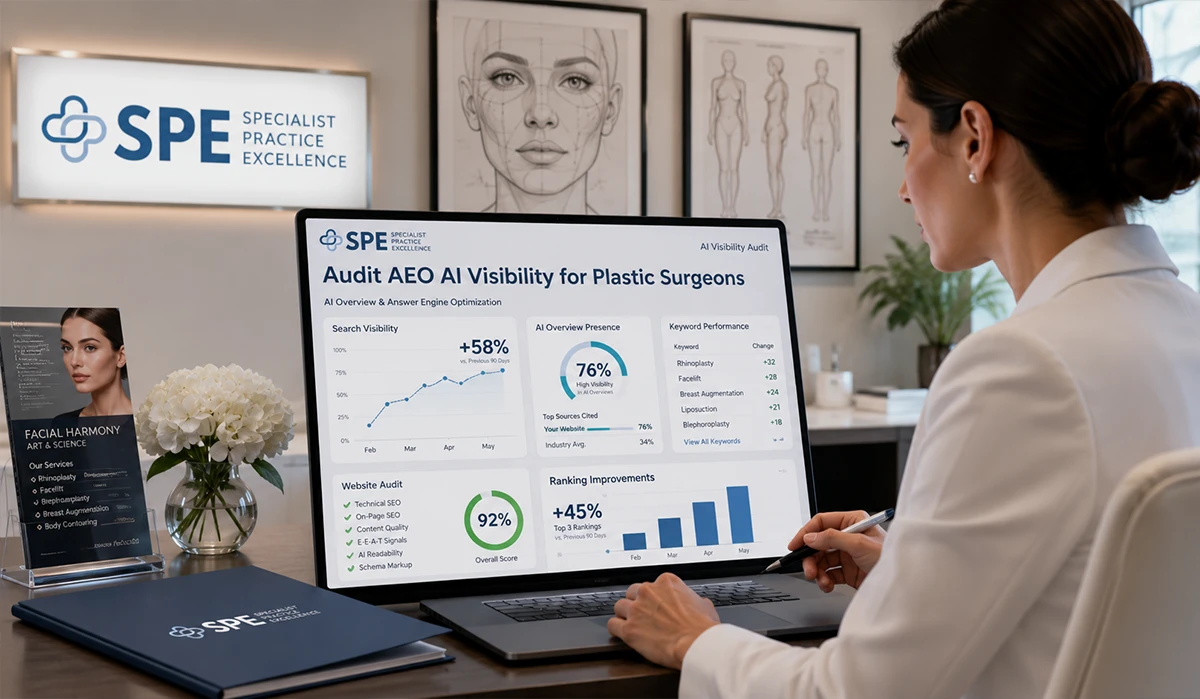
Website Architecture for Plastic Surgery Websites
A content hub (also called a topic cluster) is an SEO and user experience strategy where you build a group of highly related pages around one important procedure or topic.
Instead of having one proceedure page about “Facelift” you create an entire ecosystem of content that answers every question a prospective patient might have throughout their decision-making journey.
Google increasingly rewards websites that demonstrate topical authority rather than simply having one page targeting a keyword.
For a plastic surgery practice, this is one of the highest ROI SEO strategies because patients spend weeks or months researching before booking.
Structure of a Content Hub – Facelift Example
FACELIFT HUB
│
Pillar Procedure Page
│
┌────────┬────────┬────────┬────────┐
│ │ │ │ │
Support Support Support Support Support
Page 1 Page 2 Page 3 Page 4 Page 5
│
─────────────────────────────────────────────
Blog Articles
Blog Articles
Blog Articles
Blog Articles
FAQs
Videos
Before & After
Every page links back to the pillar page.
Every support page links to each other where appropriate.
Blogs link into both the support pages and the pillar.
The pillar links back out to everything.
This creates a strong internal linking structure that Google understands.
1. The Pillar Page e.g. Deep Plane Facelift
The pillar page is the main procedure page.
For example
Deep Plane Facelift
This is the page designed to rank for the primary commercial keywords.
Example keywords
- Deep Plane Facelift
- Facelift Surgeon Dallas
- Facelift Specialist Dallas
- Best Deep Plane Facelift
- Deep Plane Facelift Cost
- Deep Plane Facelift Recovery
This page might be 2,500–4,000 words.
It explains
- Overview
- Benefits
- Who is suitable
- Procedure
- Recovery
- Risks
- Cost
- Before & After
- FAQs
- CTA
It becomes the “home page” for everything about facelifts.
2. Support Pages
Instead of forcing every topic onto one massive page, each important sub-topic receives its own page.
Example:
RECOVERY – Support Page 1
Deep Plane Facelift Recovery
Keywords
- facelift recovery
- recovery after facelift
- swelling after facelift
Content
- Recovery timeline
- Week by week
- Pain
- Sleeping
- Exercise
- Returning to work
COST – Support Page 2
Facelift Cost Guide
Keywords
- facelift cost
- facelift financing
- why facelifts cost what they do
Content
- What affects pricing
- Why prices vary
- Value vs cost
- Financing
(Ensure claims comply with local advertising regulations—for example, AHPRA/TGA in Australia.)
Support Page 3
Deep Plane vs SMAS Facelift
Keywords
- Deep Plane vs SMAS
- Which facelift is better
Support Page 4
Who Is a Good Candidate?
Keywords
- Am I too young?
- Am I too old?
- Best age for facelift
Support Page 5
Facelift Risks & Safety
Keywords
- Risks
- Safety
- Nerve injury
- Anaesthesia
- Smoking
- Recovery problems
Each support page is usually 1,500–2,500 words.
3. Supporting Blogs
Blogs answer the hundreds of questions patients ask during research.
Examples
- How long does facelift swelling last?
- Can I colour my hair after a facelift?
- What happens after 10 years?
- Can men have facelifts?
- Does weight loss affect a facelift?
- Will people know I had surgery?
- How painful is recovery?
- What age is too old?
- How long do scars stay red?
- Can fillers replace a facelift?
Each blog answers one question exceptionally well.
Typically 1,000–2,000 words.
Example Internal Linking
Pillar Page
Deep Plane Facelift
↑ ↑ ↑
Support Pages
- Recovery
- Cost
- Candidates
- Safety
- Deep Plane vs SMAS
↑ ↑ ↑ ↑
Blogs
- Sleeping After Surgery
- Swelling Timeline
- Pain
- Scar Care
- Driving
- Flying
- Exercise
- Hair Washing
Every blog eventually links upward.
Google interprets this as expertise.
Why This Works
Google wants to identify who is the authority on facelifts.
Imagine Website A
Facelift Page
800 words
That’s it.
Website B
Facelift Page
Recovery Guide
Cost Guide
Scar Guide
Safety Guide
Deep Plane Guide
35 Blogs
120 FAQs
Videos
Before & After
Patient Stories
Google sees far more evidence that Website B comprehensively covers the topic, making it more likely to rank for a wider range of relevant searches.
Content Hub Example
Rhinoplasty Hub
Pillar
- Rhinoplasty
Support Pages
- Recovery
- Cost
- Revision Rhinoplasty
- Functional vs Cosmetic Rhinoplasty
- Risks
Blogs
- Can I wear glasses?
- How long is swelling?
- Sleeping after rhinoplasty
- Flying after surgery
- Exercise
- Taping
- Steroid injections
- Ethnic rhinoplasty
- Thick skin
- Thin skin
- Open vs closed rhinoplasty
Breast Augmentation Hub
Pillar
- Breast Augmentation
Support Pages
- Recovery
- Implant Types
- Cost
- Risks
- Implant Placement
Blogs
- Silicone vs saline
- Motiva vs Mentor
- When can I exercise?
- Do implants need replacing?
- Pregnancy after implants
- Breastfeeding
- Rippling
- Animation deformity
- Implant illness
- Capsular contracture
Tummy Tuck Hub
Pillar
- Tummy Tuck
Support Pages
- Recovery
- Cost
- Muscle Repair
- Risks
- Candidacy
Blogs
- Drain vs drainless
- Compression garments
- Returning to work
- Walking after surgery
- Scar care
- Sleeping position
- Exercise timeline
- Weight loss first?
- Future pregnancy
- Dog ears
An Ideal Plastic Surgery Content Hub
For each major procedure, a mature content hub typically includes:
| Content Type | Target Quantity |
| Pillar page | 1 |
| Support pages | 5–10 |
| Educational blogs | 20–50 |
| FAQs | 50–100 |
| Patient stories/case studies | 10–20 |
| Before & after galleries | 30–100+ cases |
| Videos | 15–30 |
| Infographics/downloadable guides | 2–5 |
| Consultation landing page | 1 |
Patient Journey Mapping
A well-designed hub aligns content with how patients make decisions:
| Decision Stage | Content Type |
| Awareness | Educational blogs, symptom guides, “Am I a candidate?” articles |
| Consideration | Pillar page, comparison pages, FAQs, videos, before-and-after galleries |
| Decision | Cost guide, recovery guide, surgeon credentials, testimonials, consultation page |
| Confidence | Patient stories, detailed FAQs, downloadable guides, post-consult resources |
Why This Is So Effective for Plastic Surgeons
Plastic surgery is a high-consideration purchase. Patients rarely book after reading a single procedure page. Instead, they consume dozens of pieces of content across multiple sessions and devices before making contact.
A comprehensive content hub:
- Builds topical authority for Google, improving rankings across hundreds of related search terms.
- Increases the number of indexed pages, expanding the practice’s search footprint.
- Captures long-tail searches that often have high intent and lower competition.
- Keeps users engaged with logical internal linking, increasing time on site and reducing bounce rates.
- Builds trust by demonstrating expertise and answering questions before patients need to ask them.
- Improves conversion rates by guiding visitors naturally from education to consultation.
For established plastic surgery practices, building a complete content hub around each high-value procedure—such as facelift, rhinoplasty, breast augmentation, tummy tuck, eyelid surgery, liposuction, or mommy makeover—is often one of the most effective long-term investments in organic search visibility and patient acquisition.
MORE DETAIL
Plastic Surgery Content Hub Strategy
A Content Hub (also called a Topic Cluster) is a structured SEO and patient education framework built around one major procedure or treatment.
Rather than relying on a single procedure page to rank in Google, the website becomes the definitive resource on that topic by creating a network of highly relevant pages that answer every question a patient may ask throughout their decision-making journey.
Google increasingly rewards topical authority. The more comprehensive, interconnected and useful your content is, the more likely your website is to rank for both high-volume and long-tail searches.
For plastic surgeons, this strategy also mirrors the real patient journey. Most patients research for weeks or months before booking a consultation. They compare surgeons, learn about procedures, watch videos, read reviews and search for answers to dozens of specific questions.
A content hub ensures your website answers those questions instead of sending patients to your competitors.
The Content Hub Structure
Procedure Content Hub
Pillar Page
│
┌──────────────┬──────────────┬──────────────┬──────────────┬──────────────┐
│ │ │ │ │
Support Support Support Support Support
Page 1 Page 2 Page 3 Page 4 Page 5
│
│
Educational Blogs
FAQs
Videos
Before & After
Patient Stories
Downloadable Guides
Each piece of content supports every other piece through strategic internal linking.
The Pillar Page
The pillar page is the centre of the content hub.
This is the page designed to rank for the primary commercial keywords and generate consultation enquiries.
Example
Deep Plane Facelift
Target keywords might include:
- Deep Plane Facelift
- Facelift Surgeon Dallas
- Best Deep Plane Facelift
- Deep Plane Facelift Specialist
- Facelift Surgery
- Deep Plane Neck Lift
- Facelift Cost
- Facelift Recovery
Typical content includes:
- Overview of the procedure
- Why patients choose it
- Benefits
- Who is suitable
- Surgical technique
- Anaesthesia
- Recovery
- Risks
- Before & After gallery
- Frequently Asked Questions
- Consultation process
- Call to Action
Length
Approximately 2,500–4,000 words.
The Five Core Support Pages
These pages allow each major topic to rank independently while supporting the main procedure page.
Support Page 1
Facelift Recovery Guide
Purpose
Become the definitive recovery resource.
Potential headings
- Day-by-day recovery timeline
- Week 1 expectations
- Weeks 2–6 recovery
- Returning to work
- Sleeping positions
- Bruising
- Swelling
- Exercise
- Hair washing
- Driving
- Flying
- Scar care
- Massage
- Warning signs
- Long-term healing
Target keywords
- Facelift Recovery
- Recovery After Facelift
- Facelift Healing Timeline
- Swelling After Facelift
- How Long Does Recovery Take?
Support Page 2
Facelift Cost, Value & Financial Planning Guide
Purpose
Help patients understand investment rather than simply price.
Potential sections
- What determines facelift pricing?
- Why surgeons charge different fees
- Hospital fees
- Anaesthesia costs
- Revision surgery costs
- Combining procedures
- Financing options (where appropriate)
- Value versus cheapest price
- Choosing a surgeon
Target keywords
- Facelift Cost
- Cost of Deep Plane Facelift
- Facelift Financing
- Why Are Facelifts Expensive?
Support Page 3
Deep Plane vs SMAS vs Mini Facelift Comparison Guide
Purpose
Capture comparison searches.
Potential sections
- What is a SMAS facelift?
- What is a Deep Plane facelift?
- Mini facelift explained
- Which lasts longer?
- Which produces the most natural result?
- Recovery differences
- Scar differences
- Candidate selection
- Common misconceptions
Target keywords
- Deep Plane vs SMAS
- Mini Facelift vs Deep Plane
- Which Facelift Is Best?
Support Page 4
Who Is the Best Candidate for a Facelift?
Purpose
Answer self-diagnosis questions.
Potential sections
- Best age
- Skin quality
- Heavy neck
- Jowls
- Weight considerations
- Previous fillers
- Previous facelift
- Smokers
- Men vs women
- When surgery is not recommended
Target keywords
- Am I Too Young?
- Am I Too Old?
- Do I Need a Facelift?
- Best Age for Facelift
Support Page 5
Facelift Risks, Safety & Frequently Asked Concerns
Purpose
Build trust by addressing fears openly.
Potential sections
- Risks
- Nerve injury
- Bleeding
- Infection
- Hair loss
- Scarring
- Anaesthesia
- Smoking
- Blood thinners
- Recovery complications
- Choosing an experienced surgeon
Target keywords
- Facelift Risks
- Is Facelift Safe?
- Facelift Complications
Supporting Educational Blogs
Blogs answer the hundreds of individual questions patients ask Google.
Each article targets one search intent.
Each article links naturally back to the support pages and pillar page.
Below are examples.
Recovery Blogs
- Facelift Recovery Day by Day: What to Expect During the First Month
- The First 72 Hours After a Facelift Explained
- Week-by-Week Facelift Recovery Timeline
- How Long Does Swelling Last After a Facelift?
- How Long Will Bruising Last?
- When Can I Sleep on My Side Again?
- Sleeping Comfortably After Facelift Surgery
- When Can I Drive After Surgery?
- Flying After a Facelift: When Is It Safe?
- When Can I Return to Exercise?
- Returning to Work After a Facelift
- When Can I Wash My Hair?
- Why One Side May Swell More Than the Other
- How Long Does Tightness Last?
- Scar Care Tips After Facelift Surgery
Results & Longevity Blogs
- How Long Does a Deep Plane Facelift Last?
- Will I Still Look Like Myself?
- Will People Be Able to Tell I Had Surgery?
- What Happens Ten Years After a Facelift?
- Does Weight Loss Affect My Results?
- Can Weight Gain Affect My Facelift?
- Why Facelifts Continue to Age Naturally
- Can I Delay Ageing After Surgery?
- Does a Facelift Stop Ageing?
Comparison Blogs
- Deep Plane vs SMAS Facelift
- Deep Plane vs Mini Facelift
- Facelift vs Fillers
- Facelift vs Thread Lift
- Facelift vs RF Skin Tightening
- Facelift vs Ultherapy
- Neck Lift vs Facelift
- Mini Neck Lift vs Full Neck Lift
- Endoscopic Facelift vs Deep Plane
- Surgical vs Non-Surgical Rejuvenation
Cost & Planning Blogs
- Why Facelift Prices Vary So Much
- What Is Included in the Cost of Surgery?
- Is a Facelift Worth the Investment?
- How to Compare Quotes Between Surgeons
- Why the Cheapest Facelift Can Become the Most Expensive
- Can I Combine Procedures to Save Recovery Time?
- Understanding Hospital and Anaesthesia Fees
Candidate Blogs
- Am I Too Young for a Facelift?
- Am I Too Old for a Facelift?
- Can Men Have Deep Plane Facelifts?
- Is There an Ideal Age?
- Can You Have a Facelift After Weight Loss?
- Facelift After Ozempic or GLP-1 Weight Loss
- Can Smokers Have Facelift Surgery?
- Can I Have a Facelift If I’ve Had Fillers?
- Revision Facelift: Who Needs One?
Safety Blogs
- Is General Anaesthesia Necessary for a Facelift?
- Understanding IV Sedation vs General Anaesthesia
- How Safe Is Modern Facelift Surgery?
- Common Risks Explained Honestly
- How Experienced Surgeons Reduce Complications
- Why Following Recovery Instructions Matters
Lifestyle Blogs
- Travelling After Facelift Surgery
- Eating During Recovery
- Hair Colouring After Surgery
- Wearing Makeup After a Facelift
- Wearing Glasses After Surgery
- Going Back to the Gym
- Returning to Golf, Tennis and Other Sports
- Sun Exposure After Surgery
- Alcohol After a Facelift
- Smoking and Healing
Emotional & Decision-Making Blogs
- How to Know You’re Ready for a Facelift
- Should I Wait Another Year?
- Why Many Patients Say “I Wish I’d Done It Earlier”
- How to Choose the Right Plastic Surgeon
- Questions to Ask During Your Consultation
- Red Flags When Choosing a Surgeon
- What Makes a Great Facelift Result?
- How to Avoid an Overdone Appearance
- Understanding Natural-Looking Facial Rejuvenation
Additional Content That Strengthens the Hub
Beyond the pillar page, support pages and blogs, an elite content hub also includes:
FAQs (50–100+)
- Short, searchable answers to highly specific patient questions that may not justify a full blog but still attract long-tail traffic.
Before & After Galleries
- Organised by age, concern, gender, surgical technique and degree of correction, with educational commentary explaining each case.
Patient Stories & Testimonials
- Real patient journeys covering motivations, recovery experiences and outcomes, helping future patients relate to the process.
Educational Videos
- Procedure overviews, surgeon explanations, recovery diaries, FAQs, consultation insights and myth-busting videos that complement written content.
Downloadable Guides
- Resources such as “The Complete Guide to Deep Plane Facelift Surgery,” recovery checklists and consultation preparation guides that also support lead generation.
Why This Works
A patient rarely searches just once for “facelift surgeon.” Instead, they might perform 20–50 related searches over several weeks, such as:
- “How painful is facelift recovery?”
- “Deep Plane vs SMAS facelift”
- “Best age for facelift”
- “Facelift scars after one year”
- “How long does swelling last?”
- “Can fillers replace a facelift?”
- “Why do facelift prices vary?”
- “What questions should I ask my plastic surgeon?”
If your website contains high-quality answers to every one of these questions—and each page links back to your pillar page—Google recognises your practice as a topical authority. At the same time, patients remain within your website throughout their research journey, building familiarity and trust before they ever book a consultation.
This model can be replicated for every major procedure—rhinoplasty, breast augmentation, tummy tuck, eyelid surgery, liposuction, mommy makeover, body lift, labiaplasty and others—creating a scalable content architecture that strengthens SEO, improves user experience and increases consultation enquiries over time.
Absolutely. The mechanics of a content hub are only half the story. The quality, depth and strategic planning of the content determine whether it becomes an average SEO asset or a market-leading authority. Below are additional best practices I recommend to writers creating content hubs for plastic surgeons.
Think Like a Patient, Not a Keyword Research Tool
Many writers start with keywords.
Elite writers start with patient psychology.
Ask:
- What is the patient worried about?
- What is confusing them?
- What myths have they heard?
- What objections stop them booking?
- What will they search next?
Every page should reduce uncertainty.
Give Every Page a Unique Purpose
Avoid writing five pages that all say the same thing.
Each page should answer a completely different question.
Poor example
- Facelift Recovery
- Facelift Healing
- Recovering From Facelift
These are essentially duplicates.
Better
- Week-by-Week Recovery Timeline
- Managing Swelling & Bruising
- Sleeping & Exercise After Surgery
- Returning to Work
- Scar Care
Each page has a distinct search intent.
Map Content to the Patient Journey
Don’t only write for people ready to book.
Create content for every stage.
Awareness
- Why do my jowls suddenly look worse?
- Why has my neck aged so quickly?
Research
- Deep Plane vs SMAS
- Facelift vs Fillers
Evaluation
- How do I choose a surgeon?
- Questions to ask during consultation
Decision
- Cost
- Recovery
- Safety
- Before & After
Advocacy
- Long-term care
- Maintaining results
- Skin care after surgery
Create “Cornerstone” Assets
Some pages deserve exceptional investment.
Examples
- Ultimate Guide to Deep Plane Facelift
- Complete Rhinoplasty Guide
- Complete Breast Augmentation Guide
These can be 5,000–10,000 words with:
- diagrams
- illustrations
- videos
- FAQs
- downloadable PDFs
- recovery timelines
- comparison tables
These often become the highest authority pages on the website.
Use Semantic SEO, Not Keyword Stuffing
Google understands concepts.
Instead of repeating
Deep Plane Facelift
include related terminology naturally:
- facial rejuvenation
- SMAS
- platysma
- neck lift
- facial ageing
- jowls
- marionette lines
- cervicomental angle
- skin laxity
- retaining ligaments
- facial volume loss
This strengthens topical relevance.
Create Topic Depth Before Expanding Breadth
Many clinics publish:
- Facelift
- Rhinoplasty
- Tummy Tuck
- Breast Augmentation
Then stop.
A stronger strategy is to dominate one procedure first.
Example
Facelift
↓
40 blogs
↓
8 support pages
↓
100 FAQs
↓
30 videos
↓
50 gallery cases
↓
Patient stories
↓
Downloadable guide
Only then move onto Neck Lift.
Google tends to reward depth.
Build Internal Linking Intentionally
Don’t randomly link pages.
Every link should answer:
“What should the patient read next?”
Example
Facelift Recovery
↓
Scar Care
↓
Sleeping After Surgery
↓
Exercise
↓
Facelift FAQ
↓
Consultation
Natural progression.
Use Consistent Terminology
Don’t call it
- Facelift
- Face Lift
- Facial Lift
- Rhytidectomy
randomly.
Pick a preferred naming convention.
Maintain consistency across:
- URLs
- H1
- title tags
- internal links
- CTAs
Answer One Question Per Section
Every heading should answer a question.
Instead of
Recovery
write
How Long Does Facelift Recovery Take?
Instead of
Risks
write
What Are the Risks of Facelift Surgery?
Google increasingly rewards question-based content.
Include Comparison Tables
These rank well.
Examples
| Deep Plane | SMAS |
| Recovery | Recovery |
| Longevity | Longevity |
| Candidates | Candidates |
| Scars | Scars |
Google loves structured comparisons.
Patients do too.
Use Original Surgeon Expertise
This is one of the biggest competitive advantages.
Instead of generic content,
include:
“In my practice…”
“I generally recommend…”
“Most of my patients…”
“One misconception I often see…”
These demonstrate first-hand experience and help satisfy Google’s emphasis on experience and expertise.
Build Supporting Media Around Every Page
Don’t publish text only.
Aim for:
- custom diagrams
- before & after examples
- videos
- animations
- infographics
- downloadable checklists
Multiple media formats improve engagement and accessibility.
Create a Logical URL Structure
Example
/facelift/
/facelift/recovery/
/facelift/cost/
/facelift/deep-plane-vs-smas/
/facelift/risks/
/facelift/candidate/
This reinforces the relationship between pages for users and search engines.
Refresh the Hub Regularly
Don’t publish and forget.
Update:
- statistics
- FAQs
- images
- videos
- internal links
- before & after cases
- surgeon commentary
- emerging techniques
- new patient questions
Fresh, maintained hubs generally outperform static ones over time.
Avoid Cannibalisation
Every page should have one primary keyword focus.
Poor
Recovery Page
“Facelift Recovery”
Blog
“Facelift Recovery”
FAQ Page
“Facelift Recovery”
Instead
Recovery Guide
↓
Week-by-Week Recovery
↓
Sleeping After Surgery
↓
Exercise
↓
Scar Care
↓
Bruising Timeline
Each page targets a different search intent.
Think Beyond Google
A well-structured content hub can be repurposed into:
- YouTube videos
- podcast episodes
- consultation handouts
- email nurture sequences
- downloadable patient guides
- FAQ pages
- social media posts
- Google Business Profile posts
- AI chatbot knowledge bases
- voice assistant responses
One authoritative article can generate dozens of supporting content assets.
Measure Success at the Hub Level
Don’t judge success by whether a single page ranks #1. Instead, track the performance of the entire cluster:
- Total organic traffic across the hub
- Number of ranking keywords
- Growth in top-3 and top-10 positions
- Internal click paths between pages
- Average engagement time
- Consultation enquiries attributed to the hub
- Assisted conversions (where a hub page influenced an enquiry)
- Featured snippets and AI Overview citations
- Backlinks earned by the cluster
- Percentage of relevant patient questions covered
A mature content hub should behave like a self-reinforcing ecosystem: each new high-quality page strengthens the authority of the others, improving the visibility and conversion potential of the entire procedure category rather than relying on a single “hero” page.
About Specialist Practice Excellence
Specialist Practice Excellence helps plastic surgeons and aesthetic practices build stronger websites that attract, educate and convert more suitable patients. SPE develops practical SEO, AEO and content strategies based on how patients research procedures before booking a consultation. This includes procedure pages, content hubs, educational blogs, FAQs, patient resources, internal linking plans and conversion pathways that work together as one coordinated system.
About David Staughton
David Staughton is a practice growth consultant, speaker and specialist practice strategist who works with plastic surgeons and practice teams across Australia, the United States and the United Kingdom. He helps practices identify gaps in their website content, strengthen their authority around priority procedures and turn clinical knowledge into clear, patient-friendly resources. His approach combines SEO strategy, patient psychology, practice positioning and conversion improvement to help surgeons build a more visible and trusted online presence.
Build a Stronger Content Strategy for Your Practice
A successful content hub requires more than publishing a collection of disconnected articles. Each page should have a clear purpose, target a specific stage of the patient journey, and guide readers towards the next useful resource or action.
Specialist Practice Excellence can audit your existing website, identify missing content, plan procedure-based content hubs and create a prioritised strategy for blogs, FAQs, videos, galleries and patient guides.
To discuss a content hub or website growth strategy for your practice, contact us.