
Executive Summary
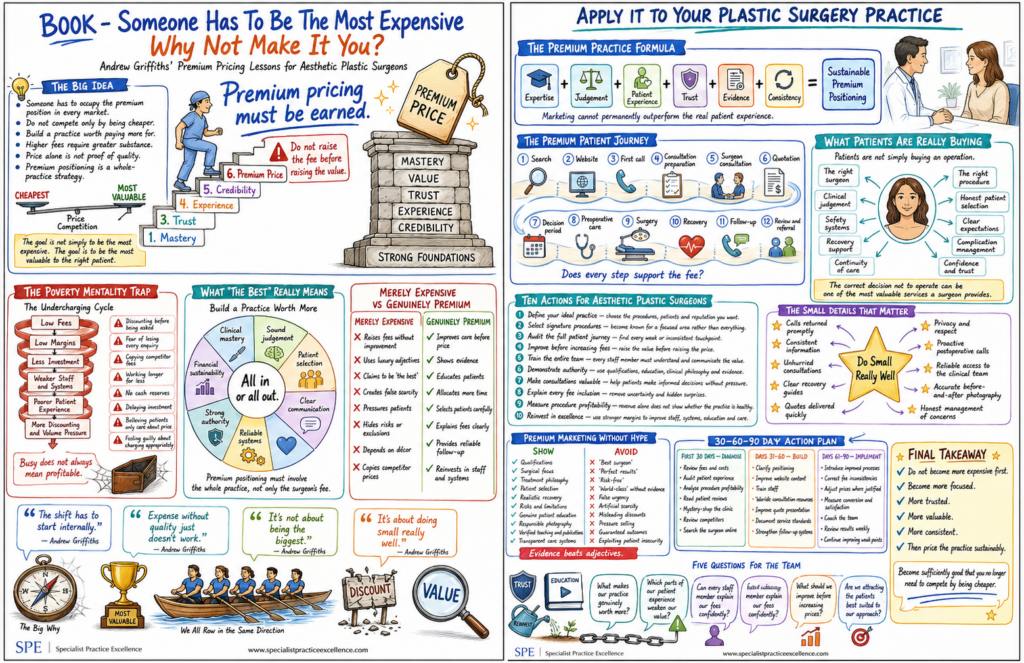
Andrew Griffiths’ central argument is provocative but easily misunderstood. He is not telling business owners to increase prices without justification. He is telling them to build a business that is so capable, trusted, distinctive and valuable that charging a premium becomes commercially credible.
His qualification is essential: “But if you’re going to be the most expensive, you have to be the best.”
The word best does not simply mean technically competent. Griffiths uses it more broadly. It includes:
- Mastery of the core service
- Exceptional customer care
- A memorable experience
- Strong communication
- Clear differentiation
- Credibility and authority
- Attention to small details
- Financial sustainability
- Consistent staff behaviour
- Confidence in discussing value
- A willingness to specialise
- The courage to reject price-based competition
The book was developed from Griffiths’ decades of entrepreneurial experience. Its stated purpose is to address undercharging, undervaluation and the “quiet poverty” that can exist behind businesses that look successful from the outside.
For an aesthetic plastic surgeon, the message is not:
Charge more because you are a surgeon.
It is:
Build a practice whose clinical standards, judgement, communication, patient selection, service, systems and reputation justify an appropriate premium.
Price alone is not evidence of quality. A highly priced surgeon may still provide poor communication, inconsistent care or an undifferentiated experience. Conversely, an excellent surgeon may be undercharging because the clinic has failed to communicate, package and consistently deliver the value surrounding the surgeon’s expertise.
The book therefore provides a useful framework for answering five questions:
- Are we charging enough to provide excellent and sustainable care?
- What would have to improve before we could credibly charge more?
- Are we attracting patients who value our philosophy and expertise?
- Does every part of the patient journey support our positioning?
- Can the entire team clearly explain why patients choose this practice?
The Book in Ten Sentences
- Many apparently busy businesses are financially weak because they do not charge enough.
- Undercharging is often caused by fear, low confidence and scarcity thinking.
- Being the cheapest is rarely a sustainable point of difference.
- Modern customers are not always searching for the lowest price; many are searching for the strongest value.
- A business cannot simply increase its prices without improving what it delivers.
- Premium pricing requires mastery, differentiation, trust and a superior experience.
- Not everyone should be the business’s customer.
- Credibility must be demonstrated through evidence, communication and reputation.
- Moving to a premium position may initially reduce customer volume and require substantial organisational change.
- The strategy only works when the owner and team commit to becoming genuinely better, not merely more expensive.
About Andrew Griffiths and the Purpose of the Book
Andrew Griffiths describes himself as an entrepreneurial futurist, author, speaker and long-term business owner. His books have been distributed internationally, and his work focuses heavily on practical small-business strategy, resilience and value creation. The official description presents this book as the culmination of approximately 35 years of entrepreneurial experience.
Griffiths identifies one recurring problem across many businesses: owners work extremely hard but retain little profit. They may appear successful because they are busy, have employees and generate substantial revenue. However, they remain vulnerable because there is little cash in reserve, inadequate profit and insufficient capacity to reinvest.
His website describes the book as addressing:
“undercharging, undervaluing and the quiet poverty”
The central enemy is not low pricing by itself. It is a business model in which the owner:
- Works harder to compensate for poor margins
- Attracts patients or customers primarily through price
- Discounts before being asked
- Cannot afford good employees
- Delays investment in technology and education
- Makes decisions from fear
- Has no financial reserve
- Struggles to provide an exceptional experience
- Feels increasingly exhausted and resentful
- Loses enthusiasm for the business
The book is therefore as much about business design and owner psychology as it is about pricing.
What Griffiths Means by “Poverty Mentality”
Griffiths uses poverty mentality to describe a pattern of thoughts and behaviours that keep a business trapped in financial struggle.
The official sampler identifies signs such as:
- Not charging enough
- Finding money conversations difficult
- Discounting without being asked
- Giving discounts whenever someone requests one
- Believing long hours and low income are inevitable
- Fearing the sudden loss of customers
- Reacting anxiously to competitors
- Resisting price increases for years
- Assuming customers cannot afford to pay more
- Changing direction before a strategy has time to work
- Sabotaging progress when success begins to appear
These patterns are not solved merely by entering a new price into a practice management system. Griffiths argues that the shift must begin with the owner’s beliefs:
“The shift has to start internally.”
A surgeon may recognise this mindset in statements such as:
- “No one in our city will pay that.”
- “The other surgeon charges less.”
- “We should offer a discount before the patient goes elsewhere.”
- “We cannot charge a consultation fee.”
- “Patients only care about price.”
- “We need more leads, even though we cannot manage the current enquiries properly.”
- “We have always included that service for free.”
- “I feel uncomfortable explaining why my fee is higher.”
- “The patient likes me, so I should reduce the fee.”
- “We cannot afford a better coordinator.”
These beliefs may be true in isolated circumstances. The problem occurs when they become permanent assumptions that are never tested.
Why Being the Cheapest Is Dangerous
Griffiths describes his own early experience of running businesses around a low-price strategy.
The result was not prosperity through volume. He reports that:
- He made little or no meaningful profit.
- There was no financial reserve.
- Growth required more debt.
- Decisions were driven by fear.
- He attracted highly price-conscious customers.
- Supplier relationships became stressful.
- He could not afford strong advice.
- The business lacked a meaningful point of difference.
- Minor financial disruptions became serious crises.
- Working harder did not solve the underlying model.
His conclusion is blunt: a strategy based mainly on being the cheapest creates a fundamentally weak business.
This is especially relevant to plastic surgery because surgical services are not interchangeable commodities.
A patient is not simply purchasing:
- A number of hours in an operating room
- A breast implant
- A facelift
- An abdominoplasty
- An anaesthetic
- A postoperative garment
The patient is choosing a clinical decision-maker and a complete system of care.
That system may include:
- Determining whether surgery is appropriate
- Choosing the correct operation
- Recognising anatomical limitations
- Evaluating physical and psychological suitability
- Managing expectations
- Selecting an accredited facility
- Coordinating anaesthesia
- Preventing avoidable complications
- Responding to postoperative concerns
- Making sound decisions when recovery does not follow the expected course
- Providing long-term follow-up
- Taking responsibility for outcomes
A clinic that competes only on price encourages patients to compare surgery as though each surgeon, operation and care pathway were equivalent.
They are not.
Value Is Not the Same as Low Price
One of the book’s central themes is that consumers do not live in a purely price-driven world. They live in a value-driven world.
Different consumers define value differently.
For one patient, value may mean:
- The lowest available fee
For another, it may mean:
- A highly experienced revision surgeon
- More time with the surgeon
- A specific surgical philosophy
- A well-organised recovery process
- Easy access to a postoperative nurse
- Greater confidence in the facility
- Natural-looking outcomes
- An unhurried consultation
- A surgeon who is willing to decline inappropriate surgery
- Clear information about limitations and risks
A lower fee may represent good value for one patient. A much higher fee may represent better value for another.
The premium practice must therefore communicate more than price. It must show patients what they receive, why it matters and how it affects their experience.
The Structure of the Book
The verified table of contents divides the book into 12 parts and 64 chapters.
Part I: The Big Why
The first part asks business owners to examine why they started their businesses and what they now want their businesses to provide.
The big why might include:
- Financial independence
- Greater control over time
- The ability to employ excellent people
- More meaningful work
- Better service for customers
- A respected professional reputation
- The ability to support a family
- Funding education, research or charitable work
- Avoiding exhaustion and burnout
- Creating a business that can function without constant crisis
Application to surgeons
A plastic surgeon should define the type of practice they genuinely want.
Questions include:
- Which procedures do I most want to perform?
- Which patients am I best equipped to help?
- Do I want a high-volume or highly personalised practice?
- Do I want to be known for primary surgery, revision surgery or both?
- How many surgical days do I want each week?
- How much time should each consultation receive?
- What level of postoperative access should patients have?
- What kind of team do I need?
- How much profit is required to sustain these standards?
- What do I want my professional reputation to represent?
Without a clear answer, practices often grow reactively. They add procedures, staff, devices, locations and marketing campaigns without a coherent model.
Part II: The World Has Changed – Have You?
This section addresses changes in customer power, information and expectations.
Patients can now:
- Compare numerous surgeons online
- Read reviews
- Examine before-and-after galleries
- Ask questions in patient groups
- Watch procedure videos
- Compare stated qualifications
- Consult multiple practices
- Use AI assistants to research surgeons
- Examine negative reviews
- Investigate complications
- Compare prices across regions or countries
The clinic no longer controls most of the information available about it.
Griffiths argues that businesses must understand how modern customers assess value and why some consumers willingly pay more.
Plastic surgery implication
A premium surgeon’s digital presence must answer:
- Who is this surgeon?
- What are their recognised qualifications?
- What procedures do they focus on?
- How do they make surgical decisions?
- Who is and is not a suitable patient?
- What does recovery realistically involve?
- What are the main risks?
- What happens when complications occur?
- How are revisions handled?
- What distinguishes the consultation?
- What evidence supports the surgeon’s positioning?
A polished homepage without substantive answers will not establish premium value.
Part III: Reasons to Become the Most Expensive
This part explores the benefits of moving away from low-price competition.
Possible benefits include:
- Better profitability
- Fewer patients required to achieve revenue goals
- Greater capacity to invest
- Better staff
- More time per patient
- Improved systems
- More financial resilience
- Better-aligned patients
- More control over the practice
- Reduced dependence on discounts
- Greater professional satisfaction
- Stronger ability to survive difficult economic periods
These benefits do not automatically follow a price increase. They become possible when the additional revenue is used intelligently.
Reinvestment priorities for a clinic
Additional margin might fund:
- Experienced nursing staff
- Better coordinator training
- Accredited operating facilities
- Improved emergency and postoperative protocols
- Photography systems
- Patient education
- Staff development
- Cybersecurity
- Practice management technology
- Insurance
- Audit and quality-improvement systems
- Research and professional education
- Appropriate surgeon leave and recovery time
- Financial reserves
A clinic that increases fees while cutting service may become more expensive without becoming more valuable.
Part IV: How Scared Does This Idea Make You?
Griffiths recognises that premium pricing raises emotional issues.
Owners may fear:
- Rejection
- Criticism
- Competitor attacks
- Loss of volume
- Empty appointment books
- Staff resistance
- Negative reviews about price
- Appearing greedy
- Being unable to meet higher expectations
A recent interview about the book described pricing as deeply connected to confidence and identity.
For surgeons, fee confidence should not come from ego. It should come from clearly understanding:
- The surgeon’s training
- The complexity of the procedure
- The time required
- The resources provided
- The support included
- The clinic’s costs
- The practice’s responsibilities
- The quality of the overall care system
Confidence that is not supported by evidence becomes arrogance. Evidence without the confidence to communicate it remains commercially invisible.
Part V: What Does It Mean to Be the Best?
This is the heart of the book.
The table of contents identifies themes including:
- Becoming the recognised go-to business
- Committing to mastery
- Treating customers exceptionally well
- Moving from transactions to experiences
- Learning from failure
- Observing strong businesses
- Doing small things well
- Understanding emotional responses to the business
“Best” in plastic surgery
In healthcare, no clinic should casually claim to be objectively “the best.” Such a claim may be impossible to substantiate and may breach advertising requirements.
The useful interpretation is:
Become the best version of the practice you are qualified and capable of operating.
That means pursuing excellence across:
Clinical competence
- Appropriate qualifications
- Continuing professional development
- Sound procedure selection
- Evidence-informed techniques
- Honest recognition of limitations
- Appropriate referrals
- Complication preparedness
Clinical judgement
- Knowing when not to operate
- Selecting the correct procedure
- Avoiding unnecessary combinations
- Recognising unrealistic expectations
- Distinguishing technical possibility from patient benefit
Communication
- Explaining options clearly
- Discussing limitations
- Presenting realistic recovery information
- Avoiding pressure
- Checking understanding
- Allowing patients time to decide
Patient experience
- Prompt responses
- Consistent information
- Privacy
- Respect
- Clear financial communication
- Reliable postoperative access
- Long-term follow-up
Organisational quality
- Well-trained staff
- Documented processes
- Accurate records
- Appropriate escalation pathways
- Consistent photography
- Clear responsibilities
- Regular quality review
Part VI: Can This Work in Any Market?
Griffiths argues that premium positioning can work in many industries and economic conditions, provided the business creates enough value.
This does not mean every plastic surgeon in every location can charge the same premium.
The viable fee depends on:
- Local household income
- Procedure demand
- Surgeon reputation
- Competition
- Accessibility
- Travel requirements
- Facility and anaesthesia costs
- Procedure complexity
- Local regulations
- Practice capacity
- The quality of the offer
- The strength of patient demand
A premium strategy may mean becoming:
- The highest-priced surgeon in a city
- One of the higher-priced specialists in a procedure category
- The most comprehensive revision practice
- The most personalised boutique option
- The strongest value at a moderately premium price
The goal is not necessarily to hold the highest numerical fee. The goal is to escape undifferentiated price competition.
Part VII: Does the Principle Work Online?
The book explores why people buy online and how experience influences online pricing.
For plastic surgery, the website is not merely a brochure. It is part of the consultation process.
A premium digital experience should provide:
- Fast and technically reliable pages
- Clear navigation
- Detailed surgeon credentials
- Procedure-specific information
- Candidacy guidance
- Recovery timelines
- Risk information
- Frequently asked questions
- Genuine before-and-after photography
- Explanations of the surgeon’s philosophy
- Clear locations and contact details
- Accessible privacy information
- Helpful enquiry processes
Common premium-positioning failures include:
- Generic procedure copy
- Stock photographs
- Unsupported superlatives
- Hidden surgeon credentials
- Broken enquiry forms
- Inconsistent pricing messages
- Poor mobile performance
- No recovery information
- Little discussion of risk
- No clear differentiation
- Aggressive pop-ups or countdowns
A high fee combined with a weak website creates cognitive dissonance. The patient sees a premium price but not a premium level of substance.
Parts VIII and IX: Rules and Process
The public table of contents confirms that these sections establish rules and an implementation process, although the sampler does not publish the individual chapter titles.
The broader book structure suggests a sequence such as:
- Clarify the purpose of the business.
- Identify scarcity-based beliefs.
- Understand the market and customer.
- Stop competing mainly on price.
- Define what “best” means.
- Improve the service and experience.
- Strengthen authority and credibility.
- Change how value is communicated.
- Prepare staff and advisers.
- Change pricing only when the foundation supports it.
- Expect disruption during the transition.
- Commit fully and continue improving.
For a clinic, this means pricing comes late in the process, not first.
Part X: Rethink What You Say
This section includes chapters on:
- Changing language
- Avoiding common marketing mistakes
- Understanding the problems the business solves
- Thinking beyond a local market
- Storytelling
- Explaining the new direction
- Subtle selling
- Searching for your own online reputation
- Becoming a strong communicator
From procedure seller to problem solver
A plastic surgeon does not simply “sell a facelift.”
The practice may help a suitable patient:
- Understand why the lower face and neck have changed
- Separate realistic options from unsuitable treatments
- Decide whether surgery is appropriate
- Select among limited, SMAS, deep-plane or other approaches
- Understand scars, recovery and risk
- Plan around work and family responsibilities
- Make a measured and informed decision
The marketing should therefore explain the decision process, not merely promote the procedure.
Better language
Weak message:
We provide the best facelifts with amazing results.
Stronger message:
Dr [Name] focuses on facial rejuvenation and develops an individual surgical plan after assessing the face, neck, skin quality, anatomy, previous procedures and the patient’s goals.
Weak message:
Get your dream body today.
Stronger message:
Body contouring may improve selected areas after pregnancy or major weight loss, but suitability, scars, recovery and likely limitations must be assessed during consultation.
Weak message:
Book now before places run out.
Stronger message:
Consultation availability is limited by the time allocated to each patient. Prospective patients are encouraged to review the procedure information before arranging an appointment.
Part XI: Credibility, Trustworthiness and “Buyability”
The book recommends credibility-building activities such as:
- Writing useful content
- Speaking publicly
- Working with strong partners
- Displaying legitimate trust signals
- Gathering testimonials where legally permissible
- Using media
- Maintaining a strong website
- Publishing regularly
- Managing social media carefully
Authority for a plastic surgeon
Useful evidence may include:
- Recognised medical qualifications
- Specialist registration
- Board certification
- Hospital appointments
- Professional memberships
- Peer-reviewed research
- Conference presentations
- Teaching roles
- Fellowship training
- Relevant procedure experience
- Transparent facility information
- Detailed patient education
- Consistent clinical photography
- Thoughtful explanations of technique and judgement
Authority is strongest when the evidence is specific.
“We are world-class” is weak.
“Dr [Name] completed fellowship training in [field], has presented on [topic] at [meeting], and focuses on [procedures]” is more informative and verifiable.
Part XII: The Road Is Not for the Faint of Heart
The final part warns that premium repositioning may produce:
- Temporary reductions in volume
- Changes in the patient mix
- Staff turnover
- New advisers
- Competitor criticism
- Increased expectations
- The need for deeper investment
- Pressure to remain consistent
- A requirement for full commitment
A premium position is difficult to hold because every interaction can either support or weaken it.
One rude phone call can weaken it.
A delayed quotation can weaken it.
An unclear complication policy can weaken it.
An outdated website can weaken it.
A rushed consultation can weaken it.
A premium brand is not what the surgeon says. It is the pattern patients observe.
The Most Memorable Verified Stories
1. Holy Crumpets
The book opens with Griffiths describing a difficult process of purchasing premium crumpets in Melbourne.
The product:
- Was available for only a limited collection period
- Required advance online ordering
- Regularly sold out
- Cost approximately seven times the supermarket alternative
- Required travel to an unpolished location
Despite the inconvenience and price, customers actively sought it out because they considered the product exceptional.
Lesson
People may accept inconvenience and premium pricing when the product is sufficiently distinctive and valued.
Plastic surgery application
Patients may travel, wait and pay more for a surgeon when they strongly value:
- The surgeon’s judgement
- A particular area of expertise
- Revision capability
- A natural-results philosophy
- A personalised care model
- The surgeon’s reputation
However, this should not be misapplied. Making patients struggle unnecessarily does not create prestige. Poor communication, inaccessible postoperative care and arbitrary delays are not premium features.
2. Griffiths’ Low-Price Business
Griffiths describes years of running businesses in which low pricing produced activity but little prosperity.
The central lesson is that volume does not repair inadequate economics.
Plastic surgery application
A clinic may perform many procedures yet remain financially weak when:
- Fees do not reflect operating costs
- The surgeon performs low-margin procedures
- Revisions are not accounted for
- Consultations are poorly converted
- Staff time is not measured
- Facility costs rise without fee review
- Marketing costs are uncontrolled
- Unprofitable inclusions accumulate
- The clinic depends on repeated discounting
Busy is not the same as profitable.
3. The Premium Barber
Griffiths describes a Melbourne barber charging A$75 for a shave, with customers willing to wait.
His point is that the service was not being experienced as a “simple shave.” The total experience justified a different value perception.
Plastic surgery application
A surgical consultation is not merely a 30-minute appointment.
Its value may include:
- Review of medical history
- Anatomical assessment
- Diagnosis of the actual concern
- Comparison of treatment options
- Candidacy determination
- Risk discussion
- Surgical planning
- Photography
- Recovery education
- Financial explanation
- The decision not to recommend surgery when inappropriate
The consultation fee should reflect what the consultation actually involves.
4. The Advice That Changed Griffiths’ Direction
In an earlier article, Griffiths recalls being told that someone must be the most expensive, but that the position requires being the best. At the time, he was young, struggling and using low price as his principal marketing strategy. The advice caused him to reconsider the customers and business model that low pricing attracted.
Plastic surgery application
A surgeon cannot build a strong long-term practice merely by quoting less than the clinic down the road.
A more useful question is:
What could we provide, communicate or demonstrate that would make direct price comparison less relevant?
Selected Verified Quotations and Their Meaning
1. “The shift has to start internally.”
Meaning: Fee strategy begins with the owner’s beliefs and confidence, not with a spreadsheet.
Clinic application: The surgeon and coordinator must become comfortable discussing fees without apology while remaining empathetic and transparent.
2. “Someone has to be the most expensive.”
Meaning: Every market has a price range. Occupying the premium end is a legitimate strategic choice.
Clinic application: A surgeon may choose to provide fewer, more comprehensive and more personalised surgical experiences.
3. “You have to be the best.”
Meaning: Price must be supported by extraordinary quality and commitment.
Clinic application: Premium fees require continuous improvement in clinical care, service, communication and systems.
4. “Customers are in the driver’s seat.”
Meaning: Customers have more information, choice and power.
Clinic application: Patients will evaluate reviews, credentials, photographs, educational content and the responsiveness of the clinic before consulting.
5. “Expense without quality just doesn’t work.”
Meaning: Increasing price without improving substance will eventually fail.
Clinic application: The clinic must audit its patient journey before materially changing fees.
6. “It’s not about being the biggest.”
Meaning: Scale is not the only form of business success.
Clinic application: A small boutique practice may outperform a larger clinic in profitability, patient experience and surgeon satisfaction.
7. “It’s about doing small really well.”
Meaning: Small details create trust and distinction.
Clinic application: Accurate instructions, prompt calls, a prepared consultation room and proactive recovery checks matter.
8. “All in or all out.”
Meaning: Premium positioning cannot be confined to marketing while operations remain ordinary.
Clinic application: The website, staff, consultation, operating arrangements and follow-up must support the same promise.
The 25 Best Ideas for Plastic Surgeons
1. Define the practice you actually want
Do not allow the practice to become a random collection of procedures, devices and promotional campaigns.
Action: Write a one-page definition of the ideal practice.
Metric: Percentage of revenue generated by priority procedures.
2. Identify the surgeon’s big why
A meaningful reason helps the surgeon tolerate the discomfort of change.
Action: Define what better profitability would allow the practice to improve.
Metric: Progress against the surgeon’s three-year professional goals.
3. Audit scarcity-based decisions
Find decisions made primarily because the clinic feared losing a patient.
Action: Review every discount provided during the past 12 months.
Metric: Total annual discounts and concessions.
4. Stop treating surgery as a commodity
Explain the clinical reasoning and care system surrounding the procedure.
Action: Rewrite procedure pages around candidacy, decisions, risks and recovery.
Metric: Procedure-page engagement and qualified enquiries.
5. Specialise more clearly
Patients find it easier to recognise expertise when the surgeon has a defined focus.
Action: Select three to five priority procedure categories.
Metric: Priority procedures as a percentage of surgical volume.
6. Mastery is continuous
Premium positioning requires ongoing education and self-assessment.
Action: Develop a procedure-specific development plan.
Metric: Relevant education, audit and peer-review activities completed.
7. Not everyone is the right patient
A premium clinic should be willing to decline unsuitable or poorly aligned patients.
Action: Document candidacy and exclusion criteria.
Metric: Reasons for declining surgery and subsequent outcomes.
8. Improve value before increasing price
The sequence matters.
Action: Complete a patient journey audit first.
Metric: Number of high-priority service gaps corrected.
9. Make the consultation valuable
A consultation should help the patient make a sound decision, even when surgery does not proceed.
Action: Create a structured consultation framework.
Metric: Patient-reported consultation value.
10. Train staff to explain value
Patients often discuss money with the coordinator, not the surgeon.
Action: Develop a fee and value communication script.
Metric: Quote-to-deposit conversion rate.
11. Replace defensive fee explanations
Apologising for the fee weakens confidence.
Action: Explain inclusions, responsibilities and support clearly.
Metric: Percentage of staff completing fee communication training.
12. Create an experience, not a sequence of transactions
The patient should experience one coherent journey.
Action: Map every handoff between team members.
Metric: Handoff errors and repeated patient questions.
13. Win through small details
Small acts often become the most memorable.
Action: Add proactive postoperative calls at clinically appropriate points.
Metric: Patient comments mentioning communication or care.
14. Demonstrate authority
Do not rely on adjectives.
Action: Build a verified surgeon knowledge base.
Metric: Percentage of credential and philosophy questions answered online.
15. Tell better stories
Explain how and why the surgeon developed their philosophy.
Action: Create surgeon-led educational videos.
Metric: Video completion and assisted-consultation enquiries.
16. Maintain a credible website
A premium fee requires a premium level of information.
Action: Audit every priority procedure page.
Metric: Content completeness score.
17. Search the surgeon’s name regularly
The clinic’s brand exists beyond its own website.
Action: Conduct a quarterly online reputation audit.
Metric: Accuracy of third-party profiles and listings.
18. Use reviews ethically
Reviews help patients understand the experience but must not be manipulated.
Action: Use a neutral, consistent review request process where permitted.
Metric: Review volume, rating distribution and recurring themes.
19. Work with strong partners
Facilities, anaesthetists, suppliers and advisers influence the overall standard.
Action: Review external partners against documented criteria.
Metric: Partner performance incidents and service quality.
20. Build financial reserves
A premium practice should be more resilient, not merely more luxurious.
Action: Establish a target operating reserve.
Metric: Months of operating expenses held in reserve.
21. Measure profitability by procedure
Revenue alone can hide weak economics.
Action: Calculate the contribution margin of each major procedure.
Metric: Profitability by procedure and surgeon day.
22. Expect the patient mix to change
Some price-focused patients may leave.
Action: Monitor lost enquiries by reason.
Metric: Qualified enquiry rate and average case value.
23. Prepare for competitor responses
Competitors may discount or criticise the repositioning.
Action: Establish a professional response policy.
Metric: Team adherence to approved communication.
24. Make language consistent
The surgeon, coordinator, nurse and website must describe the practice similarly.
Action: Build a practice messaging guide.
Metric: Mystery-shopper consistency score.
25. Treat premium positioning as permanent improvement
It is not a launch campaign.
Action: Hold a quarterly premium-practice review.
Metric: Improvement across the complete scorecard.
Merely Expensive Versus Genuinely Premium
| Merely more expensive | Genuinely premium | Sustainable premium practice |
| Raises prices suddenly | Improves the experience first | Aligns price with cost, value and capacity |
| Uses luxury adjectives | Provides specific evidence | Maintains a verified knowledge base |
| Has attractive interiors | Creates calm, private patient spaces | Combines environment with strong clinical systems |
| Claims to be the best | Explains credentials and focus | Avoids unsupported comparisons |
| Creates artificial scarcity | Allocates appropriate time | Manages capacity transparently |
| Pressures patients | Supports informed decisions | Accepts that some patients will not proceed |
| Hides risks | Discusses risks clearly | Audits consent and education |
| Displays selective outcomes | Uses responsible photography | Maintains consistent photography standards |
| Offers inconsistent follow-up | Provides reliable support | Documents escalation pathways |
| Depends on one charismatic surgeon | Has capable staff | Trains and audits the entire team |
| Adds unnecessary gifts | Solves meaningful patient problems | Invests in care rather than theatre |
| Discounts during quiet periods | Protects pricing integrity | Adjusts capacity and marketing intelligently |
| Treats every enquiry equally | Qualifies suitability respectfully | Focuses resources on appropriate patients |
| Copies competitor fees | Understands its economics | Reviews profitability and market position |
| Wants premium profit immediately | Accepts transition costs | Builds reserves and measures progress |
Applying the Book to the Patient Journey
1. Search and discovery
Patient needs
- Accurate information
- Recognisable qualifications
- Proof of procedural focus
- Realistic outcomes
- Confidence that the clinic is legitimate
Premium improvements
- Detailed surgeon profile
- Strong procedure pages
- Clear educational videos
- Consistent third-party profiles
- Responsible before-and-after images
- Useful FAQs
- AI-ready structured information
Common damage
- Unsupported claims
- Generic content
- False awards
- Misleading review practices
- Overly edited photographs
2. Initial enquiry
Patient needs
- A respectful response
- Basic procedural information
- Clear next steps
- Privacy
- Realistic guidance about availability
Premium improvements
- Prompt response standards
- Trained enquiry staff
- Procedure-specific questions
- Clear consultation fees
- Helpful pre-consultation materials
Common damage
- Unanswered calls
- Abrupt staff
- Immediate pressure to book
- Quoting surgery without assessment
- Inconsistent information
3. Consultation preparation
Premium improvements
- Medical history forms
- Procedure guides
- Recovery planning questions
- Medication information
- Photo consent information
- Consultation expectations
- Questions the patient may wish to ask
The patient should arrive prepared to participate in a clinical decision, not merely receive a sales presentation.
4. The surgeon consultation
The surgeon should:
- Understand the patient’s goals
- Assess anatomy and health
- Explore motivation and expectations
- Discuss appropriate options
- Explain limitations
- Recommend against unsuitable procedures
- Discuss risks and recovery
- Explain the rationale for the recommendation
- Give the patient time to reflect
Premium care may require more time. It does not require more persuasion.
5. Quotation
The quotation should clearly explain:
- Surgeon fee
- Facility fee
- Anaesthesia fee
- Implants or devices
- Garments
- Appointments included
- Postoperative support
- Payment arrangements
- Cancellation terms
- Potential additional costs
- Revision policy
A quotation that is clear and complete builds more trust than one that merely presents a total.
6. Decision period
The practice should provide:
- Space to decide
- Access to factual questions
- A clear contact person
- Relevant educational resources
- No false urgency
- No pressure based on insecurity
The coordinator’s role is to help the patient reach an informed decision, not to overcome every objection.
7. Surgery and early recovery
Premium value becomes tangible through:
- Preparation
- Clear instructions
- Reliable logistics
- Professional staff
- Privacy
- Pain and nausea planning
- Early follow-up
- Appropriate escalation
- Clear access to help
The most expensive clinic should not leave patients wondering whom to call.
8. Long-term care
Premium practices think beyond the initial postoperative photographs.
Long-term care may include:
- Scheduled reviews
- Scar monitoring
- Implant surveillance guidance where relevant
- Long-term procedure advice
- Clear pathways for future concerns
- Honest management of dissatisfaction
- Continuity of records
Pricing Architecture for Plastic Surgery
A clinic should understand its complete cost of care before setting fees.
Costs may include:
- Surgeon time
- Consulting time
- Facility charges
- Anaesthesia
- Nursing
- Implants
- Devices
- Garments
- Photography
- Administration
- Patient coordination
- Insurance
- Rent
- Technology
- Marketing
- Postoperative appointments
- Unplanned calls
- Revision exposure
- Education
- Compliance
- Financial processing
- Taxation
- Appropriate profit
Profit is not an unethical addition to healthcare.
A financially healthy practice can:
- Employ more capable people
- Retain staff
- Invest in systems
- Maintain reserves
- Provide more time
- Improve patient education
- Continue professional development
- Respond more effectively when problems occur
The ethical issue is not the existence of profit. It is whether the patient receives truthful information, appropriate care and a fair understanding of what is included.
Ethical Boundaries
Being expensive does not prove quality
Patients must never be encouraged to assume:
- Higher price guarantees a better result
- A premium surgeon cannot have complications
- A long waiting list proves superiority
- Celebrity patients establish clinical excellence
- Social media popularity demonstrates competence
- An expensive facility eliminates surgical risk
Price can be a signal, but it is not clinical evidence.
Patient selection comes before revenue
A premium clinic must be willing to decline surgery when:
- Expectations are unrealistic
- The procedure is unlikely to achieve the patient’s goal
- Medical risk is unacceptable
- Psychological concerns require further assessment
- The patient is being pressured by someone else
- The patient does not understand the limitations
- The requested operation is outside the surgeon’s competence
- The treatment plan would be excessive
Consent is not sales
Patients must receive balanced information about:
- Benefits
- Risks
- Limitations
- Alternatives
- Recovery
- Scars
- Possibility of revision
- Possibility of dissatisfaction
- The option of no treatment
Regulatory Considerations
Australia
Australian cosmetic-surgery advertising must comply with the National Law and the Medical Board of Australia’s specific cosmetic-surgery advertising guidance.
Current guidance makes clear that advertising must not trivialise surgery, create unreasonable expectations or use incentives that encourage people to undergo cosmetic surgery. The Medical Board’s FAQs state that inappropriate inducements can include deadline-based discounts, travel or accommodation benefits, discounted procedure bundles and gifts for promotion. Before-and-after images must be used responsibly and should represent actual patients treated by the advertising practitioner.
Practical implications include avoiding:
- Countdown offers
- Surgery prizes
- “Book this month and save” promotions
- Misleading bundled discounts
- Minimising words such as “simple,” “easy” or “safe”
- Testimonials in regulated health-service advertising
- Misleading titles or credentials
- Advertising that exploits insecurity
TGA requirements may also apply when advertising services involving therapeutic goods or prescription-only medicines.
United States
Requirements vary by state, but federal truth-in-advertising principles still apply.
The Federal Trade Commission requires advertising claims to be truthful, non-misleading and appropriately supported. Its final rule on reviews prohibits practices including buying fake reviews, using undisclosed insider reviews, suppressing reviews deceptively and purchasing fake indicators of social influence.
The American Society of Plastic Surgeons’ ethical advertising guidance also cautions against:
- Misrepresentations
- Exaggerated claims
- False expectations
- Guarantees
- Misleading photographs
- Testimonials that imply unpredictable results are typical
- Claims such as “best” or “number one” without support
Practices should also review:
- State medical board rules
- State consumer laws
- HIPAA and patient privacy
- Photography consent
- Financing disclosures
- Endorsement disclosures
- Facility advertising requirements
United Kingdom
The General Medical Council requires doctors offering cosmetic interventions to work within their competence, obtain consent themselves where required, discuss risks and likely outcomes, give patients time to reflect, consider vulnerability and market services responsibly.
CAP and ASA guidance states that:
- Qualifications must not be exaggerated.
- Objective efficacy claims need robust evidence.
- Advertising must not mislead about likely outcomes.
- Surgery must not be trivialised.
- Marketing should not exploit insecurity.
- Terms such as “safe” or “easy” should be used with great caution.
- Before-and-after images must not create misleading impressions.
A 90-Day Implementation Plan
Days 1–30: Diagnose
Leadership
- Define the surgeon’s big why.
- Describe the desired practice model.
- Identify priority procedures.
- Define the ideal patient.
- Identify procedures the surgeon does not want to grow.
Financial
- Calculate profitability by procedure.
- Review consultation fees.
- Measure discounts and concessions.
- Analyse facility and anaesthesia cost changes.
- Establish a reserve target.
Patient experience
- Map the complete patient journey.
- Mystery-shop phone and web enquiries.
- Review quote turnaround times.
- Analyse complaints and negative reviews.
- Interview recent patients.
Marketing
- Audit surgeon credentials online.
- Review procedure-page quality.
- Search the surgeon’s name.
- Check directory accuracy.
- Review all superiority claims.
Days 31–60: Build
Positioning
- Create a clear positioning statement.
- Define signature procedure categories.
- Document the surgeon’s philosophy.
- Build procedure-specific differentiation.
Team
- Train staff in value communication.
- Create consistent answers to common fee questions.
- Establish enquiry response standards.
- Improve coordinator follow-up.
- Define clinical escalation pathways.
Patient education
- Develop procedure guides.
- Improve recovery information.
- Expand FAQs.
- Create consultation preparation materials.
- Clarify financial inclusions.
Digital authority
- Rewrite priority pages.
- Improve the surgeon biography.
- Add clinically useful videos.
- Standardise before-and-after galleries.
- Correct inaccurate third-party profiles.
Days 61–90: Implement
- Introduce revised consultation systems.
- Launch improved patient materials.
- Correct fee inconsistencies.
- Adjust fees where the value and economics justify it.
- Monitor enquiry quality.
- Measure consultation conversion.
- Review patient feedback.
- Coach staff using recorded or observed interactions where lawful.
- Correct weak touchpoints.
- Review progress weekly.
Premium Practice Scorecard
Score each category from 1 to 10.
Clinical foundation
- Qualifications and scope
- Procedure experience
- Patient selection
- Risk communication
- Complication preparedness
- Continuing education
Patient experience
- Responsiveness
- Consultation preparation
- Privacy
- Surgeon communication
- Coordinator communication
- Quotation clarity
- Postoperative support
- Long-term follow-up
Authority
- Surgeon biography
- Procedure pages
- Educational content
- Reviews
- Photography
- Third-party profile accuracy
- Publications and presentations
Operations
- Staff capability
- Documented systems
- Handoffs
- Technology
- Data security
- Financial reporting
- Capacity management
Financial resilience
- Profitability
- Cash reserves
- Procedure margin
- Revenue per surgeon day
- Marketing efficiency
- Staff retention
- Reinvestment capacity
Interpretation
- Under 120: The premium claim is substantially ahead of the practice.
- 120–170: Good foundations exist, but inconsistencies remain.
- 171–210: Strong premium potential.
- Above 210: The practice is likely delivering a highly consistent premium model, subject to clinical and regulatory review.
Questions for the Surgeon and Leadership Team
- Why does this practice exist?
- What do we want to be known for?
- Which patients receive the greatest benefit from our approach?
- Which procedures should define our reputation?
- Which procedures distract us from that reputation?
- Are our fees based on cost, habit or competitor pricing?
- Which parts of our experience justify a premium?
- Which parts undermine it?
- What do patients value most?
- What do patients complain about?
- Where do patients experience uncertainty?
- Are we discounting before patients request it?
- Can staff explain what is included in the fee?
- Can staff explain why the surgeon’s process is different?
- Does the website accurately represent the real practice?
- Are we making claims we cannot prove?
- Do our photographs follow consistent standards?
- Are we attracting patients who fit our philosophy?
- Are unsuitable patients being filtered appropriately?
- Do patients receive enough time to decide?
- Are quotes timely and easy to understand?
- Is our postoperative access clear?
- How do we respond to complications?
- How do we respond to dissatisfied patients?
- Are we measuring profitability by procedure?
- Do we have sufficient reserves?
- Can we afford excellent employees?
- Which team positions require upgrading?
- Are external partners supporting our standards?
- What would have to improve before fees increased?
- Would fewer, better-aligned patients improve the practice?
- What would the surgeon stop doing in an ideal model?
- What would the surgeon do more often?
- Are we willing to lose price-only enquiries?
- How will we know the repositioning is working?
- Which metrics matter beyond revenue?
- What patient experience would be genuinely worth more?
- How can additional profit improve patient care?
- What ethical risks could arise from premium marketing?
- Are we prepared to maintain this standard every day?
Twenty Ways Surgeons Misapply Premium Pricing
- Raising fees without improving care
- Copying another surgeon’s price
- Using luxury décor as the main differentiator
- Claiming to be “the best”
- Confusing social popularity with authority
- Making access deliberately difficult
- Creating false waiting lists
- Offering artificial deadline discounts
- Pressuring patients to pay deposits
- Hiding financial exclusions
- Minimising risk
- Promising natural or perfect results
- Using inconsistent before-and-after images
- Failing to train coordinators
- Ignoring postoperative communication
- Investing in branding but not systems
- Treating every patient as suitable
- Measuring revenue but not profit
- Assuming high prices prevent complaints
- Treating premium positioning as a one-time campaign
The Ten Most Important Lessons for Aesthetic Plastic Surgeons
1. Premium pricing must be earned
The fee must reflect real substance, not confidence alone.
2. Clinical judgement is a major component of value
The correct decision not to operate may be one of the most valuable services a surgeon provides.
3. Patient experience begins before consultation
Search results, website information and the first phone call shape perceived value.
4. Not every patient is the right patient
Clear selection protects patients, outcomes and the practice.
5. Staff determine whether positioning is believable
The surgeon cannot deliver a premium experience alone.
6. Small details create disproportionate trust
Prompt calls, clear instructions and consistent information matter.
7. Authority should be demonstrated, not declared
Credentials, teaching, education and transparent clinical thinking are more persuasive than superlatives.
8. Profit supports quality
A financially healthy practice can invest in people, systems, education and resilience.
9. Changing the patient mix takes courage
Some enquiries will not proceed when fees or selection standards change.
10. The work never finishes
Premium value must be recreated during every patient interaction.
Final Interpretation
Andrew Griffiths’ idea is deliberately challenging:
Someone will occupy the premium position in every market. Why should it not be a business that is deeply committed to quality?
For aesthetic plastic surgeons, however, the more appropriate aspiration is not simply to become the most expensive.
It is to become:
- The most trusted
- The most clinically thoughtful
- The clearest communicator
- The most consistent
- The most appropriately selective
- The most educational
- The most responsive
- The most credible
- The most valuable to the right patient
A premium plastic surgery practice does not use price to imply superiority.
It builds such a strong system of expertise, judgement, education, service and care that patients can understand why its fees differ.
The order is critical:
- Improve the practice.
- Demonstrate the value.
- Communicate it clearly.
- Price it sustainably.
- Continue earning the position.
Someone Has to Be the Most Valuable – Why Not Make It Your Practice?
The most useful message from the book is not “charge more.” It is:
Become sufficiently good, focused, trusted and valuable that you no longer need to compete by being cheaper.