15 Advanced Claude Cowork Use Cases for Aesthetic Plastic Surgeons
Most aesthetic plastic surgery practices are only beginning to explore artificial intelligence.
A surgeon may use AI to improve an email. A marketing manager may ask it to create social media ideas. A patient coordinator may use it to rewrite a follow-up message. A practice manager may ask it to summarise meeting notes.
These isolated tasks can save time. However, they capture only a small part of AI’s potential.
The larger opportunity is to use AI as a shared operational resource across the practice. Instead of acting as a chatbot that answers occasional questions, Claude Cowork could help organise information, prepare work, coordinate teams, analyse patterns and complete approved multi-step tasks.
Anthropic describes Cowork as a mode of Claude that goes beyond conventional chat by allowing users to delegate multi-step work. Current official materials describe workflows that may draw on working folders, documents, browser activity and connected business tools. Anthropic also refers to global instructions, Projects, Skills and plugins as ways to teach Cowork how a team operates. Availability will depend on the plan, configuration, permissions and integrations being used. (anthropic.com)
For an aesthetic plastic surgery practice, this creates a potential shift from:
A chatbot that individual team members use occasionally to:
An operational intelligence layer that supports the entire clinic
That does not mean handing clinical judgement to AI. Claude should not decide whether a patient is suitable for surgery, interpret urgent postoperative symptoms or replace the surgeon, nurse or practice manager.
The objective is to help qualified people work with better information, stronger systems and fewer avoidable administrative delays.
An Important Privacy Warning Before Using Claude Cowork
Aesthetic practices must separate attractive AI possibilities from what is legally and technically permitted.
For US practices, Anthropic’s current commercial BAA information states that HIPAA-ready services are available under defined conditions, but Claude Cowork is currently excluded from Anthropic’s BAA coverage. A standard Enterprise subscription does not create BAA coverage automatically, and covered organisations must activate the applicable HIPAA-ready configuration and accept the relevant agreement. (Anthropic Trust Center)
This means a US practice should not assume that identifiable patient information or protected health information can be placed into Cowork merely because other Claude Enterprise services may be HIPAA-ready.
A safer initial approach is to use Cowork for:
- De-identified information
- Generic workflows
- Approved scripts
- Non-patient-specific policies
- Marketing planning
- Training simulations
- Public competitor research
- Administrative templates
- Synthetic patient scenarios
- Operational analysis that excludes protected information
UK practices must assess lawfulness, fairness, transparency, accuracy, security and accountability under the UK GDPR and related data protection requirements. The Information Commissioner’s Office recommends addressing these matters through formal governance, including data protection impact assessments where appropriate. (ICO)
Australian practices should conduct due diligence before placing personal information into a commercial AI system. The Office of the Australian Information Commissioner advises organisations to examine privacy and security risks, access controls, intended uses and human oversight. It recommends that sensitive information should not be entered into publicly available generative AI systems. (OAIC)
The practical rule is simple:
Do not place identifiable patient information into Claude Cowork until the practice has verified that the exact product, plan, configuration, contract, integration and workflow satisfy its legal and privacy obligations.
With that foundation established, the following use cases show how Claude Cowork could support an aesthetic plastic surgery practice.
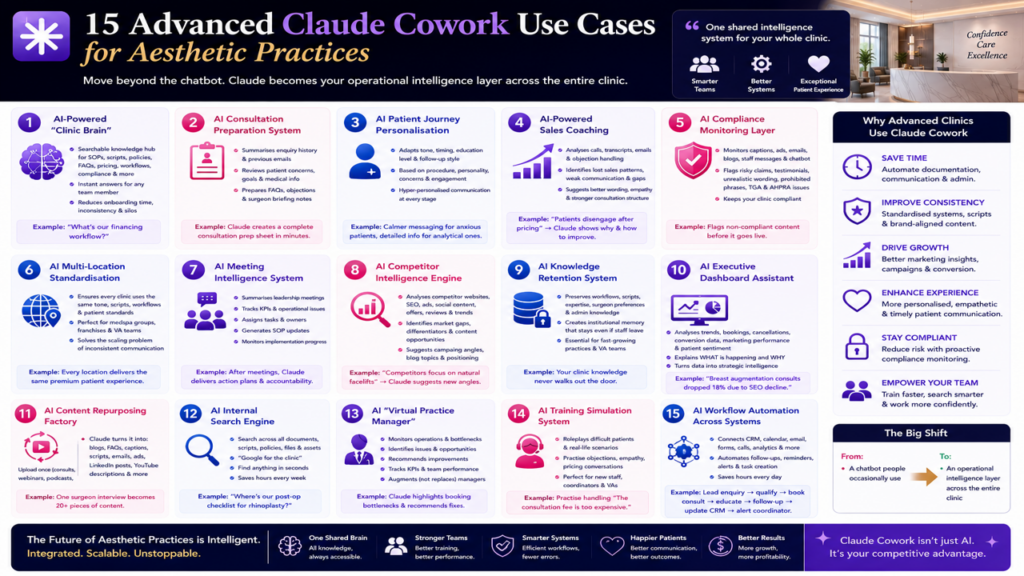
1. An AI-Powered “Clinic Brain”
A busy practice can accumulate hundreds of important documents:
- Standard operating procedures
- Consultation scripts
- Preoperative instructions
- Postoperative information
- Staff policies
- Pricing guidelines
- Financing explanations
- Patient FAQs
- Complaint procedures
- Marketing rules
- Emergency escalation pathways
- Surgeon preferences
- Vendor instructions
- Referral processes
- Consent-related information
The problem is rarely a total lack of information. The problem is that nobody can find the correct version quickly.
One document may sit in Google Drive. Another may be attached to an old email. A third may be saved on the practice manager’s computer. Staff members then depend on memory or ask the same experienced employee repeatedly.
Claude Cowork could help turn approved practice documents into a searchable clinic knowledge system.
A team member might ask:
“What is our approved process when a patient reports increasing pain after surgery?”
The system should not independently provide clinical advice. It should identify the relevant approved escalation procedure, show its source and direct the employee to the designated nurse or surgeon.
Other questions might include:
- “Which preparation guide should be sent before a facelift?”
- “What is our policy for rescheduling surgery?”
- “Who approves a refund request?”
- “Which postoperative questions must be escalated immediately?”
- “What information may a coordinator give about recovery?”
- “Where is the latest Motiva implant warranty information?”
What the system requires
A clinic brain is only reliable when the underlying knowledge is reliable. The practice needs:
- One approved source for each process
- Named document owners
- Review dates
- Version control
- Role-based permissions
- Clear clinical escalation rules
- Removal of obsolete files
- A process for correcting inaccurate answers
Claude should be instructed to say that it cannot find an approved answer when the information is missing. It must not fill gaps by inventing a plausible policy.
Example
A new patient coordinator receives a question about flying home after a body lift. Instead of relying on memory, she searches the approved knowledge base. Claude identifies the practice’s general travel information and instructs her to obtain patient-specific guidance from the clinical team.
Benefits
The clinic gains faster onboarding, fewer conflicting answers and less dependence on one experienced employee.
SPE Practice Tip: Start with the 30 questions staff ask most often. Build and approve those answers before attempting to upload every document in the practice.
2. An AI Consultation Preparation System
A surgeon may enter a consultation knowing only the patient’s name and requested procedure.
Meanwhile, the practice may already possess useful information across an enquiry form, emails, coordinator notes and telephone records.
The prospective patient may have explained that:
- She wants a facelift but fears looking unnatural.
- She previously had lower eyelid surgery elsewhere.
- Her daughter is getting married in nine months.
- She is comparing three surgeons.
- She is worried about general anaesthesia.
- Her main concern is recovery rather than cost.
When this information remains scattered, the patient has to repeat herself. Important concerns may not be addressed, and the consultation can feel less personal.
Claude Cowork could prepare a structured pre-consultation briefing from appropriately permitted information.
Suggested consultation briefing
Primary goal
What the patient hopes surgery may improve.
Relevant background
Previous procedures, treatments or information the surgeon should review.
Emotional concerns
Fear of looking operated on, anxiety about pain, concern about scars or worry about judgement from family.
Practical considerations
Work commitments, caregiving duties, travel, major events and preferred timing.
Known questions
Recovery, anaesthesia, cost, scars, longevity, revision policies or expected follow-up.
Information requiring clarification
Unclear goals, missing medical information or conflicting statements.
Recommended education
Approved guides, videos, FAQs or before-and-after examples that may help the consultation.
Example
A patient enquires about a tummy tuck after significant GLP-1-related weight loss. She has also mentioned breast deflation and skin laxity but has not requested a mommy makeover.
Claude could summarise her stated concerns without deciding which surgery she needs. The surgeon would assess her anatomy, health, expectations and candidacy before discussing any procedural options.
Risks
The system must not:
- Diagnose a condition
- Determine candidacy
- Recommend an operation
- Infer sensitive facts that the patient has not provided
- present assumptions as established information
- substitute its summary for reviewing the original record
Benefits
The surgeon is better prepared. The coordinator can anticipate likely questions. The patient spends less time repeating information and more time discussing her goals.
SPE Practice Tip: Limit the briefing to one page. A preparation system should improve the consultation, not bury the surgeon in another long report.
3. AI Patient Journey Personalisation
Many practices send every patient the same sequence of messages.
That is simple to administer, but it can feel impersonal.
A 62-year-old facelift patient worried about anaesthesia does not need the same communication as a 29-year-old breast augmentation patient comparing implant options.
Claude Cowork could help adapt approved communication according to factors such as:
- Procedure of interest
- Stage of the patient journey
- Questions already asked
- Preferred level of detail
- Emotional concerns
- Consultation status
- Surgery status
- Recovery stage
- Geographic location
- Communication preference
- Previous engagement
Examples of appropriate personalisation
An anxious patient might receive shorter messages, reassurance about the next step and a clear point of contact.
An analytical patient might receive a detailed procedure guide, recovery timeline and list of questions to discuss with the surgeon.
An international patient might receive information about consultation logistics, travel planning and the requirement to remain locally for postoperative care.
A revision patient may need more acknowledgement of previous disappointment and a clearer explanation of why revision assessment can be complex.
A post-GLP-1 patient may benefit from education about weight stability, staged procedures and the limitations of surgery, subject to the surgeon’s individual assessment.
Personalisation without manipulation
The purpose should be to improve relevance and understanding—not to exploit anxiety.
AI should not:
- Intensify fear to secure a booking
- Pretend the surgeon personally wrote an automated message
- Create artificial urgency
- Suggest that surgery will solve emotional or relationship problems
- Pressure a patient who has expressed uncertainty
- Send clinical instructions that have not been approved
Example
A prospective rhinoplasty patient repeatedly opens information about recovery but does not engage with financing content. Instead of sending another price-focused email, the practice sends an approved guide explaining swelling, return to work and the gradual development of the result.
Benefits
Patients receive information that is more relevant to their actual concerns. Coordinators spend less time manually selecting resources, and communication becomes more consistent.
SPE Practice Tip: Personalise the information pathway, but preserve human contact at high-emotion moments such as complaints, complications, cancellations and major treatment decisions.
4. AI-Powered Consultation and Sales Coaching
Ethical consultation conversion is not about persuading everyone to have surgery.
It is about helping a suitable patient make a clear, informed and unpressured decision.
Claude Cowork could analyse de-identified consultation notes, call transcripts, follow-up patterns and outcome data to identify where communication is breaking down.
Possible patterns include:
- Price is introduced before value and suitability are explained.
- Coordinators speak too much and ask too few questions.
- The patient’s real motivation is never clarified.
- Recovery concerns are dismissed too quickly.
- Next steps remain vague.
- Follow-up is inconsistent.
- Staff become defensive when another surgeon is mentioned.
- Too much information is delivered in one conversation.
- Family or partner concerns are ignored.
- The coordinator does not confirm whether the patient understood the quote.
Example: patients disengage after hearing the fee
Claude might identify that consultations are progressing well until the total investment is presented.
The issue may not be the fee alone. The patient may not yet understand:
- What is included
- Why the recommended operation is more extensive
- Who provides postoperative care
- Where surgery is performed
- How revisions are handled
- What separates the surgeon’s approach from a lower-priced option
- What the realistic recovery commitment involves
The system could recommend a stronger conversation structure:
- Reconfirm the patient’s goals.
- Summarise the surgeon’s recommendation.
- Explain what the surgical plan includes.
- Clarify the recovery and support process.
- Present the fee clearly.
- Pause for questions.
- Discuss next steps without pressure.
Coaching applications
Claude could create individual training for:
- Patient coordinators
- Front-desk employees
- Nurses
- Practice managers
- Surgeons
It could identify phrases that sound rushed, cold, defensive or overly promotional.
Risks
Recorded calls and consultation material may contain protected or sensitive information. Any analysis must use a legally permitted system and approved workflow.
A conversion score should also never override suitability. Some patients should not proceed.
SPE Practice Tip: Measure the quality of the decision process as well as the booking rate. A high-performing coordinator helps unsuitable or uncertain patients feel safe saying no.
5. An AI Compliance Monitoring Layer
Aesthetic practices publish large volumes of content:
- Procedure pages
- Blogs
- Social media posts
- Paid advertisements
- Patient guides
- Email campaigns
- SMS messages
- Chatbot answers
- Review requests
- Before-and-after captions
- Video scripts
- Promotional offers
One poorly worded claim can create unnecessary risk.
Claude Cowork could perform a first-pass review against approved practice rules and jurisdiction-specific compliance checklists.
It might flag:
- Guaranteed outcomes
- Unsupported superiority claims
- Misleading qualifications
- Unrealistic recovery statements
- Inadequate presentation of risks
- Inappropriate testimonials
- Pressure-based language
- Misleading pricing
- Claims outside the surgeon’s scope
- Unapproved treatment descriptions
- Statements likely to encourage unnecessary surgery
- Language suggesting a result is typical when it may not be
Australian advertising rules, for example, prohibit misleading or deceptive advertising, unreasonable expectations of beneficial treatment and advertising that encourages indiscriminate or unnecessary use of regulated health services. The guidelines apply to websites, blogs and social media as well as traditional advertising. (ahpra.gov.au)
Example
A draft social post states:
“Our advanced tummy tuck will give you the flat stomach you have always wanted with minimal downtime.”
Claude could flag:
- An implied outcome guarantee
- A subjective and potentially unrealistic promise
- An undefined claim of superiority
- Possible understatement of recovery
It might suggest a more balanced draft for human review:
“Tummy tuck surgery may remove excess abdominal skin and repair selected muscle separation in suitable patients. Recovery, scars and outcomes vary, and an individual consultation is required.”
What AI compliance monitoring cannot do
It cannot provide final legal approval.
Regulations can vary according to:
- Country
- State or territory
- Practitioner type
- Procedure
- Advertising platform
- Use of patient images
- Sponsorship arrangements
- Claims being made
Every final item should remain subject to the practice’s approval process.
SPE Practice Tip: Create a written “approved claims library” containing permitted phrases, prohibited phrases and examples relevant to the procedures the practice actually offers.
6. AI Multi-Location Standardisation
Multi-location practices often struggle to deliver a consistent patient experience.
One clinic answers calls differently. Another uses outdated information. A third quotes fees in a different way. Staff may create their own email templates because they cannot find the approved version.
Claude Cowork could help standardise:
- Enquiry handling
- Phone scripts
- Consultation preparation
- Fee explanations
- Patient education
- Follow-up processes
- Escalation procedures
- Complaint handling
- Brand language
- Reporting
- Staff onboarding
The goal is not to make every clinic identical.
Location-specific differences may remain necessary, including:
- Surgeons
- Consultation availability
- Fees
- Operating facilities
- Procedures
- Financing arrangements
- Local regulations
- Postoperative appointments
- Travel requirements
- Staff responsibilities
Example
A practice operates in New York City and a seasonal satellite location.
Both clinics use the same approved explanation of breast implant revision. However, Claude selects the correct address, consultation schedule, facility information and local contact details based on the clinic being discussed.
Avoiding over-standardisation
Clinical care should not be forced into a generic script.
Different surgeons may use different:
- Operative techniques
- Anaesthesia arrangements
- Recovery protocols
- Implant preferences
- Follow-up schedules
- Candidacy criteria
The knowledge system must preserve these distinctions.
Benefits
Patients receive clearer information regardless of which location they contact. Managers spend less time correcting local variations, and new locations can adopt proven workflows more quickly.
SPE Practice Tip: Standardise the patient experience first. Do not standardise clinical protocols unless the surgeons and clinical governance team have formally approved them.
7. An AI Meeting Intelligence System
Many practices hold meetings but fail to convert discussions into completed actions.
People leave with different interpretations of what was decided. Tasks have no owner. Deadlines are not recorded. The same problem appears again at the next meeting.
Claude Cowork could support:
- Daily huddles
- Leadership meetings
- Marketing reviews
- Sales meetings
- Operations meetings
- Clinical administration meetings
- Project reviews
- Campaign planning
- Staff training sessions
Subject to consent and privacy requirements, it could help:
- Prepare the agenda
- Summarise the discussion
- Record decisions
- Identify unresolved questions
- Assign actions
- Capture deadlines
- Compare progress with previous meetings
- Highlight overdue tasks
- Create follow-up reports
Example
A leadership meeting identifies that consultation waiting times have increased.
Claude produces an action plan:
- Practice manager: examine surgeon capacity by Friday.
- Patient coordinator: report the number of patients awaiting appointments.
- Marketing manager: pause campaigns that promote unavailable consultation dates.
- Surgeon: decide whether additional consultation sessions are appropriate.
- Team: review progress at the next leadership meeting.
Risks
AI-generated meeting notes can omit context or assign an action to the wrong person. Sensitive employment or patient information may also require special handling.
The meeting chair should review the summary before it becomes the official record.
Benefits
The practice gains clearer accountability, faster follow-through and a record of why decisions were made.
SPE Practice Tip: End every meeting with four fields: decision, action, owner and deadline. Claude can help draft these, but the meeting leader should confirm them aloud.
8. An AI Competitor Intelligence Engine
Competitor research is often informal.
A surgeon may notice another practice’s advertisement. A coordinator may hear that a competitor has reduced a consultation fee. A marketing agency may provide a rankings report without explaining the competitor’s broader positioning.
Claude Cowork could organise publicly available competitor information from:
- Websites
- Surgeon biographies
- Procedure pages
- Social media
- Public reviews
- Advertisements
- Educational videos
- Media coverage
- Publicly stated fees
- Search results
- Offers
- Patient FAQs
It could help identify:
- Common positioning themes
- Content gaps
- Weak procedure education
- Frequent patient complaints
- Strong reputation signals
- Geographic opportunities
- Underdeveloped patient questions
- Potential points of differentiation
- Changes in competitor messaging
Example
Five local surgeons heavily promote “natural facelift results.”
Simply repeating the same phrase will not distinguish another practice.
Claude could examine the practice’s genuine strengths and suggest alternative positioning around:
- Complex neck anatomy
- Revision experience
- Long-term postoperative care
- Anaesthesia approach
- Privacy
- Detailed consultation planning
- A particular patient demographic
Any positioning must be accurate and supportable.
Ethical boundaries
A practice should not:
- Copy competitor content
- Publish defamatory comparisons
- Create false reviews
- Misrepresent another surgeon’s credentials
- Scrape restricted information unlawfully
- Claim superiority without evidence
Benefits
Competitor intelligence can guide better content and market decisions without relying on isolated anecdotes.
SPE Practice Tip: Ask, “What important patient question is nobody answering well?” That is often more useful than asking how to copy the highest-ranking competitor.
9. An AI Knowledge Retention System
A long-serving coordinator may know:
- Which patients need an additional call
- How the surgeon likes consultation days organised
- Which facility forms cause delays
- How to resolve common financing problems
- When a complaint should be escalated
- Which vendor to contact
- How to prepare the weekly report
When that employee leaves, much of this knowledge can disappear.
Claude Cowork could support a structured knowledge-capture programme.
Recommended process
- Identify roles with high operational dependency.
- Interview experienced staff.
- Record how work is actually performed.
- Convert the information into workflows and checklists.
- Validate each procedure with the relevant manager.
- Assign an owner.
- Establish a review schedule.
- Place approved material in the clinic knowledge base.
Example
Before a senior surgical coordinator retires, the practice records her process for:
- Confirming surgery
- Liaising with the facility
- Checking payments
- Preparing preoperative documents
- Identifying incomplete testing
- Coordinating postoperative appointments
- Handling common exceptions
Claude helps organise the interview notes into draft procedures. The coordinator and practice manager then correct and approve them.
Benefits
The practice becomes less vulnerable to resignation, illness, retirement or rapid growth.
SPE Practice Tip: Capture exceptions as well as the ideal workflow. The most valuable employee knowledge often concerns what to do when the usual process fails.
10. An AI Executive Dashboard Assistant
A dashboard may show dozens of numbers without explaining what deserves attention.
Claude Cowork could help interpret approved practice data, including:
- Enquiry volume
- Consultation bookings
- Attendance
- Surgery bookings
- Conversion rates
- Lead sources
- Marketing spend
- Cost per enquiry
- Cost per consultation
- Cost per booked surgery
- Cancellation rates
- Response times
- Average procedure value
- Surgeon utilisation
- Procedure demand
- Review volume
- Website performance
- Patient sentiment
Moving from reporting to interpretation
A conventional dashboard might show:
Breast augmentation consultations decreased by 18%.
An AI-supported analysis could ask:
- Did enquiry volume decline?
- Did response time increase?
- Was advertising reduced?
- Did consultation availability change?
- Did more patients fail to attend?
- Was the website page changed?
- Did competitors launch new campaigns?
- Is the decline seasonal?
Claude could generate a weekly management briefing:
What changed
Breast augmentation enquiries and consultations declined.
Possible contributing factors
Reduced paid search activity and fewer available consultation appointments occurred during the same period.
What remains uncertain
The data does not prove either factor caused the decline.
Recommended investigation
Review campaign activity, enquiry quality, response times, appointment availability and local market demand.
Risks
AI can identify correlation, but it should not present correlation as causation.
Data may also be incomplete, duplicated or incorrectly classified.
Benefits
Leadership receives a concise explanation of what may require attention instead of another spreadsheet with no interpretation.
SPE Practice Tip: Configure the system to identify exceptions, not merely restate every metric. A useful executive report highlights what changed, why it may matter and what should be investigated.
11. An AI Content Repurposing Factory
A surgeon may spend an hour recording an expert interview. The practice then publishes one video and moves on.
Claude Cowork could help transform that original material into a structured content library.
One interview could become:
- A long-form blog
- Procedure FAQs
- Short video scripts
- Social media posts
- Email education
- Google Business Profile posts
- A patient guide
- Staff talking points
- YouTube descriptions
- Consultation follow-up material
- A media pitch
- Internal training content
Example
A surgeon records a 40-minute interview about deep plane facelift surgery.
Claude could extract themes such as:
- Who may be suitable
- What the procedure addresses
- How it differs from a skin-only lift
- The role of the neck
- Anaesthesia
- Scarring
- Recovery
- Risks
- Longevity
- Questions to ask during consultation
It could then create draft assets for different channels.
Preserving the surgeon’s voice
AI content often becomes generic because it removes the very details that make the surgeon distinctive.
The practice should retain:
- The surgeon’s actual philosophy
- Preferred terminology
- Areas of caution
- Decision-making criteria
- Honest limitations
- Real examples
- Personal communication style
Every medical asset must be reviewed before publication.
Benefits
The surgeon’s expertise can reach more prospective patients without requiring a separate recording session for every platform.
SPE Practice Tip: Do not begin by asking Claude to “write a facelift blog.” Begin with a detailed surgeon interview so the content reflects real expertise rather than generic internet language.
12. An AI Internal Search Engine
Internal search differs from a general clinic brain because its primary purpose is finding the right resource quickly.
Staff could search across:
- Policies
- Forms
- Scripts
- Meeting notes
- Training materials
- Procedure guides
- Marketing assets
- Approved messages
- Staff manuals
- Checklists
- Vendor instructions
- Project files
Questions might include:
- “Where is the latest rhinoplasty preoperative checklist?”
- “Which template follows a facelift consultation?”
- “What is our cancellation policy?”
- “Where is the current implant warranty guide?”
- “Which document explains financing?”
- “What was decided at the last marketing meeting?”
Essential search controls
A trustworthy internal search system should ideally show:
- The source document
- The relevant passage
- The version
- The review date
- The owner
- Any access restrictions
It should not mix approved material with:
- Old drafts
- Personal notes
- Unverified uploads
- Obsolete clinical instructions
- Content copied from other practices
Example
A nurse searches for the latest postoperative guidance after a breast lift. Claude identifies two files with similar names but notes that one is archived and the other is the approved current version.
Benefits
Employees waste less time searching folders or interrupting managers.
SPE Practice Tip: Good search depends on disciplined filing. Establish naming rules, document status and archive procedures before expecting AI to solve document chaos.
13. An AI “Virtual Practice Manager”
Claude Cowork should not be described as a literal replacement for a practice manager.
A real practice manager handles people, judgement, conflict, culture, leadership, confidentiality and accountability. These responsibilities require human experience and authority.
Claude could instead act as an operational assistant to the manager.
It might monitor approved information related to:
- Unanswered enquiries
- Consultation capacity
- Booking delays
- Staff workloads
- Overdue projects
- Follow-up completion
- Marketing activity
- Complaints
- Repeated patient questions
- Training gaps
- Key performance indicators
- Operational bottlenecks
Example
The weekly briefing shows that the average time between an online enquiry and the first attempted telephone call has increased.
Claude examines the operational data and identifies:
- Two coordinators were absent.
- Enquiry volume increased.
- Weekend enquiries were not allocated.
- No backup owner was assigned.
It could recommend investigating:
- Weekend routing
- Backup responsibilities
- Automated acknowledgement
- Daily uncontacted-lead reports
- Temporary staffing support
The human manager decides what action is appropriate.
Benefits
A manager gains an organised view of the practice without manually combining information from multiple systems.
Risks
The system may misunderstand workload, staff performance or the emotional context behind a problem. It should not make autonomous employment decisions.
SPE Practice Tip: Ask Claude to surface risks and questions, not to manage people. Leadership remains a human responsibility.
14. An AI Training Simulation System
Staff training often consists of reading a script and observing a more experienced employee.
That does not prepare people for emotionally complex conversations.
Claude Cowork could create realistic role-play simulations involving:
- Anxious patients
- Price objections
- Recovery concerns
- Complaints
- Surgery delays
- Refund requests
- Revision enquiries
- Unrealistic expectations
- Family objections
- Financing questions
- International travel
- Patients comparing surgeons
- Postoperative escalation
Claude could act as the patient while the employee practises responding.
Example scenario
The simulated patient says:
“I do not understand why I should pay a consultation fee when another surgeon sees patients for free.”
The coordinator must respond without becoming defensive or criticising the competitor.
Claude could assess whether the response:
- Acknowledged the concern
- Explained the consultation’s value
- Avoided pressure
- Used clear language
- Invited further questions
- Stayed within the coordinator’s role
The system might then increase the difficulty by having the patient challenge the answer.
Clinical boundaries
Training must clearly identify when staff should:
- Stop answering
- Escalate to a nurse
- Contact the surgeon
- Direct the patient to emergency care
- Avoid giving personalised medical advice
Benefits
Employees can practise repeatedly in a low-risk environment before speaking with real patients.
SPE Practice Tip: Score staff on listening, clarity, empathy, accuracy and escalation—not merely whether they secured an appointment.
15. AI Workflow Automation Across Systems
The most advanced use case is coordinated workflow automation.
Depending on available integrations, permissions and third-party tools, Claude Cowork could potentially help move approved work across:
- CRM systems
- Forms
- Calendars
- Task management
- Shared files
- Marketing automation
- Call systems
- Reporting platforms
- Website chat
- Practice management software
Official Cowork materials describe the ability to work with connected tools, browser-based work and documents, although the exact capabilities available to a practice will depend on the product configuration and connected services. (anthropic.com)
Example enquiry workflow
New enquiry received
→ Procedure interest categorised
→ Approved educational material selected
→ Coordinator alerted
→ Follow-up task created
→ CRM record updated
→ Unanswered enquiry escalated
Additional workflows
Consultation booked
→ Preparation information sent
→ Reminder scheduled
→ Internal preparation task created
Surgery booked
→ Preoperative checklist started
→ Payment milestones recorded
→ Facility coordination tasks assigned
Surgery completed
→ Approved recovery communication begins
→ Follow-up appointments checked
→ Unanswered concerns escalated
Inactive enquiry
→ Record reviewed
→ Appropriate re-engagement pathway selected
→ Coordinator approval obtained
→ Follow-up sent
Essential controls
Every automated workflow needs:
- Defined permissions
- Human approval points
- Audit trails
- Error monitoring
- Exception handling
- Escalation rules
- Test environments
- Fallback procedures
- Data minimisation
- Clear ownership
Automation must never create a barrier between a postoperative patient and urgent clinical assistance.
Benefits
The practice can reduce repetitive administration and prevent important tasks from being forgotten.
SPE Practice Tip: Automate predictable administrative steps. Keep clinical judgement, sensitive communication and exceptional cases under direct human control.
Why Advanced Aesthetic Practices May Use Claude Cowork
Save Time
Claude Cowork could reduce time spent on:
- Searching for documents
- Preparing meetings
- Summarising non-clinical information
- Drafting reports
- Repurposing content
- Organising tasks
- Preparing approved communications
- Compiling operational data
Time savings should be redirected towards higher-value work such as patient care, leadership, training and meaningful personal communication.
Improve Consistency
A shared system could help employees use:
- The same current information
- Approved scripts
- Consistent brand language
- Standard escalation procedures
- Reliable training materials
- Common service standards
Consistency does not mean every patient receives a robotic response. It means the underlying information and process remain dependable.
Drive Sustainable Growth
Better operational intelligence may support:
- Faster response to enquiries
- Better consultation preparation
- Stronger follow-up
- More useful marketing analysis
- Improved content production
- Better capacity planning
- Greater patient retention
- More consistent referral activity
AI does not automatically increase revenue. It can help the practice identify and act on opportunities more systematically.
Enhance the Patient Experience
Potential benefits include:
- Faster responses
- Less repetition
- More relevant education
- Clearer next steps
- Better-prepared staff
- Improved coordination
- More consistent follow-up
The best patient experience will still depend on human empathy and clinical excellence.
Support Compliance and Risk Reduction
AI may help with:
- Preliminary content checks
- Approved-source retrieval
- Consistent escalation
- Access control
- Documentation
- Audit trails
- Identification of risky language
It cannot guarantee compliance.
Empower the Team
Staff may gain:
- Faster access to answers
- Better onboarding
- More practice opportunities
- Clearer procedures
- Reduced administrative burden
- Stronger confidence
The objective is not to remove employees. It is to help good employees perform at a higher level.
The Big Shift: From Chatbot to Operational Intelligence
The old approach
- Staff use separate AI accounts.
- Each person creates different prompts.
- Outputs are inconsistent.
- Practice knowledge is scattered.
- Information is not systematically reviewed.
- AI remains disconnected from operations.
- Nobody owns governance.
The advanced approach
- AI uses approved practice information.
- Access is controlled.
- Roles and permissions are defined.
- Workflows connect across departments.
- Outputs are reviewed.
- Performance is measured.
- Errors are reported.
- Human accountability remains clear.
The goal is not to add another AI tool. The goal is to build a better operating system for the practice.
A Practical Claude Cowork Implementation Roadmap
Phase 1: Identify One High-Value Problem
Begin with a specific problem, such as:
- Staff cannot find current procedures.
- Consultation preparation takes too long.
- Meeting actions are forgotten.
- Patient follow-up is inconsistent.
- New employees require months to become confident.
- Content creation depends entirely on the surgeon.
Avoid beginning with the vague objective of “using more AI.”
Phase 2: Audit the Information
Determine:
- What information exists
- Where it is stored
- Whether it is accurate
- Who owns it
- Whether it contains patient data
- Which employees should access it
- What may legally be processed
- What must remain outside the system
Phase 3: Clean the Knowledge Base
Before uploading information:
- Remove duplicates
- Archive obsolete files
- Correct contradictions
- Add version numbers
- Add review dates
- Name document owners
- Separate clinical from administrative content
- Label drafts clearly
- Restrict sensitive files
Phase 4: Establish Governance
Create written rules covering:
- Permitted uses
- Prohibited uses
- Patient information
- Clinical escalation
- Human review
- Marketing approval
- Access controls
- Passwords and authentication
- Error reporting
- Record retention
- Connected tools
- Audit logs
Phase 5: Run a Controlled Pilot
Select:
- One use case
- A small team
- A limited document set
- A defined testing period
- A named project owner
- Clear success measures
A clinic knowledge search pilot is often safer than beginning with patient communication automation.
Phase 6: Measure the Results
Possible indicators include:
- Time saved
- Answer accuracy
- Staff adoption
- Response time
- Reduction in repeated questions
- Completion of meeting actions
- Training improvement
- Patient satisfaction
- Compliance issues detected
- Number of errors requiring correction
Phase 7: Expand Carefully
Expand only when:
- The pilot is useful
- Outputs are accurate
- Staff understand the boundaries
- Governance is working
- Privacy requirements have been verified
- Human review is reliable
Risks and Limitations
Claude Cowork implementation can fail when a practice overlooks:
- Incorrect or hallucinated answers
- Outdated documents
- Conflicting policies
- Privacy breaches
- Excessive user permissions
- Poorly designed prompts
- Unreliable integrations
- Automation errors
- Staff resistance
- Hidden bias
- Excessive data collection
- Weak human review
- Loss of empathy
- Unclear accountability
- Patients mistaking automation for personal clinical advice
A sophisticated AI system cannot repair disorganised source material automatically.
A disorganised practice does not become organised merely by adding AI. It may simply automate its existing confusion.
What Claude Cowork Should Not Do
Claude Cowork should not independently:
- Diagnose a patient
- Determine surgical candidacy
- Select an operation
- Interpret urgent postoperative symptoms
- Replace informed consent
- Guarantee a result
- Prescribe medication
- Provide unreviewed personalised clinical advice
- Pressure someone into surgery
- Conceal that communication is automated
- Override the clinical team
- Make final legal or compliance decisions
- Access information beyond the user’s role
- Publish medical content without approval
- Make autonomous employment decisions
Five Practical Plastic Surgery Examples
Facelift Consultation Preparation
Problem: The patient has discussed fears about looking unnatural across several emails.
Claude’s role: Prepare a short briefing summarising her goals, concerns, previous treatments and questions.
Human review: The coordinator verifies the summary, and the surgeon assesses suitability.
Benefit: The consultation begins with a better understanding of what matters to the patient.
Tummy Tuck Follow-Up
Problem: A patient has not progressed after consultation because her question about time away from work was not answered.
Claude’s role: Identify the unresolved question and create a coordinator task.
Human review: The coordinator sends approved general information and asks the clinical team for patient-specific guidance.
Benefit: The patient receives a complete answer without an inappropriate automated clinical recommendation.
Staff Knowledge Retention
Problem: An experienced surgical coordinator is leaving.
Claude’s role: Turn structured interviews into draft workflows, checklists and training materials.
Human review: The coordinator and manager validate each procedure.
Benefit: Operational knowledge remains in the practice.
Marketing Compliance Review
Problem: A social post implies a guaranteed recovery.
Claude’s role: Flag the wording against the practice’s compliance checklist and suggest an alternative draft.
Human review: The surgeon or compliance lead approves the final version.
Benefit: Risky language is identified before publication.
Multi-Location Standardisation
Problem: Two offices give patients conflicting consultation information.
Claude’s role: Use a shared approved process while selecting the correct surgeon, fee, location and scheduling details.
Human review: Location managers verify local differences.
Benefit: Patients receive a consistent but accurate experience.
Claude Cowork Readiness Checklist
Before implementation, determine whether the practice has:
- Current operating procedures
- Approved patient information
- Clear staff roles
- Document owners
- Review dates
- Secure data policies
- Role-based access
- Clinical escalation rules
- Approved marketing language
- A designated AI project leader
- Human review procedures
- Staff training
- An incident-reporting process
- A measurable pilot
- Regular governance reviews
- Written rules about patient information
- Verified contracts and product settings
- A fallback process when the system fails
FAQs about Claude Cowork for Plastic Surgeons
What is Claude Cowork for a plastic surgery practice?
Claude Cowork is a Claude work mode designed to assist with multi-step tasks involving files, documents and connected tools. In a plastic surgery practice, its safest initial uses may involve non-clinical operations, training, knowledge management and de-identified information.
How is Claude Cowork different from a normal AI chatbot?
A chatbot mainly responds to individual prompts. Cowork is intended to support delegated work that may involve several steps, sources or business tools, depending on the configuration and permissions provided. (anthropic.com)
Can Claude Cowork help a surgeon prepare for consultations?
It could organise appropriately permitted pre-consultation information into a concise briefing. It should not diagnose the patient, determine candidacy or replace the surgeon’s review of the original information.
Can Claude Cowork access patient records?
Technical access depends on the systems and integrations being used. Legal permission is a separate issue, and practices should not connect patient records until privacy, security, contracts, access controls and product eligibility have been formally verified.
Is Claude Cowork HIPAA compliant?
Practices should not describe a product as HIPAA compliant without checking the exact service and configuration. Anthropic’s current BAA information states that Cowork is excluded from BAA coverage, even though certain other Claude Enterprise and API services may be eligible under defined conditions. (Anthropic Privacy Center)
Can an Australian plastic surgery clinic use Claude Cowork?
It may use AI for suitable tasks, but the practice must assess its Privacy Act and professional obligations. Australian privacy guidance recommends due diligence, clear governance, human oversight and caution before entering sensitive information into commercial AI products. (OAIC)
Can a UK aesthetic practice use Claude Cowork?
Potential use should be assessed under UK data protection requirements. The practice may need to consider lawful processing, transparency, fairness, data minimisation, security and whether a data protection impact assessment is required. (ICO)
Can AI give postoperative advice to plastic surgery patients?
AI may deliver pre-approved general information in an appropriate system. It should not assess symptoms or replace clinical advice, and urgent concerns must be escalated to a qualified clinician.
Can Claude Cowork improve consultation conversion rates?
It may help identify communication gaps, incomplete follow-up and repeated objections. Conversion improvement still depends on patient suitability, trust, surgeon quality, coordinator skill and an ethical decision process.
Can Claude Cowork train patient coordinators?
It could create role-play scenarios, provide structured feedback and simulate common patient questions. Training should reinforce professional boundaries and clinical escalation.
Can Claude Cowork monitor advertising compliance?
It could conduct a first-pass review using approved rules and examples. Final approval should remain with the appropriate human reviewer because laws, regulations and professional standards vary.
Can Claude Cowork connect with a plastic surgery CRM?
This depends on the CRM, available connectors, third-party automation and security configuration. Each connection should be assessed for permissions, privacy, reliability and auditability.
Will Claude Cowork replace a practice manager?
No. It may assist with reporting, task tracking and operational analysis, but it cannot replace leadership, judgement, staff management, accountability or emotional intelligence.
How can a clinic create an AI knowledge base?
Begin with current approved documents, remove obsolete material, assign owners and establish review dates. Test the system with common staff questions before adding more complex information.
What is the best Claude Cowork use case to start with?
A non-clinical internal knowledge search or meeting action system is often a practical first pilot. It offers measurable value without beginning with high-risk patient-specific automation.
What are the main risks of AI in an aesthetic practice?
The main risks include privacy breaches, inaccurate answers, outdated information, over-automation, weak access control and employees treating AI output as authoritative. Clear governance and human review are essential.
Building a More Intelligent Aesthetic Practice
The greatest benefit of Claude Cowork is unlikely to come from producing one more blog, email or social media caption.
The larger opportunity is to build:
- A shared clinic knowledge system
- Better staff decision support
- More consistent patient communication
- Stronger operational visibility
- Faster access to approved information
- Better staff training
- More reliable workflows
- Stronger organisational memory
The technology alone is not enough.
The winning combination is:
AI capability + accurate practice knowledge + secure systems + trained staff + human accountability
Specialist Practice Excellence helps aesthetic plastic surgeons and practice leaders improve their AI readiness, patient journeys, consultation systems, staff training, knowledge management, marketing, AEO strategy and operational workflows.