How Plastic Surgeons Can Use Better Questions to Improve Consultations Without Pressuring Patients
Plastic surgery consultations can become overloaded with information.
The surgeon explains procedures, incisions, recovery, risks, alternatives, financing, expected outcomes and limitations. The patient listens, asks several questions and leaves with a large amount of information to process.
Despite the surgeon’s effort, the patient may still say:
- “I need to think about it.”
- “I’m not sure which procedure is right for me.”
- “I need to speak with my partner.”
- “I’m worried about recovery.”
- “I don’t know whether the result is worth the operation.”
- “I’m not ready to book yet.”
The immediate temptation is to provide more information, answer more objections or encourage the patient to commit.
Neil Rackham’s SPIN Selling suggests a different approach: before presenting a solution, understand how the person sees their current situation, what concerns they are trying to resolve, why those concerns matter and what they would consider a valuable outcome.
The book is based on research into more than 35,000 sales calls involving approximately 10,000 salespeople across 23 countries over 12 years. Rackham’s research challenged several traditional sales assumptions, particularly the idea that techniques effective in small, simple transactions also work in larger, more complex decisions.
Plastic surgery is not an ordinary sales transaction. A patient consultation must protect autonomy, suitability, informed consent and voluntary decision-making. The surgeon’s responsibility to the patient remains paramount, and relevant options-including choosing no treatment-must be explained accurately.
Used ethically, however, SPIN can help surgeons and patient coordinators:
- Ask more thoughtful questions
- Understand what the patient is actually trying to change
- Avoid giving a generic procedure presentation
- Clarify practical concerns about recovery, timing and support
- Identify unsuitable expectations earlier
- Explain recommendations in language relevant to the patient
- Reduce pressure-based closing
- Improve the quality, consistency and usefulness of consultations
The objective is not to use questions to manipulate a patient into surgery.
The objective is to create a consultation in which the patient feels heard, understands their options and can make a well-considered decision.
What Is SPIN Selling About?
SPIN Selling was developed for complex, higher-value decisions in which the buyer faces greater cost, risk and uncertainty than in a simple transaction.
The publisher describes the book as a challenge to conventional sales beliefs about aggressive closing, objection handling, product benefits and broad questioning techniques. Rackham argues that methods developed for small sales often become less effective as the size and complexity of the decision increase.
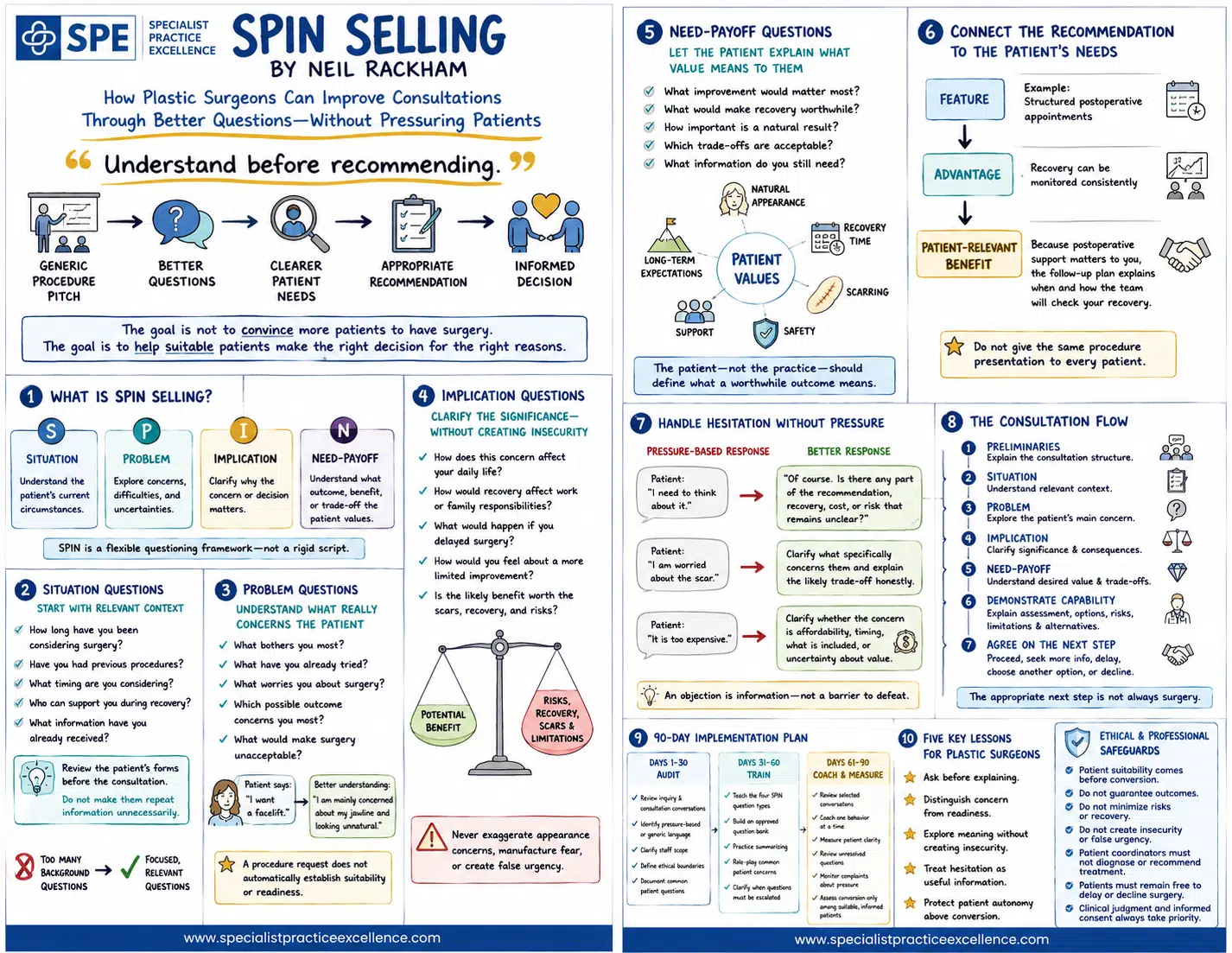
SPIN stands for four types of questions:
- Situation questions
- Problem questions
- Implication questions
- Need-payoff questions
These questions provide a flexible structure rather than a script that must be followed rigidly. Huthwaite International, the organization associated with the original research, describes SPIN as a framework for helping people uncover needs and recognize the value of an appropriate solution.
The broader conversation has four stages:
- Preliminaries – establish rapport and agree on the purpose of the conversation
- Investigating – understand the person’s situation, concerns and priorities
- Demonstrating capability – connect an appropriate solution to the needs identified
- Obtaining commitment – agree on a suitable next step
These stages remain part of Huthwaite’s current description of the methodology.
For a plastic surgery practice, the key lesson is:
Do not begin with the operation. Begin with the patient’s situation, concerns, goals and readiness.
Who Is Neil Rackham?
Neil Rackham is the author associated with the development of the SPIN methodology and the research described in SPIN Selling. The Routledge edition identifies him with Huthwaite Incorporated in Virginia and outlines the book’s focus on research into complex selling behavior.
Rather than relying mainly on anecdotes from charismatic salespeople, Rackham and his team observed and analyzed real sales interactions. The resulting framework focused on behaviors that could be identified, practiced and coached. Huthwaite continues to present SPIN as a behavior-based, consultative approach rather than a collection of persuasion tricks.
That distinction is especially important in medicine.
The useful part of SPIN is not the language of “closing.” It is the discipline of:
- Listening before recommending
- Exploring the patient’s perspective
- Distinguishing a vague dissatisfaction from a clearly understood need
- Tailoring explanations to the individual
- Agreeing on the next appropriate step
Why SPIN Selling Is Relevant to Plastic Surgeons
Elective surgery involves a considered decision.
A prospective patient may be evaluating:
- Physical concerns
- Emotional motivations
- Surgical risk
- Recovery time
- Financial cost
- Family responsibilities
- Work commitments
- Scarring
- Long-term changes
- Alternative treatments
- Whether surgery is appropriate at all
The patient may also have incomplete, conflicting or unrealistic information from social media, friends, previous consultations or online research.
A generic consultation can fail because it gives the same information to every patient regardless of what matters most to them.
For example, two patients asking about abdominoplasty may have completely different priorities.
Patient A
- Has stable weight
- Has completed their family
- Is concerned mainly about loose abdominal skin
- Has adequate support at home
- Understands the likely scar
- Wants to plan around a quiet work period
Patient B
- Is actively losing weight
- May want another pregnancy
- Has limited recovery support
- Expects surgery to produce major weight loss
- Is reluctant to accept scarring
- Feels pressure to proceed before an event
A procedure-centered presentation may treat these patients similarly.
A needs-centered consultation reveals that they may require very different recommendations. Patient B may be better served by delaying surgery.
The AMA describes informed consent as a communication process that should include the proposed intervention, its risks and benefits, alternatives and the option of forgoing treatment. The patient must be able to make an independent, voluntary decision.
SPIN can support this process only when it is used to clarify-not control-the patient’s decision.
The Difference Between Small and Complex Decisions
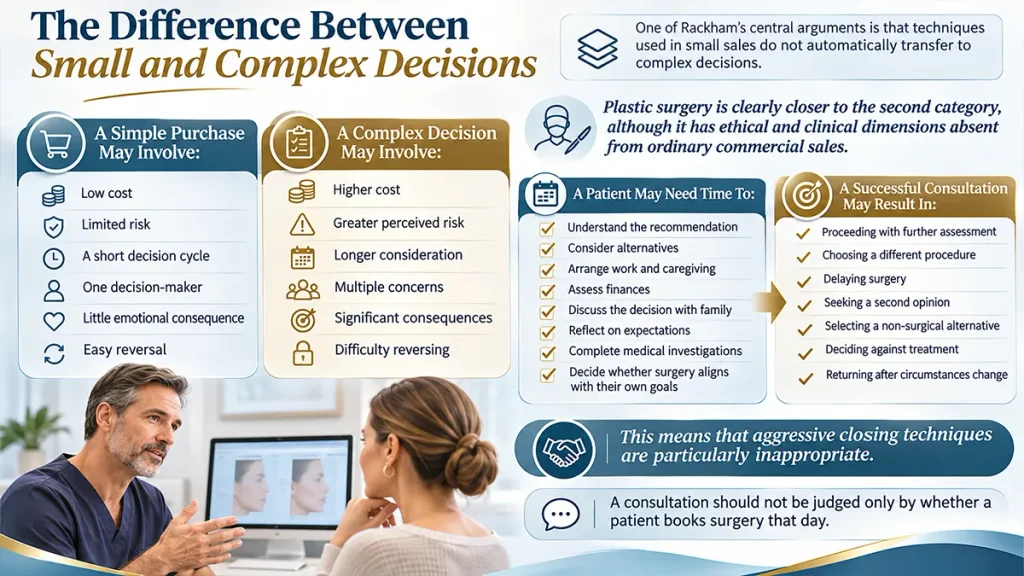
One of Rackham’s central arguments is that techniques used in small sales do not automatically transfer to complex decisions.
A simple purchase may involve:
- Low cost
- Limited risk
- A short decision cycle
- One decision-maker
- Little emotional consequence
- Easy reversal
A complex decision may involve:
- Higher cost
- Greater perceived risk
- Longer consideration
- Multiple concerns
- Significant consequences
- Difficulty reversing the decision
Plastic surgery is clearly closer to the second category, although it has ethical and clinical dimensions absent from ordinary commercial sales.
A patient may need time to:
- Understand the recommendation
- Consider alternatives
- Arrange work and caregiving
- Assess finances
- Discuss the decision with family
- Reflect on expectations
- Complete medical investigations
- Decide whether surgery aligns with their own goals
This means that aggressive closing techniques are particularly inappropriate.
A consultation should not be judged only by whether a patient books surgery that day.
A successful consultation may result in:
- Proceeding with further assessment
- Choosing a different procedure
- Delaying surgery
- Seeking a second opinion
- Selecting a non-surgical alternative
- Deciding against treatment
- Returning after circumstances change
The quality of the decision matters more than the speed of the decision.
The Four SPIN Questions
1. Situation Questions
Situation questions gather relevant facts and background information.
In a commercial setting, these questions establish the person’s current circumstances. Huthwaite advises that they should be focused and limited because excessive Situation questions can feel tedious or unnecessary.
Plastic Surgery Situation Questions
Appropriate examples might include:
- What changes have you noticed?
- How long have you been considering surgery?
- Have you had previous procedures in this area?
- Is your weight currently stable?
- Are you planning future pregnancies?
- What does your normal workweek involve?
- Who would be available to support you during recovery?
- Is there a particular timeframe you are considering?
- What information have you already received?
- Have you consulted another surgeon?
Some of these questions may be asked by the surgeon; others may be covered by the clinical history or pre-consultation process.
Why Situation Questions Matter
They help establish:
- Relevant medical and procedural background
- The patient’s stage of research
- Practical constraints
- Previous experiences
- Available support
- Timing considerations
The Common Mistake
The mistake is asking the patient to repeat information the practice already has.
For example, if the patient has completed a detailed questionnaire, the surgeon should not spend the first ten minutes reading it aloud as questions.
A stronger opening might be:
“I have reviewed the history you provided. You mentioned that your main concern is the change in your abdomen since pregnancy. Could you tell me what aspect concerns you most?”
This acknowledges the existing information and moves quickly toward the patient’s perspective.
Ethical Boundary
Situation questions should gather clinically or practically relevant information. They should not become intrusive questioning designed primarily to identify financial capacity or exploit vulnerability.
2. Problem Questions
Problem questions explore dissatisfaction, difficulty or concern.
Huthwaite distinguishes between an implied need, such as a problem or dissatisfaction, and an explicit need, in which the person clearly expresses a desire for a particular outcome or solution. Problem questions reveal implied needs, but they do not automatically mean the person is ready to act.
Plastic Surgery Problem Questions
Examples include:
- What bothers you most about the area?
- Are there activities or clothing choices affected by the concern?
- What have you tried already?
- What was unsatisfactory about those approaches?
- What worries you most about surgery?
- Is there anything about recovery that may be difficult for you?
- Which possible outcome would you be most disappointed by?
- What information have you found confusing?
- What did you feel was missing from previous consultations?
- What would make you decide that surgery is not right for you?
Example: Breast Reduction
A patient may initially say:
“My breasts feel too large.”
Problem questions may reveal that the central concern is not appearance. It may involve:
- Physical discomfort
- Difficulty exercising
- Problems finding clothing
- Skin irritation
- Self-consciousness
- Concern about scarring
- Fear of losing too much volume
The recommendation should respond to the patient’s actual priorities, not the procedure name they entered into an online form.
Example: Facelift
A patient may say:
“I look old.”
Further questions may reveal:
- They are mainly concerned about the jawline
- They are not concerned about the forehead
- They fear appearing “pulled”
- They have an important caregiving role
- They cannot accept several weeks of visible recovery
- They are comparing surgery with a non-surgical treatment
This creates a more accurate basis for discussion.
The Common Mistake
The practice may assume that identifying a problem means the patient needs the practice’s solution.
A concern does not automatically establish:
- Surgical suitability
- Emotional readiness
- Realistic expectations
- Medical fitness
- Acceptance of risk
- Willingness to proceed
Problem questions should open the assessment, not predetermine its conclusion.
3. Implication Questions
Implication questions examine the consequences or significance of a problem.
In SPIN, they help a person understand why an unresolved issue matters. Huthwaite describes them as questions that explore the wider effects of a problem and help clarify whether it is important enough to address.
This is the most sensitive part of adapting SPIN to plastic surgery.
In commercial selling, an Implication question may deliberately increase awareness of the cost of leaving a business problem unresolved.
In medicine, the same technique could become unethical if staff:
- Exaggerate a patient’s concern
- Increase insecurity
- Create fear about appearance
- Suggest the problem will inevitably worsen
- Imply that surgery is urgently required
- Use social embarrassment as leverage
- Present normal aging as a crisis
Ethical Implication Questions
Appropriate questions should clarify practical meaning without manufacturing distress.
Examples include:
- How does this concern affect your daily life, if at all?
- Does it influence the activities you choose?
- How important is it for you to address this now rather than later?
- How would a long recovery affect your work or family responsibilities?
- What would happen if you decided not to have surgery?
- Would delaying the procedure create any difficulty for you?
- How would you feel if the improvement were more modest than expected?
- What effect would a visible scar have on your satisfaction?
- How would future pregnancy or weight change affect your decision?
- Is the concern significant enough that you would accept the recovery and risks involved?
Notice that several of these questions may lead away from surgery.
That is appropriate.
Example: Abdominoplasty Timing
The patient wants surgery within six weeks because of an upcoming event.
An ethical Implication discussion may include:
- How would the recovery period affect event preparation?
- What would happen if swelling remained visible?
- Would you have adequate help at home?
- Could the timing create pressure to return to activity prematurely?
- Would postponing until after the event reduce stress?
The purpose is to support realistic planning, not increase urgency.
The Common Mistake
A patient coordinator might say:
“If you do not book now, you may lose the date and have to live with this problem for another year.”
This is not a thoughtful Implication question. It is scarcity pressure.
A better approach is:
“You mentioned that timing is important. Would it help to compare the realistic recovery requirements of each available period before you decide?”
4. Need-Payoff Questions
Need-payoff questions encourage the person to describe the value of resolving the problem.
In SPIN, they help transform a general dissatisfaction into a clearer understanding of what an appropriate solution would achieve. Huthwaite explains that they invite the customer to articulate the benefits of solving the problem rather than having the seller simply announce those benefits.
Plastic Surgery Need-Payoff Questions
Examples include:
- What would a satisfactory improvement mean to you?
- Which change would matter most?
- What would make the recovery worthwhile?
- How important is maintaining a natural appearance?
- What would help you feel confident in the decision?
- How would clearer postoperative support affect your comfort?
- Would a staged approach be preferable if it reduced complexity?
- What information would you need before deciding?
- How valuable would it be to preserve certain features?
- What would an acceptable result look like in practical terms?
Example: Rhinoplasty
A patient may initially ask for a smaller nose.
Need-payoff questions may reveal that they value:
- Better balance rather than minimum size
- Preservation of family characteristics
- Improved breathing
- Avoidance of an obviously operated appearance
- A result that looks appropriate from several angles
This helps the surgeon explain the plan in terms meaningful to the patient.
Example: Implant Removal
A patient may request immediate implant removal.
Need-payoff questions may reveal that the patient wants:
- Relief from anxiety
- Clear information about expected appearance
- Understanding of capsulectomy options
- A plan for potential skin laxity
- Time to consider whether lift surgery should be combined or staged
The conversation becomes more useful than a simple yes-or-no discussion.
The Common Mistake
Need-payoff questions should not lead the patient to praise a predetermined procedure.
For example:
“Wouldn’t it be wonderful to finally have the body you have always wanted?”
This is emotionally loaded and presumes the proposed surgery is the answer.
A more neutral question is:
“Which potential improvement matters most to you, and what limitations would you be prepared to accept?”
Implied Needs and Explicit Needs
A major idea in SPIN Selling is the distinction between implied and explicit needs.
Implied Need
A concern, difficulty or dissatisfaction:
- “I do not like my neck.”
- “My clothes do not fit well.”
- “I am worried about my implants.”
- “I look tired.”
- “I find exercise uncomfortable.”
Explicit Need
A clearer statement of what the person wants or values:
- “I want to understand whether a neck lift is appropriate.”
- “I would accept a scar if it improved the loose skin.”
- “I want the implants removed, but I need realistic guidance about the likely shape afterward.”
- “I want a subtle improvement that still looks like me.”
- “I want to know whether breast reduction could reduce the physical burden.”
In a commercial context, SPIN treats movement toward an explicit need as an important part of developing value.
In plastic surgery, an explicit request still does not establish that surgery is appropriate. It simply gives the surgeon a clearer basis for assessment and education.
A patient can clearly want surgery and still be:
- Medically unsuitable
- Emotionally unprepared
- Unrealistic about outcomes
- Unable to accept risks
- Poorly supported for recovery
- Better served by another treatment
- Better served by no treatment
The surgeon must remain willing to recommend against surgery.
Do Not Present the Solution Too Early
One of the most practical lessons from SPIN is that presenting a solution before understanding the need often creates resistance.
A patient says:
“I am concerned about my lower face.”
The practice immediately responds:
“You are an excellent candidate for our deep-plane facelift package.”
This may create several problems:
- The diagnosis has not been established
- The patient’s priorities are unknown
- Their expectations are unclear
- Alternatives have not been discussed
- Practical limitations have not been explored
- The recommendation may feel formulaic
- Trust may decline
A better sequence is:
- Understand what the patient notices
- Explore why it matters
- Assess anatomy and suitability
- Discuss limitations and alternatives
- Explain the recommendation
- Confirm understanding
- Agree on the next appropriate step
The recommendation then feels connected to the patient’s needs rather than attached to a sales target.
Features, Advantages and Benefits
Many practices explain procedures primarily through features.
Features
- The type of anesthesia
- Incision placement
- Surgical technique
- Operating time
- Facility
- Devices or technology
- Number of postoperative appointments
These facts are important, but patients may struggle to understand why they matter.
Advantages
An advantage explains what the feature can do in general:
- The incision provides access to deeper tissues
- The facility allows coordinated surgical care
- The follow-up schedule allows recovery to be monitored
- Staging can reduce the extent of one operation
Patient-Relevant Benefit
A benefit connects the capability to an explicit patient need:
- Because you are concerned about visible scarring, we can explain the likely incision position and how it may appear with your hairstyle.
- Because you care for young children, we should plan around the lifting restrictions and identify the support you will require.
- Because maintaining breast volume matters to you, we should compare the trade-offs between a lift alone and a lift with an implant.
- Because your priority is a subtle result, we should discuss what can reasonably be improved without overcorrecting other features.
The benefit is meaningful only because it relates to something the patient has already identified as important.
Preventing Objections Rather Than Overcoming Them
Traditional sales training often treats objection handling as a central skill.
Rackham’s framework places greater emphasis on preventing avoidable objections through better discovery and value development. Huthwaite currently describes SPIN as a method that can reduce objections by focusing the conversation on genuine needs before presenting a solution.
In plastic surgery, an “objection” is often valuable information.
It may reveal:
- The patient does not understand the recommendation
- The recovery is incompatible with their life
- The financial commitment is not comfortable
- The patient fears a particular complication
- Expectations remain unrealistic
- A partner or caregiver is not supportive
- The patient is not ready
- The treatment is not appropriate
The goal should not be to defeat the objection.
The goal is to understand it.
Patient Says: “It Is Too Expensive”
Weak response:
“We offer financing, and most patients find the result worth it.”
Better questions:
- Is your concern the total cost, the timing or uncertainty about the value?
- Would it help to review exactly what is included?
- Are you comparing this recommendation with another option?
- Would you prefer to take time before making a financial decision?
Patient Says: “I Need to Think About It”
Weak response:
“What is stopping you from booking today?”
Better response:
“Of course. Is there any part of the recommendation that remains unclear or any information you would like before you take time to consider it?”
Patient Says: “I Am Worried About the Scar”
Weak response:
“The scar usually fades and most patients are happy.”
Better questions:
- Which aspect of the scar concerns you most?
- Would you like to review its expected position and possible visibility?
- How would you feel if the scar remained more noticeable than you hoped?
- Is the expected improvement worth that trade-off for you?
This approach protects the patient’s concern rather than attempting to neutralize it.
Obtaining Commitment Without High-Pressure Closing
SPIN challenges the idea that repeated closing attempts improve complex decisions. The publisher specifically highlights aggressive closing among the conventional assumptions questioned by the book’s research.
In a plastic surgery consultation, commitment should mean agreeing on the next appropriate step-not forcing an immediate surgical booking.
Possible next steps include:
- Completing medical assessment
- Reviewing photographs or educational material
- Obtaining records
- Discussing anesthesia
- Returning for a second consultation
- Considering an alternative
- Allowing a reflection period
- Confirming logistical support
- Receiving a written quotation
- Deciding not to proceed
Appropriate Commitment Questions
- What would be the most helpful next step for you?
- Would you like written information to review?
- Is there anyone you want involved in the decision?
- Would another consultation help?
- Are there medical questions we need to clarify first?
- Would you prefer to contact us after you have had time to think?
- Is there anything preventing you from making a well-informed decision?
The patient should remain free to decline.
AMA ethics guidance emphasizes that medical decisions must be voluntary and that physicians should accurately present risks, benefits and alternatives, including forgoing treatment.
How Patient Coordinators Can Use SPIN
Patient coordinators play an important role, but their scope should remain clear.
They may appropriately explore:
- What information the patient is seeking
- Whether the patient understands the consultation process
- Practical scheduling concerns
- Financing questions
- Communication preferences
- Whether written information was received
- Whether the patient has unresolved administrative questions
They should not:
- Diagnose
- Determine candidacy
- Recommend a procedure independently
- Minimize risk
- Interpret clinical symptoms
- Promise outcomes
- Pressure the patient
- contradict the surgeon’s recommendation
Inquiry Example
Instead of:
“Are you ready to book a mommy makeover consultation?”
A coordinator might ask:
“Which changes are you hoping to discuss, and what information would help you decide whether a consultation is worthwhile?”
Follow-Up Example
Instead of:
“I’m calling to see whether you are ready to secure your surgery date.”
Use:
“I’m checking whether you received the information from your consultation and whether you have any administrative questions we can help clarify.”
The distinction is subtle but important.
Sample SPIN Consultation Framework
The following is a simplified framework, not a medical script.
Stage 1: Preliminaries
Purpose:
- Establish rapport
- Explain the consultation structure
- Confirm the patient’s priorities
- Create permission for questions
Example:
“I have reviewed the information you provided. I would first like to understand what you are hoping to change, then examine you and discuss the options, limitations and recovery. Does that approach work for you?”
Stage 2: Situation
- How long has this concerned you?
- What previous procedures or treatments have you had?
- What is your current health and lifestyle context?
- What timing are you considering?
- What support would be available during recovery?
Stage 3: Problem
- What bothers you most?
- What have you found frustrating?
- What are you most concerned about?
- Which part of the decision feels uncertain?
- What would make surgery unacceptable to you?
Stage 4: Implication
- How significant is the concern in daily life?
- What would recovery require from your family or work?
- What happens if you delay?
- How would you respond to a more limited improvement?
- How important is avoiding a particular scar or trade-off?
Stage 5: Need-Payoff
- What improvement would matter most?
- What would make the recovery worthwhile?
- What would help you feel comfortable with the decision?
- Which trade-offs are acceptable?
- What information do you need before deciding?
Stage 6: Demonstrating Capability
The surgeon explains:
- Assessment
- Suitability
- Recommended option
- Alternatives
- Risks
- Limitations
- Recovery
- Expected range of outcomes
- Reasons surgery may not be advisable
Stage 7: Commitment
Agree on the next responsible step:
- Proceed with planning
- Complete further assessment
- Return for review
- Consider alternatives
- Delay
- Decline treatment
Eight Hypothetical Plastic Surgery Scenarios
These examples are hypothetical and are not presented as real patient cases.
Scenario 1: “I Need to Think About It”
Presenting problem
The coordinator interprets the statement as a sales objection.
SPIN interpretation
The patient may have an unresolved Problem or an undeveloped explicit need.
Better response
Ask whether any part of the recommendation, recovery, cost or risk remains unclear. Respect the patient’s wish for time.
Measure
Track whether follow-up conversations answer genuine questions rather than simply repeating booking requests.
Ethical boundary
Do not create urgency or imply that delay reflects a lack of commitment.
Scenario 2: Many Consultations but Few Bookings
Presenting problem
The practice assumes the patient coordinator needs stronger closing techniques.
Possible root issues
- Poor-quality inquiries
- Generic consultations
- Inappropriate recommendations
- Long wait times
- Unclear pricing
- Weak follow-up
- Unrealistic marketing
- Patients not ready for surgery
SPIN application
Review whether the consultation adequately identifies the patient’s concerns, readiness and practical constraints before presenting the recommendation.
Measure
Assess consultation quality, unresolved questions, suitability and patient feedback-not conversion alone.
Scenario 3: The Surgeon Gives Too Much Information
Presenting problem
The consultation becomes a 45-minute lecture.
SPIN application
Ask focused questions first, then prioritize explanations around the patient’s explicit needs.
Practical response
If the patient’s primary concern is recovery, address that clearly before giving every technical detail about the operation.
Measure
Ask patients whether they understood the recommendation and which questions remained unanswered.
Scenario 4: The Patient Wants the Most Extensive Procedure
Presenting problem
The patient believes more surgery will create a better result.
SPIN application
Explore what outcome they value and what risks, scars and recovery they are willing to accept.
Practical response
The surgeon may recommend a smaller procedure, staged approach or no surgery.
Ethical boundary
Need development must never be used to increase the size or price of treatment unnecessarily.
Scenario 5: Price Is the Main Concern
Presenting problem
Staff immediately introduce financing.
SPIN application
Clarify whether the issue is affordability, uncertainty about what is included, comparison with another recommendation or lack of perceived value.
Practical response
Provide transparent pricing information and allow the patient to decide without pressure.
Measure
Track pricing clarity and complaint rates, not only finance applications.
Scenario 6: The Patient Has Unrealistic Expectations
Presenting problem
The patient asks to look identical to a celebrity or expects complete correction.
SPIN application
Explore what the requested appearance represents and how the patient would respond to a more realistic result.
Practical response
Explain limitations clearly. Do not proceed when expectations cannot be responsibly aligned.
Measure
Document expectation discussions and reasons for declining unsuitable treatment.
Scenario 7: The Practice Uses the Same Script for Everyone
Presenting problem
Every caller receives identical procedure and pricing information.
SPIN application
Create a flexible question framework based on the patient’s procedure interest, decision stage and primary concern.
Practical response
Train staff to listen and categorize needs without making clinical recommendations.
Measure
Review recorded calls where lawful and appropriately disclosed, or audit written inquiry notes for quality and completeness.
Scenario 8: Follow-Up Feels Pushy
Presenting problem
Patients receive repeated messages asking whether they are ready to book.
SPIN application
Follow-up should address unresolved needs and provide useful information.
Practical response
Send one relevant resource, invite questions and give the patient control over further communication.
Ethical boundary
Stop promotional follow-up when requested and comply with applicable privacy and communications requirements.
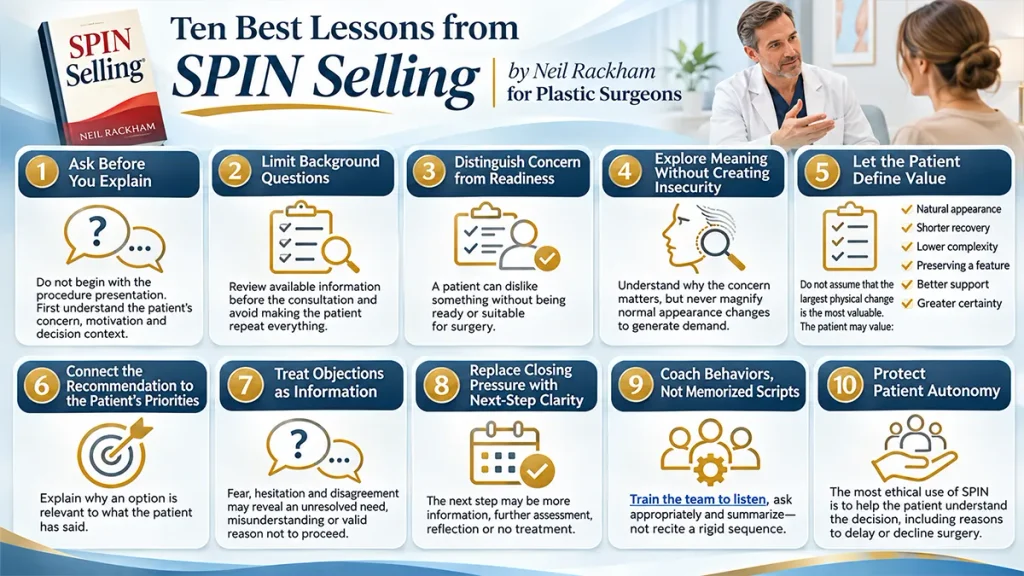
Ten Best Lessons from SPIN Selling by Neil Rackham for Plastic Surgeons
1. Ask Before You Explain
Do not begin with the procedure presentation.
First understand the patient’s concern, motivation and decision context.
2. Limit Background Questions
Review available information before the consultation and avoid making the patient repeat everything.
3. Distinguish Concern from Readiness
A patient can dislike something without being ready or suitable for surgery.
4. Explore Meaning Without Creating Insecurity
Understand why the concern matters, but never magnify normal appearance changes to generate demand.
5. Let the Patient Define Value
Do not assume that the largest physical change is the most valuable.
The patient may value:
- Natural appearance
- Shorter recovery
- Lower complexity
- Preserving a feature
- Better support
- Greater certainty
6. Connect the Recommendation to the Patient’s Priorities
Explain why an option is relevant to what the patient has said.
7. Treat Objections as Information
Fear, hesitation and disagreement may reveal an unresolved need, misunderstanding or valid reason not to proceed.
8. Replace Closing Pressure with Next-Step Clarity
The next step may be more information, further assessment, reflection or no treatment.
9. Coach Behaviors, Not Memorized Scripts
Train the team to listen, ask appropriately and summarize-not recite a rigid sequence.
10. Protect Patient Autonomy
The most ethical use of SPIN is to help the patient understand the decision, including reasons to delay or decline surgery.
A 90-Day SPIN Implementation Plan
Days 1-30: Audit Current Consultations
Review the patient journey
Examine:
- Inquiry calls
- Consultation preparation
- Surgeon consultation
- Quotation presentation
- Follow-up
- Reasons patients do not proceed
- Complaints or misunderstandings
Identify common weaknesses
Look for:
- Excessive talking
- Repeated generic scripts
- Poor documentation of patient priorities
- Early procedure pitching
- Pressure-based language
- Weak explanation of alternatives
- Staff answering clinical questions outside scope
- Follow-up focused only on booking
Define ethical boundaries
Agree that:
- Suitability comes before conversion
- The surgeon makes clinical recommendations
- No one guarantees outcomes
- Risks are not minimized
- Patients may delay or decline
- Staff do not manufacture insecurity
- Sensitive information is protected
AMA guidance places informed, voluntary decision-making and accurate discussion of alternatives at the center of patient communication.
Days 31-60: Train the Team
Introduce the four question types
Use non-clinical role-play examples first.
Then practice:
- Inquiry conversations
- Recovery concerns
- Price questions
- Consultation follow-up
- Requests for inappropriate procedures
Build a question bank
Create approved examples for:
- Facial surgery
- Breast surgery
- Body contouring
- Revision surgery
- Out-of-town patients
- Patients considering several options
The question bank should guide staff, not become a compulsory script.
Train summarizing
After asking questions, team members should summarize:
“What I am hearing is that your main concern is the recovery period rather than the procedure itself. Is that correct?”
Summarizing helps confirm understanding.
Clarify escalation
Define which questions must go to:
- Surgeon
- Nurse
- Practice manager
- Billing staff
- Patient coordinator
Days 61-90: Coach and Measure
Observe conversations
Where lawful and properly disclosed, review calls or consultations for:
- Listening
- Question quality
- Interruptions
- Premature recommendations
- Accuracy
- Pressure
- Clear next steps
Coach one behavior at a time
Examples:
- Reduce unnecessary Situation questions
- Ask one additional Problem question
- Summarize before explaining
- Avoid interrupting
- Confirm the patient’s primary concern
- Ask permission before follow-up
Measure responsibly
Possible measures include:
- Patient-reported clarity
- Questions unresolved after consultation
- Complaints about pressure
- Follow-up response
- Consultation preparedness
- Documented patient priorities
- Appropriate declines or delays
- Conversion among suitable, informed patients
Do not use conversion rate as the sole measure.
Suggested Team Scorecard
A responsible consultation scorecard might include:
- Percentage of patients whose main priority is documented
- Percentage receiving written risk and recovery information
- Percentage with a clear next step
- Number of unresolved administrative questions
- Patient-reported consultation clarity
- Complaints involving pressure or inconsistent information
- Follow-up completed with consent
- Number of patients appropriately advised to delay or decline treatment
Commercial measures can still be reviewed, but they should sit alongside indicators of communication quality and patient suitability.
Common Mistakes When Using SPIN
Turning the Consultation into an Interrogation
Questions should feel relevant and conversational.
Do not ask every possible SPIN question.
Following the Acronym Mechanically
SPIN is a framework, not a mandatory sequence.
Real conversations may move backward and forward.
Asking Leading Questions
A leading question contains the desired answer:
“Wouldn’t you feel much more confident after surgery?”
Use neutral language instead.
Exaggerating Implications
Do not make a patient feel that normal aging, asymmetry or body variation is an urgent problem.
Using Need-Payoff Questions to Manufacture Desire
The patient should describe their own values, not repeat the staff member’s preferred answer.
Presenting Surgery Before Assessing Suitability
No questioning technique replaces clinical examination and professional judgment.
Treating Every Concern as an Objection
Sometimes the patient’s hesitation is reasonable and should lead to delay or no surgery.
Measuring Only Bookings
A high booking rate may conceal poor selection, pressure, unrealistic expectations or future dissatisfaction.
Limitations of SPIN Selling
The Original Research Was Commercial, Not Clinical
The research described by the publisher examined sales calls across business environments. It was not designed to validate communication techniques in elective medical consultations. Applying the framework to plastic surgery is therefore an adaptation, not a medically proven intervention.
The Word “Selling” Can Create the Wrong Mindset
A patient is not simply a prospect.
A physician has ethical duties that differ fundamentally from those of a commercial salesperson. AMA principles state that the physician’s responsibility to the patient is paramount.
Implication Questions Can Be Misused
Poorly trained staff could use them to magnify fear, embarrassment or dissatisfaction.
This is especially concerning in appearance-related medicine.
The Framework Can Feel Scripted
Patients may notice when staff are following a formula.
Good implementation requires listening and flexibility.
It Does Not Replace Informed Consent
SPIN may help identify concerns, but informed consent requires accurate discussion of the intervention, expected benefits, material risks, alternatives and the option not to proceed.
It Does Not Solve Poor Marketing or Suitability
Better questioning cannot compensate for:
- Misleading advertising
- Inappropriate lead generation
- Weak clinical recommendations
- Poor patient experience
- Unclear pricing
- Excessive waiting times
- Inadequate follow-up
ASPS advertising principles state that advertisements should not be deceptive or misleading and that clinical or statistical claims should be supportable.
It Requires Coaching
Huthwaite emphasizes that effective implementation involves practice, coaching and behavior change rather than simply memorizing the acronym.
Privacy and Marketing Considerations
When consultation insights are used to improve marketing, the practice should work with general patterns rather than identifiable patient information.
HIPAA generally requires valid authorization before protected health information is used or disclosed for marketing, subject to limited exceptions. Authorization is more specific than informal consent and must identify the information, intended use, recipients and other required elements.
The practice should not publish:
- A patient’s story
- Consultation details
- Photographs
- Messages
- Audio
- Identifying circumstances
without appropriate authorization and review.
Testimonials should also be truthful and not misleading. FTC guidance states that material relationships must be disclosed and that endorsements should not make unsupported claims.
FAQs About SPIN Selling by Neil Rackham for Plastic Surgeons
Is SPIN suitable for medical consultations?
Parts of the framework can help clinicians and coordinators ask more relevant questions and understand patient priorities. It must be adapted to protect autonomy, informed consent, suitability and professional judgment.
Should the surgeon ask all four types of questions?
No. The categories are a planning framework, not a checklist. Ask only questions that are appropriate to the patient and the consultation.
Can patient coordinators use SPIN?
Yes, within a clearly defined non-clinical scope. They can explore information needs, practical concerns and next steps but should not diagnose, recommend treatment or minimize risk.
Can SPIN improve consultation conversion?
It may improve the quality and relevance of conversations, which could help suitable patients make clearer decisions. It should not be treated as a guaranteed conversion technique.
What are the most dangerous questions?
Questions that exaggerate appearance concerns, create fear, manufacture urgency or imply that surgery is necessary.
What should happen when a patient says, “I need to think about it”?
Respect the statement. Ask whether any information remains unclear, offer appropriate resources and allow the patient time without pressure.
Should price objections be “overcome”?
No. Clarify the concern, explain pricing accurately and let the patient decide whether the cost is acceptable.
Is a same-day booking the ideal outcome?
Not necessarily. The appropriate outcome is a well-informed and voluntary next step.
How can the practice measure success?
Use a balanced set of measures, including patient clarity, suitability, communication quality, unresolved questions, complaints, follow-up quality and conversion among appropriately selected patients.
What is the most important SPIN principle for surgeons?
Understand before recommending.
Key Takeaways from SPIN Selling by Neil Rackham
- Complex decisions require a different approach from simple transactions.
- Ask focused questions before presenting a procedure.
- Situation questions establish relevant context.
- Problem questions uncover concerns and difficulties.
- Implication questions should clarify significance without increasing insecurity.
- Need-payoff questions help patients explain what outcomes and trade-offs matter.
- A stated desire for surgery does not establish suitability.
- Benefits should be connected to the patient’s explicit priorities.
- Objections are information, not barriers to defeat.
- Commitment should mean the next appropriate step, including delay or no treatment.
- Patient autonomy, informed consent and clinical judgment always take priority over conversion.
Final Thought
The strongest lesson from SPIN Selling is not that plastic surgeons need better sales scripts. It is that they need better conversations. A patient should not leave a consultation feeling that they received a polished presentation but were never truly understood.
The practice should understand:
- What the patient is concerned about
- Why it matters
- What outcome they value
- Which limitations they can accept
- Whether the timing is appropriate
- Whether expectations are realistic
- Whether surgery is genuinely suitable
- What information is still required
When those questions are explored carefully, the surgeon can make a more relevant recommendation, the patient can make a more informed decision and the practice can reduce its reliance on pressure-based follow-up.
Used responsibly, SPIN is not a method for convincing more people to have surgery.
It is a framework for slowing down, listening more carefully and helping the right patients reach the right decision for the right reasons.