
Phone Skills to Convert More Prospects Into Patient Consultations for Plastic Surgery Practices
Effective plastic surgery phone skills combine empathy, active listening, clear information and confident guidance. Front desk staff should uncover the caller’s goals, answer questions honestly, explain the practice’s value and agree on a clear next step without giving clinical advice or pressuring the patient.
Every plastic surgery patient starts with a conversation.
In many practices, that first conversation happens by phone. It may begin when someone calls after looking at a surgeon’s website, seeing a before-and-after image, reading a review or receiving a recommendation from a friend.
The person calling may sound confident, but they may also be anxious, embarrassed or uncertain.
They could be:
- Worried about being judged.
- Nervous about surgery or anaesthesia.
- Comparing several surgeons.
- Trying to understand the likely cost.
- Unsure which procedure may be suitable.
- Concerned about recovery, scars or time away from work.
- Quietly testing whether your team feels trustworthy.
- Calling several practices within the same hour.
This is not simply another telephone enquiry.
It is the patient’s first experience of your surgeon, your team and your standards of care.
A warm, structured and helpful conversation can move someone towards a consultation. A rushed, cold or confusing call can cause them to continue searching elsewhere.
The purpose of the call is not to pressure a person into having surgery. It is to help them feel heard, provide accurate non-clinical information and guide them towards an appropriate next step.
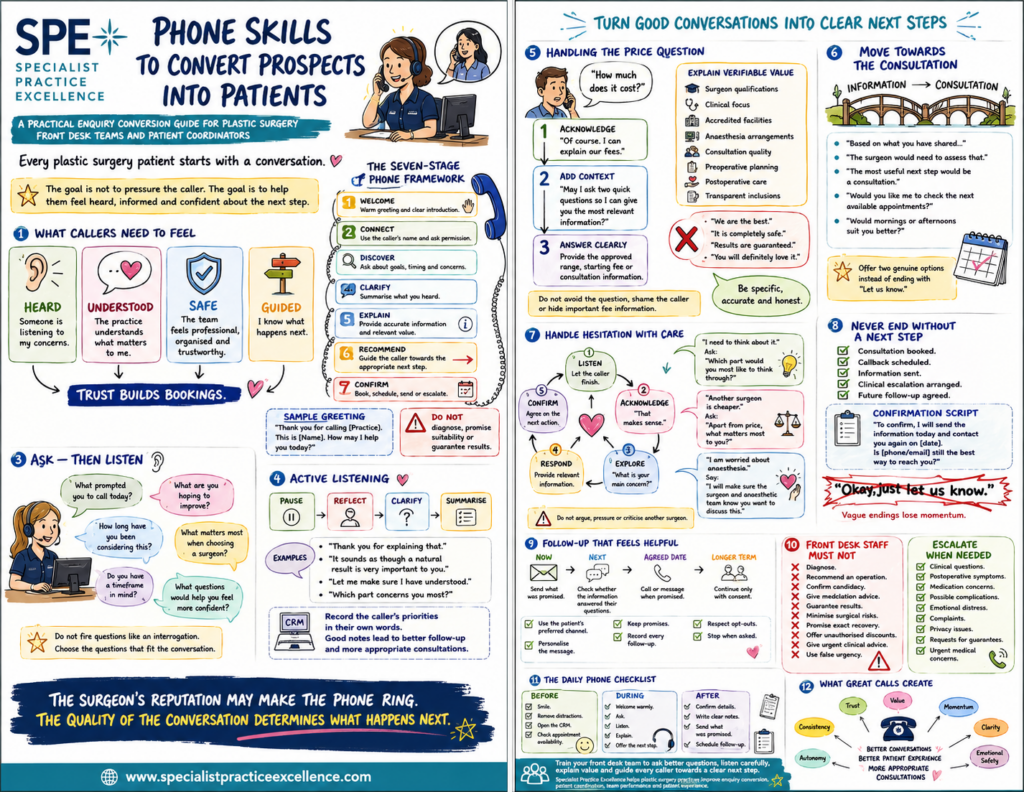
Why First Calls Matter More in Plastic Surgery
Plastic surgery decisions are rarely based on one factor.
Patients may be considering their appearance, health, confidence, identity, relationships, finances and ability to recover. Some have thought about surgery for years before making their first call.
They want to know more than whether the surgeon has an available appointment.
Most callers want to feel:
- Heard: Someone has listened to their individual concerns.
- Understood: The practice recognises what they are hoping to achieve.
- Safe: The team appears qualified, organised and professional.
- Guided: There is a clear process and an appropriate next step.
A caller forms opinions quickly.
A long hold time, distracted greeting or impatient answer may lead them to wonder:
- Will the surgeon listen to me?
- Will the practice return my calls after surgery?
- Will I have to keep repeating my story?
- Is this clinic organised?
- Do they care about me, or only about making a booking?
The surgeon’s reputation may generate the enquiry. The front desk team determines what happens next.
Clinical excellence cannot fully compensate for an enquiry experience that feels dismissive, confusing or impersonal.
What Is the Real Objective of a Plastic Surgery Enquiry Call?
The objective is not simply to answer one question.
It is not enough to:
- Recite a price.
- Give the next available date.
- Transfer the call without explanation.
- Tell the caller to read the website.
- Send a standard brochure.
- End with, “Call us when you’re ready.”
A successful enquiry call should achieve several things:
- Establish a human connection.
- Understand the caller’s general goals.
- Identify the information they need.
- Determine whether clinical escalation is required.
- Explain the practice’s relevant value.
- Collect accurate contact information and communication consent.
- Offer an appropriate consultation or next step.
- Confirm what will happen after the call.
A successful call does not always produce an immediate booking.
Sometimes the correct outcome is a scheduled callback, an information email, a nurse discussion, a clinical review or a respectful decision not to proceed.
The key is that the call ends with clarity.
Prepare the Front Desk for Phone Success
Strong phone performance starts before the telephone rings.
Front desk staff need the right environment, information and systems. Even an experienced team member will struggle if they cannot access approved fees, procedure information or current appointment availability.
Before Answering the Phone
Make sure the team has:
- A comfortable, quiet place to answer calls.
- A reliable headset with clear audio.
- The appointment system open.
- The CRM or patient management system ready.
- Approved procedure guides.
- Current consultation fees.
- Approved surgical fee ranges, where used.
- Information about what is included in each consultation.
- Clear guidance about finance and payment options.
- A list of questions that require clinical escalation.
- An agreed missed-call process.
- A documented emergency and postoperative call procedure.
Staff should avoid checking emails, speaking to colleagues or completing unrelated tasks while handling a sensitive enquiry.
Patients can hear distraction.
Before answering, take one breath, sit upright and smile. This brief reset can improve tone, pace and concentration.
Start With a Winning First Impression
A strong greeting should sound warm, clear and natural.
A useful standard greeting is:
“Thank you for calling [Practice Name] in [Location]. This is [Name]. How may I help you today?”
A boutique practice might use:
“Good morning. Thank you for calling the rooms of Dr [Name]. This is [Team Member]. How can I help?”
A multi-surgeon clinic might say:
“Thank you for calling [Clinic Name]. You’re speaking with [Name]. Which surgeon or procedure can I help you with today?”
When returning a missed call:
“Hello, this is [Name] calling from [Practice]. We noticed that you tried to reach us earlier, so I wanted to return your call. Is now a convenient time?”
For a website enquiry:
“Hello, this is [Name] from [Practice]. You recently requested information about [procedure]. I wanted to introduce myself, answer any initial questions and learn a little more about what you’re looking for.”
For an after-hours callback:
“Hello, this is [Name] from [Practice]. Thank you for contacting us after hours. I’m following up on your enquiry about [procedure]. Is this still a suitable time to talk?”
Avoid greetings that are:
- Mumbled.
- Too fast.
- Overly casual.
- Robotic.
- Filled with internal abbreviations.
- Delivered as though the caller is an interruption.
Your tone should communicate, “I am pleased you called, and I am ready to help.”
Build Trust in the First 30 Seconds
Do not begin by interrogating the caller.
Start with a simple question, then explain why you need more information.
For example:
“Is this your first time contacting our practice?”
Then:
“Thank you. Would you mind if I ask a few brief questions so I can understand what information would be most helpful?”
This approach gives the caller a sense of control.
It also prevents the conversation from turning immediately into a discussion about cost or dates before you understand what the person wants.
A strong opening may sound like this:
“Thank you for calling the rooms of Dr Williams. This is Sarah. How may I help?”
“I’m interested in a tummy tuck and want to know how much it costs.”
“Of course. I can explain how our fees work. Before I do, would you mind if I ask two quick questions so I can give you the most relevant information?”
The caller’s question has been acknowledged. It has not been avoided.
Match the Caller’s Pace and Communication Style
People tend to feel more comfortable when a conversation fits their preferred pace.
A fast, direct caller may want brief answers and immediate options.
A nervous caller may need more reassurance and slower explanations.
A highly informed caller may have technical questions that require escalation.
A talkative caller may need gentle structure so the conversation continues moving forward.
Matching does not mean copying the caller. It means adjusting your style without losing professionalism.
A Fast, Direct Caller
Use concise responses:
“Certainly. I’ll ask two quick questions, explain the consultation fee and then check the next available dates.”
A Nervous Caller
Slow down and acknowledge the emotion:
“It is completely understandable to have questions before taking the next step. We can go through the process one part at a time.”
Avoid saying that surgery is “completely safe”. All surgery carries risks.
A Highly Informed Researcher
Respect their knowledge:
“It sounds as though you have done a great deal of research. Which aspects would you most like the surgeon to address during the consultation?”
A Guarded or Private Caller
Do not push for unnecessary personal information:
“You only need to share what you are comfortable discussing with our administrative team. Clinical details can be discussed privately with the surgeon.”
A Caller Whose First Language Is Not English
Speak clearly, avoid idioms and check understanding:
“Would it help if I summarised that more slowly or sent the information in writing?”
A Frustrated Caller
Acknowledge their experience:
“I’m sorry this has been difficult. Let me take responsibility for clarifying what happens next.”
Ask Better Questions Without Sounding Like an Interrogation
Strong enquiry conversations are built around curiosity.
Open questions encourage callers to describe what matters to them. Closed questions are useful for confirming details but should not dominate the conversation.
The team should not ask every question on a list. Select the questions that fit the call.
Opening Questions
- “What prompted you to contact us today?”
- “How can we best help?”
- “Is this the first time you’ve contacted our practice?”
- “What information would be most useful today?”
Goals and Motivation Questions
- “What are you hoping to improve?”
- “What would a good outcome mean to you?”
- “How long have you been considering this?”
- “Is there one concern that matters most?”
Research and Experience Questions
- “Have you previously had a consultation about this?”
- “Have you had a similar procedure before?”
- “What information have you found most useful so far?”
- “Is there anything you have read that you would like clarified?”
Timing Questions
- “Do you have a general timeframe in mind?”
- “Are there work, travel or family commitments that may affect timing?”
- “Are you actively planning, or are you gathering information at this stage?”
Decision Questions
- “What matters most when choosing a surgeon?”
- “What questions would help you feel more confident about the next step?”
- “Is anyone else involved in helping you make the decision?”
- “What would prevent you from arranging a consultation?”
Referral Questions
- “How did you first hear about Dr [Name]?”
- “Was there a particular result, article or recommendation that encouraged you to call?”
- “Were you referred by another patient or health professional?”
Referral questions help the practice understand which marketing channels are producing meaningful enquiries.
The SPE guide on the best questions to ask a phone enquiry provides additional discovery and transition questions for front desk teams.
Listen for the Meaning Behind the Question
Good phone skills are not based on talking more.
They are based on noticing what the caller is telling you.
Active listening includes:
- Allowing the caller to finish.
- Pausing before answering.
- Reflecting key words.
- Summarising important points.
- Checking that you understood correctly.
- Acknowledging emotion.
- Recording relevant details.
- Listening for concerns that have not been stated directly.
The SPE article on how to be a better listener in a plastic surgery practice recommends giving patients full attention, paraphrasing their concerns and recording details so the next team member can continue the conversation without asking the patient to start again.
“I want it to look natural.”
This may mean the caller fears looking overdone or unrecognisable.
A suitable response is:
“Natural-looking results are clearly important to you. Are there particular changes you would like to see while still feeling like yourself?”
“I cannot take much time away from work.”
The real issue may be recovery planning rather than a lack of interest.
Say:
“Recovery time is an important planning factor. The surgeon will need to explain what is realistic for your procedure and circumstances. Would it help to arrange a consultation well before your preferred date?”
“My partner is not sure.”
This may indicate financial concerns, fear or a need for more information.
Say:
“It sounds as though you would both like more clarity. What is your partner most concerned about?”
“I have spoken with three clinics.”
Do not become defensive.
Say:
“That makes sense. This is an important decision. What differences are you noticing between the practices?”
“I just need a rough price.”
The caller may be trying to avoid wasting their time.
Say:
“Certainly. I can explain our general range and what it includes. I’ll also clarify which parts can only be confirmed after the surgeon assesses you.”
“I am frightened of anaesthesia.”
Do not offer reassurance beyond your role.
Say:
“Thank you for telling me. That is an important concern. I can explain our general process, and I’ll make sure the surgeon and anaesthetic team know that you want to discuss it in detail.”
Use Positive, Reassuring Language
Helpful language does not mean making unrealistic promises.
It means showing that you have heard the caller and will help them navigate the process.
| Situation | Avoid saying | Better alternative |
|---|---|---|
| You do not know the answer | “I don’t know.” | “I want to give you accurate information, so let me check with the appropriate team member.” |
| Another department is responsible | “That’s not my department.” | “Our patient coordinator handles that. I’ll explain the situation so you do not have to start again.” |
| No appointments are available | “There’s nothing available.” | “The next standard appointment is on [date]. I can also add you to our cancellation list.” |
| A caller questions the fee | “That’s just our price.” | “I understand cost is important. Let me explain what the consultation includes.” |
| A caller is anxious | “Don’t worry.” | “It is understandable to feel uncertain. Which part concerns you most?” |
| A caller asks about safety | “It’s completely safe.” | “All surgery carries risks. The surgeon will explain your individual risks and safety planning during consultation.” |
| A caller asks for a guarantee | “You’ll definitely love it.” | “Results vary, and the surgeon will discuss what may be realistic for you.” |
| You must return the call | “You’ll have to call back.” | “I will arrange for the right person to contact you. Which time and number are best?” |
Useful reinforcing phrases include:
- “That is a helpful question.”
- “Thank you for explaining that.”
- “I can understand why that matters.”
- “Let me make sure I have understood.”
- “What I’m hearing is…”
- “I’ll take responsibility for the next step.”
- “Here is what we can do.”
How to Answer the Price Question
Patients ask about price for many reasonable reasons.
They may be:
- Checking whether surgery is financially possible.
- Comparing practices.
- Planning how long they need to save.
- Worried about paying a consultation fee before understanding likely costs.
- Trying to avoid an uncomfortable sales conversation.
- Uncertain about what surgical quotes include.
Do not shame a caller for asking about cost.
Do not pretend the question was not asked.
A respectful price response has three parts:
- Acknowledge the question.
- Ask enough questions to provide useful context.
- Give the approved information transparently.
When the Practice Publishes Fee Ranges
“Our published range for this procedure is approximately [range]. The final quote depends on the operation recommended, theatre time, anaesthesia, hospital fees and your individual plan. The surgeon can confirm those details after assessing you.”
When the Practice Provides a Starting Range
“Fees generally begin from [amount], but more complex or combined surgery may cost more. Would you like me to explain what is normally included?”
When a Consultation Is Required Before Quoting
“The final fee cannot be calculated accurately before the surgeon assesses your anatomy, goals and the likely complexity of surgery. I can explain the consultation fee and the main components that may appear in a surgical quote.”
When Another Surgeon Is Cheaper
“It makes sense to compare your options. When you compare quotes, check whether each includes the surgeon, anaesthetist, facility, implants or garments, follow-up care and possible additional charges. What matters most to you apart from price?”
When the Caller Refuses to Answer Questions
“That is fine. I can give you the approved general range first. I only ask questions to avoid giving you information that may not apply to your situation.”
When Asked About the Consultation Fee
“The consultation fee is [amount]. It includes [length or structure of consultation and approved inclusions]. Our cancellation and refund terms are [brief policy].”
When Asked About Payment Options
“We accept [approved payment methods]. We can explain any available payment arrangements, but our team cannot provide personal financial advice.”
In Australian advertising, fee information must be clear and not misleading. Australian practices must also avoid misleading claims, testimonials in regulated health-service advertising, unreasonable expectations and language that encourages unnecessary use of health services.
Where a health-service advertisement also directly or indirectly promotes a therapeutic good, TGA advertising requirements may apply.
Explain Value Before and Around Price
Value should be specific and verifiable.
Avoid empty statements such as:
- “We are the best.”
- “Our surgeon is the safest.”
- “You will get a perfect result.”
- “It is virtually risk-free.”
- “We offer scarless surgery.”
- “Our results are guaranteed.”
Relevant value points may include:
- The surgeon’s recognised qualifications.
- Their clinical focus and experience.
- Accredited operating facilities.
- The involvement of an appropriately qualified anaesthetist.
- The length and quality of the consultation.
- Personalised surgical planning.
- Preoperative education.
- Continuity of care.
- Postoperative review arrangements.
- Experienced nursing and patient coordination.
- Clear written quotes.
- Transparent policies.
- Careful patient selection.
A concise value statement may sound like this:
“Dr [Name] is a specialist plastic surgeon with a particular focus on [procedure]. The consultation includes a detailed assessment, discussion of options, risks, recovery and likely costs. Surgery is performed in an accredited facility, with planned postoperative care from our team.”
Another option is:
“Our approach is based on careful assessment rather than offering the same operation to every patient. The surgeon will explain what may be achievable and whether surgery is appropriate.”
The SPE resource on pricing plastic surgery and explaining value offers further ideas for helping teams discuss fees with greater clarity and confidence.
The Seven-Stage Plastic Surgery Phone Framework
A call should have structure without sounding scripted.
Use the following framework:
1. Welcome
Purpose: Create a warm first impression.
Example:
“Thank you for calling [Practice]. This is [Name]. How may I help?”
Common mistake: Speaking too quickly or sounding distracted.
2. Connect
Purpose: Build initial rapport and obtain permission to ask questions.
Example:
“Would you mind if I ask two brief questions so I can guide you properly?”
Common mistake: Launching into a checklist without explaining why.
3. Discover
Purpose: Understand the caller’s goals, timing and concerns.
Example:
“What prompted you to contact us now?”
Common mistake: Asking only which procedure the caller wants.
4. Clarify
Purpose: Summarise and confirm understanding.
Example:
“So your main priorities are a natural result and planning recovery around work. Is that correct?”
Common mistake: Assuming the caller’s meaning.
5. Explain
Purpose: Provide accurate information and relevant value.
Example:
“The consultation allows the surgeon to assess your options and explain likely recovery, risks and fees.”
Common mistake: Giving a long speech that is unrelated to the caller’s concerns.
6. Recommend the Next Step
Purpose: Guide the caller without diagnosing.
Example:
“Based on what you have shared, the most useful next step is a consultation with Dr [Name].”
Common mistake: Recommending a specific operation without clinical assessment.
7. Confirm
Purpose: Book, schedule or agree on a clear follow-up.
Example:
“We have Tuesday morning or Thursday afternoon. Which generally suits you better?”
Common mistake: Ending with, “Let us know.”
Identify Patient Readiness Without Judging
Avoid reducing every caller to a “hot”, “warm” or “cold” lead.
Use a patient-centred readiness model.
Ready to Arrange a Consultation
Offer suitable appointments and confirm the process.
Actively Comparing Options
Ask what matters most, explain relevant differences and agree on follow-up.
Early in the Research Stage
Provide educational information and obtain permission for future contact.
Interested but Facing a Practical Obstacle
Identify whether the obstacle involves timing, support, travel, recovery or finances.
Not Currently Appropriate for Booking
Provide a respectful explanation and record any agreed future action.
Requires Clinical Escalation
Transfer or arrange contact with an appropriate clinician.
The purpose is not to label the person. It is to provide the right level of support.
Collect Micro-Commitments Ethically
Patients rarely move from a first greeting to a consultation booking in one step.
Small, permission-based agreements can make the conversation easier:
- “Would it be alright if I ask a few questions?”
- “May I take a note of that?”
- “Would you like me to send the procedure guide?”
- “Shall I check the next available consultations?”
- “May we contact you next week?”
- “Would you prefer email or text?”
These small agreements should support patient autonomy.
They must never be used to override hesitation, exploit insecurity or pressure a distressed caller.
Transition From Information to Consultation
Once you understand the caller’s needs, guide the conversation forward.
Useful bridge phrases include:
- “Based on what you have shared, the most useful next step would be…”
- “The surgeon would need to assess that in person before advising you.”
- “A consultation would allow you to discuss your goals, risks, recovery and fees.”
- “Would you like me to check the next suitable appointments?”
Breast Surgery
“Because implant choice, breast shape and your goals all affect the plan, the surgeon would need to assess you before recommending an option.”
Body Contouring
“The surgeon would need to assess skin, muscle separation and the areas you want treated before advising whether surgery may be suitable.”
Facial Surgery
“A facial consultation allows the surgeon to assess your anatomy and discuss how to aim for a balanced, natural-looking result.”
Rhinoplasty
“The surgeon will need to assess both appearance and, where relevant, breathing concerns before discussing possible options.”
Revision Surgery
“Revision cases often require additional records and careful assessment. I can explain what photographs or operation reports the surgeon may request.”
Post-Weight-Loss Surgery
“There may be several areas to discuss, so the consultation helps establish priorities and whether procedures would need to be staged.”
Unsure Which Procedure Is Needed
“You do not need to diagnose yourself. You can explain your concerns, and the surgeon can assess which options may be appropriate.”
Ask for the Consultation Clearly
Do not assume the caller will ask to book.
Invite them to take the next step.
Choice Close
“Would mornings or afternoons usually suit you better?”
Calendar Close
“We have Tuesday at 10:00 am or Thursday at 2:00 pm. Does either work?”
Next-Step Close
“The next step is a consultation. Shall I arrange that for you?”
Follow-Up Close
“You would like more time to think. Would next Wednesday be suitable for me to check in?”
Information Close
“I’ll send the guide today. May I call you after you have read it?”
Escalation Close
“That question requires clinical advice. I’ll arrange for our nurse to contact you.”
Do not invent scarcity.
Only say an appointment is limited or a date may change when that information is accurate.
Handle Objections With Care
Use a five-step objection framework:
- Listen.
- Acknowledge.
- Explore.
- Respond.
- Confirm the next step.
“I Need to Think About It”
Possible meaning: The caller lacks information or does not yet feel confident.
Response:
“Of course. Which part would you most like to think through?”
Next step: Agree on a follow-up date.
“I Need to Speak With My Partner”
Possible meaning: The partner may have concerns about cost, safety or recovery.
Response:
“That makes sense. What questions do you expect your partner may have?”
Next step: Send clear information that the caller can share.
“The Consultation Fee Is Too High”
Possible meaning: The caller does not understand the consultation’s value.
Response:
“I understand. Would it help if I explained what is included and what you should expect to leave with?”
“Another Surgeon Is Cheaper”
Possible meaning: The patient is comparing value as well as price.
Response:
“It is sensible to compare. Are the quotes structured in the same way, and what matters most to you when choosing?”
“I Am Worried About Anaesthesia”
Response:
“That is an important concern. I will make sure it is documented so the surgeon and anaesthetic team can discuss your individual risks and options.”
“I Cannot Manage the Recovery”
Response:
“Which part of recovery would be most difficult: work, children, travel or support at home?”
“I Am Just Researching”
Response:
“That is a good time to gather reliable information. Which questions are most important at this stage?”
“I Have Heard Mixed Reviews”
Response:
“Thank you for raising that. What specifically have you read or heard that concerns you?”
Do not argue or criticise reviewers.
“I Live Too Far Away”
Response:
“We regularly explain the travel process to out-of-area patients. I can outline which appointments may be virtual and which require you to attend in person.”
“Can You Guarantee My Result?”
Response:
“No ethical practice can guarantee a surgical result. The surgeon can discuss likely outcomes, limitations and risks after assessing you.”
“Which Procedure Do I Need?”
Response:
“I cannot recommend a procedure without a clinical assessment. I can arrange a consultation where the surgeon can evaluate your concerns properly.”
The SPE article on reasons patients do not book plastic surgery examines common barriers such as timing, finances, support, medical readiness and fear.
Know When to Escalate the Call
Front desk staff should not provide clinical advice.
Escalate:
- Questions about clinical suitability.
- Requests for a diagnosis.
- Medication instructions.
- Postoperative symptoms.
- Possible complications.
- Severe pain, bleeding or breathing concerns.
- Requests to interpret test results.
- Concerns about anaesthesia risk.
- Severe emotional distress.
- Threats of self-harm.
- Possible body dysmorphic concerns.
- Formal complaints.
- Legal or media enquiries.
- Privacy breaches.
- Threatening or abusive behaviour.
- Requests for outcome guarantees.
Urgent medical concerns must follow the practice’s documented clinical and emergency procedures. They must not remain in a normal enquiry or sales queue.
Capture the Right Information
A useful enquiry record may include:
- Full name.
- Preferred name.
- Telephone number.
- Email address.
- Preferred communication channel.
- General procedure or concern.
- Location.
- Referral source.
- Broad timeframe.
- Main questions.
- Primary concern or obstacle.
- Information provided.
- Consultation offered.
- Outcome of the call.
- Agreed follow-up date.
- Consent to receive relevant communications.
Do not collect detailed sensitive information unless it is necessary and permitted within your practice systems.
Write Better CRM Notes
CRM notes should be factual, relevant and respectful.
Poor Note
“Difficult lady. Price shopper. Probably won’t book.”
This is judgemental and unhelpful.
Improved Note
“Enquired about facelift fees. Comparing three practices. Requested written information and was not ready to book today.”
Excellent Concise Note
“Sarah, 57, enquired about facial and neck ageing. Priorities: natural-looking result and recovery before daughter’s wedding in November. Comparing three surgeons. Concerned about anaesthesia and time away from work. Explained consultation process and general fee structure. Sent facial surgery guide with consent. Follow-up booked for Tuesday, 11 August at 2:00 pm.”
Good notes allow the next team member to continue the conversation without making the patient repeat sensitive details.
Never End Without a Defined Next Step
The call should end with one of these outcomes:
- Consultation booked.
- Callback scheduled.
- Clinical escalation arranged.
- Information email or text agreed.
- Future follow-up date recorded.
- Respectful decision not to proceed.
Use a final confirmation:
“To confirm, you are interested in [concern or procedure]. I will send [information] today, and we will speak again on [date]. Is [phone/email] still the best way to contact you?”
Avoid:
“Okay, just let us know.”
That phrase creates no responsibility, momentum or follow-up plan.
Follow Up Without Becoming Annoying
Many people need time before arranging a plastic surgery consultation.
They may need to:
- Speak with family.
- Arrange leave.
- Save money.
- Compare surgeons.
- Understand recovery.
- Build confidence.
- Wait for a suitable life stage.
Agree on the next contact during the first call whenever possible.
Ask:
“When would it be helpful for me to contact you again?”
Use the caller’s preferred channel.
Send information that relates to their actual questions rather than placing every caller into the same generic sequence.
Example Follow-Up Sequence
Immediately after the call:
Send the promised guide, appointment details or consultation information.
Several days later:
Ask whether the information answered their main questions.
At the agreed follow-up date:
Make a personal call or send a short message.
Longer-term:
Provide relevant education only when the caller has consented to receive it.
Follow-Up Email
Thank you for speaking with me today. As discussed, I have attached information about [procedure or consultation]. Your main questions were about [concerns]. I will contact you on [date], or you are welcome to reply sooner.
SMS
Hello Sarah, this is Emma from Dr Lee’s practice. I have emailed the information we discussed. Please let me know if it has not arrived. I will follow up next Tuesday as agreed.
Voicemail
Hello Sarah, this is Emma from Dr Lee’s practice. I’m following up as agreed after our conversation about a consultation. There is no urgency. Please call me on [number], or I will send a brief text so you can reply when convenient.
Re-Engagement Question
“Has anything changed since we last spoke, or is there another question we can help you answer?”
Respect opt-outs. Stop contacting people who ask not to be contacted.
Missed Calls, Voicemail and After-Hours Enquiries
Missed calls are missed conversations, not necessarily lost patients.
Practices should have a clear system for:
- Returning missed calls promptly.
- Sending an acknowledgement where consent and local rules allow.
- Reviewing voicemail throughout the day.
- Assigning responsibility for callbacks.
- Recording attempts in the CRM.
- Responding to weekend enquiries.
- Distinguishing new enquiries from clinical or postoperative calls.
A suitable voicemail greeting is:
“Thank you for calling [Practice]. We are assisting other patients or the practice is currently closed. Please leave your name, number and a brief reason for calling. If you have an urgent medical concern, follow the emergency instructions provided by your clinical team or contact the appropriate emergency service.”
Automated text-back systems may acknowledge an enquiry, but they should not attempt to diagnose or manage urgent clinical concerns.
Phone-to-Text and Omnichannel Communication
A prospective patient may begin on Instagram, complete a website form, receive a text and then book by phone.
The practice should preserve context across channels.
Patients should not have to repeat the same sensitive story every time they speak with someone new.
Record:
- Where the enquiry began.
- What information has already been provided.
- The caller’s preferred channel.
- Questions that remain unanswered.
- The agreed next step.
Technology should support a human relationship, not create more barriers.
Phone Skills for Sensitive Situations
A Crying Caller
Slow down.
“Take your time. You do not need to explain everything at once. Would you prefer to continue now or have us call you later?”
Embarrassment About a Body Area
Use neutral language.
“Many people find this difficult to discuss. You only need to share what is necessary with me. The clinical conversation will be private.”
Previous Surgical Complications
Do not criticise the previous surgeon.
“I’m sorry you have had a difficult experience. Revision cases require careful assessment. I can explain which records or reports may be helpful.”
Unrealistic Expectations
Do not promise the desired outcome.
“The surgeon will need to assess whether your goals are realistic and explain the limitations of surgery.”
A Caller Who Dominates the Conversation
Acknowledge and redirect:
“Thank you. You have given me helpful background. May I summarise the main points and explain the next step?”
A Caller Demanding an Immediate Surgery Date
“Surgery cannot be scheduled responsibly until the consultation and required assessment are complete. I can help you arrange the earliest appropriate consultation.”
What Front Desk Staff Must Never Do
Front desk staff must not:
- Diagnose.
- Recommend an operation based only on a phone call.
- Confirm that someone is a surgical candidate.
- Guarantee results.
- Describe surgery as risk-free.
- Minimise recovery.
- Give unauthorised medication advice.
- Criticise another surgeon.
- Argue about reviews.
- Pressure a distressed caller.
- Promise an exact recovery date.
- Alter approved fees.
- Offer unauthorised discounts.
- Record insulting or judgemental comments.
- Share confidential information.
- Leave urgent clinical concerns in a sales queue.
- Use false urgency or scarcity.
- suggest that surgery is necessary for happiness, success or acceptance.
Four Sample Plastic Surgery Enquiry Calls
Tummy Tuck Price Enquiry
Caller: “How much is a tummy tuck?”
Team member:
“Certainly. I can explain our general fee structure. Before I do, may I ask two brief questions so I can give you the most relevant information?”
Caller: “Okay.”
Team member:
“What prompted you to enquire now?”
Caller: “I’ve lost weight, and the loose skin is bothering me.”
Team member:
“Congratulations on your weight loss. Are you mainly concerned about excess skin, or have you also been told that you may have muscle separation?”
Caller: “Both, I think.”
Team member:
“The surgeon would need to assess that before recommending a plan. Our general fees begin from [approved amount or range], depending on complexity, facility and anaesthesia. The consultation includes an assessment of the skin, abdominal muscles, scars, risks and recovery. Would you like me to check consultation times?”
CRM note:
“Post-weight-loss caller enquiring about tummy tuck. Concerned about excess skin and possible muscle separation. General range and consultation process explained. Consultation offered.”
Nervous Facelift Caller
Caller: “I’m frightened I’ll look pulled or unnatural.”
Team member:
“That is a common concern, and natural-looking change is clearly important to you. What would you most like to improve while still feeling like yourself?”
Caller: “My neck and lower face.”
Team member:
“Thank you. The surgeon will assess those areas and discuss what may be realistic without promising a particular result. Would it help if I explained what happens during the facial consultation?”
CRM note:
“Facial ageing enquiry. Main priority is avoiding an overdone appearance. Concerned about lower face and neck. Consultation process explained; facial guide sent.”
Breast Augmentation Comparison Caller
Caller: “I am speaking with several surgeons. Why should I choose yours?”
Team member:
“It makes sense to compare carefully. What factors matter most to you?”
Caller: “Natural results and good follow-up.”
Team member:
“Our process includes a detailed assessment, discussion of implant options where appropriate, risks, recovery and postoperative reviews. I can also explain the surgeon’s qualifications and clinical focus. Which questions have other practices not answered clearly?”
CRM note:
“Comparing multiple surgeons for breast augmentation. Priorities: natural-looking result and postoperative access. Asked about qualifications and follow-up. Consultation offered.”
Post-Weight-Loss Patient Unsure of Procedure
Caller: “I have loose skin everywhere and don’t know what operation I need.”
Team member:
“You do not need to work that out before contacting us. Which areas affect you most day to day?”
Caller: “My abdomen and arms.”
Team member:
“The surgeon can assess those areas, discuss priorities and explain whether surgery may need to be staged. I cannot recommend an operation by phone, but I can arrange the appropriate consultation.”
CRM note:
“Major weight-loss enquiry. Main concerns: abdomen and upper arms. Unsure about procedure. Explained assessment and possible staged planning without recommending surgery. Consultation booked.”
Daily and Weekly Team Training
Phone confidence comes from practice.
Useful training activities include:
- Five-minute daily phrase drills.
- Weekly roleplays.
- Objection-handling practice.
- Active-listening exercises.
- Procedure knowledge refreshers.
- CRM note reviews.
- Mystery-call assessments.
- Reviewing successful calls.
- Coaching after missed opportunities.
- Practising handovers between reception and coordinators.
Where call recording is lawful and appropriately disclosed, managers may review calls for coaching and quality improvement.
Training should create psychological safety.
The goal is to improve performance, not embarrass team members.
The SPE guide on advanced phone skills to book more patients covers voice control, confidence, listening and structured booking conversations.
Plastic Surgery Phone Enquiry Scorecard
Score each item as:
- 0: Not completed.
- 1: Partly completed.
- 2: Completed well.
Assess whether the team member:
- Answered promptly.
- Used a warm, clear greeting.
- Introduced themselves.
- Used the caller’s name appropriately.
- Obtained permission to ask questions.
- Asked open discovery questions.
- Clarified the caller’s goals.
- Acknowledged emotional cues.
- Provided accurate information.
- Explained relevant value.
- Stayed within non-clinical boundaries.
- Collected contact details.
- Offered a consultation or next step.
- Confirmed follow-up.
- Completed useful CRM notes.
Use the score for coaching rather than punishment.
Phone Metrics Plastic Surgery Practices Should Track
Monitor:
- Call answer rate.
- Missed-call rate.
- Average callback time.
- Percentage of enquirers successfully contacted.
- Enquiry-to-consultation booking rate.
- Consultation attendance rate.
- Booking rate by enquiry source.
- Time from enquiry to consultation booking.
- Follow-up completion rate.
- Number of enquiries without a defined next step.
- Common reasons for not booking.
- Conversion patterns by team member.
- Patient feedback about front desk communication.
Metrics should identify problems in training, systems and patient experience.
They should not be used to pressure staff into unsafe or inappropriate bookings.
One-Page Plastic Surgery Phone Call Checklist
Before the Call
- Sit upright.
- Smile.
- Open the CRM.
- Check approved information.
- Remove distractions.
Open
- Welcome the caller.
- State the practice name.
- Introduce yourself.
- Ask how you can help.
Connect
- Use the caller’s name.
- Acknowledge their question.
- Obtain permission to ask more.
Discover
- Ask what prompted the enquiry.
- Clarify goals.
- Ask about timing.
- Identify the main concern.
Explain
- Answer honestly.
- Use plain language.
- Explain relevant value.
- Stay within your role.
- Escalate clinical questions.
Offer
- Recommend the appropriate next step.
- Offer specific appointment options.
- Avoid false urgency.
Confirm
- Repeat the agreed action.
- Confirm contact details.
- Confirm date and communication channel.
Record
- Write factual CRM notes.
- Document concerns and preferences.
- Record consent and follow-up.
Follow Up
- Send what was promised.
- Contact the caller when agreed.
- Personalise the message.
- Respect opt-outs.
The Psychology of a Successful Enquiry Call
Successful calls rest on seven foundations.
Trust
Created through honesty, empathy and consistency.
Value
Established through relevant, specific information about the surgeon, team and care process.
Momentum
Built by moving the conversation towards a clear next step.
Clarity
Created when callers understand what happens next, what it costs and who is responsible.
Emotional Safety
Developed when patients can discuss personal concerns without feeling judged.
Autonomy
Protected when patients are supported without being pressured.
Consistency
Demonstrated when the website, phone team, consultation and follow-up all communicate the same standards.
When these foundations align, prospective patients are more likely to continue the conversation and make an informed decision.
Frequently Asked Questions About Plastic Surgery Phone Skills
What should a receptionist say when someone asks only for a price?
Acknowledge the question, provide the approved range or fee information and explain which parts can only be confirmed after assessment.
Should a plastic surgery clinic publish fee ranges online?
Published ranges may help patients plan, but they must be accurate, current and clear about variables, inclusions and the need for individual assessment.
How quickly should a missed plastic surgery enquiry call be returned?
Return it as soon as the team can provide a calm, useful conversation. A fast but rushed callback may be less effective than a prompt, prepared response.
Can reception staff recommend a plastic surgery procedure?
No. Non-clinical staff may explain the consultation process, but diagnosis, suitability and treatment recommendations require an appropriately qualified clinician.
How many times should a plastic surgery clinic follow up?
There is no ideal number for every patient. Agree on the next contact, use the preferred channel and stop when the person opts out or asks not to be contacted.
What information should be entered into the CRM after a phone enquiry?
Record contact details, goals, concerns, referral source, information provided, consultation status, communication consent and the agreed next step.
How can staff use a phone script without sounding robotic?
Teach a flexible conversation framework rather than a speech. Staff should understand the purpose of each stage and use words that feel natural to them.
What should staff say when a caller is comparing plastic surgeons?
Respect the comparison, ask what matters most and explain the practice’s verifiable differences without criticising other surgeons.
How should a clinic respond when a caller is frightened of anaesthesia?
Acknowledge the concern, avoid making safety promises and arrange for the surgeon or anaesthetic team to discuss individual risks and options.
Does using the caller’s name improve rapport?
It can help personalise the conversation when used naturally. Repeating the person’s name too often may feel scripted or insincere.
Should front desk staff ask about a prospective patient’s budget?
They may ask how cost affects planning, but the question should be respectful and relevant. Avoid making assumptions about affordability or suitability.
What should happen when a caller is not ready to book?
Identify the information or obstacle involved, offer a useful resource and agree on a suitable follow-up rather than ending the conversation vaguely.
Can artificial intelligence answer plastic surgery enquiry calls?
AI can acknowledge enquiries, collect basic information and support scheduling, but it requires privacy safeguards, human oversight and immediate escalation pathways.
Which phone metrics should a plastic surgery practice monitor?
Track answer rates, callback speed, consultation bookings, attendance, follow-up completion, referral sources and calls that end without a clear next step.
How often should front desk teams practise phone skills?
Short weekly roleplays and regular phrase drills are more effective than one annual training session. Frequent practice makes good communication feel natural.
Recommended Reading From Specialist Practice Excellence
These SPE resources can help front desk staff, patient coordinators and practice managers strengthen enquiry handling, consultation conversion and patient communication.
- Superstar Phone Questions and Phrases for Plastic Surgeons
Practical phrases for taking control of price questions, building rapport and guiding callers towards the next step. - Advanced Phone Skills to Book More Patients
Advanced guidance on vocal confidence, listening, call structure, objection handling and booking conversations. - List of the Best Questions to Ask a Phone Enquiry
A collection of discovery, rapport, qualification and transition questions for enquiry teams. - Simple Sales Skills for Front Desk Staff Handling Enquiries
Straightforward techniques that help reception teams communicate value and move conversations forward professionally. - How to Be a Better Listener in a Plastic Surgery Practice
Practical listening exercises and phrases that improve rapport, handovers and patient understanding. - Advanced Sales Skills for Patient Coordinators
Detailed coaching on consultative communication, confidence, follow-up, technology and patient decision support. - How to Convert More Patient Consultations Into Surgery
Strategies for improving the consultation process, aligning expectations and helping suitable patients make informed decisions. - Pricing Your Plastic Surgery and Explaining Value
Resources for strengthening price confidence and communicating the value behind surgical fees. - Reasons Patients Don’t Book Plastic Surgery and How to Overcome Them
A guide to identifying barriers involving timing, money, support, medical readiness, fear and uncertainty. - SPE Learning Academy for the Front Desk Team and Receptionists
A central training library covering patient relationships, listening, sales skills, phone performance and patient experience.
Seven-Day Phone Skills Implementation Plan
Day One: Review the Current Experience
Call the practice as a prospective patient or arrange a mystery call.
Assess:
- Answer speed.
- Greeting.
- Tone.
- Questions asked.
- Information provided.
- How the call ends.
Day Two: Choose a Call Framework
Introduce the seven-stage framework:
Welcome, Connect, Discover, Clarify, Explain, Recommend and Confirm.
Ask every team member to keep it beside the phone.
Day Three: Improve Price Responses
Agree on:
- Approved fee information.
- What is included.
- What requires assessment.
- How staff should explain value.
- Which questions must be escalated.
Day Four: Practise Discovery Questions
Select five questions that feel natural for your practice.
Roleplay callers who are:
- Nervous.
- Direct.
- Comparing surgeons.
- Focused on price.
- Unsure about the procedure.
Day Five: Improve CRM Notes
Review ten recent enquiry records.
Replace vague or judgemental notes with concise, factual information and clear next steps.
Day Six: Build the Follow-Up System
Define:
- Who owns each enquiry.
- When follow-up occurs.
- Which channels are used.
- What content is sent.
- How consent and opt-outs are recorded.
Day Seven: Coach and Measure
Use the phone enquiry scorecard to review performance.
Choose one skill for the team to improve during the next week rather than attempting to change everything at once.
Turn More Enquiries Into Better Patient Conversations
The front desk is not “just reception”.
Your enquiry team is:
- The first human contact.
- The voice of the surgeon.
- A guide through uncertainty.
- A guardian of patient experience.
- A vital part of ethical practice growth.
Every phone call is an opportunity to demonstrate professionalism, build trust and help a prospective patient understand the next step.
The most effective teams do not rely on pressure.
They ask better questions. They listen carefully. They provide accurate information. They communicate value. They document what matters. They follow up when promised.
The surgeon’s reputation may make the phone ring. The quality of the conversation determines whether the prospective patient feels confident enough to continue.
Specialist Practice Excellence helps plastic surgery practices improve enquiry conversion, patient coordinator performance, front desk skills, follow-up systems and the complete patient experience.
Contact Us to explore practice consulting, coaching and team-training resources.